Struggling with reconciliation accuracy?
Finexer gives UK platforms FCA-authorised AIS access to verified bank transaction data – structured, continuous, and audit-ready.
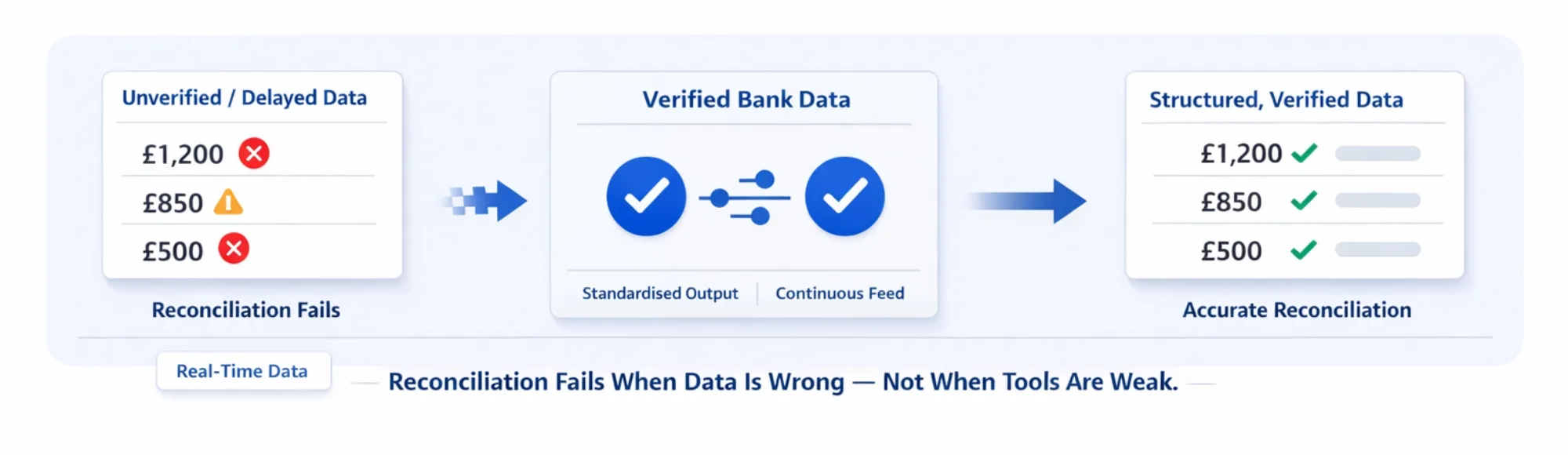
Financial reconciliation is treated as a process problem by most platforms. It is not. It is a data problem.
Teams invest in reconciliation tools, workflow automation, and accounting integrations. But when the underlying bank transaction data is delayed, incomplete, or inconsistently formatted, the reconciliation process breaks – regardless of how sophisticated the tooling is.
At Finexer, I work with accounting SaaS platforms, ERP providers, and payment infrastructure teams across the UK. The reconciliation issues they report follow a consistent pattern. At the root of almost every one is the same cause: the financial data being matched does not accurately reflect what actually happened in the bank.
This blog explains why financial reconciliation fails at the data layer, what that means for your operations, and how verified bank transaction data changes the accuracy picture.
TL;DR
Financial reconciliation depends on matching internal records with bank transaction data accurately. When that data is delayed, fragmented, or inconsistently structured, reconciliation of payments fails – not because the process is wrong, but because the data feeding it is unreliable. Finexer provides FCA-authorised AIS access to verified, structured bank transaction data, giving platforms the accurate foundation that reliable reconciliation depends on.
Key Takeaways
What is financial reconciliation?
Financial reconciliation is the process of matching a platform’s internal financial records against bank transaction data to confirm accuracy and completeness.
Why does reconciliation of payments fail in modern platforms?
Reconciliation of payments fails primarily because transaction data is delayed, fragmented across sources, or inconsistently formatted – making accurate record matching impossible regardless of the tooling in place.
What data problems cause reconciliation to break?
The most common causes are delayed settlement data, missing transactions, mismatched record formats between internal systems and bank outputs, and incomplete coverage across multiple payment sources.
Which platforms are most affected by reconciliation data problems?
Accounting SaaS platforms, ERP systems, and payment infrastructure platforms processing high transaction volumes or managing financial records on behalf of clients.
Where does Finexer fit in reconciliation workflows?
Finexer provides the verified bank transaction data layer that reconciliation logic runs on – structured, bank-authenticated, and continuously delivered.
Why Does Financial Reconciliation Break at the Data Layer?
The Timing Gap Problem
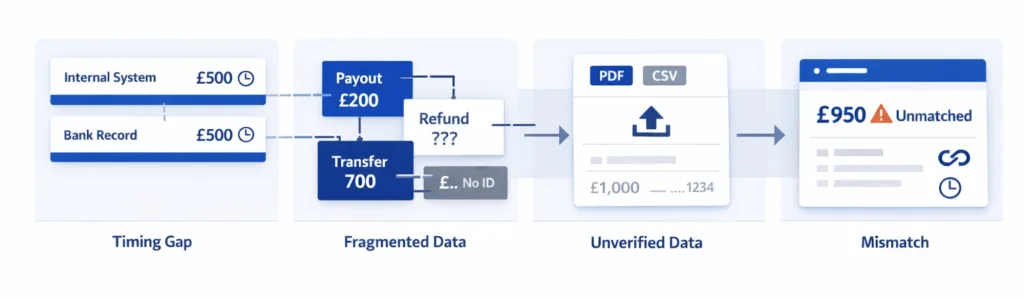
Your internal system records a payment the moment it is initiated. The bank reflects it hours – sometimes days – later.
That gap is where financial reconciliation breaks.
The mismatch is not a real error. The payment happened. Both records are correct. But because data arrives out of sync, your reconciliation logic flags it as unmatched – and someone on your ops team manually investigates, verifies, and clears it.
At low volumes, this is manageable. At scale, it becomes a recurring drain – finance teams spending hours each week resolving discrepancies that should never have appeared.
The instinct is to solve this with better tooling. Build smarter matching rules. Add exception queues. But automation cannot fix data that arrives late. The timing gap is in the data – not the process.
“The platforms I work with don’t have a reconciliation problem. They have a data timing problem that looks like a reconciliation problem. Fix the data, and the reconciliation fixes itself.” – Ravi, Finexer
Finexer’s AIS delivers bank transaction data via real-time webhooks. The moment a transaction occurs at the bank, it is available to your reconciliation logic. No batch window. No settlement lag. No false mismatches from timing gaps.
Automated Payment Reconciliation covers how automation addresses reconciliation workflow gaps for UK platforms.
The Fragmented Data Problem
Most platforms handle payments across multiple sources simultaneously:
- Bank transfers
- Bulk payouts
- Refunds and reversals
- Client disbursements across accounts
Each source produces data in a different format, on a different timeline, through a different reporting mechanism. When reconciliation logic tries to match across these fragmented sources, gaps appear silently.
A payout may not surface in the bank transaction feed with the reference needed to match it to the internal record. A refund may appear with a different merchant identifier than the original transaction. Partial payments – a client paying an invoice in two instalments – produce two transaction records that need matching against one internal record.
The business impact is significant. Reconciliation looks like it is completed. Transactions were missed. Records are unmatched. And because the gaps are silent, your team does not know until a discrepancy surfaces in a report or an audit.
“Silent gaps are the worst kind of reconciliation failure. The process ran, no errors were flagged, and something was still missed. That only happens when the data source is incomplete.” – Ravi, Finexer
Finexer’s AIS provides structured, standardised transaction data across 99% of UK banks from a single API connection. Counterparty details, reference fields, and merchant identifiers are consistent across every bank – removing the per-source post-processing that introduces reconciliation errors.
Automated Bulk Payment Reconciliation covers how bulk payout reconciliation compounds these data fragmentation problems specifically.
The Unverified Data Problem
Many platforms still rely on manually submitted bank statements for financial reconciliation. Clients upload PDFs or CSV exports. Finance teams process them.
The problem is structural. The client controls what gets submitted. Accounts with problematic activity can be excluded. Transaction periods with gaps can be omitted. The finance team has no mechanism to verify that what was submitted is complete.
This creates a reconciliation process that looks robust but has blind spots built in. It also creates an audit risk – if a reconciliation output is challenged, it cannot be defended with data that came from a client-controlled submission.
“If the data came from the client, it is not a verified record. It is the client’s version of events. That distinction matters enormously when reconciliation outputs need to hold up under audit.” – Ravi, Finexer
Finexer’s AIS accesses transaction data directly from the bank with user consent – not from what the client chose to share. The data is bank-authenticated, timestamped, and carries a full consent log. Every reconciliation output built on it is defensible.
Payroll Reconciliation Automation covers how payroll-specific transaction data compounds reconciliation complexity for disbursement platforms.
How Should Platforms Evaluate Bank Data Infrastructure for Reconciliation?
| Data Requirement | Why It Matters | What to Look For |
|---|---|---|
| Real-Time Transaction Data | Eliminates timing gaps that create false mismatches | Real-time webhooks; event-driven delivery; no batch delays |
| Structured Data Output | Consistent formats across banks remove post-processing requirements | Standardised JSON; merchant IDs; counterparty details; reference fields |
| Transaction History Depth | Lookback access enables reconciliation of historical mismatches | Up to 7 years transaction history; multi-period access |
| Multi-Account Coverage | Complete picture across all client accounts prevents coverage gaps | Multi-account AIS access; 99% UK bank coverage |
| Bank-Verified Source | Reconciliation outputs are defensible only when data is bank-authenticated | FCA-authorised AIS; consent-based access; bank-authenticated records |
| Continuous Feed | Ongoing reconciliation requires data that updates automatically | Automated ongoing feeds; configurable refresh; webhook alerts |
How Does Finexer Support Financial Reconciliation Workflows?
Finexer provides FCA-authorised AIS infrastructure delivering verified bank transaction data to platforms that need a reliable data foundation for financial reconciliation. Finexer does not perform reconciliation – it provides the bank-authenticated, structured transaction data that platforms use to match records accurately.
What Finexer’s AIS Provides
- Verified bank transaction data from 99% of UK bank accounts
- Real-time webhooks delivering transaction events as they occur
- Transaction history up to 7 years for historical reconciliation
- Structured data output standardised across all connected banks
- Multi-account access from a single consent-based API connection
- Counterparty details and transaction references per record
- Usage-based pricing with 3-5 weeks onboarding support
Manual Reconciliation vs Automation covers how platforms transition from manual processes to data-driven automated workflows.
What I Feel
The platforms with the most accurate financial reconciliation share one characteristic – they solved the data problem before the process problem.
Most teams do it backwards. They build workflows, connect accounting tools, set up automation – then discover none of it works reliably because the bank transaction data feeding the system is delayed, incomplete, or inconsistently formatted.
Reconciliation of payments does not become accurate when you add better tooling to bad data. It becomes accurate when the data is reliable – structured, continuous, and verified directly from the bank. That is the shift worth making.
Common Use Cases
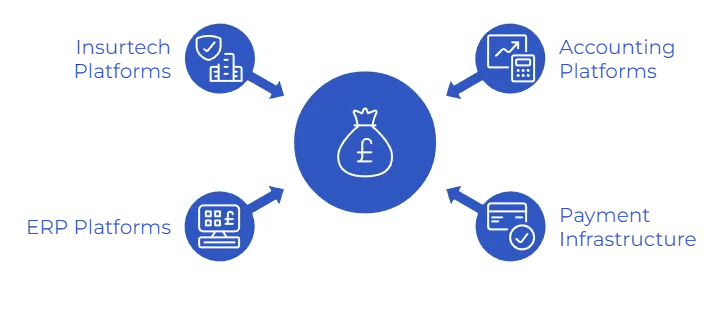
Accounting & ERP Platforms
Accounting SaaS platforms use Finexer’s AIS to access verified client bank transaction data for financial reconciliation workflows. Instead of manually submitted statements, platforms receive structured bank transaction data automatically – consistent reference fields and merchant identifiers across all UK banks, ready to match against internal records without post-processing.
Payment Infrastructure Platforms
Payment infrastructure platforms managing settlement reconciliation use Finexer’s AIS to verify payout records against actual bank transactions. Real-time webhooks mean reconciliation runs on current data – not delayed settlement files that create timing-based mismatches at high transaction volumes.
ERP Platforms
ERP platforms with financial data sync requirements use Finexer’s AIS to maintain continuous bank transaction visibility across client accounts. Standardised feeds across 99% of UK banks eliminate per-bank post-processing – removing format inconsistencies that introduce reconciliation errors across multi-bank client bases.
Insurtech Platforms
Insurtech platforms reconciling premium collections and claims disbursements use verified bank transaction data to match financial records accurately. Finexer’s AIS provides structured transaction history enabling reconciliation of payments across multiple accounts – without the silent coverage gaps that fragmented data sources create.
What is financial reconciliation in the UK?
Financial reconciliation is the process of matching internal financial records against bank transaction data to confirm accuracy and completeness. It is a core operational requirement for accounting platforms, ERP systems, and any regulated platform managing client financial records.
Why is reconciliation of payments difficult for platforms?
Reconciliation of payments is difficult because transaction data is often delayed by settlement cycles, fragmented across multiple payment sources, and inconsistently formatted across banks – making accurate record matching unreliable without a verified, standardised bank data source.
Can Finexer improve reconciliation accuracy?
Yes. Finexer is FCA-authorised and provides AIS infrastructure covering 99% of UK banks – delivering structured bank transaction data with counterparty details, reference fields, and up to 7 years of transaction history. Platforms apply their own reconciliation logic against Finexer’s verified, continuous bank data feeds.
Improve financial reconciliation accuracy with verified bank transaction data your team can rely on.
About the Author

Ravi Ranjan
Finexer