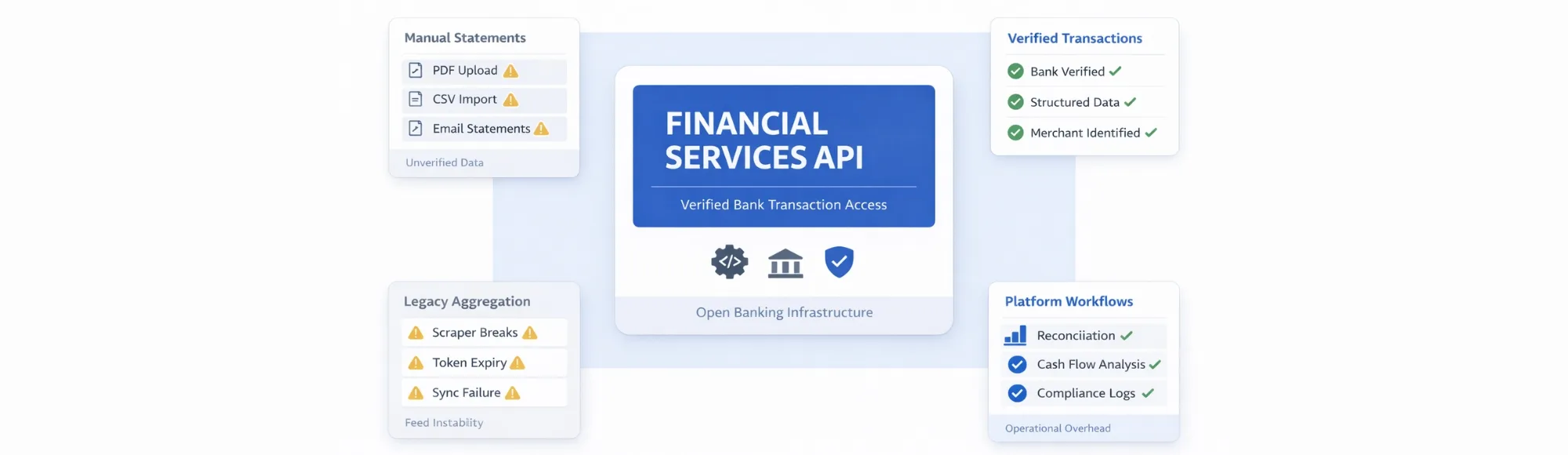
Manual bank statements breaking financial workflows?
Access verified bank transaction data via financial services API infrastructure.
UK fintech platforms cannot build reliable features when bank data access depends on manual statements or unreliable aggregators. Accounting automation, lending workflows, and compliance features require verified transaction data through financial services API infrastructure eliminating operational overhead.
Modern platforms need API-first bank data access providing structured transaction outputs, consent-based authentication, and scalable integration. Screen scraping and manual uploads cannot support production workflows requiring verified financial data.
This explains how financial services API infrastructure enables verified bank transaction access, what breaks traditional approaches, and why Open Banking APIs support regulated platforms building automation features.
TL;DR
Financial services API infrastructure transforms how platforms access bank transaction data. Open Banking APIs provide verified, consent-based transaction access eliminating manual uploads and screen scraping through FCA-authorised connectivity enabling fintech platforms to build reliable financial automation.
Key Takeaways
Why do platforms need financial services API infrastructure?
Modern fintech platforms require verified bank transaction data for automation features. Financial services API infrastructure provides structured transaction access, consent management, and scalable integration eliminating manual processes and unreliable aggregation.
What breaks without proper API infrastructure?
Manual bank statements lack verification. Screen scraping breaks frequently. Unstructured data prevents automation. Missing consent tracking creates compliance exposure. Unreliable aggregators introduce operational overhead.
How do Open Banking APIs improve bank data access?
Open Banking provides FCA-authorised financial services API infrastructure. Platforms access verified transaction data through consent-based APIs. Structured outputs enable automation. Real-time webhooks eliminate polling delays.
What should platforms evaluate when choosing API financial services?
API architecture quality, bank coverage depth, transaction data structure, consent management capabilities, historical access, enrichment accuracy, FCA authorisation status, integration complexity.
Where does Finexer provide financial services API infrastructure?
Finexer operates Open Banking connectivity using FCA-authorised infrastructure. Platforms integrate verified bank transaction access via financial services API endpoints enabling automated workflows without operational overhead.
Why verified bank data APIs matter for fintech platforms
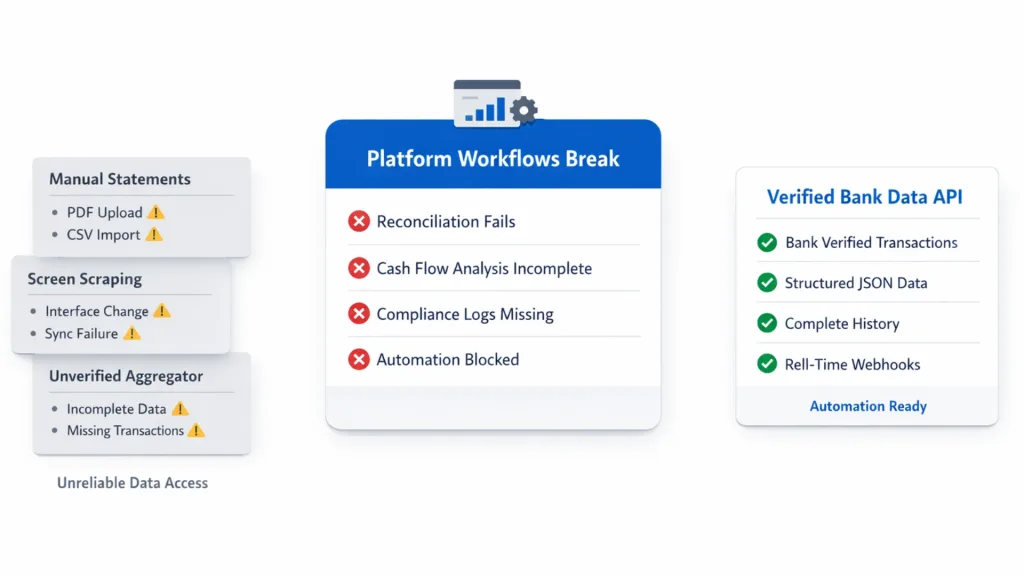
Fintech platforms building financial features discover serious infrastructure gaps when bank data access depends on manual processes or unreliable aggregation.
Operational problems without proper API financial services infrastructure:
- Manual bank statements require user intervention
- Screen scraping breaks when banks update interfaces
- Unstructured transaction data prevents automation
- Missing verification creates compliance exposure
- Unreliable aggregators introduce operational overhead
- Broken connectivity disrupts production workflows
Accounting SaaS platforms cannot automate reconciliation when transaction visibility requires periodic manual uploads. Lending platforms performing cash flow underwriting need complete verified transaction history through reliable financial services API connectivity. Compliance platforms monitoring financial activity require audit-ready records with institutional verification.
Traditional approaches using screen scraping or manual collection cannot provide data quality required for production API financial services workflows at scale.
What breaks traditional bank data access
- Screen scraping lacks reliability: Legacy systems access banking websites programmatically. Banks update interfaces without coordination. Scrapers break requiring immediate engineering fixes. Production workflows stop unexpectedly.
- Manual uploads prevent automation: Users download bank statements manually. File formats vary across institutions. Import mapping requires configuration. Automation impossible when visibility depends on periodic manual collection.
- Unstructured data formats: Transaction descriptors lack standardisation. Merchant names vary unpredictably. Categorisation rules fail frequently. Manual cleanup required before processing.
- Missing institutional verification: Platforms receive unverified documents. Auditors cannot authenticate source. Chain of custody absent. Compliance exposure increases.
- No consent management infrastructure: Credential storage creates security risks. Users cannot revoke access granularly. GDPR compliance requires consent tracking that manual processes cannot provide.
For platforms requiring banking API integration, infrastructure architecture determines automation success versus operational overhead.
How Open Banking financial services APIs work

Open Banking provides regulated infrastructure for verified bank transaction access through consent-based API architecture enabling modern financial services API implementations.
- Consent-based authentication: Users authenticate through banking apps. Platforms request specific data permissions. Banks provide tokenised API access. No credential storage required.
- Verified transaction data: Direct-from-bank financial records with institutional authentication. Complete transaction history without manual collection. Verified data provenance supporting audit requirements.
- Structured API outputs: Consistent JSON format across UK banks. Standardised transaction fields including merchant details, amounts, timestamps, counterparties. Data arrives enriched enabling automation.
- Real-time webhook notifications: Banks notify platforms when transactions occur. No polling delays. Immediate visibility. Workflows trigger automatically.
- Historical data access: Transaction retrieval up to 7 years (bank dependent). Complete financial history for new connections. Compliance reporting supported automatically.
Platforms using Open Banking for financial services API infrastructure access verified bank data through regulated framework eliminating traditional reliability problems.
Financial services API infrastructure evaluation
| Criteria | Why It Matters | What to Look For |
|---|---|---|
| API architecture | Poor design creates integration overhead | RESTful endpoints with comprehensive documentation |
| Bank coverage | Gaps prevent complete financial visibility | 99% UK bank coverage including challengers |
| Data structure | Inconsistent formats break automation | Standardised JSON with enrichment |
| Consent management | GDPR compliance requires proper tracking | Granular permissions with revocation |
| FCA authorisation | Regulatory compliance determines legitimacy | Verified FCA-authorised infrastructure |
How Finexer enables financial services API infrastructure
Finexer operates Open Banking connectivity using FCA-authorised infrastructure enabling platforms to access verified bank transaction data through financial services API endpoints.
Key capabilities:
- 99% UK bank coverage
- FCA-authorised infrastructure
- RESTful API architecture
- Real-time webhooks
- Up to 7 years historical data
- Merchant enrichment (100M+ database)
- Transaction categorisation (95%+ accuracy)
- Usage-based pricing
- White-label ready
- 2-3x faster integration
- 3-5 weeks onboarding support
- Saves up to 90% on transaction costs
Platforms integrate verified bank data access through REST endpoints. Users authenticate via secure Open Banking flows. Transaction data flows continuously through webhooks without credential storage.
Structured transaction outputs include merchant details, categorisation intelligence, and payment metadata enabling automated processing. Historical access retrieves complete financial records supporting compliance workflows.
Critical positioning:
Finexer does not provide financial planning software. Platforms control workflow logic and feature development.
Finexer provides verified bank transaction data infrastructure through Open Banking APIs enabling fintech platforms to build reliable financial automation features using scalable API financial services connectivity.
For platforms requiring payroll and invoicing automation, verified transaction access removes operational bottlenecks.
What we see in practice
Most fintech platforms underestimate infrastructure complexity required for production-grade bank data access. Initial implementations using screen scraping appear functional until scaling exposes reliability problems.
Platforms discover screen scraper maintenance consumes increasing engineering capacity. Banks update interfaces without coordination. Sync failures multiply across user base. Support teams handle reconnection requests constantly.
Common infrastructure problems at scale:
- Manual bank statement collection prevents automation
- Unverified data creates audit exposure
- Broken connectivity disrupts production workflows
- Missing consent tracking violates GDPR requirements
- Operational overhead compounds with growth
Accounting platforms switching to Open Banking financial services API infrastructure report dramatic improvements. Sync reliability increases significantly. Manual intervention decreases. Engineering capacity redirects to feature development instead of data pipeline maintenance.
Lending platforms discover verified transaction access transforms underwriting quality. Cash flow analysis becomes reliable. Income verification achieves institutional authentication. Credit decisions improve when financial services API infrastructure provides verification.
Compliance platforms monitoring client accounts need audit-ready records. Manual uploads cannot provide verification required during regulatory reviews. API infrastructure with institutional authentication eliminates compliance gaps.
Common use cases
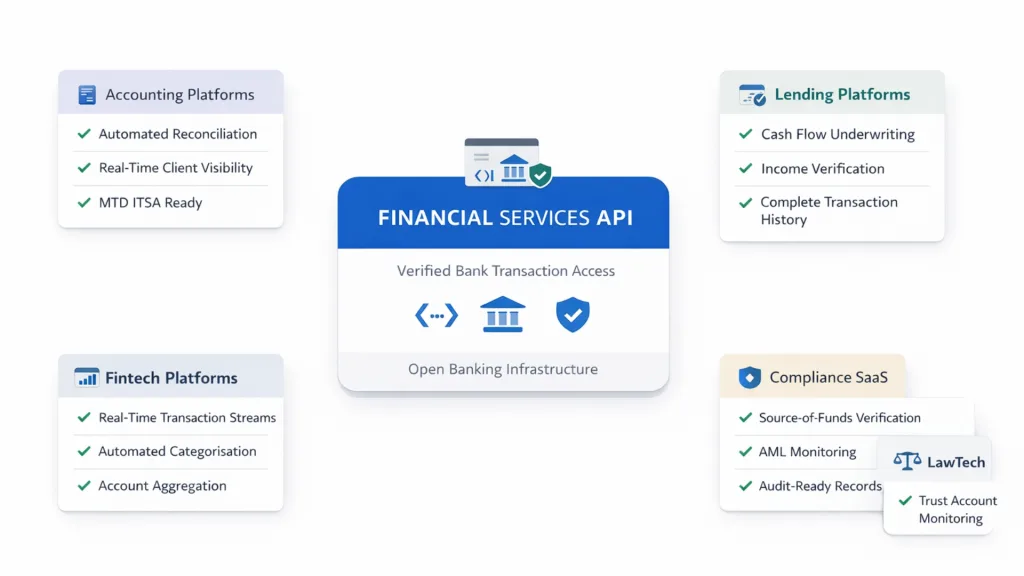
Accounting SaaS platforms:
- Automate bank reconciliation using verified transaction data
- Eliminate manual statement uploads from workflows
- Provide real-time financial visibility to clients
- Support MTD ITSA compliance with structured records
- Build audit-ready transaction logs automatically
Lending platforms:
- Perform cash flow underwriting with verified data
- Verify income through bank-authenticated records
- Monitor borrower financial activity ongoing
- Support credit decisions with complete history
- Reduce fraud through institutional verification
Fintech platforms:
- Build financial features using verified bank data
- Access real-time transaction streams via APIs
- Enable automated categorisation workflows
- Provide consolidated account views
- Scale operations without manual processes
Compliance SaaS:
- Monitor client accounts with verified visibility
- Verify source-of-funds using complete history
- Maintain audit-ready financial records
- Support AML screening with transaction data
- Provide regulatory reporting infrastructure
LawTech platforms:
- Oversight client accounts for trust monitoring
- Verify source-of-funds for compliance
- Maintain records meeting SRA Account Rules
- Support debt relief and IVA workflows
- Enable secure client data access
What are financial services APIs?
Financial services APIs enable platforms to access bank transaction data programmatically. Open Banking provides FCA-authorised API infrastructure for verified transaction access through consent-based authentication eliminating manual uploads and screen scraping for fintech platforms.
How do financial services APIs work?
Platforms integrate API endpoints connecting to banking institutions via Open Banking infrastructure. Users authenticate through banking apps granting consent. Platforms receive structured transaction data continuously through webhooks enabling automated workflows with verified financial records.
What is API in financial services?
API in financial services refers to Application Programming Interfaces enabling secure, programmatic access to bank transaction data and payment initiation. Open Banking APIs provide regulated infrastructure for verified data access supporting fintech platform automation features through financial services API connectivity.
Enable verified bank transaction access with financial services API infrastructure and Open Banking connectivity.
About the Author

Ravi Ranjan
Finexer