
Real-time bank transaction data. Structured expense categorisation. MTD-ready financial records.
Open Banking AIS infrastructure for accounting SaaS, ERP systems, and expense management platforms.
The HMRC expenses list is not the problem. Every accounting platform knows what categories exist.
At Finexer, I work directly with accounting SaaS teams, ERP builders, and expense management platforms. The question I hear most is not “what can we claim?” – it is “how do we make sure what we claim is right?”
That is a data infrastructure question, not a tax rules question.
The problem is what happens between the transaction and the tax return. A purchase lands in a business bank account. Someone categorises it – correctly or not. The category feeds into the expense claim. The claim goes to HMRC. If the category was wrong, the claim is wrong.
Manual categorisation at scale is where the HMRC expenses list fails in practice – and where accounting platforms carry the most compliance risk. Not because the rules are unclear – but because the data feeding into the system is unstructured, delayed, or mismatched.
From April 2026, sole traders earning over £50,000 must use Making Tax Digital for Income Tax (MTD for IT), requiring digital records and quarterly submissions. The accuracy problem just became a compliance problem.
TL;DR
The HMRC expenses list outlines nine core categories of allowable business expenses – all subject to the “wholly and exclusively” rule. Tracking them accurately requires structured transaction data at the point of categorisation, not manual review after the fact. MTD for Income Tax (April 2026, £50,000+ threshold) makes digital records mandatory, raising the stakes for every wrongly coded transaction. Accounting platforms and ERP systems that rely on client-submitted data or manual bank imports introduce categorisation errors that compound across quarterly submissions.
Key Takeaways
What is the HMRC expenses list?
The HMRC expenses list covers nine allowable business expense categories: office costs, travel and vehicles, clothing, staff costs, stock and materials, financial costs, premises costs, advertising and marketing, and training costs. All must pass the business-only test. Client entertainment and commuting to a permanent workplace are both excluded.
What are the most commonly misclaimed expenses?
The three highest-risk categories on the HMRC expenses list are travel (personal vs business mileage), home working (proportion vs flat rate), and entertainment spend (incorrectly claimed as allowable). Mixed-use expenses – a phone used 60% for business – require apportionment. Manual categorisation processes regularly miss this distinction.
How does MTD for Income Tax change expense tracking requirements?
From April 2026, sole traders earning over £50,000 must maintain digital records and submit quarterly updates to HMRC. This means expense categorisation cannot be deferred to year-end. Every transaction needs a category at or near the point of purchase – making real-time bank data essential for platforms building MTD-compliant workflows.
How does real-time bank data improve HMRC expense tracking?
Bank transaction data via Open Banking AIS arrives with merchant IDs and category codes applied at source – letting platforms map each transaction to the correct HMRC expenses list category automatically. A transaction at a fuel station arrives pre-labelled – not as a raw bank description string. This removes the manual categorisation step for standard expense types and reduces the error rate that creates compliance risk in HMRC submissions.
What Does the HMRC Expenses List Actually Cover?
What Are the Nine HMRC Allowable Expense Categories?
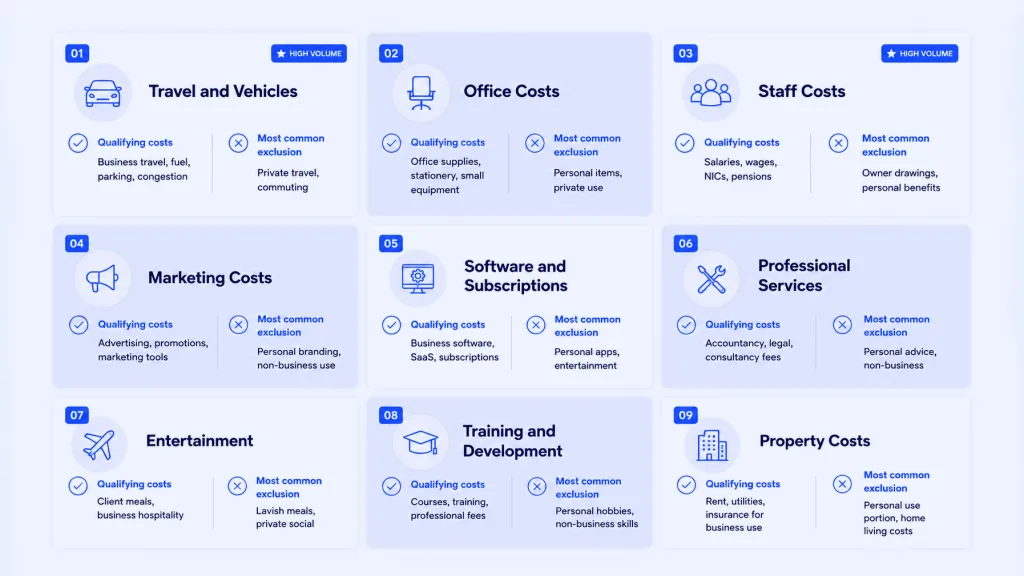
The HMRC expenses list is structured around nine core categories. Understanding each one is the starting point – but the compliance challenge is mapping real transactions to the right entry on that list. These categories apply to both self-employed individuals and limited companies, though the specific rules differ.
| HMRC Expense Category | What Qualifies | Common Exclusion |
|---|---|---|
| Office costs | Stationery, software subscriptions, phone bills (business portion) | Personal phone use proportion |
| Travel and vehicles | Business mileage at 45p/mile (first 10,000), public transport, parking | Commuting to permanent workplace |
| Clothing | Uniforms, protective gear required for the job | Everyday clothing, even if worn for work |
| Staff costs | Salaries, employer NI, pensions, subcontractor payments, staff training | Personal drawings from the business |
| Stock and materials | Raw materials, goods for resale | Personal purchases via business account |
| Financial costs | Business bank charges, interest on business loans, insurance premiums | Personal loan interest, personal insurance |
| Premises costs | Office rent, business rates, utilities. Home working: proportion of bills or flat rate | Mortgage capital repayments |
| Advertising and marketing | Website costs, digital advertising, professional directories | Client entertainment – not allowable under any circumstances |
| Training costs | Courses improving existing skills for current trade | Training for a new trade or qualification |
The HMRC list of expenses is clear on categories. The compliance problem is not what is on the HMRC expenses list – it is the process that connects a live transaction to the correct category.
“The HMRC expenses list is a starting point, not a system. Every platform that helps businesses claim correctly needs to solve the categorisation problem – which is fundamentally a data quality problem, not a tax rules problem.” – Ravi, Finexer
Where Does HMRC Expense Tracking Break Down in Practice?
Why Does Miscategorisation Happen at Scale?
The HMRC list of expenses has been stable for years. The categorisation problem has not improved because the underlying data workflow has not changed.
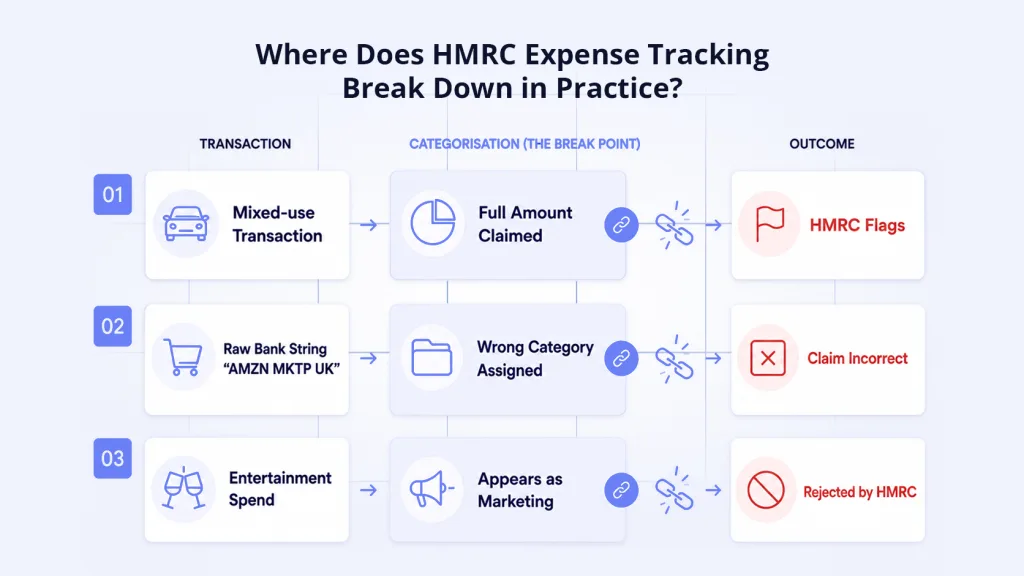
Three failure modes occur repeatedly in accounting SaaS and ERP platforms.
- Mixed-use transactions land in the wrong category. A business owner uses a personal phone 60% for business. The full phone bill arrives as a single transaction. Without apportionment built into the categorisation layer, the full amount gets claimed. HMRC requires only the business proportion.
- Bank description strings do not match expense categories. A raw bank transaction might show “AMZN MKTP UK” – which could be office supplies, stock for resale, or a personal purchase. Assigning the correct HMRC category requires human judgment. At scale, across hundreds of clients, that judgment either slows down the workflow or gets skipped.
- Entertainment spend slips through. Dinners, hospitality, and event tickets look like legitimate business costs. They are the single most commonly rejected expense category under HMRC rules. Platforms relying on client-submitted records regularly inherit incorrectly categorised entertainment spend.
The compounding effect: one miscategorised transaction per week across a year-end Self Assessment or quarterly MTD submission creates a pattern that triggers HMRC attention.
For accounting SaaS platforms building MTD-compliant workflows against the HMRC expenses list, how the bank data behind the Making Tax Digital for Income Tax process is structured determines whether submissions are accurate or require manual correction cycles.
How Does Real-Time Bank Data Fix the Expense Tracking Problem?
What Does Structured Transaction Data Change for HMRC Expense Categories?
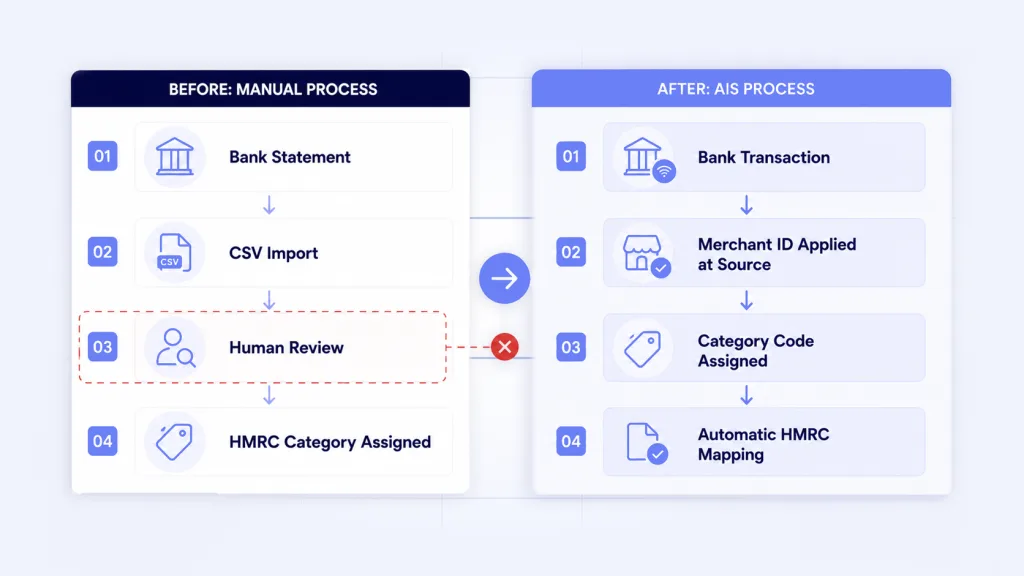
The HMRC list of expenses requires categorisation. The question – and the one that most accounting platforms have not fully answered – is where that categorisation happens in the data workflow when building against the HMRC expenses list.
When a platform uses client-submitted bank statements or manual CSV imports, categorisation happens at the platform level – by a human, after the transaction has already occurred. This is slow and error-prone.
When a platform uses Open Banking AIS to access bank transaction data directly, categorisation happens earlier – at the data source, before the transaction reaches the platform’s logic layer. Merchant IDs and category codes are applied at source.
A petrol station transaction arrives with a fuel merchant ID. A software subscription arrives with a SaaS merchant category code. The platform’s HMRC expense mapping layer has structured data to work with – not an unstructured reference requiring human interpretation.
This does not eliminate edge cases. Mixed-use transactions still require apportionment logic. But it removes the bulk categorisation problem that drives most HMRC expenses list errors in automated accounting platforms.
How Does Finexer Support HMRC Expense Tracking Workflows?
What Does Finexer’s AIS Provide for Expense Management Platforms?
Finexer does not provide tax advice, expense management software, or HMRC submission tools.
Finexer provides FCA-authorised Open Banking AIS – the bank data infrastructure that accounting SaaS, ERP systems, and expense management platforms use to access structured transaction data and map it accurately to the HMRC expenses list categories.
- Merchant IDs at source – each transaction arrives with a consistent merchant identifier, enabling automated mapping to HMRC expense categories
- Category codes applied at source – 95%+ accuracy across 100M+ merchants at under 100ms, before data reaches the platform’s categorisation layer
- Real-time transaction data – transactions available at settlement, not in end-of-day batch imports
- Up to 7 years of transaction history – full depth for Self Assessment amendments and HMRC enquiry responses
- Structured JSON – consistent format across virtually every UK bank, no manual import or format conversion required
- 99% UK bank coverage – high street, challenger, and business accounts
- Usage-based pricing, no setup fees, 3-5 weeks to production
For platforms building MTD-compliant expense workflows, structured bank data at source means the categorisation layer works with clean inputs – reducing the overhead that slows quarterly submission cycles.
For accounting platforms already building for Making Tax Digital, how the MTD bridging software layer connects to bank data determines whether the quarterly submission workflow is automated or dependent on manual review.
What I Feel
The HMRC expenses list is not where accounting platforms struggle. Every platform knows the nine categories. Every platform knows what “wholly and exclusively” means.
The struggle is the gap between a transaction clearing in a business bank account and that transaction being correctly categorised, apportioned, and mapped to an HMRC category – at scale, across hundreds of clients, on a quarterly MTD cycle.
“Structured bank data does not replace judgment – it replaces the manual matching step that slows every accounting platform down at scale. When merchant IDs arrive with the transaction, the categorisation layer has something to work with.” – Ravi, Finexer
That gap is a data problem. Platforms that solve it build their HMRC expenses list mapping on structured, merchant-coded bank data – not on human review at the end of the workflow.
Common Use Cases
Accounting SaaS
Merchant IDs and category codes applied at source allow accounting platforms to pre-map transactions to every category on the HMRC list of expenses before the client review step. Mixed-use transactions arrive with enough merchant context to trigger apportionment logic automatically.
ERP Systems
Structured transaction data in consistent JSON format replaces manual bank import workflows. Every transaction maps cleanly to an HMRC expenses list category – running against merchant-coded data rather than unstructured reference strings.
Expense Management Tools
Real-time bank transaction access means expense categorisation happens at or near the point of purchase. This meets the MTD for Income Tax requirement for timely digital records – and maps each transaction to the correct HMRC expenses list category without manual upload workflows.
Payroll and Invoicing Platforms
Staff cost transactions – payroll runs, subcontractor payments – arrive with consistent counterparty identification. They map automatically to the staff costs entry on the HMRC expenses list without manual matching.
What expenses are on the HMRC list?
The HMRC expenses list covers nine categories: office costs, travel and vehicles, clothing, staff costs, stock and materials, financial costs, premises costs, advertising and marketing, and training costs. All must be for business purposes only. Hospitality costs are not on the HMRC list of expenses as an allowable category under any circumstances.
What are allowable expenses in the UK?
Allowable expenses in the UK are business costs that meet HMRC’s “wholly and exclusively” test – incurred solely for running the business. Mixed-use costs can be apportioned. Capital expenses are handled via capital allowances, not included in the HMRC list of expenses for direct deduction. The Annual Investment Allowance (AIA) allows 100% deduction of qualifying plant and machinery up to £1 million.
Which expenses are 100% deductible?
Software subscriptions, professional fees, staff training for existing roles, business insurance premiums, and advertising costs are typically 100% deductible when wholly for business use. Vehicles and equipment may qualify for 100% deduction via the Annual Investment Allowance. Entertainment and commuting costs are both excluded from HMRC expense deductions.
What are the four categories of expenses in HMRC terms?
HMRC broadly groups business expenses into revenue expenditure (day-to-day costs claimable in the year incurred), capital expenditure (assets handled via capital allowances), disallowable expenditure (personal or non-business costs), and mixed-use expenditure (costs requiring apportionment between business and personal use).
To see how Finexer provides structured bank transaction data for HMRC expense categorisation workflows
About the Author

Ravi Ranjan
Ravi Ranjan is Co founder & CEO of Finexer