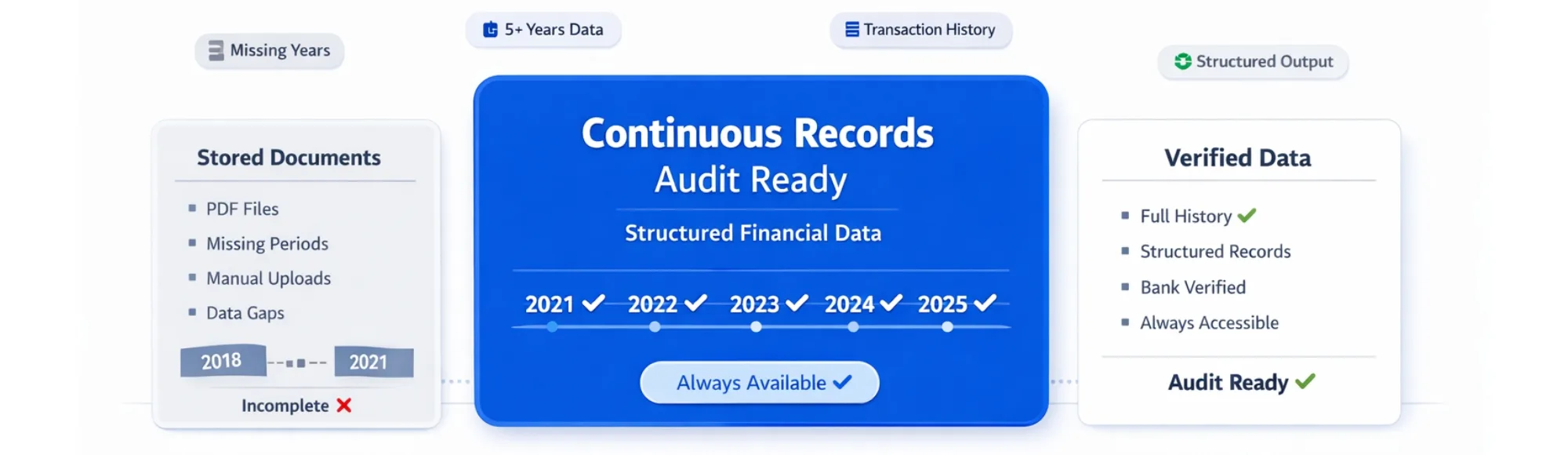
Your clients’ HMRC recordkeeping obligations require continuous, structured financial data.
Finexer provides bank transaction data infrastructure for audit-ready financial records.
HMRC how long to keep records is not just a filing deadline question. It is a data infrastructure question.
Under UK tax regulation, businesses must retain accurate, accessible financial records for defined periods – and HMRC can request those records at any point during an enquiry. For accounting SaaS platforms and tax compliance tools, meeting the HMRC requirement to keep records at scale means having a data layer that is continuous, structured, and audit-ready without depending on manual uploads or fragmented document sources.
This blog covers the HMRC retention requirements by business type, what those requirements mean operationally for platforms, and how continuous bank transaction data via FCA-authorised AIS supports compliant recordkeeping workflows.
TL;DR
HMRC how long to keep records depends on business type – self-employed and most businesses must keep records for 5 years after the 31 January submission deadline; companies for 6 years from the end of the relevant financial year. The HMRC requirement to keep records extends to 12 years for offshore matters and up to 20 years in cases of deliberate tax evasion. For platforms, meeting these obligations means continuous, structured financial data – not periodic document uploads. Finexer’s FCA-authorised AIS provides that data layer for UK accounting and compliance platforms.
Key Takeaways
How long does HMRC require records to be kept for self-employed businesses?
The answer to hmrc how long to keep records for self-employed individuals is at least 5 years after the 31 January submission deadline of the relevant tax year. For the 2024-25 tax year (deadline 31 January 2026), records must be kept until 31 January 2031.
How long must company records be kept under HMRC requirements?
Companies must keep records for 6 years from the end of the last company financial year they relate to. This is the standard HMRC requirement to keep records for limited companies.
Can HMRC go back more than 7 years?
Yes. HMRC can go back further than 7 years in specific circumstances – up to 12 years for offshore matters, and up to 20 years where deliberate tax evasion is suspected. If an HMRC enquiry is open, records must be retained until the enquiry is resolved.
What are the penalties for failing to meet HMRC requirements to keep records?
HMRC can impose penalties of up to £3,000 for failure to keep or preserve adequate records. For regulated platforms managing client financial data, incomplete or inaccessible records create direct compliance risk.
What Are the HMRC Requirements to Keep Records?
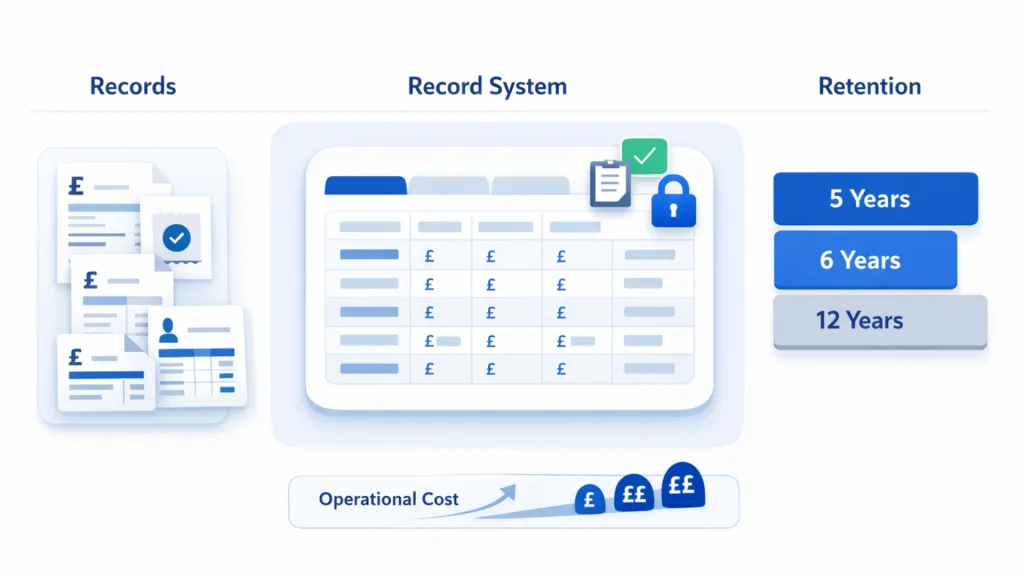
What Records Must Businesses Keep Under HMRC Rules?
The question of hmrc how long to keep records is governed by UK tax legislation. Businesses are required to keep accurate financial records that support their tax returns and are accessible to HMRC on request.
The HMRC requirement to keep records applies to:
- Business income and expenses
- Bank statements and transaction records
- Sales invoices and purchase receipts
- Payroll records and PAYE information
- VAT records where VAT-registered
GOV.UK guidance on how long to keep self-employment records sets out the statutory retention obligations in full for individuals and businesses.
Records must be kept in a format that is readable and accessible. HMRC does not specify paper or digital, but Making Tax Digital requirements increasingly expect digital records to be maintained and submitted through compatible software.
What Are the Retention Periods by Business Type?
Understanding hmrc how long to keep records requires looking at business structure. Retention periods differ depending on the legal structure and circumstances of the business:
- Self-employed individuals and most businesses – 5 years after the 31 January submission deadline of the relevant tax year
- Limited companies – 6 years from the end of the last financial year the records relate to
- Late-filed returns – 5 years from the actual submission date, not the original deadline
- Offshore matters – up to 12 years
- Deliberate tax evasion – up to 20 years
- Active HMRC enquiry – records must be retained until the enquiry is resolved, regardless of the standard period
“Under UK regulation, the HMRC requirement to keep records is clear on timelines – but the operational challenge for platforms is ensuring that financial records are not just stored but maintained in a format that can withstand regulatory scrutiny at any point during the retention window.” – Clare, Finexer
Why Does HMRC Recordkeeping Create a Data Infrastructure Problem for Platforms?
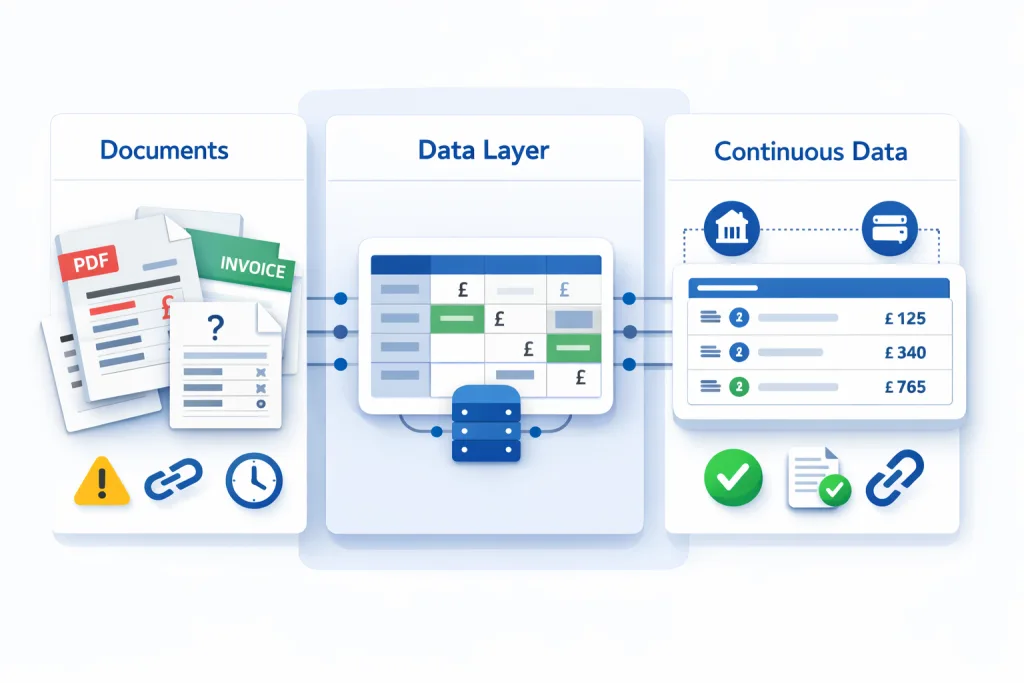
Why Are Document-Based Records Insufficient for Audit Readiness?
Most businesses retain financial records through a combination of bank statement downloads, PDF invoices, and spreadsheet-based transaction logs. This approach satisfies the hmrc how long to keep records requirement in principle – but it creates an audit readiness problem in practice.
HMRC enquiries require records to be produced accurately and quickly. A PDF bank statement from three years ago may be incomplete, may not cover the correct period, or may be in a format that is difficult to cross-reference against tax return figures. A spreadsheet-based transaction log has no independent verification – it reflects what was entered, not what the bank actually recorded.
How platforms build MTD quarterly reporting with digital records covers the digital record requirements under Making Tax Digital that increasingly govern how HMRC-compliant financial data must be maintained.
What Does Continuous Data Access Mean for HMRC Compliance?
For accounting SaaS and tax compliance platforms, the hmrc how long to keep records obligation is not satisfied by a one-time data export at year-end. It requires:
- Transaction data that is complete for the full retention period
- Records that can be traced back to an independently verifiable source
- Financial data that is accessible and structured for production on request
- A data trail that supports the figures submitted in tax returns
Manual uploads and periodic CSV exports do not provide this reliably at scale. A client who switches banks mid-year may not export historical data from their previous institution. A document uploaded at tax filing time may not cover the complete period. Gaps in the data record create HMRC compliance risk that surfaces only during an enquiry.
| Business Type | HMRC Retention Period | What Records Must Be Kept |
|---|---|---|
| Self-employed / sole trader | 5 years after 31 January submission deadline | Income, expenses, bank records, invoices, receipts |
| Limited company | 6 years from end of relevant financial year | Accounting records, bank statements, payroll, VAT records |
| Late-filed returns | 5 years from actual submission date | As above – period extends from actual filing date |
| Offshore matters | Up to 12 years | Records relating to offshore income or transactions |
| Deliberate tax evasion | Up to 20 years | All financial records relevant to the evasion period |
| Active HMRC enquiry | Until enquiry is resolved | All records relevant to the enquiry scope |
How Does Finexer Support HMRC-Compliant Recordkeeping for UK Platforms?
For accounting SaaS platforms, tax software providers, and compliance tools managing the hmrc how long to keep records obligation on behalf of clients – Finexer’s FCA-authorised AIS provides continuous, structured bank transaction data that supports audit-ready financial recordkeeping.
MTD record keeping requirements for UK platforms covers the Making Tax Digital digital records requirements that sit alongside HMRC’s general retention obligations.
What Does Finexer’s AIS Infrastructure Provide?
- FCA-authorised AIS – verifiable on the FCA register, read-only bank data access
- Up to 7 years of transaction history for historical recordkeeping and HMRC compliance
- 99% UK bank coverage across retail, business, and challenger banks
- Continuous transaction feeds via webhooks – data updates as transactions occur
- Structured transaction data with timestamps, references, and categorisation
- Consent logs and access timestamps per data retrieval for audit trail support
- Multi-account connectivity – all consented accounts covered in a single data feed
- White-label consent flows under the platform’s own brand
- Usage-based pricing – scales with client volume
- 3-5 weeks onboarding support to reach production deployment
“The HMRC requirement to keep records for 5 or 6 years means that platforms need a data layer that maintains continuity over that period – not just a document store that may have gaps. Continuous bank transaction data via FCA-authorised AIS provides the complete, verifiable financial record that audit readiness requires.” – Clare, Finexer
What I Feel
HMRC how long to keep records is a question most platforms treat as a compliance checkbox rather than a data infrastructure requirement. The retention period is clear – 5 years, 6 years, longer in specific circumstances. What is less clear is whether the data maintained during that period is actually fit for purpose if HMRC opens an enquiry.
Document stores and periodic exports leave gaps. Bank transaction data retrieved via FCA-authorised AIS does not. The HMRC requirement to keep records is satisfied not by volume of stored files but by the verifiability and completeness of the underlying financial data.
Making Tax Digital for VAT – platform guide covers the broader MTD compliance obligations that sit alongside HMRC record retention requirements for VAT-registered businesses.
Common Use Cases

Accounting & ERP Platforms
Accounting platforms managing client tax compliance need transaction records that cover the full hmrc how long to keep records retention period without gaps. Finexer’s AIS provides up to 7 years of bank transaction history per consented account – supporting continuous, verifiable recordkeeping that meets HMRC requirements without manual statement requests.
Lawtech Platforms
LawTech platforms managing client financial records for compliance reviews require transaction data that is independently verifiable. Finexer’s FCA-authorised AIS provides bank-authenticated records with consent logs and timestamps – supporting HMRC-compliant financial records for regulated legal workflows.
Payroll & Invoicing Platforms
Payroll platforms managing PAYE records and invoicing platforms tracking business income need complete transaction histories for the HMRC retention period. Finexer’s AIS delivers structured bank transaction data per account – enabling continuous recordkeeping without manual data gaps.
Proptech & Real Estate Platforms
PropTech platforms managing rental income records for landlord clients need bank-verified income data across the HMRC retention period. Finexer’s AIS provides verified rental receipt history per consented account – supporting accurate income records for tax compliance.
How long does HMRC require records to be kept for UK businesses?
Self-employed individuals and most businesses must keep records for 5 years after the 31 January submission deadline. Limited companies must keep records for 6 years from the end of the relevant financial year. HMRC can require longer retention in specific circumstances including offshore matters and active enquiries.
Should I keep bank statements for 7 years in the UK?
The standard HMRC requirement is 5 years for self-employed individuals and 6 years for limited companies – not 7. However, keeping bank statements for 6-7 years covers both scenarios and provides a buffer if HMRC opens an enquiry. Bank transaction data via FCA-authorised AIS provides continuous, verifiable records without manual statement management.
What happens if records are not kept to HMRC requirements?
HMRC can impose penalties of up to £3,000 for failure to keep or preserve adequate records. Incomplete records also create risk during HMRC enquiries, where the absence of verifiable data may result in estimated assessments.
Build HMRC-compliant financial recordkeeping on continuous, verified bank transaction data.
About the Author

Clare Pearson
Clare Pearson is a senior payments professional with extensive experience across the global financial services and payments industry. She specialises in Open Banking, payment infrastructure, and financial technology transformation, with expertise spanning product delivery, operational strategy, regulatory compliance, and large-scale payments programmes. Clare currently serves as a Non-Executive Director at Finexer and a panel member for the Payment Systems Regulator (PSR), advising on the development of payment systems policy and innovation