Rent in Seconds, Not Days
Finexer’s PIS infrastructure embeds Pay by Bank rent collection inside UK landlord and letting agency platforms
A landlord with three properties asked me last month which payment method to use. Their current setup is standing orders. Two out of three tenants pay on time. The third has missed the date twice this year by four days.
The landlord wanted to know if Direct Debit would fix it. Or Open Banking. Or whether they should just keep chasing.
The honest answer depends on which problem they are actually solving. The three UK landlord rent collection methods solve different things. Picking the wrong method means paying for control you do not need, or staying with control you do not have.
This blog walks through all three landlord rent collection methods, what each one does, and which one fits which portfolio size.
“Most landlords I talk to are not really choosing between methods. They have inherited Standing Orders and only consider alternatives when something goes wrong. By the time they look, the problem they want to solve has already changed.” – Ravi, Finexer
TL;DR
Three UK landlord rent collection methods. Standing Order: tenant-controlled, free, no failure alerts. Direct Debit: landlord-initiated via GoCardless, 1% + 20p capped at £4. Open Banking PIS: instant settlement, low fees, real-time reconciliation. Standing Order suits small portfolios. Direct Debit suits arrears patterns. Open Banking suits scaled automation.
How Does Standing Order Rent Collection Actually Work?
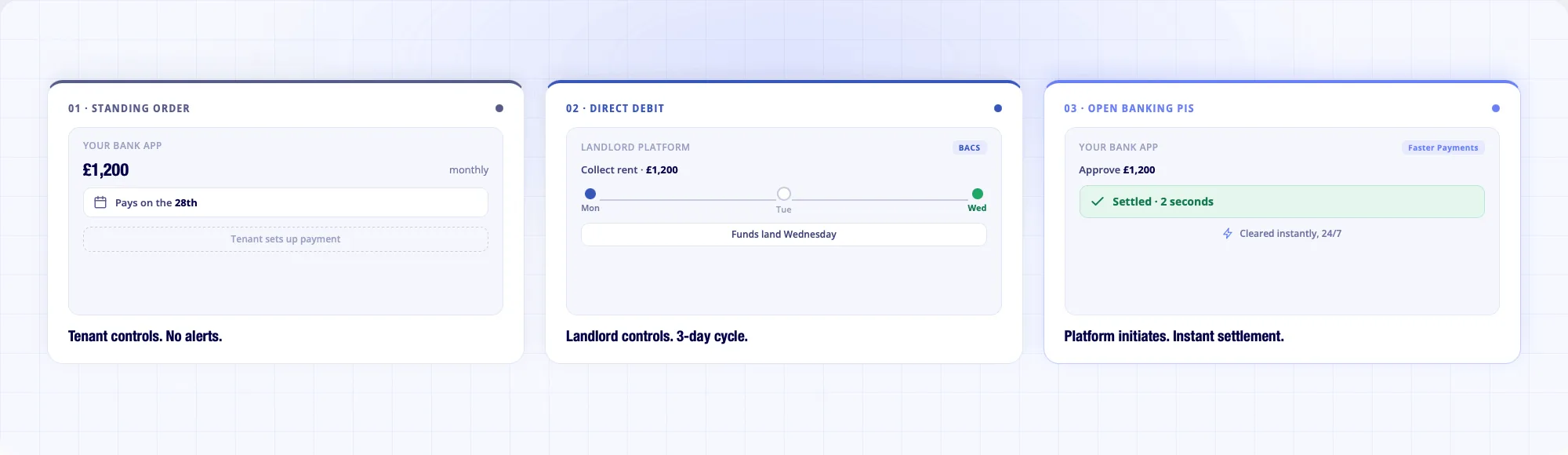
Standing Order is the default UK landlord rent collection method and has been for decades. The tenant instructs their own bank to send a fixed amount on a set date each month. The landlord receives the funds in their bank account, identifies it from the reference, and updates their records.
The mechanism matters here. The tenant controls the standing order entirely.
They set it up. They can amend the amount or date. They can cancel it without telling the landlord.
For the landlord, this means three things:
- Zero transaction cost – banks do not charge for receiving a standing order
- Zero control – if a tenant cancels, the landlord finds out when the money does not arrive
- Manual reconciliation – the landlord matches incoming payments to tenancies by reading the reference field
This works well for small portfolios. Tenants are reliable, the rent amount does not change, the landlord knows each tenant directly.
A self-managing landlord with two or three long-term tenants on stable jobs has very little reason to move away from this method.
Standing Order stops working when arrears become a pattern or the portfolio grows. Reconciliation scales linearly with property count.
Ten properties means ten manual matches per month. Fifty means five hours of admin and a higher chance of missing a non-payment until day three or four.
How Does Direct Debit Rent Collection Work for UK Landlords?
Direct Debit reverses the rent collection control. The landlord, through a Direct Debit provider, initiates each collection from the tenant’s account on the scheduled date. The tenant signs a one-time mandate authorising future collections.
For UK landlords, this typically means a provider like GoCardless, PayProp, LettsPay, or a letting platform with Direct Debit built in. Setting up a Direct Debit-based landlord rent collection service requires a Service User Number from a sponsor bank or routing through a provider that holds one.
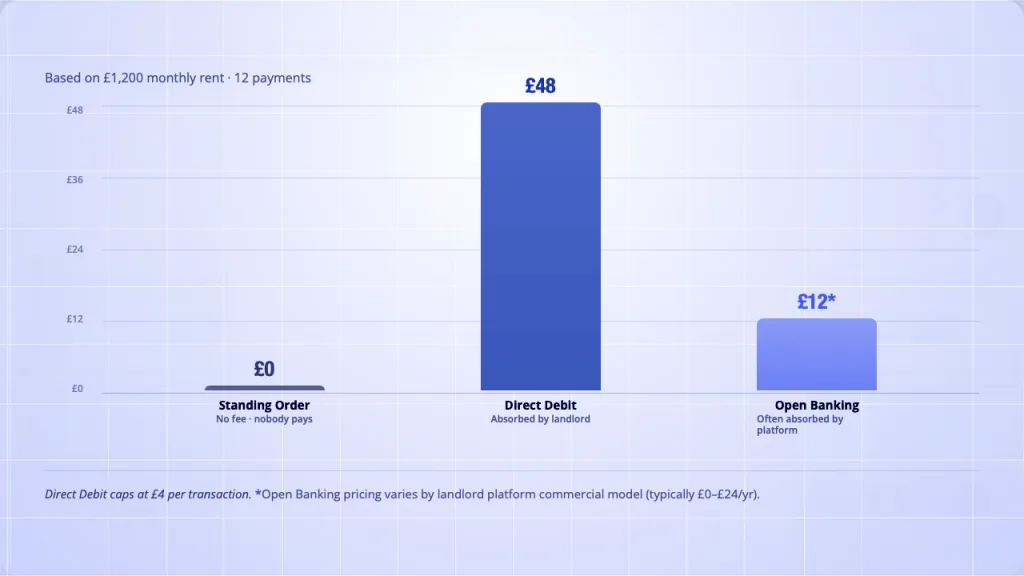
The cost. GoCardless charges 1% plus 20p per transaction, capped at £4.
For a £1,200 monthly rent, that works out to £4 per transaction. Across a 12-month tenancy, that is £48. For a five-property portfolio, £240 per year. For a 50-property letting agency, £2,400 a year.
The control trade-off is real though. The landlord initiates the payment. A cancelled mandate is flagged immediately, not discovered through silence.
Failed payments are notified through the provider’s dashboard. The Direct Debit Guarantee adds tenant protection – they can claim a refund for any incorrect collection, which most tenants find reassuring.
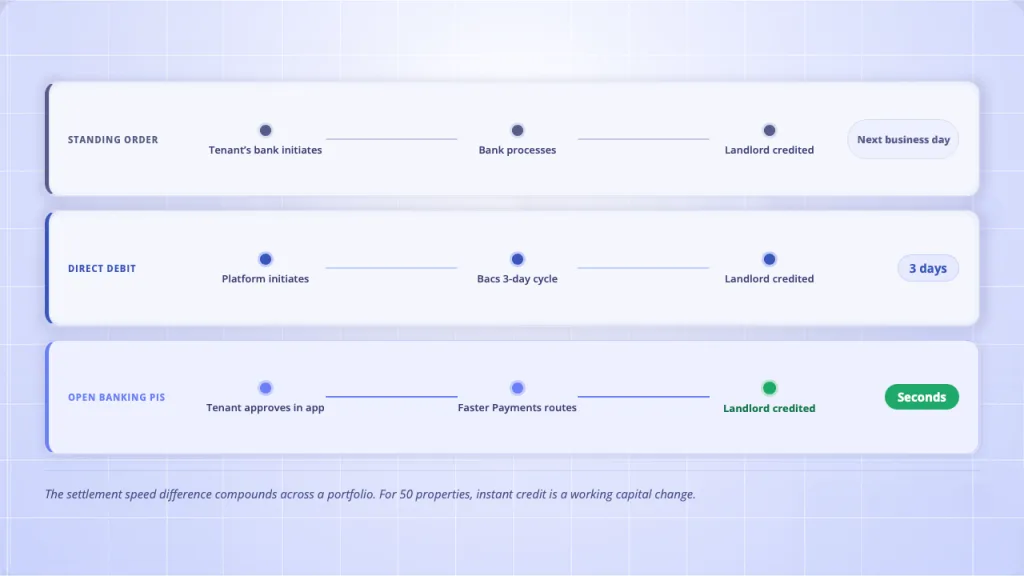
What Direct Debit does not solve: settlement is not instant. Bacs Direct Debit follows a three-day cycle. Funds collected on Monday arrive Wednesday. For most landlords, this matters less than the control gain.
What Is an Open Banking Rent Collection?
Open Banking PIS – Payment Initiation Service – is the newest rent collection method. It is regulated under PSD2 and authorised through the FCA. The landlord platform initiates the payment, the tenant approves it once in their banking app, and the funds settle instantly via Faster Payments.
Open Banking sits between the other two methods on the control axis, and ahead of both on settlement speed.
What it actually looks like on a landlord platform. The tenant sees a rent payment screen – inside Lendlord, Landlord Vision, Latch, or similar.
They tap “Pay rent.” Their banking app opens. They approve the payment.
Underneath this consumer-facing flow, the Pay by Bank mechanics are the same rail platforms used across e-commerce and B2B checkouts.
Funds arrive in the landlord’s account in seconds. The tenancy is already reconciled because the platform initiated the payment.
The cost varies by platform. Some landlord platforms pass on no transaction fee for Open Banking payments at all. Others charge a flat fee well below the Direct Debit rate. The exact pricing depends on the platform’s commercial agreement with their Open Banking provider.
Settlement is the bigger commercial point. Funds move over the UK Faster Payments scheme, which runs 24/7.
A tenant paying at 11pm on Sunday means funds clear that night, not Wednesday. For landlords running on tight cash flow margins – mortgage payment due on the 1st, rent expected on the 28th – this difference matters.
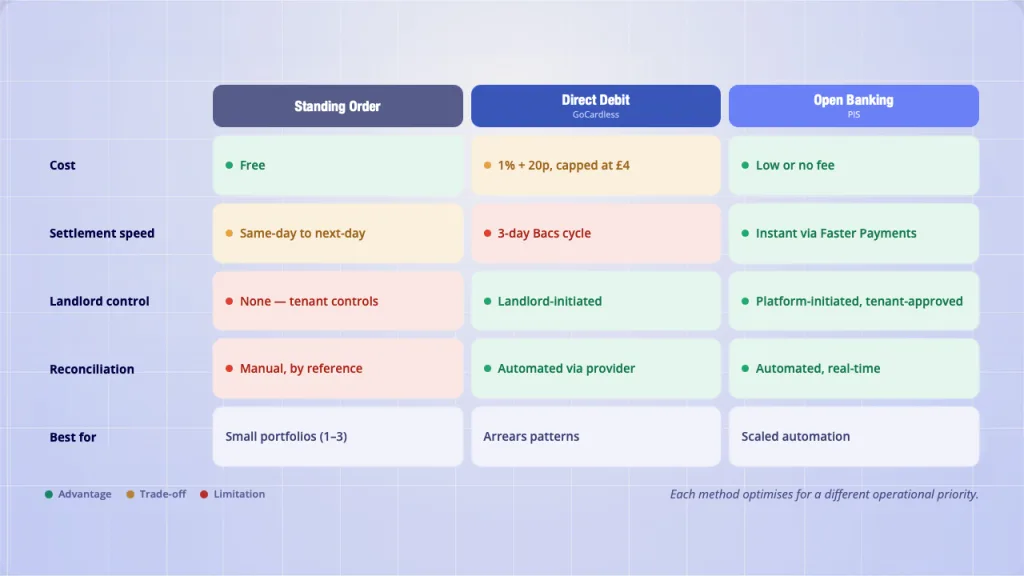
| Method | Cost per payment | Settlement speed | Landlord control | Reconciliation |
|---|---|---|---|---|
| Standing Order | Free | Same-day to next-day | None – tenant controls | Manual, by reference |
| Direct Debit (e.g. GoCardless) | 1% + 20p, capped at £4 | 3-day Bacs cycle | Landlord-initiated | Automated via provider |
| Open Banking PIS | Low or no fee (platform-dependent) | Instant via Faster Payments | Platform-initiated, tenant-approved | Automated, real-time |
Which Method Fits Which Landlord?
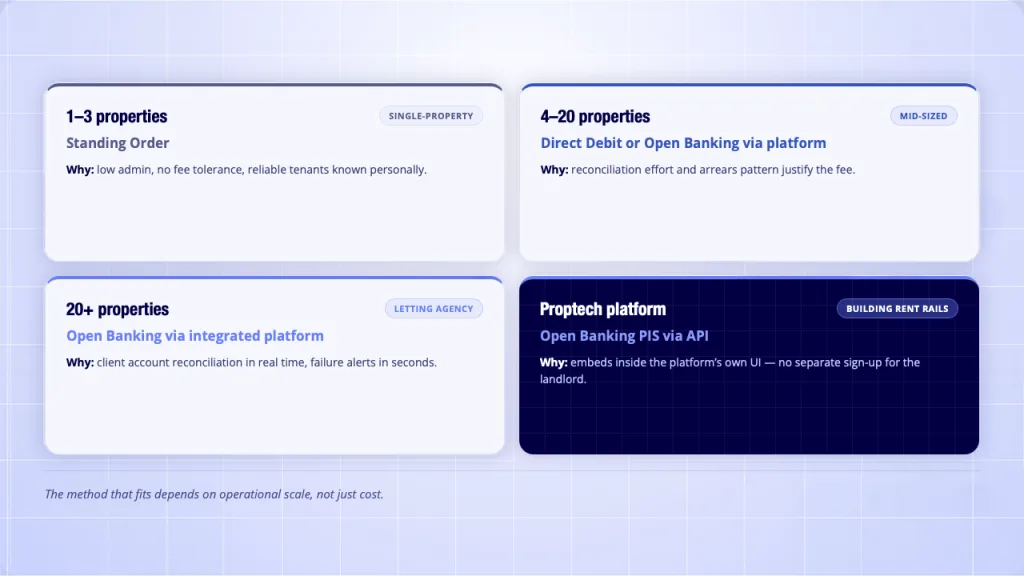
The right method for landlord rent collection depends less on cost and more on operational pattern.
Single-property landlords (1-3 properties). Standing Order remains the rational choice. The portfolio is small enough that manual reconciliation takes minutes. Transaction fees would add up to a meaningful percentage of total rental income. The landlord likely knows each tenant personally and has direct contact for any issue. There is no business case for the Direct Debit fee unless arrears are already a problem.
Mid-sized portfolios (4-20 properties). This is where the calculation shifts. Manual reconciliation starts costing real time, and one missed payment per quarter is no longer rare. Direct Debit or Open Banking through a platform like Lendlord or Landlord Vision starts paying for itself in time saved on chasing and reconciling. Landlords at this stage typically evaluate automated rent collection tools before picking a platform. The choice between the two often comes down to the platform’s commercial model rather than the underlying method.
Letting agencies and large portfolios (20+ properties). At this scale, manual reconciliation is no longer realistic. The decision is between Direct Debit through an established provider and Open Banking through a platform with PIS integrated. Open Banking advantages compound here – instant settlement means client account reconciliation happens in real time, and failure alerts come in seconds rather than days.
Proptech platforms building rent workflows. This is a different conversation entirely. A proptech platform serving landlords needs the rent collection rail embedded inside the platform, not as a separate provider. The wider context for Open Banking payments in proptech sits beyond rent collection alone.
Open Banking PIS, integrated via API, is the method that fits this pattern – without forcing the landlord through a separate sign-up flow.
The Renters’ Rights Act, which came into force on 1 May 2026, changes some context here. Ground 8 now requires three months of arrears instead of two before possession proceedings.
This makes early detection of missed payments more commercially relevant – the longer arrears go unnoticed, the longer the recovery process takes.
How Does Finexer Power Open Banking Rent Collection?
Finexer is not a landlord-facing app. It is an FCA-authorised Payment Initiation Service Provider (FRN 925695). It sits inside the platforms landlords actually use for rent collection.
Proptech platforms building rent workflows integrate Finexer’s PIS API to enable Open Banking rent collection inside their own product. The landlord never sees Finexer. The tenant never sees Finexer. The rent payment happens inside the platform’s branded experience, with Finexer handling the bank connection, the payment initiation, and the settlement confirmation.
What Finexer’s PIS does for these platforms:
- Initiates rent payments from the tenant’s bank account inside the platform’s UI – white-label, fully branded
- Routes settlement via Faster Payments – funds arrive in the landlord’s account within seconds
- Connects to virtually every UK bank – high street, challenger, and business accounts – through one API
- Provides real-time payment confirmation back to the platform for automated reconciliation against the correct tenancy
Finexer is PSD2-compliant, FCA-authorised AISP and PISP (FRN 925695). Usage-based pricing, commercial terms agreed based on use case. 3 to 5 weeks of hands-on onboarding support for platforms embedding the rent collection rail.
“The proptech platforms that win in 2026 will not be the ones with the prettiest dashboard. They will be the ones where the rent collection rail is invisible to the landlord and instant for the tenant. That is what Open Banking PIS makes possible.” – Ravi, Finexer
Other published guides sit in the proptech category hub, tracking how Open Banking is reshaping landlord and tenant workflows across UK property platforms.
What is the best way to collect rent as a UK landlord?
Standing Order suits 1-3 properties with reliable tenants. Direct Debit suits portfolios with recurring arrears. Open Banking via a landlord platform gives instant settlement and automated reconciliation.
Can a landlord keep overpaid rent in the UK?
No. Overpaid rent must be returned to the tenant or credited to future rent with the tenant’s agreement. Keeping overpayments without consent can constitute unjust enrichment under UK law.
How many months of unpaid rent before eviction in the UK?
Under the Renters’ Rights Act 2026, Ground 8 possession requires three months of arrears at the time of the court hearing. Ground 8A covers persistent arrears that may not reach three months but show a pattern.
Is Direct Debit better than Standing Order for landlord rent collection?
Direct Debit gives the landlord control and instant failure alerts but costs around 1% per transaction. Standing Order is free but tenant-controlled and offers no failure notification.
Is Open Banking better than Standing Order for landlord rent collection?
For instant settlement and automated reconciliation, yes. For landlords with a small portfolio and reliable tenants, the operational gain may not justify moving from a working Standing Order setup.
If you are building a rent collection product for UK landlords, Finexer’s PIS infrastructure powers Open Banking rent inside your platform.
About the Author

Ravi Ranjan
Ravi Ranjan is Co founder & CEO of Finexer