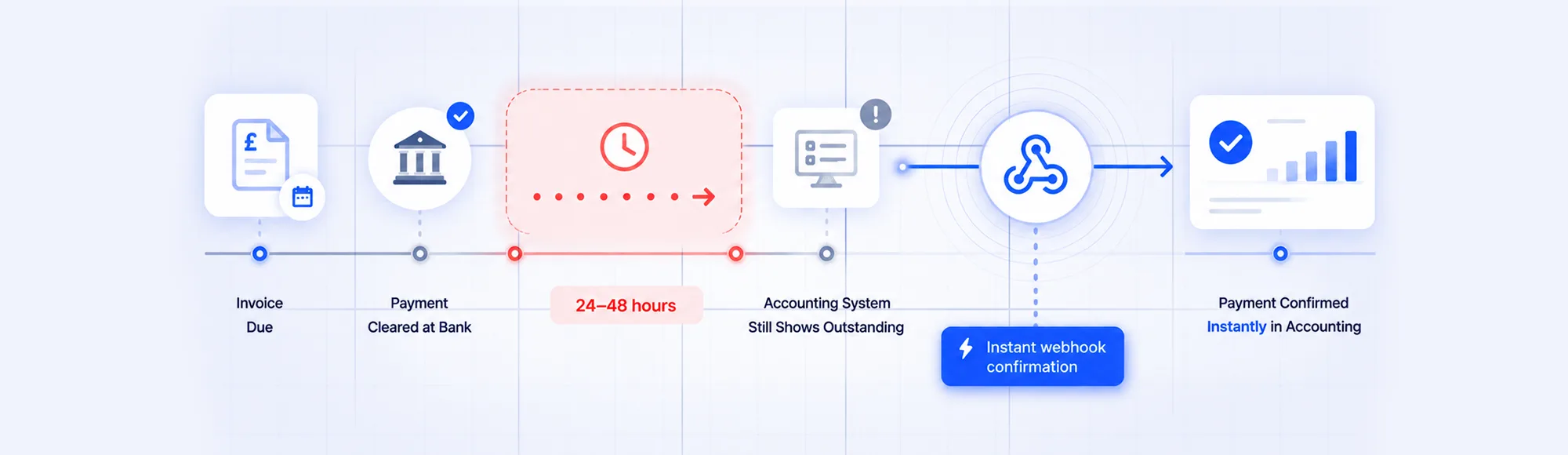
Real-time bank transaction data. Instant payment confirmation. Automated reconciliation.
Open Banking infrastructure for accounting SaaS, billing platforms, and ERP systems managing receivables.
Late payment of commercial debts is the UK’s most persistent business finance problem.
The law has existed since 1998. The Late Payment of Commercial Debts (Interest) Act gives every UK business the legal right to charge statutory interest on overdue invoices. Yet in Q1 2026, 1.57 million UK businesses were carrying overdue invoices on their books – a total of 17.48 million overdue invoices, up 3% year on year (R3/Creditsafe, April 2026).
Late payments cost UK businesses £7 billion a year and the broader economy £11 billion annually (GOV.UK, March 2026). 38 businesses close every single day because they are not paid on time.
Legal rights did not solve this. Enforcement did not solve this. The problem is not the law. The problem is the system – specifically, the lack of real-time accounting data that allows platforms, finance teams, and billing systems to see payment status at the moment it occurs, not days later.
TL;DR
Late payment of commercial debts in the UK is governed by the Late Payment of Commercial Debts (Interest) Act 1998. Businesses have statutory rights to charge interest and fixed compensation on overdue invoices – but legal enforcement is reactive. The UK Government announced major reforms on 24 March 2026, including a 60-day payment cap and mandatory interest clauses. Real-time accounting data addresses late payments before enforcement is needed – instant payment confirmation, live reconciliation, and real cash position visibility change collections at the workflow level.
Key Takeaways
What is the late payment of commercial debts law in the UK?
The Late Payment of Commercial Debts (Interest) Act 1998 gives UK businesses the automatic right to charge interest on overdue B2B invoices. The current rate is 8% above the Bank of England base rate – 12.5% at the current base rate of 4.5% (February 2026). Fixed debt recovery compensation is £40 for invoices under £1,000, £70 for £1,000-£9,999, and £100 for invoices of £10,000 or more.
What did the UK late payment reforms of 2026 change?
The UK Government announced major late payment reforms on 24 March 2026 – described as the toughest late payment crackdown in over 25 years (GOV.UK):
- Mandatory 60-day maximum payment cap (previously unlegislated – confirmed April 2026, implementation no earlier than 2027)
- Statutory interest at 12.5% made mandatory – clauses waiving interest will be void
- 30-day statutory deadline for raising invoice disputes
- Small Business Commissioner given binding adjudication powers and fines for persistent late payers
Why do late payments still happen despite the law?
Because legal rights are reactive. Interest accrues from the day after the due date – but only if the supplier knows the invoice is overdue, chases it, and applies the interest. Most B2B late payments are resolved before legal action is taken. The real operational problem is earlier: a supplier does not know in real time that a payment has cleared. They wait for bank statements. Reconciliation is manual. By the time the overdue invoice is identified, days have passed.
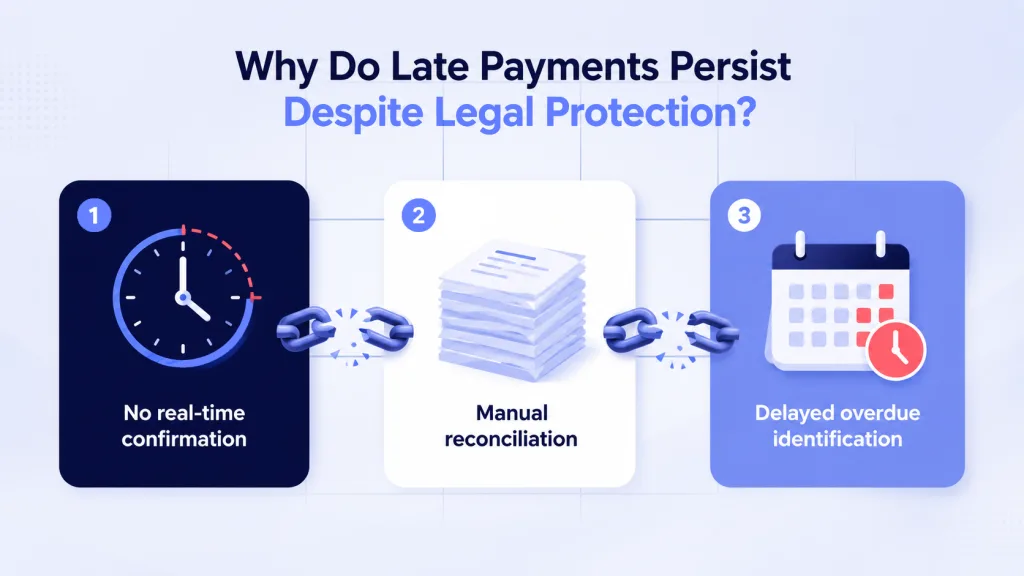
Why Do Late Payments Persist Despite Legal Protection?
What Causes Late Payment of Commercial Debts Operationally?
The law is clear. The commercial reality is different.
Late payment of commercial debts persists not because customers are unaware of their obligations – the payment terms and legal rights are standard in most B2B contracts. It persists because the payment workflow has structural gaps that create delay before any legal trigger is reached.
Gap 1 – No real-time payment confirmation: When a customer initiates a bank transfer, the supplier does not know the payment has been made until it appears on their bank statement – typically at end of day or the following business day. In the interim, the supplier’s accounts receivable system shows the invoice as outstanding. No automated alert. No confirmation. The payment may have cleared – but the platform does not know.
Gap 2 – Manual reconciliation: Bank statements arrive in batches. Finance teams match payments to invoices manually – checking amounts, references, and dates. Where payment references are incomplete or incorrect, matching fails. Unmatched transactions sit in a reconciliation queue. Invoices remain marked as outstanding even after payment has cleared.
Gap 3 – Delayed overdue identification: Because reconciliation depends on batch bank data, overdue invoices are often identified days after the due date has passed. By the time a chase email goes out, the customer has already moved on. Payment urgency fades. The longer an invoice sits overdue, the harder collection becomes.
“Late payment of commercial debts is not just a legal problem. It is a visibility problem. Finance teams cannot act on an overdue invoice they do not know is overdue – and they often do not know because their payment confirmation arrives one to two days after the customer has already paid.” – Ravi, Finexer
Accounting SaaS platforms adopting real-time accounting and continuous data replace this lag with per-payment confirmation at the moment of settlement.
What Does Real-Time Accounting Data Change?
How Does Real-Time Accounting Data Reduce Late Payment of Commercial Debts?
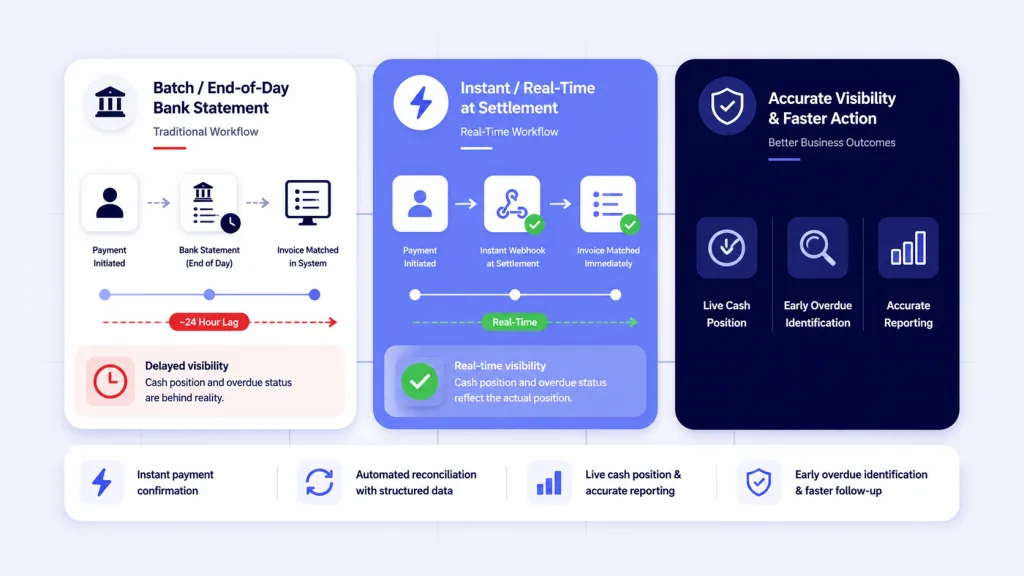
Real-time accounting data closes the visibility gap at the point of payment – not at the point of overdue escalation.
When bank transaction data arrives via webhook at the moment of settlement, the accounting system knows the invoice has been paid the instant it clears. No end-of-day batch. No manual reconciliation step. No overdue chase email sent to a customer who paid yesterday.
What real-time accounting data changes in the collections workflow:
Payment confirmation at settlement: Each incoming payment triggers a webhook to the accounting platform at the moment it clears. The platform marks the invoice paid. Accounts receivable reflects the actual position, not the position as of last night’s bank statement.
Automated reconciliation: Structured payment data with consistent merchant references allows automated matching – payment to invoice, automatically, at the moment of receipt. The manual reconciliation step is replaced by a structured data match.
Live cash position: Cash flow reports reflect confirmed cleared payments, not projected settlements. Finance teams see actual cash positions in real time – not a position that is 24-48 hours behind reality.
Early overdue identification: When payment confirmation is real-time, an invoice that has not been paid by its due date is immediately visible as overdue – not discovered two days later when the bank statement processes. Early identification means earlier, more effective chasing.
| Collections Step | Without Real-Time Data | With Real-Time Accounting Data |
|---|---|---|
| Payment confirmation | End-of-day batch – 24 hours after payment | Webhook at moment of settlement |
| Invoice reconciliation | Manual matching from bank statement | Automated matching at payment receipt |
| Overdue identification | 1-2 days after due date – via statement | Immediately on due date – via live data |
| Cash position | Projected – based on yesterday’s statement | Confirmed – based on cleared transactions |
| Collections trigger | Reactive – after delay identified manually | Automated – at due date, same day |
Replacing batch bank statements with per-payment webhooks is covered in detail in the real-time bank feeds for accounting guide, which explains how live bank feeds change accounts receivable accuracy.
How Does Finexer Support Real-Time Accounting Data for Collections?
What Does Finexer’s AIS Provide for Late Payment Visibility?
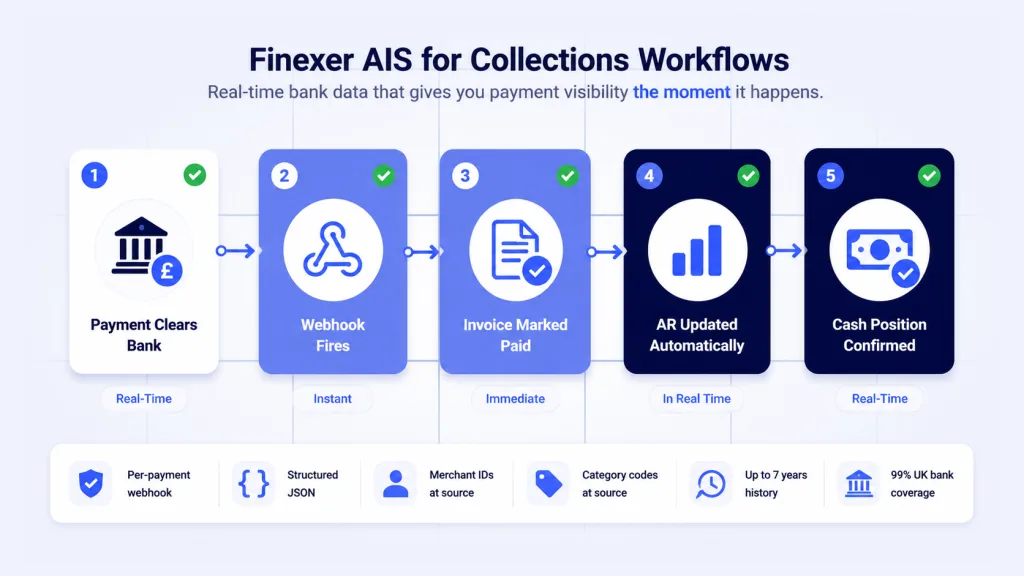
Finexer does not provide debt recovery, legal enforcement, or invoice chasing tools. Finexer provides real-time bank transaction data that enables accounting SaaS, billing platforms, and ERP systems to see payment status at the moment of settlement – not the day after.
AIS – real-time bank transaction data:
- Per-payment webhook – each incoming payment delivered to the accounting platform at the moment it clears. Invoice status updated immediately.
- Structured JSON – consistent transaction format with payment references, amounts, and counterparty data across almost all major UK banks
- Merchant IDs at source – consistent counterparty identification across payment channels, enabling automated invoice matching
- Category codes at source – payment classification applied before data reaches the platform
- Up to 7 years of transaction history – historical depth for trend analysis and overdue pattern identification
- 99% UK bank coverage – high street, challenger, and business accounts
- Usage-based pricing, no setup fees, 3-5 weeks to production
Real-time accounting data from Finexer’s AIS means late payment of commercial debts is identified the day it occurs – not the day after reconciliation runs.
For billing platforms managing recurring collections alongside invoice payments, Variable Recurring Payments offer a pre-authorised alternative to Direct Debit that supports flexible payment schedules without per-cycle manual action.
Legal and compliance platforms managing client payments can see how this applies to their workflows in the Finexer Open Banking impact on Lawtech guide.
What I Feel
The late payment of commercial debts problem has had legal solutions for 25 years.
The law works. Businesses can charge interest. Businesses can recover compensation. The Small Business Commissioner can now adjudicate disputes.
And yet the problem persists – not because the law is weak, but because the operational workflow does not surface overdue invoices until the enforcement window has already opened.
Legal rights are not enough when the operational workflow does not surface overdue invoices until the enforcement window has already opened. The fix is not more enforcement. It is better visibility – knowing payment status in real time so the collections process starts at the right moment.
“Real-time accounting data does not just improve reconciliation speed. It changes when the collections process starts – which is the only moment that actually matters for reducing late payment of commercial debts.” – Ravi, Finexer
Common Use Cases
Accounting SaaS Platforms
Real-time bank transaction data marks each invoice paid at the moment of settlement. AR reflects actual cleared payments – not projected positions. Overdue invoices are visible same-day.
Billing and Invoicing Platforms
Payment references embedded at initiation match automatically to invoice records. Late payment of commercial debts is identified before it becomes a collections problem – not after the next bank statement.
ERP Systems
Structured bank transaction data in consistent JSON format replaces end-of-day batch reconciliation. Cash position is accurate for period-end close without manual matching overhead.
Finance Teams Managing Receivables
Real-time accounting data removes the lag between a payment clearing and the system knowing it has cleared. AR teams chase overdue invoices at the right moment – same-day, not two days later.
What is the late payment of commercial debts interest rate in the UK?
The Late Payment of Commercial Debts Act 1998 gives UK businesses the right to charge statutory interest on overdue B2B invoices at 8% above the Bank of England base rate – currently 12.5% (at 4.5% base rate, February 2026). Fixed compensation of £40-£100 per invoice applies automatically – no prior agreement required to claim it.
How does real-time accounting data reduce late payments?
Real-time accounting data delivers payment confirmation at the moment a transaction clears – via webhook per payment rather than end-of-day batch. Overdue invoices are identified on the due date itself. Earlier identification allows earlier chasing, higher collection rates, and accurate cash flow visibility without manual bank statement reconciliation.
How can accounting SaaS and ERP platforms reduce late payment of commercial debts?
nting SaaS and ERP platforms reduce late payment of commercial debts by replacing end-of-day batch bank data with real-time transaction feeds. When each incoming payment triggers a webhook at settlement, accounts receivable reflects the actual cleared position immediately. Overdue invoices are visible same-day. Collections workflows trigger at the right moment – not after a 24-hour data lag.
Reduce late payment of commercial debts with real-time payment visibility – before enforcement becomes necessary.
About the Author

Ravi Ranjan
Ravi Ranjan is Co founder & CEO of Finexer