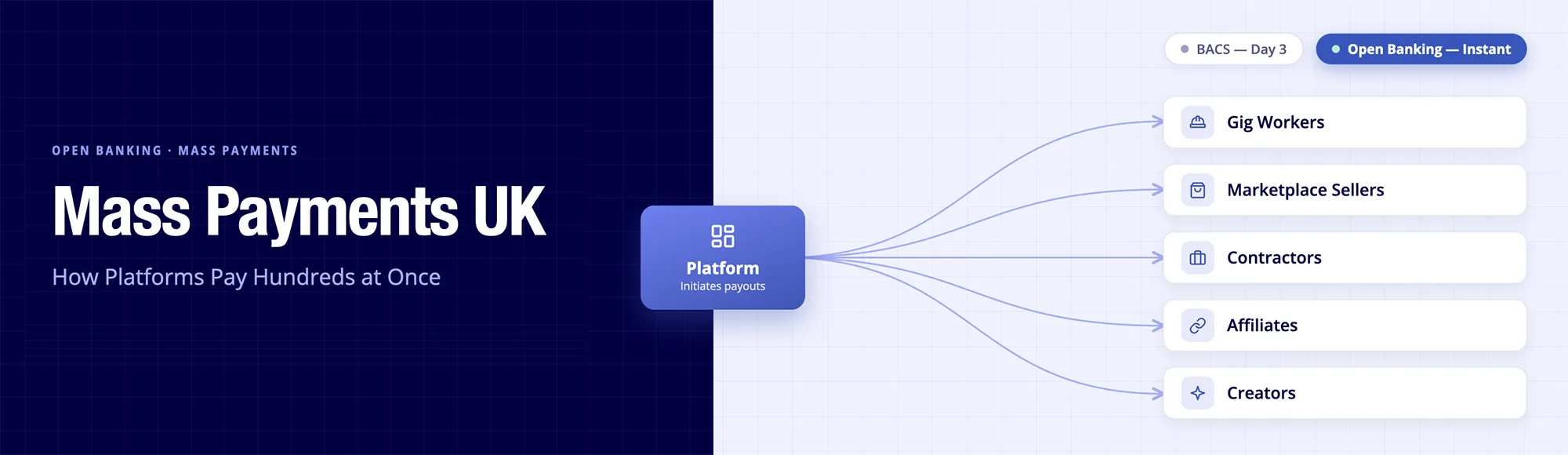
Platforms that pay dozens, hundreds, or thousands of recipients like affiliates, gigworkers, contractors, and marketplace sellers face one common operational challenge. Their traditional payment methods lack real-time visibility and limit transparency into individual payment statuses.
What happens in BACS is that you upload a file, wait 3 days, and only then do you find out whether the mass payments were successful. In this case, if an employee closes or changes his account, you don’t get to know about it instantly; rather, it’s your support team who conveys this information as the employee contacts them.
Hence, the BACS model is for predictable and scheduled payrolls, but eventually breaks when payment speed, per-recipient visibility, and error detection matter.
This guide explains how mass payment solutions work, why BACS breaks down at scale, and how Open Banking PIS provides a faster alternative.
What Are Mass Payments?
When a platform sends money to multiple external recipients in a single operation, the process is called mass payments. For example, a gig platform can pay its workers, a marketplace can pay its sellers, a payroll SaaS can pay its contractors, or even a creator platform can distribute monthly earnings. What stands out in this case is that the payout goes to external bank accounts, which you don’t control, and these are not accounts within your system.
What Is the Difference Between Mass, Batch, and Bulk Payments?
Often, these terms create confusion; hence, the differences would provide clarity.
- Mass payments – This is the money that is being transferred to many external recipients (workers, sellers, affiliates)
- Batch payments – This is the submission model with a single file containing many instructions submitted together
- Bulk payment API – This enables businesses to automate and execute multiple transactions. See our guide on bulk payouts explained for mass payment solutions and transaction patterns
For this guide, we focus on the mass payment solutions, the operational challenge of paying many people, many times, reliably.
Why BACS Fail Sometimes for Mass Payouts?
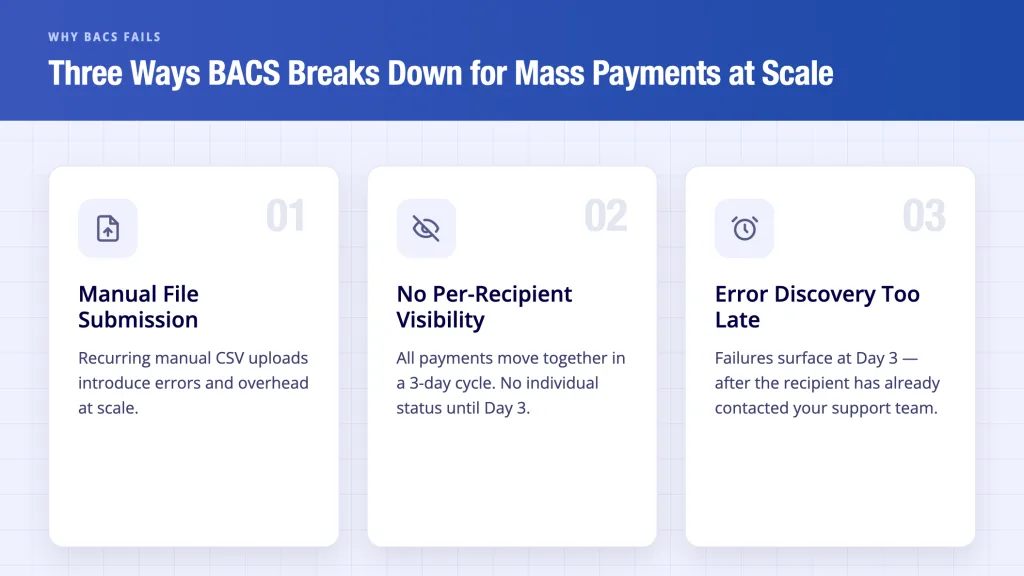
BACS is good when you have a fixed list on a schedule. But the moment you have to pay variable recipients with different timelines, here are the problems that you can face:
1. Manual file submission
Every payout needs a CSV file uploaded to your bank portal. Now, if you have platforms that process hundreds of payments weekly, then this recurrent operational task introduces manual errors.
2. No per-recipient visibility
With BACS, all your payments in a file move together in a 3-day cycle. So, whether a payment gets successful or fails, you can have this information only after that waiting period. But by then, your employee would already have informed you of not receiving payment on time.
3. Error discovery too late
As the error detection is not instant and in real-time, your finance or support team needs to manually spend hours sorting where the issue occurred and which payment failed. After this comes reprocessing the failed payments once again.
How Does Open Banking PIS Work for Mass Payment Solutions?
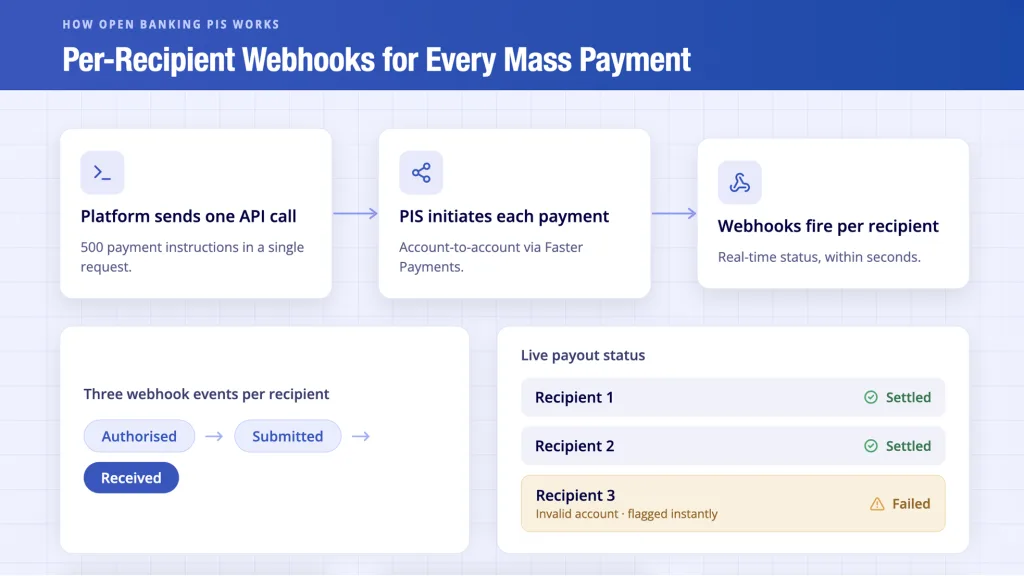
Open Banking Payment Initiation Service (PIS) changes the operational model distinctly in the case of mass payments. You submit payment instructions via API instead of uploading a CSV file. Each payment gets directly initiated from your bank account via Faster Payments. Within seconds (not days), you receive webhooks for every single update for every single recipient: authorised, submitted, received.
Real-Time Visibility Per Recipient
This is the core difference. With Open Banking, payment status tracking per transaction in mass payments becomes possible. You initiate 500 worker payouts at 5 pm Friday. By 5:05 pm, webhooks fire for each successful authorisation. By 5:30 pm, you know which of the 500 actually settled. In case three failed (invalid account or account closed), you have the information within minutes and can take action accordingly.
No waiting until Monday. No customer complaint is driving the discovery.
BACS vs Open Banking PIS for Mass Payouts
For quick insights, have a look at these differences:
| Aspect | BACS | Open Banking PIS |
|---|---|---|
| Submission Method | CSV file upload to bank portal | Single API call |
| Settlement Speed | 3 days (Day 1, 2, 3 cycle) | Instant via Faster Payments |
| Per-Recipient Status | Unknown until Day 3 | Real-time webhook per payment |
| Error Detection | Day 3 — after customer contacts you | Within minutes of initiation |
| Operational Overhead | High (manual file uploads and tracking) | Low (automated, API-driven) |
| Per-Payment Fees | BACS file fee plus per-transaction charges | Per-transaction PIS fee (no interchange) |
| Embedded in Platform UI | No — happens outside your app | Yes — webhooks trigger your platform workflows |
| Speed at Scale | Same 3-day cycle regardless of volume | Instant for any volume |
When Mass Payments Matter: Real Use Cases
Actual scenarios can help understand how each model works:
| Platform Type | Payment Scenario | BACS Limitation | Open Banking Advantage |
|---|---|---|---|
| Gig Platforms | Pay workers per shift or daily | Workers wait 3 days. No individual payment visibility until Day 3. | Same-day or next-morning payouts. Instant webhook confirmation per worker. |
| Marketplaces | Weekly seller payouts to 50–500+ sellers | Sellers wait until Day 3. No mid-cycle visibility. | Payouts settle the same evening. Webhook confirmation per seller. |
| Payroll SaaS | Contractor payments with variable recipient lists | 3-day cycles. No per-payment status. Manual reconciliation. | Same-day or next-day payouts. Per-payment webhooks for real-time tracking. |
| Affiliate Networks | Commission payouts to publishers monthly | 3-day delay. Reduced publisher trust and visibility. | Instant per-affiliate payment status. Improves trust and retention. |
| Creator Economy | Monthly earnings to thousands of creators | 3-day wait. Lack of transparency hurts creator satisfaction. | Real-time settlement confirmation per creator with exact payment timestamp. |
Choosing Between BACS and Open Banking for Mass Payouts
Both models remain valid depending on your scenario.
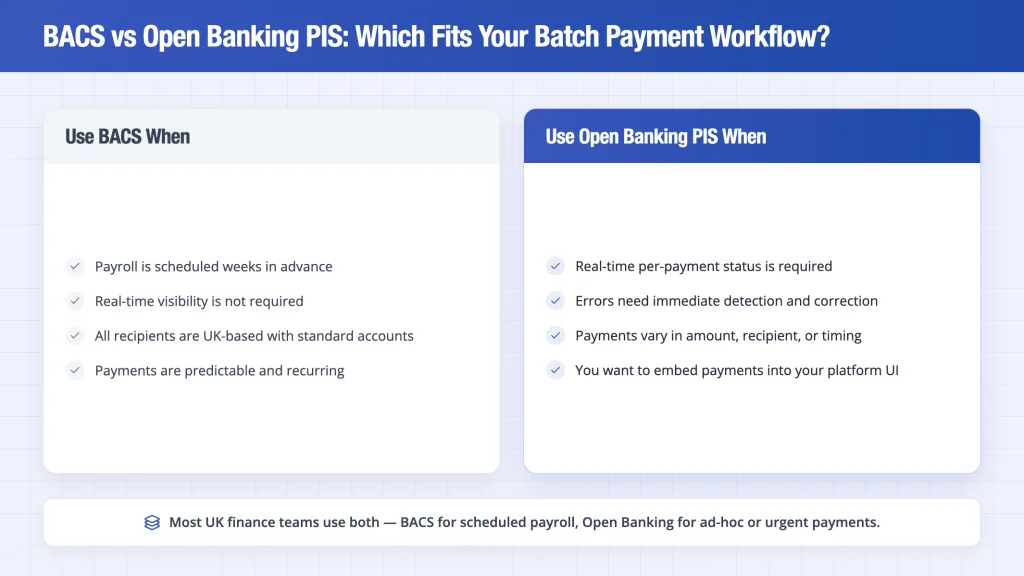
Use BACS when:
- Payouts are scheduled, recurring, and predictable
- All recipients are the same week-to-week
- Recipients are comfortable with 3-day settlement
- Volume is comparatively lower, like you are paying to some 50 employees
Use Open Banking when:
- Recipients expect fast, immediate confirmation
- Payout volume or recipient list changes weekly
- You need real-time error detection
- You want to embed payout visibility into your platform UI
- You operate at scale (hundreds or thousands of payouts per cycle)
How Open Banking Enables Real Mass Payments
If you’re already managing payouts to dozens of gig workers, marketplace sellers, or contractors weekly, you are aware of traditional silos of BACS delays and the cumulative manual labour that creates pressure on your finance or support team.
This is where Finexer can help. Instead of manual BACS uploads and 3-day waits, Finexer’s Open Banking PIS lets you initiate payouts via API and receive per-recipient webhooks as each payment settles instantly via Faster Payments. Your workers get paid immediately.
Your platform shows real-time settlement status. Your finance team has a complete, per-payment audit trail. Your mass payments process gets simpler, real-time, and operationally effective- all at once.
Finexer is FCA-authorised to handle mass payouts via Open Banking. You handle the user experience and payout logic. Finexer handles the regulated payment infrastructure.
For UK platforms paying workers, sellers, or creators at scale, this removes the complexity of manual BACS uploads and the waiting game of 3-day settlement cycles.
If you need to pay recipients outside the UK, see Finexer’s international mass payouts guide for cross-border options.
How fast do Open Banking payouts settle?
Instant via Faster Payments, which runs 24/7. Settlement happens within seconds. Webhooks confirm status immediately after.
Can I track each payment individually?
Yes. Open Banking delivers per-payment webhooks. You see the status of every transaction, not just the overall file.
What if one payment fails in a 500-person run?
You’re notified immediately via webhook. Your system can flag that recipient, log the error, and retry or escalate without affecting the other 499 successful payments.
Is Open Banking more expensive than BACS?
Open Banking charges per transaction, while BACS charges per file. For high-volume mass payments, per-transaction pricing is typically lower because there are no interchange fees (unlike card payments).
Transform your mass payment process with Open Banking.
Explore with AI
About the Author

Ravi Ranjan
Ravi Ranjan is Co founder & CEO of Finexer