Verify Faster, Evidence Better
Bank-based name verification and document data extraction.
The question is rarely whether a regulated firm needs to check a customer. The harder question is what evidence it needs, when it needs it and how it can establish that the information makes sense.
TL;DR: What are money laundering checks? Money laundering checks are customer due diligence measures used to identify customers, understand their circumstances and assess money laundering risk. Depending on the customer and situation, they can involve identity and address checks, beneficial ownership information, source of funds, source of wealth and ongoing monitoring.
The UK Money Laundering Regulations apply to sectors including financial services, legal professionals, accountants, estate agents and certain letting agents.
The level of checking should reflect risk. A lower-risk customer may require less scrutiny, while a higher-risk relationship can call for enhanced due diligence and additional evidence.
This article explains UK AML concepts and Finexer’s technology role. It is not legal advice and does not determine whether a firm’s own AML controls satisfy its regulatory obligations.
What do anti-money laundering checks actually involve?
Anti-money laundering checks are not one database search or one identity check. They form part of a wider customer due diligence process.
A regulated firm may need to establish:
- Who the customer is
- Where the customer lives
- Who owns or controls a business
- Why the customer wants the service
- Where relevant money came from
- Whether the customer’s activity remains consistent with the firm’s risk assessment
HMRC describes customer due diligence as the checks businesses carry out on customers and, where applicable, beneficial owners. The measures vary according to the risk presented by the customer, relationship, product or transaction.
That distinction matters. Money laundering checks are a process and not a single product feature.
What is the difference between CDD and EDD?
Customer due diligence (CDD) covers the checks used to establish and understand a customer.
Enhanced due diligence (EDD) applies in higher-risk situations. It can require additional information about the customer, beneficial owner, relationship, source of funds and source of wealth, together with closer aml screening and monitoring.
The firm’s risk assessment determines the level of scrutiny required. There is no universal checklist that applies identically to every customer.
Who needs to carry out money laundering checks in the UK?
Businesses covered by the Money Laundering Regulations must follow the requirements relevant to their sector and operate under the appropriate supervisory arrangements.
Common regulated sectors include:
| Sector | Typical AML Concern |
|---|---|
| Law firms | Client identity and client money |
| Estate agents | Buyer and seller due diligence |
| Accountants | Customer identity and financial activity |
| Financial services | Customer risk and ongoing monitoring |
| Letting agents | Customer due diligence for qualifying rental activity |
| Trust and company service providers | Ownership and control |
HMRC lists estate agency businesses, accountancy service providers, certain letting agencies, trust and company service providers, and other sectors, within its AML supervisory framework.
For lawtech platforms, this creates a technology question as well as a compliance question: how can firms collect reliable customer evidence without making staff chase documents for every case?
What evidence do anti-money laundering checks require?
The evidence depends on the customer’s risk profile and the nature of the relationship.
Typical evidence can include:
- Identity information
A passport, driving licence or other acceptable identity document. - Address information
Evidence such as a utility bill, bank statement or other accepted document. - Business ownership information
Details about beneficial owners and people exercising control where relevant. - Source of funds
Evidence showing where the money involved in a transaction came from. - Source of wealth
Evidence explaining how the customer’s overall wealth was accumulated. - Ongoing information
Updated information and transaction activity where ongoing monitoring applies.
The FCA defines source of wealth as how a customer acquired their total wealth, while source of funds concerns the origin of money involved in the business relationship or transaction.
For practical examples, see Finexer’s guide to source of wealth examples.
Why are anti-money laundering checks important when buying a house?
Property transactions can involve substantial sums, multiple parties and funds originating from different sources. That is why buyers can encounter AML checks before a transaction progresses.
Anti-money laundering checks when buying a house help the relevant professionals establish who the buyer is and, where required, understand the origin of the money being used.
A buyer may therefore be asked for:
- Passport or driving licence
- Proof of address
- Bank statements
- Evidence explaining the source of a deposit
- Documents relating to a gift
- Sale proceeds from another property
- Investment or inheritance evidence
- Other financial documentation where risk requires it
HMRC’s current estate agency guidance notes that property transactions create an ongoing relationship and may require verification of source of funds and wealth. It also highlights additional scrutiny where enhanced due diligence applies.
The exact documents requested vary by firm and circumstance. A buyer should therefore ask the conveyancer or estate agent what evidence is needed rather than assume one fixed document list applies.
From the estate agency perspective, Finexer’s guide to aml checks for estate agents covers the sector in more detail.
Why can property AML checks take so long?
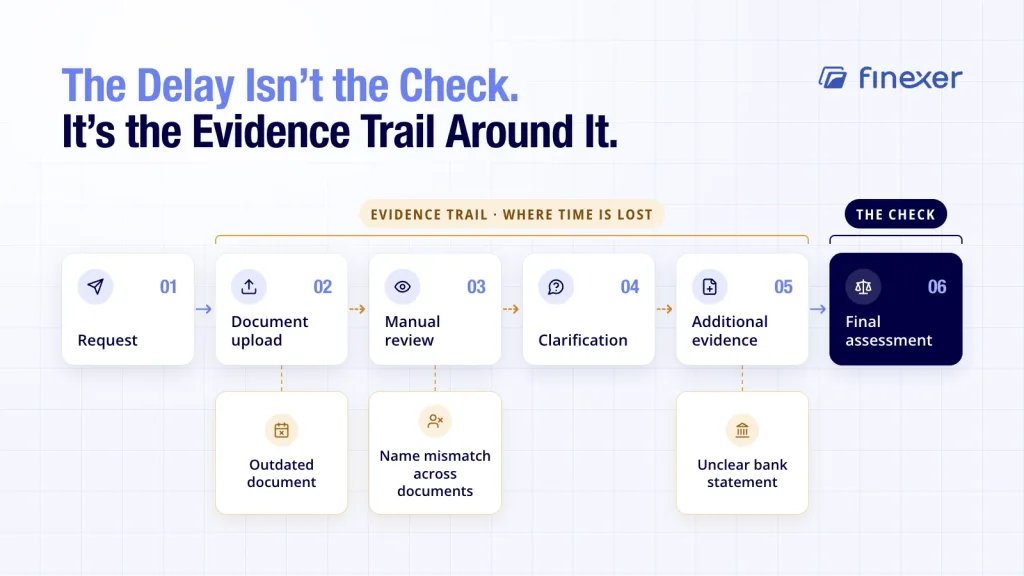
The delay is often not the check itself. It is the evidence trail around it.
A typical case can involve:
Request → document upload → manual review → clarification → additional evidence → final assessmentProblems arise when:
- A document is outdated
- A name differs between documents
- A bank statement does not clearly show the relevant funds
- A gifted deposit requires further explanation
- Several accounts are involved
- Staff must request missing documents by email
- Review queues build up
For regulated firms, the issue is therefore not merely collecting documents. It is getting enough relevant information for a reviewer to understand the customer’s circumstances.
How does a risk-based approach change the checks?
Risk-based AML does not mean every customer receives the same investigation.
A firm assesses factors such as:
- Customer type
- Geographic exposure
- Product or service
- Transaction characteristics
- Ownership structure
- Unusual or complex activity
- Other risk indicators relevant to the relationship
Higher-risk circumstances can lead to enhanced due diligence. HMRC guidance states that CDD measures should reflect the degree of risk and that higher-risk situations require additional measures.
This is why two customers using the same professional service can receive different evidence requests.
A useful way to think about it is:
Low risk does not mean no checks. Higher risk means more scrutiny.
Where does banking data fit into money laundering checks?
Banking data can provide another source of evidence alongside documents and other customer information.
With customer consent, Account Information Service (AIS) technology can provide read-only access to account, balance and transaction data. This can help a firm compare stated financial information with activity visible in the customer’s account.
For example, a customer may state that funds came from a property sale. Relevant banking data could help the firm see whether corresponding funds appear in the customer’s account, while the firm considers the other evidence required for its assessment.
Finexer’s Data product is described as consent-based access to account, balance and transaction data.
This is where bank account verification can sit within a broader evidence-gathering process.
Banking data does not replace the firm’s AML assessment. It provides another evidence source for the firm to consider.
What should firms look for in AML technology?
Technology selection should start with the firm’s actual workflow rather than a long feature list.
Consider:
| Requirement | Question to Ask |
|---|---|
| Identity | Can the system verify the relevant customer details? |
| Documents | Can staff extract useful information from submitted documents? |
| Banking data | Can the firm access consented account information where appropriate? |
| Evidence | Can results be retained for review? |
| Risk | Can staff apply their own risk-based procedures? |
| Integration | Can the technology fit the existing customer journey? |
The distinction between supporting checks and performing AML compliance is critical.
A technology provider can supply evidence and verification capabilities while the regulated firm remains responsible for its own assessment, procedures and decisions.
How does Finexer compare with other verification and Open Banking providers?
The market is not uniform. Providers tend to have different strengths across bank connectivity, payments, account data and identity-related services.
| Provider | Market Positioning | What to Consider |
|---|---|---|
| Finexer | UK-focused Open Banking and verification infrastructure | Bank-based name verification, document data extraction and banking data |
| TrueLayer | UK and European Open Banking | Strong presence in payments and account connectivity, plus verification capabilities |
| Plaid | Broad international financial-data connectivity | Strong data and identity-related capabilities, particularly where multi-market coverage matters |
| Yapily | API-first Open Banking infrastructure | UK and European connectivity, with AIS and PIS |
| Tink | European financial-data infrastructure | AIS, PIS and data-related capabilities across European markets |
| Salt Edge | Multi-market Open Banking connectivity | Useful for firms requiring broader geographic reach |
Independent provider comparisons commonly position TrueLayer around UK/European Open Banking and payments, Yapily around API infrastructure, Plaid around broader international connectivity and Tink around European data and payments.
The right comparison for AML-related workflows is narrower. A firm should ask which provider supplies the evidence it actually needs, which banks it must support, where the provider operates and how that evidence fits into its own compliance process.
Finexer currently focuses on UK banks, making UK bank connectivity a central part of its positioning.
How can Finexer support money laundering checks?
Finexer does not perform AML compliance for a regulated firm. Its Verification product provides specific evidence-gathering capabilities that can support checks performed by the firm.
These include:
- Bank-based name verification
- Facial recognition with a similarity score
- Document data extraction
- Verification reports
- Bank account holder identity verification
Finexer’s Data product can also provide consent-based account, balance and transaction data through AIS. This gives firms another data source when their procedures call for banking information.
Finexer is FCA-authorised as an Authorised Payment Institution, FRN 925695.
The distinction matters: Finexer supplies infrastructure and evidence capabilities; the regulated firm decides how those capabilities fit its AML controls.
Which industries can use this approach?
Law firms and legal technology
Conveyancing and legal platforms can use banking data and identity evidence as part of workflows involving client money and source-of-funds information.
The challenge is often moving from document collection to an evidence trail that staff can review within the case.
Proptech and estate agency
Property platforms and estate agencies deal with buyers, sellers, landlords and tenants at different stages of a transaction.
Banking data and identity verification can support evidence collection, while the firm’s own procedures determine which checks and additional evidence are appropriate.
Accounting and bookkeeping
Accountancy platforms can face customer due diligence requirements when serving regulated accounting businesses.
Access to customer-authorised banking data can also help accountants work with financial information without relying entirely on manually supplied statements.
What are the biggest mistakes firms make with AML checks?
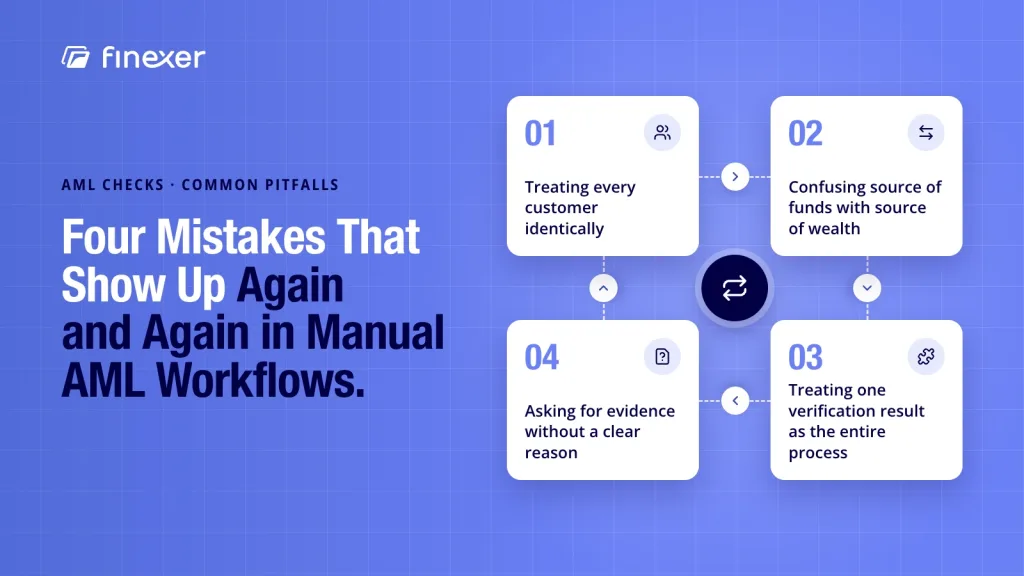
Four problems appear repeatedly in manual workflows:
1. Treating every customer identically
Risk-based requirements mean the level of checking can differ.
2. Confusing source of funds with source of wealth
They answer different questions: one concerns the money involved in a transaction; the other concerns how total wealth was accumulated.
3. Treating one verification result as the entire AML process
Identity verification is one part of customer due diligence, not the whole assessment.
4. Asking for evidence without a clear reason
Poorly defined evidence requests create unnecessary back-and-forth for customers and staff.
A well-designed workflow starts with the firm’s risk framework and then uses technology to collect and organise relevant evidence.
What should firms remember about anti-money laundering checks?
Money laundering checks are best understood as a risk-based evidence process and not a single automated test.
The core principles are:
- Identify the customer.
- Understand the relationship.
- Assess the relevant risk.
- Establish source of funds or wealth where required.
- Apply enhanced due diligence where the risk calls for it.
- Monitor ongoing relationships where required.
- Keep appropriate records.
- Use technology as evidence infrastructure, not as a substitute for the firm’s compliance judgement.
For property buyers, anti-money laundering checks when buying a house are part of the wider process used by regulated professionals to understand the customer and the money involved.
For firms, the goal is to build a workflow where relevant evidence reaches the right reviewer without unnecessary manual chasing.
Do all customers have to provide a source of wealth evidence?
No. Source of wealth evidence depends on the circumstances and the firm’s risk assessment. It can become particularly important during enhanced due diligence and is specifically required in certain higher-risk cases, such as relationships involving a politically exposed person.
Can AML checks be completed entirely online?
Many parts of the evidence-gathering process can take place digitally, including document collection and certain identity or banking-data checks. However, the regulated firm’s procedures determine what evidence it accepts and how it assesses the resulting information.
Why might a cash property buyer face additional questions?
A cash purchase can involve a substantial transfer without mortgage financing, so the firm may need to understand the origin of the funds in greater detail. HMRC’s estate agency guidance specifically highlights additional care with cash buyers.
How long should a customer keep AML documents?
The applicable record-retention period depends on the regulated firm’s obligations and sector-specific requirements. Customers should follow the instructions of the regulated professional handling their case rather than assume one universal retention period.
See how Finexer’s Verification product supports UK regulated firms with bank-based name verification, document data extraction and verification reports
Explore with AI
About the Author

Ravi Ranjan
Ravi Ranjan is Co founder & CEO of Finexer