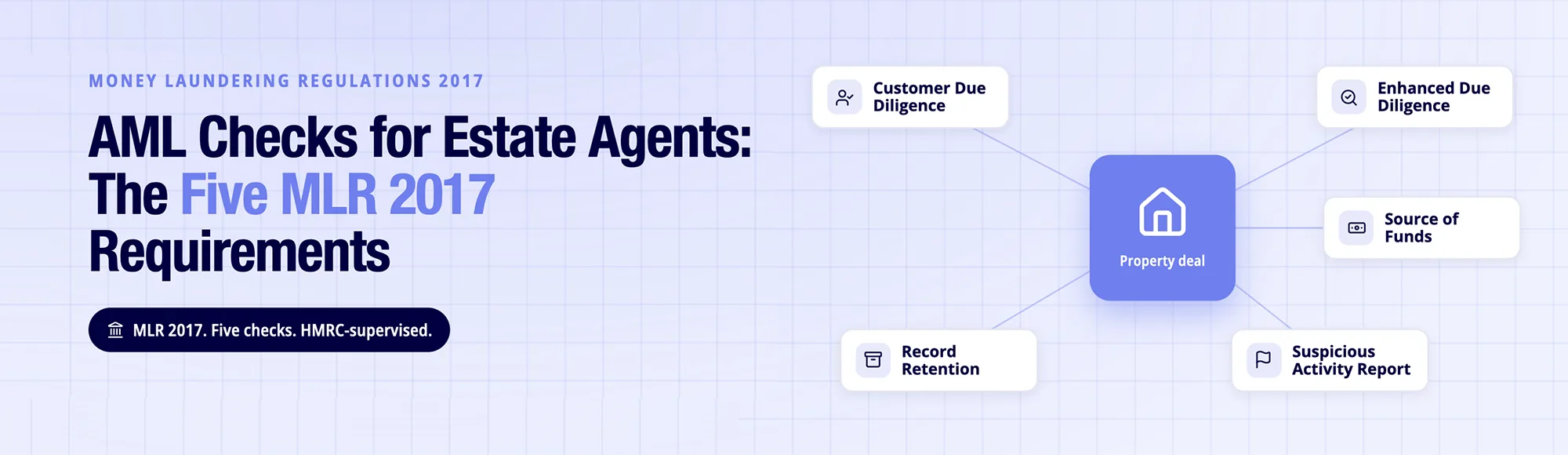
Brief: AML checks for estate agents are legal obligations under the Money Laundering Regulations 2017: customer due diligence on buyers and sellers, enhanced due diligence for higher-risk matters, source of funds checks, suspicious activity reporting, and 5-year record retention. HMRC supervises the sector, and its penalty rounds are growing, so the checks are operational requirements, not paperwork.
HMRC’s recent penalty lists reveal a common pattern. Most estate agents were not fined for uncovering complex money laundering schemes; they were fined for missing basic AML requirements like registration, risk assessments, and customer due diligence.
AML checks for estate agents exist because property is one of the easiest places to put criminal money: high values, third parties, and ownership structures that can hide a real buyer. This guide sets out exactly which MLR 2017 checks apply, when each is triggered, the red flags HMRC expects you to determine, and what the penalties look like when firms get it wrong.
If your agency handles sales or qualifying lets, this is the checklist your next inspection will run against.
What Are AML Checks for Estate Agents?
The direct answer to what are AML checks for estate agents: they are the verification and monitoring duties imposed by the Money Laundering, Terrorist Financing and Transfer of Funds Regulations 2017 (MLR 2017) on any business carrying out estate agency work in the UK.
Every firm in scope must register with HMRC for supervision before trading and appoint a nominated officer for suspicious activity reports. They also need to maintain a written firm-wide risk assessment, train staff, and run the checks below on the parties to each transaction.
The scope is wider than many firms assume. Estate agents involved in property sales must comply with AML regulations for every transaction. Letting agents are subject to these requirements only when the monthly rent is €10,000 or more. Both the buyer and the seller must be checked, not the buyer alone. AML checks for estate agents UK requirements also extend to identifying beneficial owners when a party is a company: the humans who ultimately own or control it, not just the entity name.
When AML Checks for Estate Agents Are Triggered?
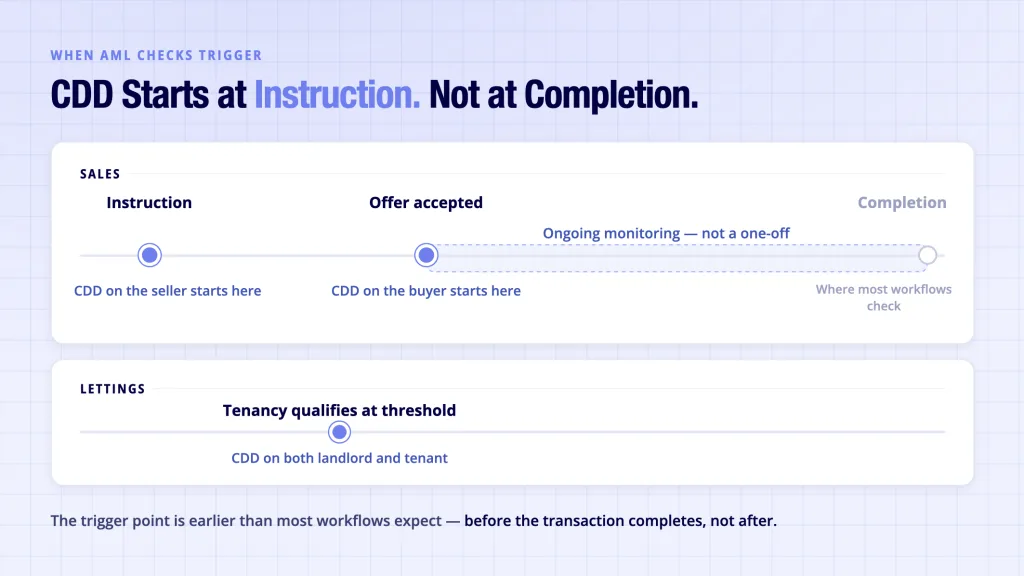
The trigger is the business relationship, and it lands earlier than most workflows expect:
- Sales: Due diligence on the seller at instruction, and on the buyer at the point their offer is accepted. Completion is far too late.
- Lettings at or above the threshold: Checks on both landlord and tenant once the tenancy qualifies. Letting workflows differ enough from sales that we cover the data side separately, in letting agents using Open Banking.
- Ongoing monitoring: Due diligence is not a one-off. Firms must keep information current and reassess when something about the transaction changes.
The Exact AML Checks for Estate Agents Under MLR 2017
Here are the exact AML checks for estate agents presented in a table:
| Check | When It Is Required | What It Involves |
|---|---|---|
| Customer due diligence (CDD) | Every in-scope transaction, both parties | Verify identity against reliable, independent data: name, address, date of birth, beneficial ownership |
| Enhanced due diligence (EDD) | Higher-risk matters | Deeper scrutiny with documented reasoning: politically exposed persons, high-risk third countries |
| Source of funds | Where risk indicates, and routinely for unusual funding patterns | Evidence of where the purchase money actually comes from: salary, sale proceeds, inheritance, gift |
| Suspicious activity reporting | Whenever suspicion arises | The nominated officer files a SAR with the National Crime Agency; the transaction must not be tipped off |
| Record retention | Always | CDD records and supporting evidence kept for 5 years after the relationship ends |
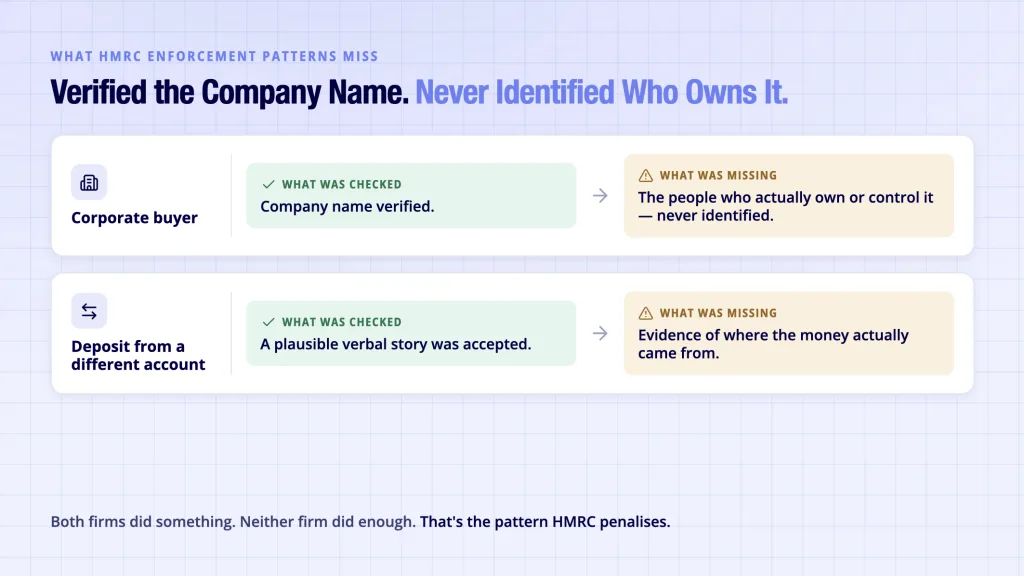
Two patterns from HMRC’s enforcement rounds show how these fail in practice-
- A firm takes on a corporate buyer and verifies the company name but never identifies the people behind it: a CDD failure, even though documents were collected.
- A buyer’s deposit arrives from an account in a different name with a plausible verbal story and no evidence: a source of funds failure that a single bank statement request would have caught.
Red Flags HMRC Expects Agents to Determine
The most cited red flag in property is the purchase with no mortgage. It is not that cash buyers are suspect by default; it is that removing the lender removes the one regulated institution that would otherwise run its own AML checks on the funds, leaving the agent as the only checkpoint. HMRC’s risk guidance treats mortgage-free and cash-heavy purchases as elevated risk for exactly this reason, alongside:
- Funds arriving from unrelated third parties or accounts in other names
- Buyers are indifferent to price, condition, or survey findings
- Complex ownership structures with no identifiable beneficiary
- Pressure for unusual speed with no credible explanation
- Prices significantly above or below market value without a reason
Since 28 January 2026, firms should also screen parties against the Office of Financial Sanctions Implementation’s consolidated Single UK Sanctions List: a separate legal duty from AML checks, with its own penalties.
For the tooling side of screening and monitoring at platform scale, see our AML screening infrastructureguide; this page stays on the regulatory requirements themselves.
Supervision, Penalties and the 2026 Changes
AML checks for estate agents are supervised by HMRC, and that is not changing: while the government confirmed in October 2025 that theFCA will become the single AML supervisor for professional services such as legal and accountancy firms by 2026, estate and letting agents remain under HMRC. What agents should expect instead is intensity.
In its latest published rounds,HMRC issued over 170 penalties to estate agency businesses totalling more than £835,000 in six months to September 2025, with most fines for registration and control failures rather than missed laundering. Beyond civil penalties, breaches can bring criminal prosecution under the Proceeds of Crime Act 2002.
Amendment regulations laid before Parliament in March 2026 will refine MLR 2017 further from mid-2026, so policies written years ago need a review date. For AML checks for estate agents UK-wide, the direction is straightforward: more supervision, better records expected, and less tolerance for tick-box compliance.
Where Bank Data Fits, Where Finexer Comes In?
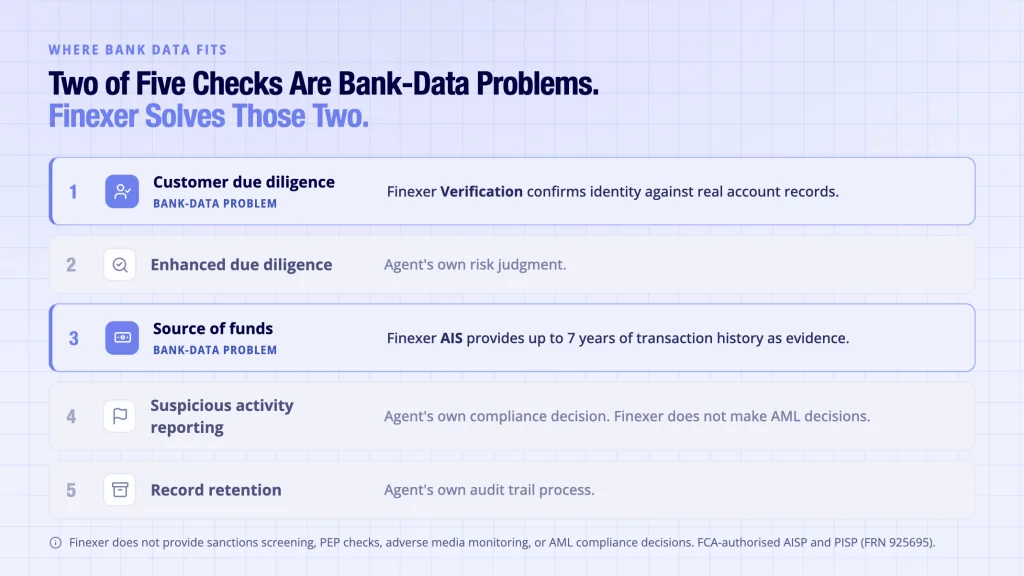
Two of the checks above are, at their core, bank-data problems: proving an account belongs to the person claiming it, and evidencing where funds actually came from. This is the layer Open Banking for Proptech platforms increasingly built in, and it is where Finexer sits.
Through Finexer’s Verification product, platforms serving agents can run bank-based name verification against real bank records, with facial matching and document data extraction for identity, while AIS provides up to 7 years of transaction history, with consent, as a source of funds evidence rather than a verbal story.
What does Finexer explicitly not do?
It does not provide sanctions screening, PEP checks, adverse media monitoring, or AML compliance decisions. Those need dedicated screening tools and your own judgement. Finexer is the regulated bank-data layer inside an AML workflow, described in full in the Proptech & Real Estate use case, and specifically:
- Bank-based name verification against real account records
- Up to 7 years of transaction history via AIS for source of funds evidence
- Verification reports for the audit trail HMRC inspections expect
- FCA-authorised (FRN925695) as both AISP and PISP
- 99% UK bank coverage
- Usage-based pricing, white-label deployment
Conclusion
The checks themselves are not complicated: verify who you are dealing with, evidence where the money comes from, escalate what looks wrong, and keep the records to prove all of it. What HMRC’s penalty rounds show is that firms fail on execution, not understanding. Treat AML checks for estate agents as a workflow with data behind it rather than a folder of PDFs, and the next inspection becomes a formality instead of a risk.
Do estate agents need AML checks in the UK?
Yes. AML checks for estate agents UK obligations apply to all estate agency businesses under MLR 2017, and to letting agents for tenancies at or above 10,000 euros in monthly rent. Firms must register with HMRC before trading, and both buyers and sellers must be checked.
What AML checks for estate agents are required to include?
At minimum: customer due diligence on all parties, enhanced due diligence where risk is higher, source of funds evidence where warranted, suspicious activity reporting through a nominated officer, and records kept for 5 years. A written firm-wide risk assessment and staff training sit underneath all of them.
What are the penalties for non-compliance?
HMRC issues civil penalties calibrated to the breach, over £835,000 across 170+ estate agency fines in a recent six-month round, and can prosecute criminally under the Proceeds of Crime Act 2002, where sentences can reach imprisonment. Senior managers and nominated officers can be personally liable. For AML checks for estate agents UK enforcement, registration failures remain the most common trigger.
If your agency or the platform serving it wants the bank-data layer of that workflow handled, verified identity, and an evidenced source of funds through one integration, Finexer’s team can walk you through how it works.
Explore with AI
About the Author

Paul Lucraft
Paul Lucraft is a payments industry strategist and advisor with more than two decades of experience across banking, card networks, and financial services infrastructure. His expertise covers fraud prevention, payment risk management, financial strategy, and the operational development of card payment systems. He previously held senior roles at Mastercard Europe where he served as General Manager for the UK and Ireland, overseeing fraud risk, operational governance, and payment network strategy across the region. Earlier in his career, Paul worked at Lloyds TSB and TSB Bank leading fraud strategy, credit collections, and card business finance operations.