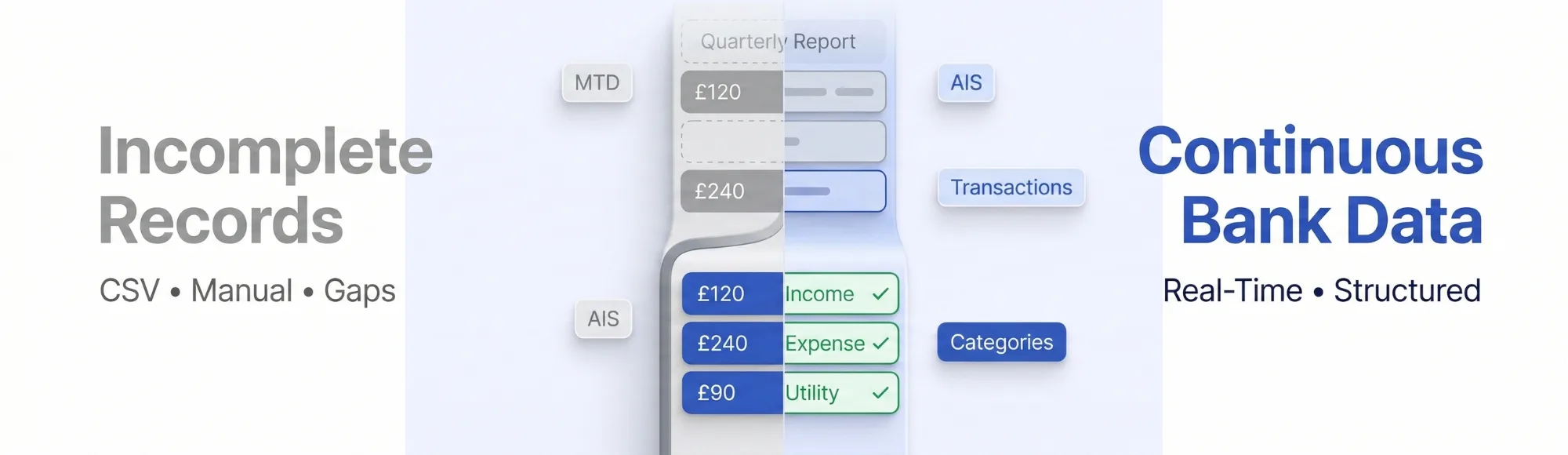
MTD data gaps surface at submission time.
Bank-verified transaction records for reliable MTD reporting workflows.
MTD reporting requirements are not complex. HMRC has defined them clearly.
Keep digital records of all income and expenses. Submit quarterly updates. File a final annual declaration. Use software that is digitally linked throughout.
The problem is not understanding the requirements. The problem is that the financial data feeding those submissions is incomplete, inconsistent, or manually maintained – and that breaks MTD reporting before the submission even happens.
In my work with accounting SaaS and tax platforms at Finexer, I see this pattern consistently. The platform is MTD-compatible. The submission mechanism works. But the underlying transaction data is not continuous enough to meet what HMRC actually requires.
TL;DR
MTD reporting requirements from April 2026 mandate quarterly income and expense updates plus an annual final declaration for self-employed individuals and landlords with combined income over £50,000. The technical requirement is digital records with category, date, and amount per transaction – maintained continuously, not reconstructed at quarter-end. Platforms that rely on periodic imports or manual data entry cannot consistently meet this standard. Finexer’s FCA-authorised AIS delivers continuous bank-verified transaction records that support reliable MTD reporting without manual data reconstruction.
Key Takeaways
What are the MTD reporting requirements from April 2026?
From April 2026, self-employed individuals and landlords with combined income over £50,000 must keep digital records of all income and expenses, submit quarterly updates to HMRC, and file an annual final declaration. Digital links are required between any software tools used in the reporting chain.
Why do platforms struggle to meet MTD reporting consistently?
MTD reporting requirements depend on continuous, accurate financial records. Platforms that collect data periodically – via CSV imports, manual entry, or document uploads – create gaps in the digital record that surface as errors or missing transactions when quarterly submissions are prepared.
What does “digital records” actually mean under MTD?
Digital records under MTD require each transaction to carry a date, amount, and category maintained in MTD-compatible software. The record must be updated continuously – not reconstructed from memory or documents at quarter-end. HMRC requires the digital record to reflect actual financial activity throughout the period.
How does continuous bank data improve MTD reporting reliability?
FCA-authorised AIS retrieves transaction data from the client’s bank as transactions occur – delivering date, amount, and merchant category per transaction in real time. The digital record is continuously updated from source, not assembled from periodic imports at submission time.
What Do MTD Reporting Requirements Actually Require?
What Are the Core MTD Obligations for Accounting Platforms?
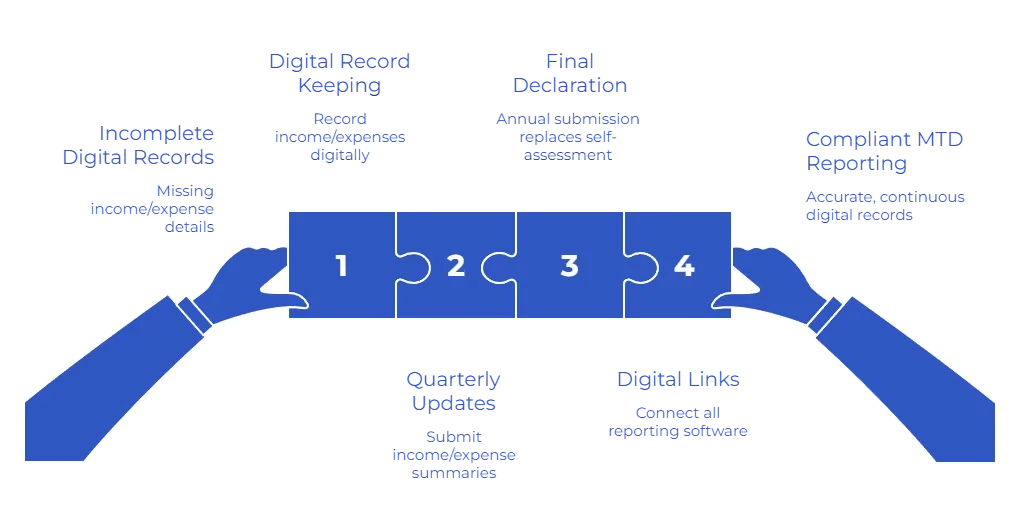
MTD reporting requirements under Making Tax Digital for Income Tax apply from April 2026 to self-employed individuals and landlords with combined income over £50,000.
The core obligations are:
- Digital records – all business income and expenses recorded digitally with date, amount, and category
- Quarterly updates – summaries of income and expenses submitted to HMRC four times per year
- Final declaration – an annual submission replacing the traditional self-assessment return
- Digital links – any software tools used in the reporting chain must be digitally connected
According to HMRC’s guidance on MTD for Income Tax eligibility, the first quarterly submission for the 2026/27 tax year is due approximately 7 August 2026. The £50,000 threshold is expected to reduce in subsequent years.
MTD quarterly reporting and digital records for accounting platforms covers the specific digital record requirements and how accounting platforms structure quarterly updates to meet HMRC standards.
“What accounting platforms often miss is that MTD reporting requirements are not just about the submission format. They are about the quality and continuity of the underlying records. A correct submission built on incomplete data does not meet the standard.” – Clare, Finexer
What Is the Business Impact When MTD Reporting Falls Short?
How Does Poor Data Quality Create Compliance Exposure for Platforms?
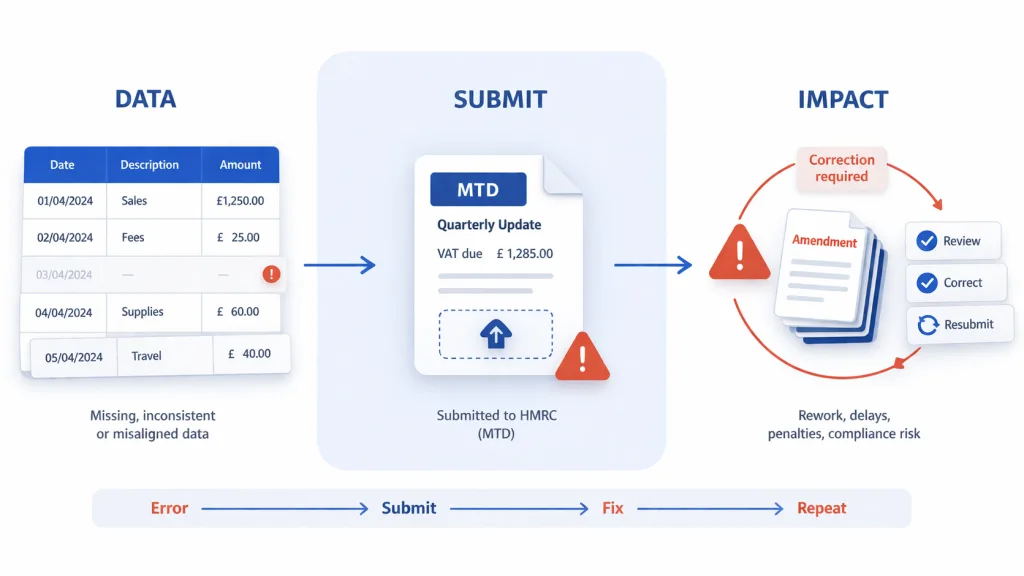
When MTD reporting fails at the data layer, the impact falls on the platform’s clients – and reflects on the platform.
An incomplete quarterly update submitted to HMRC creates a discrepancy between the client’s self-assessment record and HMRC’s data. Corrections require amended submissions. Repeated inaccuracies attract HMRC scrutiny.
For accounting SaaS platforms managing large client portfolios, data quality problems that produce MTD errors at scale create both client relationship risk and operational overhead. Each manual correction at quarter-end compounds with every client and every quarter.
Why Do Platforms Fail to Meet MTD Reporting Requirements Consistently?
Why Does Data Quality Break MTD Reporting Before Submission?

MTD reporting failures rarely happen at the submission layer. The submission mechanism works. The data feeding it does not.
Three data problems create consistent MTD reporting failures:
Periodic import gaps – CSV exports and monthly bank statement imports leave transaction gaps between import windows. Transactions that arrived mid-period are missing from the digital record until the next import. Quarterly submissions built on this data are incomplete.
Manual entry errors – manual transaction entry introduces categorisation errors, duplicate entries, and missed transactions. Each error in the digital record produces an error in the quarterly update.
Document-based reconstruction – platforms that collect bank statements at quarter-end and reconstruct the record are not maintaining continuous digital records. They are creating a retrospective approximation. This does not meet the MTD digital records standard.
MTD record keeping requirements and digital record standards covers what HMRC considers a compliant digital record and where platforms most commonly fall short.
| MTD Data Problem | How It Happens | MTD Reporting Impact | Bank Data Fix |
|---|---|---|---|
| Import timing gaps | CSV exports miss transactions between import windows | Incomplete quarterly update – missing income or expenses | Real-time AIS webhooks deliver each transaction as it occurs |
| Manual categorisation errors | Human entry assigns wrong expense category | Wrong category in quarterly update, incorrect tax calculation | Merchant IDs and category codes applied at transaction level |
| Quarter-end reconstruction | Bank statements collected and processed retrospectively | Retrospective record does not meet continuous digital record standard | Continuous AIS feed maintains record throughout the period |
| Duplicate entries | Manual entry alongside automated import | Inflated income or expenses in quarterly submission | AIS as single data source eliminates parallel entry channel |
How Does Finexer Support Reliable MTD Reporting Workflows?
What Does Finexer’s AIS Provide for MTD Compliance?
MTD reporting requirements depend on continuous, accurate digital records. Finexer’s FCA-authorised AIS solves the data quality problem by retrieving bank transaction data directly from the client’s bank as transactions occur – providing the continuous digital record that MTD requires.
- Real-time transaction feeds via webhook – each transaction delivered as it occurs, no import gaps
- Merchant IDs and category codes per transaction – correct expense categorisation from source
- Up to 7 years of transaction history – complete historical records for HMRC review
- Consent logs and access timestamps per retrieval – audit trail supporting HMRC compliance
- Structured JSON output – consistent schema compatible with MTD software integrations
- Covers almost all major UK banks – high street, challenger, and business banking providers
- White-label consent flows, usage-based pricing, 3-5 weeks onboarding support
Making Tax Digital for Income Tax – what platforms need to prepare covers the full MTD for ITSA timeline, thresholds, and platform preparation requirements.
“MTD reporting requirements are not going to get easier as the income threshold reduces. Platforms that solve the continuous data problem now – with bank-verified transaction records rather than periodic imports – will handle the expanding compliance population without increasing manual overhead.” – Clare, Finexer
Making Tax Digital software requirements and compatibility covers which software capabilities HMRC requires for MTD compliance and how AIS data feeds support them.
What I Feel
Every MTD conversation I have with accounting platforms starts the same way.
The platform is MTD-ready. The submission is tested. The software is on the compatible list.
Then I ask about the data. How is it collected? How often? Is it continuous or periodic?
That is where the gap usually is. MTD reporting requirements are a data continuity standard dressed as a submission standard. Platforms that treat it as the latter miss the former.
Common Use Cases
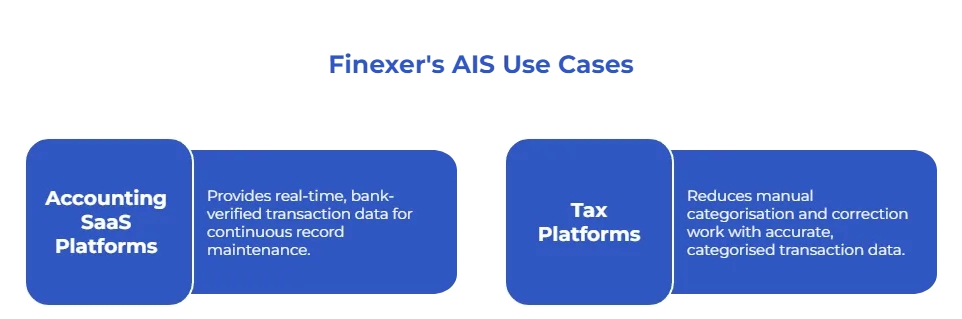
Accounting SaaS Platforms
Client digital records built on periodic CSV imports are not continuously maintained. Finexer’s AIS delivers real-time transaction data per client account – giving accounting platforms a continuous bank-verified record that meets MTD’s digital record standard throughout the quarter, not just at submission time.
Tax Platforms
Tax platforms preparing quarterly MTD updates for clients need accurate, categorised transaction data across the full period. Finexer’s AIS with merchant IDs and category codes per transaction reduces the manual categorisation and correction work that delays MTD submission preparation.
What are the MTD reporting requirements for self-employed individuals?
Self-employed individuals and landlords with combined income over £50,000 must keep continuous digital records, submit four quarterly income and expense updates to HMRC per year, and file an annual final declaration. Digital links between any software tools used in the reporting chain are required.
Why does MTD reporting fail even when software is compatible?
MTD-compatible software handles submission format correctly. Failures occur in the underlying data – periodic imports leave gaps, manual entries introduce errors, and quarter-end reconstruction does not meet the continuous digital record standard HMRC requires. Compliance depends on data quality, not just software compatibility.
How does continuous bank transaction data improve MTD reporting?
FCA-authorised AIS delivers transaction data from the bank as each transaction occurs – providing date, amount, and category continuously throughout the period. This gives platforms a bank-verified digital record that meets MTD’s continuous record-keeping standard without manual data collection or periodic import gaps.
Build MTD-compliant digital records on continuous bank transaction data.
About the Author

Clare Pearson
Clare Pearson is a senior payments professional with extensive experience across the global financial services and payments industry. She specialises in Open Banking, payment infrastructure, and financial technology transformation, with expertise spanning product delivery, operational strategy, regulatory compliance, and large-scale payments programmes. Clare currently serves as a Non-Executive Director at Finexer and a panel member for the Payment Systems Regulator (PSR), advising on the development of payment systems policy and innovation