
Most Open Banking guides explain the concepts. Developers evaluating providers need something different: the request format, response objects, authentication flow, and the production behaviours documentation rarely shows. As of 2026,
UK Open Banking processes more than 2.5 billion API calls each month, making API reliability and consistency just as important as the endpoints themselves.
Most guides stop at theory. This guide walks through each of those with practical Open Banking API examples. See open banking api use cases for what you can build with these APIs; this guide covers what the calls look like.
Key Takeaways
- Open banking API examples follow standard HTTP patterns: POST creates requests, GET retrieves data, webhooks confirm operations that complete asynchronously.
- Account data returns transaction objects with merchant name, amount, date and category, but field naming and timestamp formats vary between providers despite shared open banking API specification compliance.
- Payment initiation is a three-step workflow (create request, redirect to bank, receive webhook), not a single API call, which surprises teams reading documentation for the first time.
- Account verification returns a simple match or mismatch result against the bank’s name record, and remains underused despite the fraud reduction it offers.
- Open banking api integration success depends less on API feature count than on token lifetime handling, consent expiry re-authorisation, webhook retry logic and sandbox-to-production parity.
How Do Open Banking API Examples Differ from Open Banking API Documentation?
Every open banking API specification in the UK requires authentication via access tokens, user consent via OAuth, and rate limiting, since these are PSD2-mandated requirements enforced by the FCA. But similarity ends there.
Timestamp format varies (ISO 8601 versus Unix), field names diverge across API endpoints, and error codes differ per bank. Two providers can both claim full open banking API specification compliance while returning entirely different response shapes for identical transaction data.
This variance is why evaluating open banking API examples from your specific provider matters more than reading the open banking API spec alone. Stripe open banking API documentation and TrueLayer open banking API documentation clearly explain API endpoints and required parameters.
What they often don’t show is how transaction data actually arrives from a live UK bank connection.
How Do Developers Request Account Data through an Open Banking API?
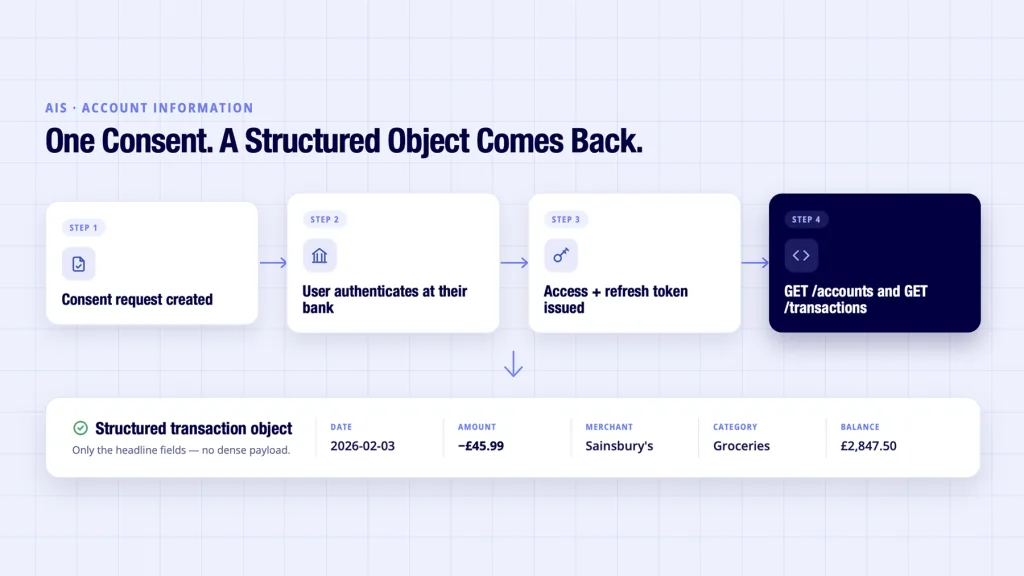
The account data workflow, called AIS, is a common open banking API integration pattern. Your backend creates a consent request and receives a redirect URL. The user authenticates with their bank and approves access. Your backend exchanges the code for an access token and refresh token.
With the token, you call GET /accounts to list accounts, then GET /accounts/{accountId}/transactions for history, typically the last 90 days.
A typical transaction object from an open banking API specification-compliant response:
transactionDate: “2026-02-03”
amount: -45.99
description: “SAINSBURYS LONDON”
merchant: “Sainsbury’s”
category: “Groceries”
balance: 2847.50
reference: “INV-0847”
The Way Open Banking API Examples Differ between Banks
Different banks connected through the same provider return different shapes for identical transactions. None of this is non-compliance; the specification does not mandate field-level consistency.
| Field | Bank A Response | Bank B Response |
|---|---|---|
| Merchant name | merchant | merchant_name |
| Category | “Groceries” | Often omitted |
| Reference | Populated | Frequently blank |
| Timestamp | ISO 8601 | Unix timestamp |
The gap most open banking API examples miss: Merchant names are not always standardised before they reach your application. Raw data often arrives as clearing codes like “SAINY 1234 LONDON”. Some providers normalise this; others pass it through raw. Your integration code must handle both, or it breaks silently when switching banks.
How Does Payment Initiation Work through an Open Banking API?
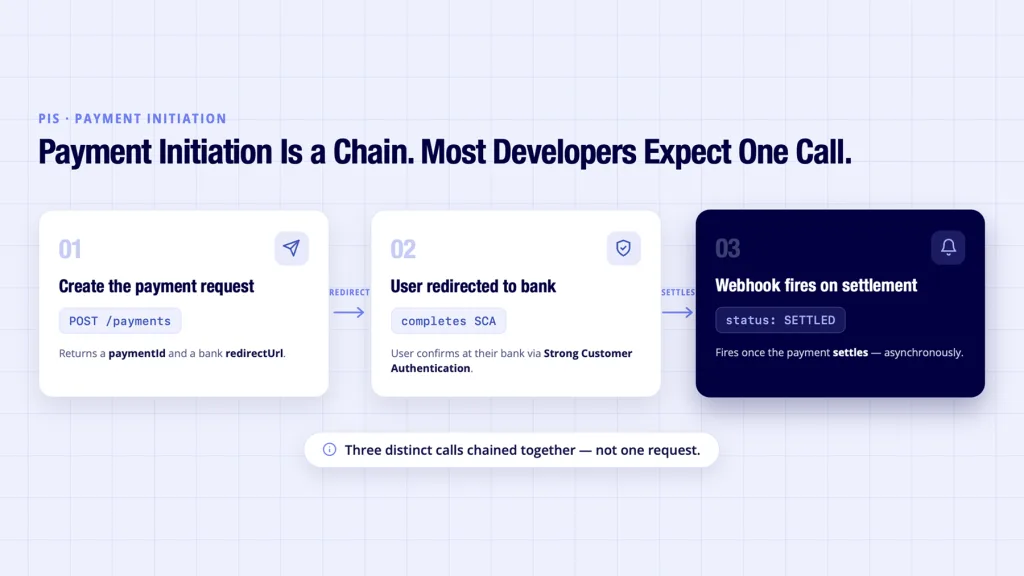
Payment initiation, known as PIS, is three API calls chained together, not one request. This surprises developers reading open banking API examples for the first time.
The first call is POST /payments with amount, payee account and reference:
paymentId: “PAY-58213”
status: “AWAITING_CONSENT”
redirectUrl: “https://bank.example.com/authorize?paymentId=PAY-58213”
expiresAt: “2026-02-03T14:35:00Z”
Your checkout redirects the user to that URL. They authenticate at their bank and confirm via Strong Customer Authentication. The bank redirects back carrying the payment ID. A webhook fires once the payment settles:
paymentId: “PAY-58213”
status: “SETTLED”
statusReason: “SUCCESS”
settledAt: “2026-02-03T09:47:22Z”
amount: 49.99
Most open banking API specification documentation focuses on the ideal payment flow, not the edge cases you encounter in production. Real integration must handle expired redirect links, payer cancellation, ambiguous statuses, and webhook delivery failures.
How Does Account Verification Work in Practice?
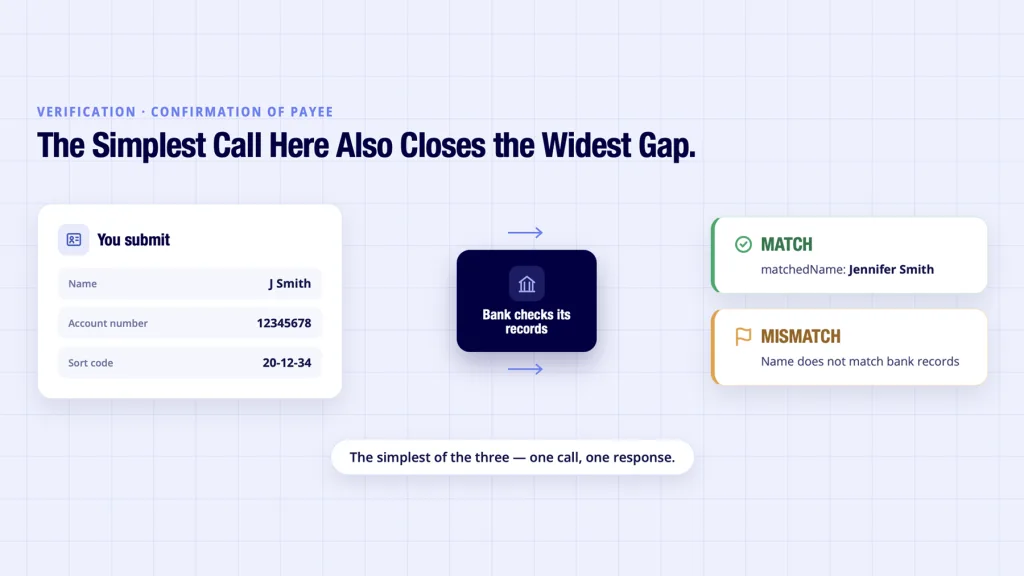
Account verification, sometimes called confirmation of payee, is the simplest of the three examples. One call, one response. You submit the account holder’s name, account number, and sort code:
accountHolderName: “J Smith”
accountNumber: “12345678”
sortCode: “201234”
The bank checks this and returns either a match:
result: “MATCH”
matchedName: “Jennifer Smith”
Or a mismatch:
result: “MISMATCH”
reason: “Account holder name does not match bank records”
Verification is where competitive advantage sits, since most platforms have not integrated it. Teams that do eliminate mistyped account numbers, where a customer enters someone else’s valid details and payment reaches the wrong person.
What Should You Look For In Open Banking API Providers?
Three factors determine whether an open banking API integration survives past week one.
- Firstly, token lifetime: access tokens typically expire within 15 minutes to an hour, and your code must handle silent refresh without forcing re-authentication.
- Secondly, consent expiry: user consent windows range from weeks to over a year, and once expired, calls to your API endpoints fail until the user re-consents.
- Thirdly, webhook retry behaviour: if your listener is briefly unavailable when a payment settles, does the provider retry, how many times?
Most open banking API specification sheets are silent on the third point. Comparing open banking API providers on these three factors matters more than comparing feature lists.
What Slows Down an Open Banking API Integration?
Sandbox and production behaviour diverge sharply for any open banking api integration. Banks do not all populate the same fields, error codes are inconsistent, settlement timing varies even though most transactions clear instantly via Faster Payments, and webhook delivery is not guaranteed. See UK open banking api for common sandbox-to-production breakage patterns.
How Does Finexer Close the Gaps This Guide Identifies?
Most open banking API examples from competitors stop at specification compliance. Finexer is one of the open banking API providers built to close the specific gaps this guide identifies.
- Unified response shapes across every UK bank, closing the field-naming variance above.
- Token and consent lifecycle handled server-side. Finexer tracks refresh tokens and expiry, sending a webhook seven days before consent expires.
- Webhook retry logic by default. Failed delivery retries up to five times with exponential backoff. Idempotency keys prevent duplicate processing.
- Sandbox and production parity by design. Examples your team tests in sandbox behave identically once live.
- Three products behind one authentication. Finexer’s bank data API bundles account data, payment initiation, and verification under one consent.
- See api for bank transactions for transaction endpoint detail, payment initiation service for PIS mechanics, and transaction data enrichment for how objects are cleaned.
Which ICPs Rely on These Open Banking API Examples Day-to-Day?
The same Open Banking API examples solve different problems depending on who is building the product. Here is where they are used most often in day-to-day development:
| ICP / Industry | How They Use Open Banking API Examples? |
|---|---|
| Accounting & ERP platforms | Use account data for invoice matching and account verification to confirm supplier bank accounts before payments. |
| Payroll platforms | Use payment initiation for batch salary disbursements and webhooks to confirm successful settlement. |
| PropTech platforms | Combine account data with payment initiation to automate rent collection and payment reconciliation. |
| EPOS & retail systems | Use payment initiation for till collections and webhook notifications to reconcile transactions in real time. |
The Bottom Line
Open banking API examples may look similar on paper, but production integrations rarely behave the same way. The real difference between a working integration and a resilient one lies in how well your provider handles token refresh, consent renewal, webhook retries, and the inconsistencies that emerge across different banks.
What Do Developers Ask Most About Open Banking API Examples?
The same handful of questions come up once teams move from reading documentation to actually integrating.
What Is The Difference Between Open Banking API Documentation And Open Banking API Examples?
Open banking API documentation shows syntax and endpoints. Examples show the workflow end to end, including operational reality documentation typically omits, like retry logic and consent expiry handling.
Do All Open Banking API Providers Return The Same Fields Under The Open Banking API Specification?
No. One bank’s transaction object includes merchant_name, another includes merchantDescription, a third omits merchant data entirely. Your code must normalise this or accept the variance bank by bank. This is also called the open banking API spec in developer shorthand, and compliance with it does not guarantee field-level consistency.
How Do You Know If A Provider Is Ready For Production Open Banking Api Integration?
Three signals matter: sandbox and production return identical shapes, webhook reliability has a stated retry SLA, and token and consent lifecycle handling is explicit, not left for you to infer from testing.
Can You Use An Open Banking API For Personal Use Or Testing Only?
Open banking API personal use is possible in sandbox environments, where providers offer free test accounts with synthetic data for developers to explore endpoints before committing commercially. Production access requires business registration and FCA-recognised use case approval, since payment initiation and account data access are regulated under PSD2.
Finexer offers open banking api uk examples free through a sandbox with realistic test data for all three workflows in this guide. Build and test your integration in weeks, not months. Build and test your integration in weeks, not months.
Ready to see open banking API examples running live in a sandbox?
Explore with AI
About the Author

Ravi Ranjan
Ravi Ranjan is Co founder & CEO of Finexer