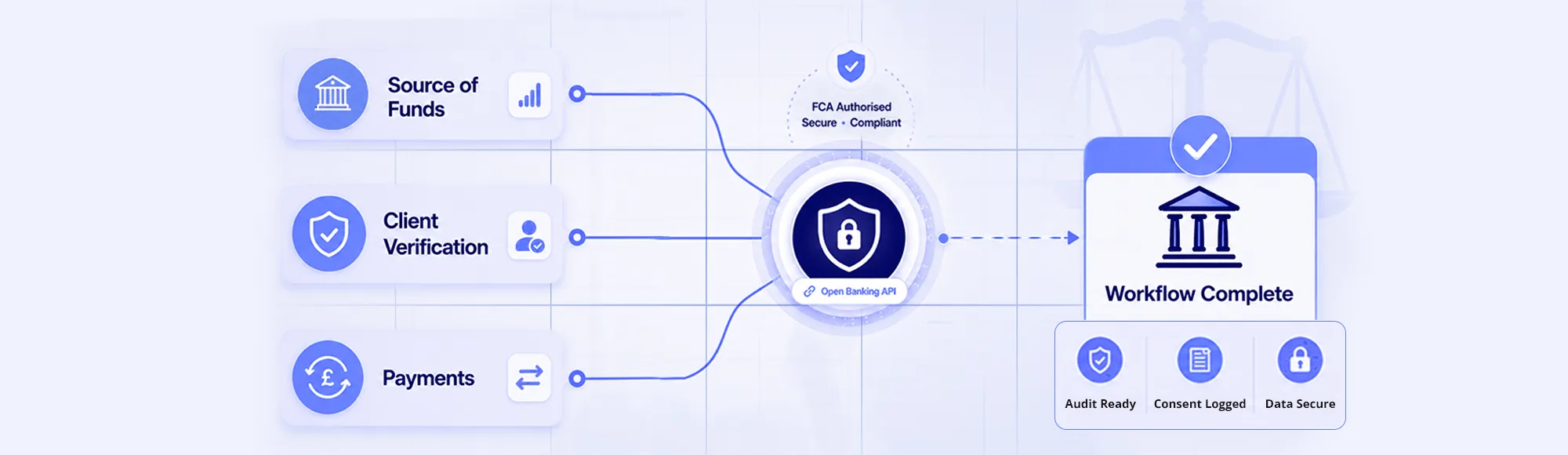
Source of funds. Client verification. Conveyancing payments. Consent logs.
Open Banking infrastructure for solicitors, Lawtech platforms, and conveyancing systems.
Open banking tools for solicitors are evaluated differently from general fintech tools. The comparison that matters is not feature lists – it is workflow fit.
The workflows are specific. Source of funds checks under MLR 2017 require verified bank transaction data with an independent data trail. Conveyancing payments require fast, irrevocable A2A settlement. Client onboarding requires identity verification that stands up to SRA audit review.
A tool that works for one of these workflows may be wrong for another. PDF bank statements are open to manipulation before submission – the digital option of downloading data and sharing in an Excel or similar is open to manipulation meaning that it is very difficult for a solicitor to trust this process alone. Open Banking provides the independent, bank-sourced alternative.
Conveyancing fraud accounts for over £4 billion per year in the UK (SAM Conveyancing, 2023). Solicitors have obligations under POCA 2002 to report suspected money laundering. Banking and finance solicitors and conveyancing practices are among the highest-risk categories under MLR 2017 – which is precisely why the data source for source of funds checks matters as much as the workflow around it.
This blog compares the best budget open banking tools for solicitors by workflow – and ranks them by how well each one supports the legal workflows that actually matter.
TL;DR
Open banking tools for solicitors fall into three categories: bank data access (AIS) for source of funds and financial verification, payment initiation (PIS) for client and conveyancing payments, and combined infrastructure covering both.
The right open banking tools for solicitors depend on workflow – not price alone. Finexer, Armalytix, Thirdfort, TrueLayer, and Atoa cover different parts of this landscape. Budget is a factor – but workflow fit determines whether the tool actually works.
Key Takeaways
What do solicitors use open banking tools for?
Three distinct workflows:
- Source of funds verification – retrieving client bank transaction history directly from the bank to evidence the origin of funds under MLR 2017. Open Banking AIS provides bank-sourced data that PDF statements cannot match for independence and integrity.
- Client identity verification – confirming bank account ownership and matching identity documents against bank records during client onboarding.
- Conveyancing and client payments – initiating payments directly from client accounts or law firm accounts for property completions, client disbursements, and supplier payments.
Why can’t solicitors rely on PDF bank statements for source of funds?
This is the core weakness of PDF-based source of funds – and why open banking tools for solicitors matter. Open Banking AIS retrieves transaction data directly from the bank at the moment of client consent – unalterable in transit, with a consent log timestamping each retrieval. This is the independence that PDF statements cannot provide.
What is the right open banking tool for a solicitor?
It depends on the workflow. The best open banking tools for solicitors doing source of funds checks = AIS-first tools with strong UK bank coverage, consent logs, and structured transaction data. Client verification = tools combining bank-based identity checks with transaction history. Conveyancing payments = PIS tools with high-value transfer capability and instant settlement. Combined workflows = single API covering AIS + PIS + Verification.
Which Are the Best Budget Open Banking Tools for Solicitors in 2026?
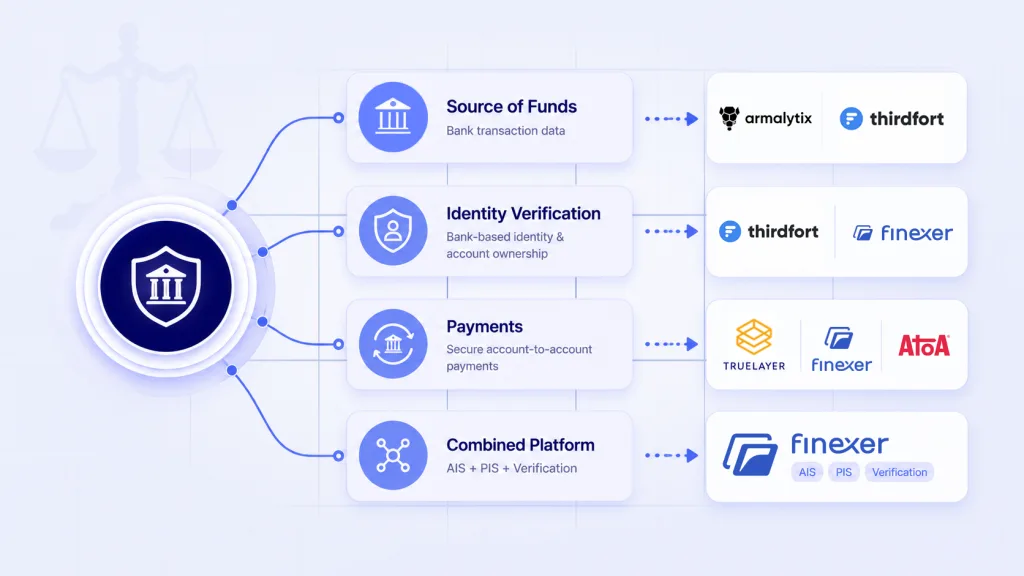
Who Are the Best Open Banking Tools for UK Solicitors in 2026?
1. Finexer
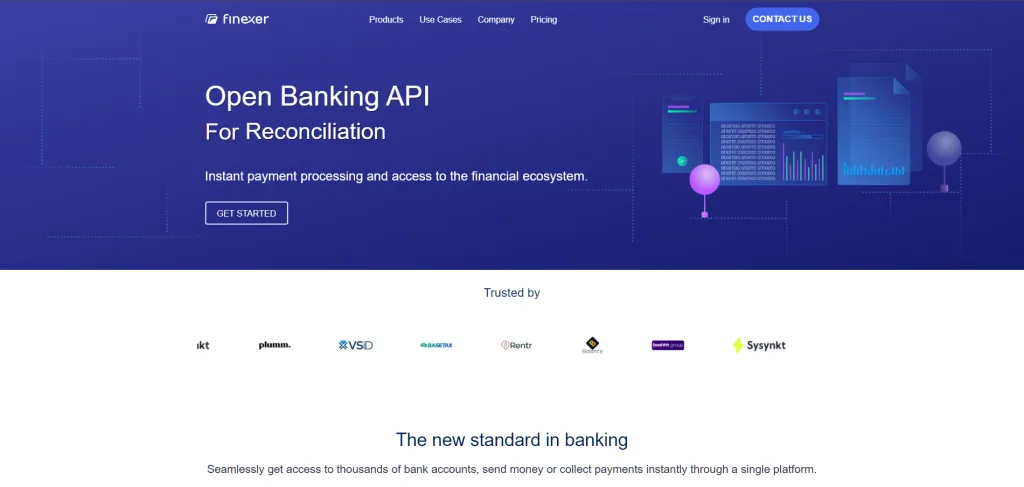
Finexer is an FCA-authorised UK-only Open Banking infrastructure provider covering AIS, PIS, and Verification in a single integration. For Lawtech platforms and legal case management systems building Open Banking capability, Finexer provides the full stack relevant to solicitor workflows – bank data, payments, and identity verification.
What it covers for solicitors:
- Source of funds – bank transaction history retrieved directly from the bank with consent log per retrieval. Data arrives structured with timestamps, merchant IDs, and category codes. Up to 7 years of history for SoW depth.
- Bank-based identity verification – name matched against bank account in real time. Facial recognition comparing selfie against passport or driving licence. Document data extraction. Verification reports per client for SRA audit purposes.
- Conveyancing and client payments – Pay by Bank and Payment Links for A2A transfers. Instant settlement via Faster Payments. Zero chargebacks.
- Consent logs – every data retrieval timestamped and logged per client, per access event. Demonstrates to SRA when data was obtained and under what consent scope.
- 99% UK bank coverage – high street, challenger, and business accounts
- Usage-based pricing, no setup fees, 3-5 weeks to production
Best for: Lawtech platforms and conveyancing systems building open banking tools for solicitors – source of funds, identity verification, and payment initiation in one integration.
Open Banking for law firms – AML, source of funds, and client onboarding covers how Finexer’s AIS and Verification support law firm compliance workflows.
2. Armalytix

Armalytix is a UK-based Open Banking platform built specifically for law firms and accountancy practices. It focuses on source of funds and source of wealth verification with a solicitor-facing workflow rather than an API-first infrastructure model.
What it covers for solicitors:
- Source of funds and source of wealth checks via Open Banking bank data retrieval
- Automated presentation of transaction analysis for conveyancing review
- Multi-account access to cover multiple personal and savings accounts
- Reports designed for SRA audit review
Budget profile: Priced per matter/client – accessible for smaller law firms without technical integration overhead.
Best for: Law firms using open banking tools for solicitors to conduct source of funds checks directly, without building into a wider platform. Solicitor-facing rather than platform-facing.
3. Thirdfort
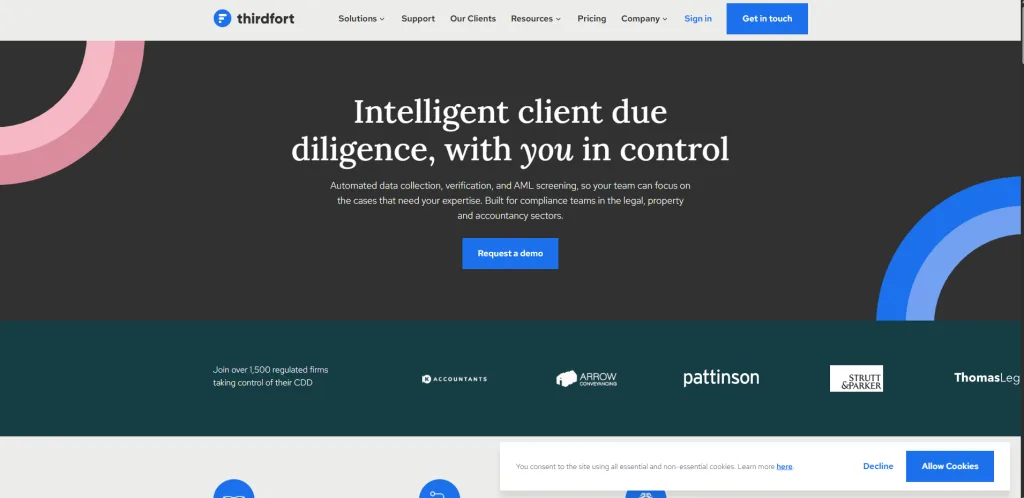
Thirdfort is a UK legal compliance platform combining identity verification, AML screening, and Open Banking source of funds in a single client onboarding workflow. Thirdfort uses Open Banking to carry out smooth, secure source of funds verification for over 500 firms.
What it covers for solicitors:
- Source of funds via Open Banking AIS
- Identity verification including biometric and document checks
- AML screening and sanctions/PEP database access
- Client onboarding workflow with digital journey
Budget profile: Per-matter pricing – scales with firm transaction volume. Higher capability than AIS-only tools; pricing reflects the broader compliance stack.
Best for: Law firms needing source of funds + AML screening + identity in one client-facing workflow.
4. TrueLayer
TrueLayer is the UK’s largest Open Banking payment network. For solicitors and Lawtech platforms, it is primarily relevant as a payment initiation infrastructure provider – used by platforms including Perfect Portal and InfoTrack to power their Open Banking workflows.
What it covers for solicitors:
- Payment initiation (PIS) – high-value A2A transfers relevant for conveyancing settlements
- Bank data access (AIS) alongside payment initiation
- Used by legal compliance and conveyancing platforms as their underlying Open Banking infrastructure
Budget profile: Enterprise-oriented pricing. More accessible to Lawtech platforms building on TrueLayer as infrastructure than to individual law firms purchasing directly.
Best for: Lawtech platforms building open banking tools for solicitors that need payment infrastructure at UK scale.
5. Atoa
Atoa is a UK payment initiation provider focused on Pay by Bank for small and medium-sized businesses. For solicitors, it is relevant primarily for client payment collection – receiving payment for legal fees and disbursements.
What it covers for solicitors:
- Pay by Bank payment links for fee collection
- Lower-cost alternative to card payment processing
- Simple integration without technical overhead
Budget profile: Low entry cost. Usage-based per transaction. No AIS or identity verification capability.
Best for: Sole practitioners and smaller law firms receiving client payments at lower cost than card processing, without needing source of funds or identity verification capability. Smaller law firms wanting budget open banking tools for solicitors focused on fee collection only.
| Tool | Source of Funds (AIS) | Identity Verification | Payments (PIS) | Best For |
|---|---|---|---|---|
| Finexer | Yes – with consent logs | Yes – bank-based + facial recognition | Yes – Pay by Bank, Payment Links | Lawtech platforms, combined workflows |
| Armalytix | Yes – SoF/SoW focused | Limited | No | Law firms – SoF checks only |
| Thirdfort | Yes – within full CDD | Yes – including AML screening | No | Law firms – compliance + identity |
| TrueLayer | Yes | No | Yes – enterprise scale | Lawtech platforms – payment infrastructure |
| Atoa | No | No | Yes – Pay by Bank only | Small firms – fee collection |
“The question for solicitors evaluating open banking tools is not which tool has the most features. It is which workflows the firm needs to support – source of funds, identity verification, payments, or all three – and which tool covers those workflows reliably under the firm’s regulatory obligations.” – Clare, Finexer
How Finexer’s Open Banking impacts Lawtech platforms covers how Open Banking infrastructure integrates into legal case management and conveyancing platform workflows.
How Do You Choose the Right Open Banking Tools for Solicitors?
What Should Solicitors Evaluate When Selecting Open Banking Tools?
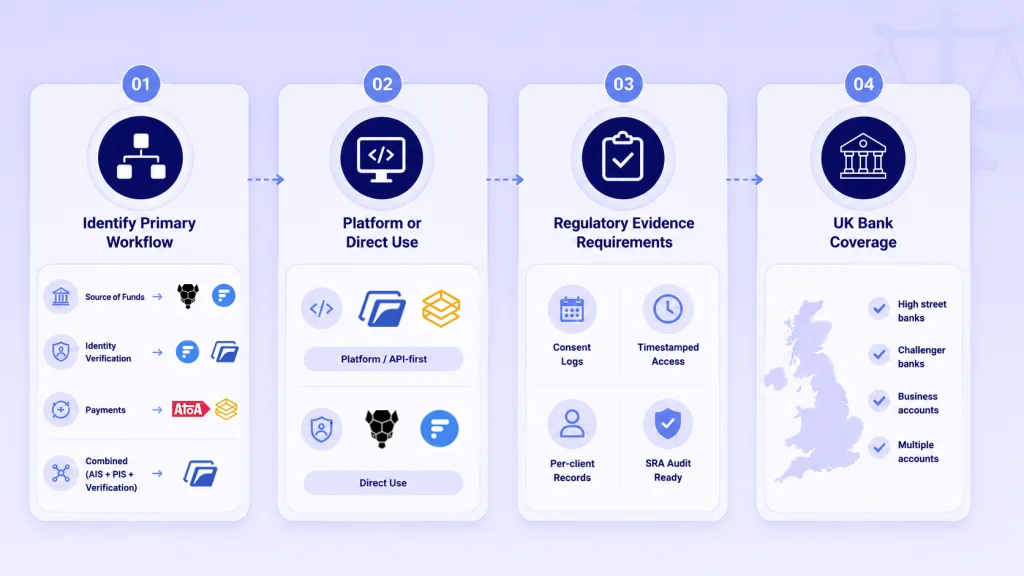
The evaluation criteria for open banking tools for solicitors differs from general fintech evaluation. Workflow fit and regulatory compliance evidence matter more than headline pricing or feature breadth.
Step 1 – Identify the primary workflow: The right open banking tools for solicitors start with workflow clarity. Source of funds only → Armalytix or Thirdfort. Source of funds + identity + payments → Finexer (for platforms) or Thirdfort (for law firms). Payments only → Atoa or TrueLayer.
Step 2 – Platform or direct use: Building Open Banking into a case management system or Lawtech platform → API-first infrastructure (Finexer, TrueLayer). Using Open Banking directly within a law firm’s existing workflow → compliance-focused tools (Armalytix, Thirdfort).
Step 3 – Regulatory evidence requirements: SRA expects audit trails showing when client data was accessed and under what consent. Consent logs per retrieval are essential. Check whether the tool produces timestamped, per-client access records.
Step 4 – UK bank coverage: Source of funds checks often require access to multiple accounts. FCA data shows more than 70 million personal accounts in the UK and almost as many easy savings accounts. Solicitors may need access to multiple accounts to complete verification. Confirm the tool covers high street, challenger, and business accounts.
“Budget is a legitimate consideration for smaller law firms and early-stage Lawtech platforms. But the cheapest open banking tool is not the best one if it cannot produce the consent logs and structured data that satisfy an SRA review.” – Clare, Finexer
Fetching client bank statements for solicitors covers the legal and practical requirements for obtaining client bank data under MLR 2017 and SRA guidelines.
Lawtech platforms and Open Banking use cases covers how Lawtech platforms integrate Open Banking AIS and PIS into legal workflows.
What I Feel
Law firms evaluating open banking tools for solicitors spend most of their time comparing pricing pages.
The more important question is: if the SRA audits this matter in 18 months, can the tool produce evidence of when client financial data was accessed, under what consent, and what it showed?
That question eliminates several tools from consideration immediately. The ones that remain are the ones worth comparing on price.
At Finexer, I work with Lawtech platforms and conveyancing systems building Open Banking into their compliance workflows. The pattern is consistent: the right tool is almost never the cheapest one – it is the one that produces the audit trail the SRA can actually review.
Common Use Cases
Conveyancing Platforms
Open banking tools for solicitors doing conveyancing need both AIS and PIS. Source of funds checks via AIS retrieve client bank transaction history directly from the bank with consent log per retrieval. Conveyancing payment initiation via Pay by Bank settles via Faster Payments. Both workflows are supported in one integration for conveyancing case management systems.
Compliance Tools for Solicitors
Open banking tools for solicitors managing compliance workflows provide bank-based identity verification confirming name match against bank records in real time. Document extraction from identity documents. Verification reports per client for SRA compliance files. Ongoing monitoring via 90-day consent window.
Legal Case Management Systems
Open banking tools for solicitors integrated into case management systems deliver structured bank transaction data in consistent JSON format across virtually every UK bank. Category codes at source reduce manual classification before presenting transaction analysis to the reviewing solicitor.
Family Law Platforms
Open banking tools for solicitors handling family law financial disclosure need verified transaction history showing income, expenditure, and asset patterns. Open Banking AIS provides up to 7 years of structured history – independent of client-submitted documents.
What should solicitors look for in budget open banking tools?
Budget open banking tools for solicitors should produce consent logs per retrieval, cover high street and challenger UK banks, and clearly support the specific workflow needed – source of funds, identity verification, or payments. Tools that do not produce timestamped, per-client access records do not satisfy SRA audit requirements regardless of price. Workflow fit matters more than headline cost.
Are open banking tools for solicitors compliant with SRA requirements?
FCA-authorised Open Banking providers operate under UK Open Banking regulation with Strong Customer Authentication and consent-based access. For SRA compliance, tools must produce consent logs per retrieval – timestamped records of when data was accessed and under what authorisation. These logs form the audit trail SRA expects for source of funds procedures. Always confirm this capability before selecting a tool.
What is the difference between Finexer and Thirdfort for solicitors?
Thirdfort is a compliance platform for law firms – combining source of funds, identity verification, and AML screening in one client-facing workflow. Finexer is Open Banking infrastructure for Lawtech platforms building these workflows into their products. Finexer does not include AML screening, sanctions databases, or PEP checks. Thirdfort suits law firms. Finexer suits platform building for law firms.
Explore Open Banking infrastructure for solicitor workflows – source of funds, verification, and payments in one integration.
About the Author

Clare Pearson
Clare Pearson is a senior payments professional with extensive experience across the global financial services and payments industry. She specialises in Open Banking, payment infrastructure, and financial technology transformation, with expertise spanning product delivery, operational strategy, regulatory compliance, and large-scale payments programmes. Clare currently serves as a Non-Executive Director at Finexer and a panel member for the Payment Systems Regulator (PSR), advising on the development of payment systems policy and innovation