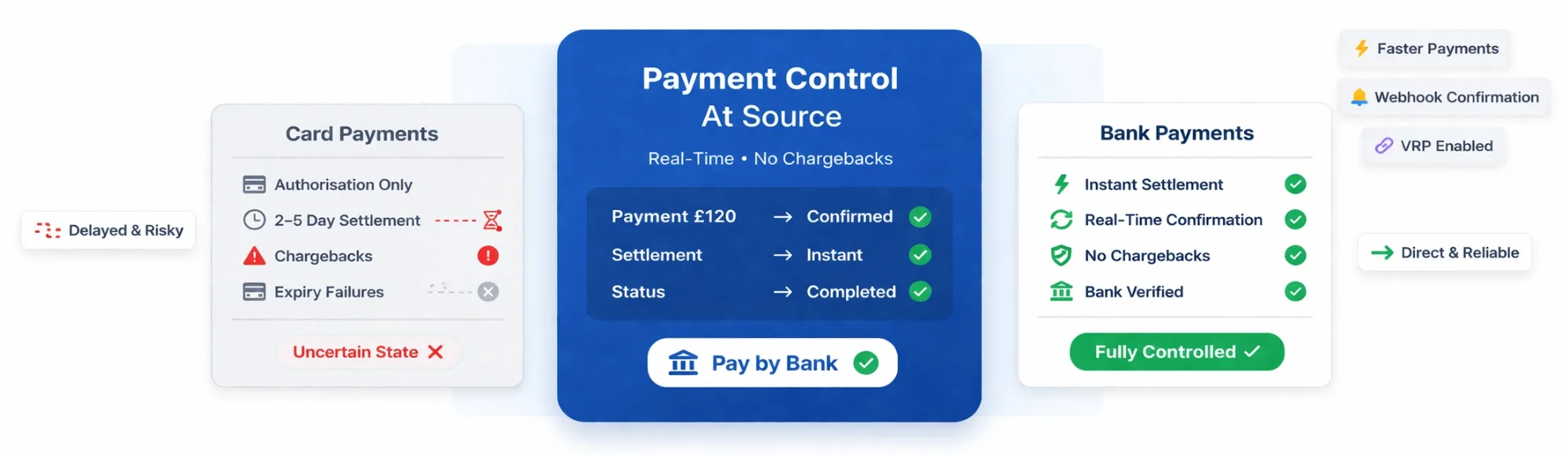
Card rails are costing you margin and control on every transaction.
Finexer provides FCA-authorised Pay by Bank and VRP infrastructure for UK platforms.
Pay by bank open banking is not a cost optimisation play. It is a control play.
At Finexer, I work with EPOS platforms and payment SaaS providers that move to pay by bank open banking expecting to save on interchange. They stay because of what they gain operationally – real-time payment confirmation, no chargeback exposure, cleaner reconciliation, and predictable payment behaviour that card rails structurally cannot provide.
This blog covers what payment control actually means for platforms, how pay by bank open banking delivers it, and where recurring payment solutions via Variable Recurring Payments extend that control into subscription and billing workflows.
TL;DR
Pay by bank open banking routes payments directly between bank accounts via the UK Faster Payments network – removing card networks, interchange fees, and chargeback exposure from the transaction entirely. Platforms gain real-time payment confirmation via webhooks, zero chargeback liability, and structured transaction data per payment event. For recurring payment solutions, Variable Recurring Payments extend this control into subscription and variable billing workflows. Finexer’s FCA-authorised PIS delivers this for UK EPOS and payment platforms.
Key Takeaways
What does pay by bank open banking give platforms that cards cannot?
Real-time payment confirmation at the moment of transaction, no chargeback exposure, no card expiry failures, and bank-authenticated payment records per event. Cards provide none of these natively – making pay by bank open banking the structurally stronger infrastructure choice for platforms at volume.
Why is payment confirmation the critical difference for EPOS platforms?
Card payments produce an authorisation, not a confirmed settlement. Pay by bank open banking produces instant settlement confirmation via Faster Payments – enabling reconciliation and order fulfilment at point of payment, not at end-of-day batch.
How do recurring payment solutions via VRP differ from Direct Debit?
Variable Recurring Payments allow platforms to initiate payments of varying amounts within pre-agreed limits, without new mandates per transaction. Direct Debit requires fixed amounts or mandate amendments. VRP gives platforms more operational flexibility for variable billing scenarios.
Which platforms gain the most from pay by bank open banking?
EPOS platforms reconciling daily against card batch files, payment SaaS providers managing high-volume transaction flows, and fintech founders building payment-native products where confirmation speed and reconciliation accuracy are product requirements.
Why Does Card-Based Payment Infrastructure Fail Platforms at Scale?
What Does Card Authorisation Actually Confirm?
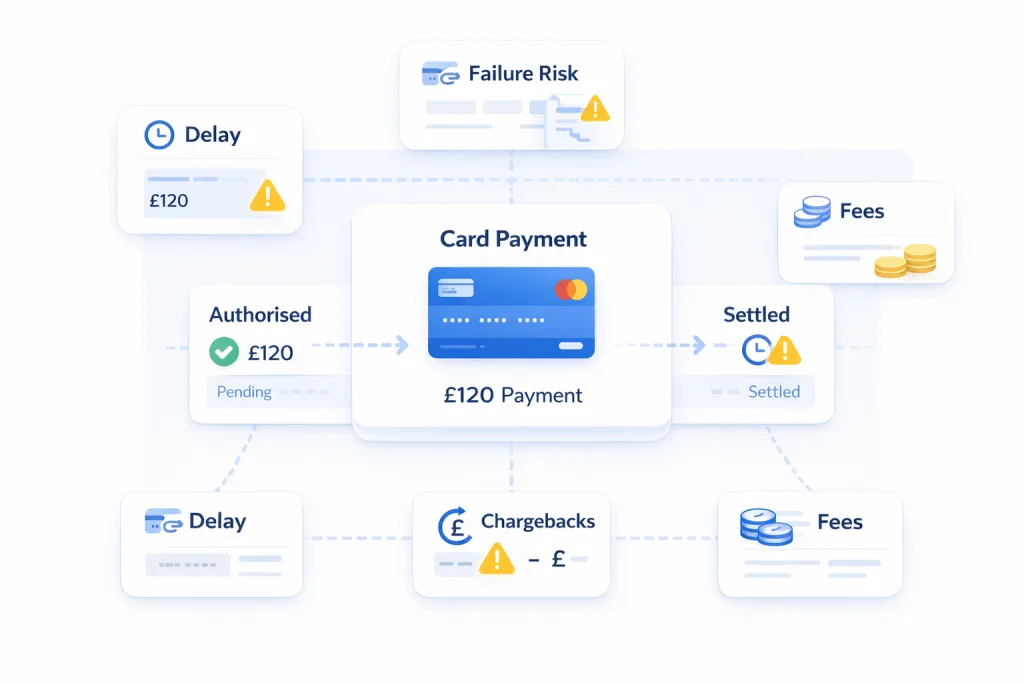
A card authorisation is not a payment. It is a promise.
When a card payment is authorised at checkout, the card scheme signals that the issuing bank will honour the transaction – subject to fraud checks, chargeback disputes, and settlement timelines extending two to five business days.
For platforms, this creates three structural problems:
- No real-time confirmation – authorisation and settlement are separate events. Reconciliation cannot close until settlement clears.
- Chargeback exposure – cardholders can reverse confirmed payments after settlement. The platform absorbs the loss and the fee.
- Expiry and failure risk – card details expire, cards are cancelled, and card-based recurring payment solutions fail when credential details become invalid.
“At Finexer, I work with EPOS platforms that spend significant resources managing chargeback disputes and end-of-day reconciliation gaps. Both problems disappear with Pay by Bank. The payment either settles or it does not – there is no middle state.” – Ravi, Finexer
Why Do Card Fees Compound Beyond Interchange?
Most platforms see the interchange rate. Fewer accounts for the full card fee stack – scheme fees, acquirer margins, gateway charges, and chargeback fees – all applied per transaction.
At volume, this compounds into a structural margin problem. How open banking payment flow works for platform systems covers the payment flow architecture that removes these fee layers entirely.
What Control Does Pay by Bank Open Banking Actually Give Platforms?
How Does Real-Time Confirmation Change Platform Operations?
Pay by bank open banking routes payments through the UK Faster Payments network. Settlement is near-instant. The platform receives a webhook at the point the payment confirms.
- Reconciliation closes at point of payment, not at end-of-day batch
- Order fulfilment or service delivery triggers on confirmed payment, not authorisation
- Cash position is visible in real time, not days after the transaction
For EPOS platforms running multi-location operations, per-transaction webhook confirmation means reconciliation is automated per payment event. No batch file to wait for. No end-of-day manual matching.
What Does Zero Chargeback Exposure Mean for Platform Economics?
Pay by bank open banking uses irrevocable push payments. The payer authenticates via their bank app, the payment clears via Faster Payments, and funds settle. There is no chargeback mechanism – no dispute window, no scheme-initiated reversal.
For platforms absorbing chargebacks at volume, this removes a variable cost that sits entirely outside the standard fee model.
| Payment Attribute | Card Payments | Pay by Bank Open Banking |
|---|---|---|
| Settlement speed | 2-5 business days | Near-instant via Faster Payments |
| Payment confirmation | Authorisation only – settlement separate | Real-time webhook on confirmed settlement |
| Chargeback exposure | Yes – buyer-initiated reversals post-settlement | None – irrevocable push payment |
| Fee structure | Interchange + scheme + acquirer + gateway | Single usage-based API fee |
| Recurring payment failure | Card expiry, cancellation, credential failures | Bank account does not expire – account-linked |
| Reconciliation | Batch settlement files, delayed | Per-transaction structured data, real-time |
How Do Recurring Payment Solutions Extend Pay by Bank Control?
Why Do Card-Based Recurring Payments Fail at Scale?
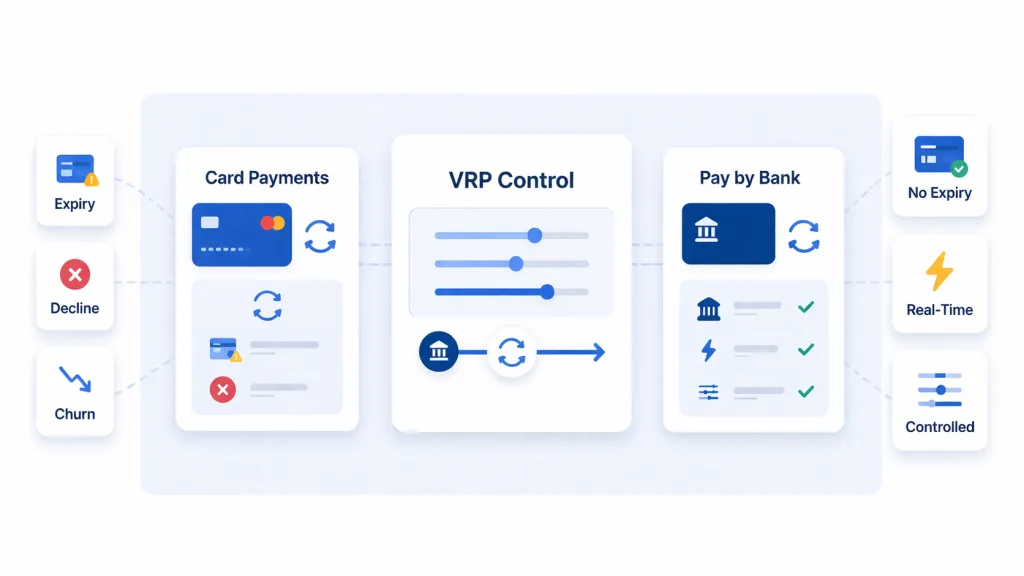
Card-based recurring payment solutions carry a structural failure mode that bank-based alternatives do not. Cards expire. Cardholders cancel and replace cards. Insufficient funds on a card produce a hard decline with no automated retry path.
For subscription platforms and billing systems, this produces involuntary churn. For platforms evaluating recurring payment solutions, the failure mode is structural – not incidental. Pay by bank open banking removes this failure mode entirely by linking payments to bank accounts that do not expire.
How VRP reduces churn in UK recurring billing covers the failure rate comparison between card-based and bank-based recurring payment solutions in detail.
What Are Variable Recurring Payments for Platform Billing?
Variable Recurring Payments (VRP) allow platforms to initiate payments of varying amounts within pre-agreed limits, without requiring a new authorisation per transaction.
Unlike Direct Debit, VRP provides:
- Variable amounts within a pre-agreed ceiling per billing cycle
- Instant Faster Payments settlement per transaction
- Real-time confirmation webhook per VRP event
- No card expiry failure mode – payments are bank account-linked
What are Variable Recurring Payments – full guide covers VRP architecture, consent flows, and UK platform use cases in detail.
For platforms building recurring payment solutions on bank rails, VRP provides the control layer that Direct Debit and card subscriptions structurally cannot match. It is the most operationally reliable recurring payment solution for variable billing at scale.
“The platforms moving to bank-based recurring payment solutions are not doing it because VRP is new. They are doing it because card-based subscriptions fail at a rate that damages retention metrics and requires operational overhead to manage.” – Ravi, Finexer
How Does Finexer Support Pay by Bank Open Banking for UK Platforms?
For EPOS platforms, payment SaaS providers, and fintech founders building payment control into their infrastructure – Finexer’s FCA-authorised PIS provides the pay by bank open banking and VRP layer that removes card rail dependencies from the payment flow.
Finexer VRP API for recurring payment solutions covers the technical integration and consent flow for platforms building VRP-based recurring billing.
What Does Finexer’s Payment Infrastructure Provide?
- FCA-authorised PIS – verifiable on the FCA register
- Pay by Bank via Faster Payments – near-instant settlement, real-time webhook confirmation
- Variable Recurring Payments – variable amount recurring payment initiation within pre-agreed consent parameters
- Payment Links and QR code payment initiation for EPOS in-person use cases
- Payout and Bulk Payout for outbound disbursements
- 99% UK bank coverage across retail and challenger banks
- White-label payment flows under the platform’s own brand
- Usage-based pricing – scales with transaction volume
- Saves platforms up to 90% on transaction costs versus card-based processing
- 3-5 weeks onboarding support to reach production deployment
What I Feel
The pay by bank open banking conversation has been dominated by the cost saving narrative for too long.
That is true – lower interchange, cheaper per transaction. But it is not why platforms stay on bank rails once they have moved.
They stay because what pay by bank open banking actually changes operationally. Confirmation at point of payment. No chargeback exposure. No card expiry failures. Reconciliation that closes at transaction level rather than batch level.
For platforms at volume, these are not incremental improvements. They are structural changes to how the payment flow works.
Common Use Cases

EPOS Platforms
Card batch settlement delays and end-of-day reconciliation overhead are removed with pay by bank open banking. Finexer’s PIS enables QR code or Payment Link payments at point of sale, with real-time webhook confirmation and near-instant Faster Payments settlement per transaction.
Payroll & Invoicing Platforms
Card invoice collection carries interchange costs and chargeback exposure on every payment. Finexer’s Pay by Bank enables direct bank-to-bank collection – the most cost-efficient recurring payment solution for platforms managing high-volume outbound and inbound payment flows.
Accounting & ERP Platforms
Accounting platforms need confirmed settlement data, not authorisation signals. Pay by bank open banking via Finexer’s PIS delivers bank-verified payment confirmation per event – enabling reconciliation at transaction level without batch file dependency.
Proptech & Real Estate Platforms
High-value property payments via card carry chargeback exposure and delayed settlement. Pay by bank open banking via Finexer’s FCA-authorised PIS provides irrevocable push payment confirmation with bank-authenticated records and consent logs – making it the reliable recurring payment solution for property platforms handling deposits and rental collections.
Utility Billing Platforms
Variable billing requires recurring payment solutions that handle variable amounts without mandate amendments. Finexer’s VRP supports variable recurring payment initiation within pre-agreed consent parameters – making it the most flexible recurring payment solution for utility billing cycles.
Lawtech Platforms
Client matter payments require irrevocable confirmation with audit trail support. Finexer’s PIS provides bank-authenticated payment records with consent logs and timestamps for regulated legal payment workflows.
What is pay by bank open banking for UK platforms?
Pay by bank open banking enables platforms to initiate account-to-account payments via FCA-authorised PIS infrastructure, routing through Faster Payments for near-instant settlement with real-time confirmation – without card networks, interchange fees, or chargeback exposure.
How do recurring payment solutions via VRP differ from Direct Debit?
VRP allows variable payment amounts within pre-agreed limits without new mandates per transaction. Direct Debit requires fixed amount mandates or amendment processes. VRP also settles via Faster Payments with per-transaction webhook confirmation.
Do platforms need FCA authorisation to offer pay by bank open banking?
Platforms building on FCA-authorised PIS infrastructure inherit the PISP compliance layer and do not need independent FCA authorisation to offer Pay by Bank.
Build payment control into your platform with FCA-authorised Pay by Bank and VRP infrastructure
About the Author

Ravi Ranjan
Ravi Ranjan is Co founder & CEO of Finexer