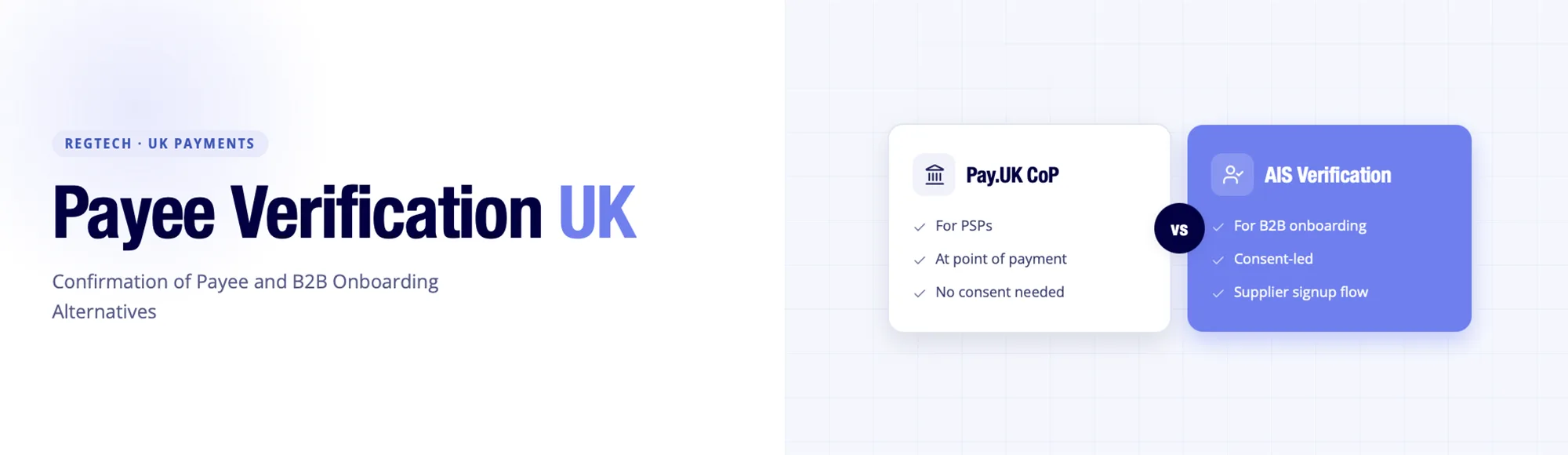
Bank Account Verification for B2B Teams.
AIS-based payee verification for B2B supplier and contractor onboarding – not a CoP replacement.
Payee verification sits at the intersection of fraud prevention and operational accuracy. In the UK, authorised push payment (APP) fraud losses reached £213.7 million in the first half of 2024 alone (UK Finance). Misdirected payments – payments sent to the wrong account due to data entry errors – create separate operational drag for finance teams.
There are two distinct mechanisms for payee verification in the UK: the Pay.UK Confirmation of Payee regulated scheme, and AIS-based bank account verification for B2B onboarding workflows. This guide covers both honestly, including where each fits and where each falls short.
TL;DR
Confirmation of Payee (CoP) is a Pay.UK regulated scheme for PSPs checking account names before payment. Mandatory for directed PSPs under PSR SD17. AIS-based bank account verification is a separate consent-led mechanism for B2B platforms onboarding suppliers and contractors – not for one-off payment checks.
What Is Payee Verification?
Payee verification confirms that a bank account belongs to the intended recipient before a payment is made or a supplier relationship is created. In the UK, two distinct mechanisms cover this: the Pay.UK Confirmation of Payee scheme for PSPs checking names at the point of payment, and AIS-based verification for B2B platforms onboarding suppliers or contractors.
What Is Confirmation of Payee in the UK?
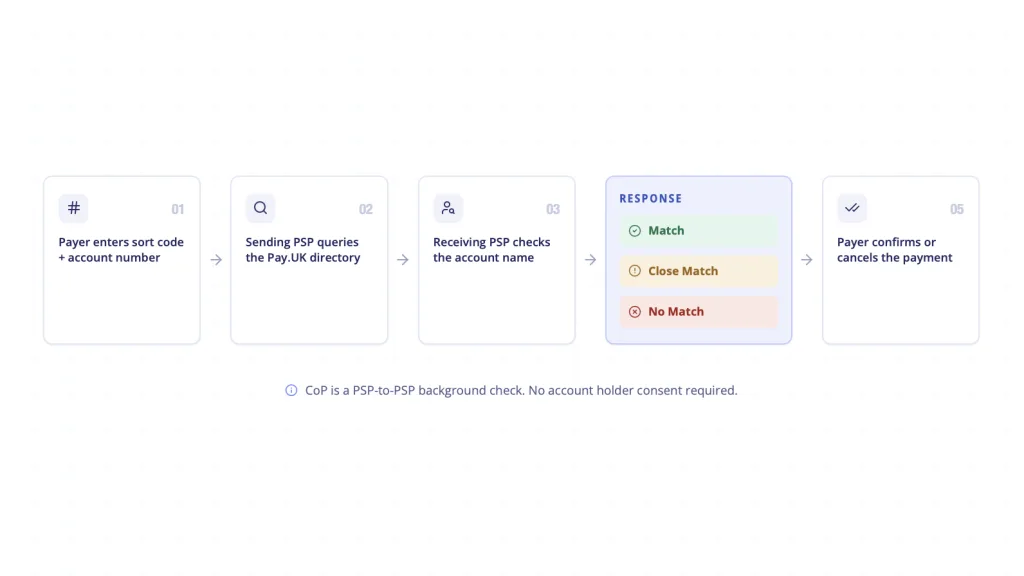
Confirmation of Payee (CoP) is a Pay.UK regulated overlay service launched in 2020. A sending PSP queries the receiving PSP via the Pay.UK directory and receives one of three responses: Match, Close Match, or No Match. No account holder consent is required – CoP is a PSP-to-PSP background check.
“Confirmation of Payee is one of the most significant anti-fraud controls in UK payments. The Match/Close Match/No Match model is deliberately simple – the player makes the final decision, but now with verified information.” – Paul, Finexer
CoP covers UK domestic payments addressable by sort code and account number. It does not extend to international payments or IBAN-based transactions. For B2B platforms using an alternative approach, how to verify bank account details covers the full AIS mechanism.
Is Confirmation of Payee Mandatory in the UK?
Yes, for directed PSPs. PSR Specific Direction 17 (SD17) mandated CoP in a phased rollout. Group 2 PSPs were required to be implemented by 31 October 2024. Over 300 organisations have implemented CoP, with more than 2 million checks completed every day (Pay.UK, wearepay.uk).
Since 7 October 2024, mandatory reimbursement rules require sending and receiving PSPs to split APP fraud losses 50/50, making CoP directly relevant to PSP liability.
Who Provides Confirmation of Payee?
CoP requires FCA or NCA regulation and account-holding PSP status with customers reachable by sort code. PSPs can participate directly or via an Aggregator – a model introduced Spring 2024. Pay.UK-listed aggregators include TechnoXander, SurePay, Modulr and LSEG Bank Wizard.
Non-account-holding organisations – platforms, SaaS providers, non-bank fintechs – do not qualify for CoP membership.
What Does Payee Verification Look Like for B2B Platforms?
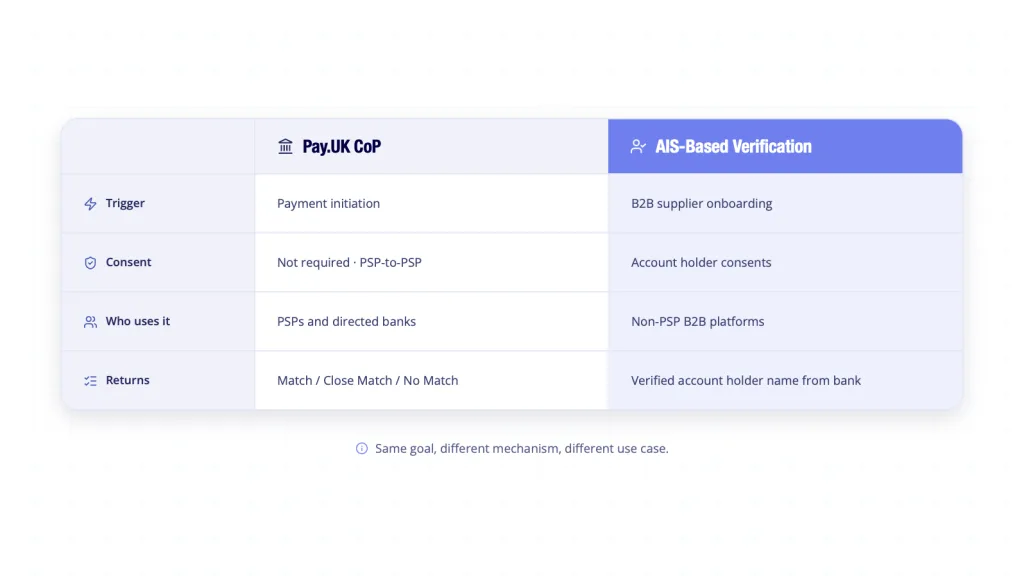
A B2B platform onboarding a new supplier, contractor or customer needs to confirm the bank account provided actually belongs to that entity. Unlike CoP, the entity is present in the process and can consent.
This is where AIS-based bank account verification applies. The supplier authenticates with their bank during onboarding, and the platform retrieves the verified account holder name directly from the bank. See Open Banking verification for how the consent-led model applies across onboarding workflows.
Where Does Finexer Fit in Payee Verification?
Finexer is not a Pay.UK Confirmation of Payee scheme member and does not provide CoP services. For one-off payee verification before initiating a payment, use CoP via your PSP or an approved aggregator.
Finexer’s Bank Account Verification uses FCA-authorised AIS (FRN 925695) to read the verified account holder name directly from their bank, with standard Open Banking consent. It is designed for B2B onboarding workflows – supplier, contractor or client onboarding where the account holder is an active participant.
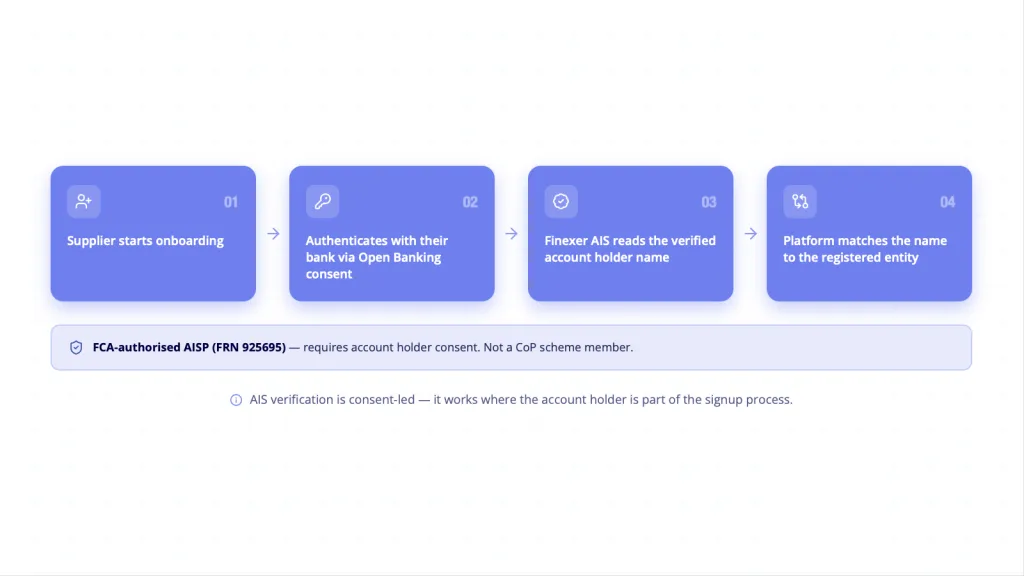
- CoP: PSP-to-PSP, no consent required, for payment initiation
- Finexer AIS verification: consent-led, for B2B onboarding only
For platforms connecting KYC verification and bank account checks in a single onboarding flow, or running income verification alongside account verification, Finexer’s AIS API connects all three from one integration.
Coverage across 99% of UK banks. PSD2-compliant. Usage-based pricing. 3 to 5 weeks of onboarding support.
“AIS-based verification and CoP solve different problems. CoP is a PSP checking an account name on behalf of a payer. AIS verification is the account holder consenting to share their own data during signup. Conflating the two leads to compliance errors.” – Paul, Finexer
When Should I Use Confirmation of Payee vs AIS Verification?
| Scenario | Right method | Why |
|---|---|---|
| One-off payment to unfamiliar payee | Pay.UK CoP (via PSP or aggregator) | No consent required. PSP-to-PSP check at point of payment. |
| B2B supplier or contractor onboarding | AIS-based bank account verification | Consent available. Account holder is active participant in onboarding flow. |
| Bulk supplier file import | CoP via aggregator for existing payees | Name-check against sort code/account before adding to payment file. |
What Does Confirmation of Payee Not Cover?
CoP confirms a name matches an account – it does not confirm whether a business is legitimate, a transaction is fraudulent, or a supplier has been compromised. For B2B vendor fraud, CoP should sit alongside KYB checks and supplier onboarding verification, not replace them.
How does Confirmation of Payee work?
The sending PSP queries the receiving PSP via the Pay.UK directory. The response is Match, Close Match or No Match. The payer sees the result before confirming. No account holder consent is required.
Is Confirmation of Payee mandatory in the UK?
Yes, for directed PSPs. PSR SD17 required Group 2 PSPs to implement CoP by 31 October 2024, with over 300 organisations now participating. From 7 October 2024, non-compliant PSPs face direct liability for APP fraud reimbursement.
How do I verify a bank account before paying?
Directed PSPs use CoP at payment initiation. Non-PSP B2B platforms use AIS-based bank account verification at onboarding, where the account holder can consent to sharing their bank data.
What happens if a Confirmation of Payee check shows No Match?
The payer is advised to recheck details with the payee. The payment is not automatically blocked – the payer makes the final decision. PSPs must present the No Match result clearly before authorisation.
Can I get Confirmation of Payee without being a PSP?
Not directly. CoP requires FCA/NCA authorisation and account-holding PSP status. Non-PSP organisations should use a CoP aggregator for payment-time checks. For B2B onboarding where consent is available, AIS-based bank account verification is the right mechanism.
If your platform needs bank account verification for supplier or contractor onboarding, see how Finexer’s AIS-based verification fits your workflow.
About the Author

Paul Lucraft
Paul Lucraft is a payments industry strategist and advisor with more than two decades of experience across banking, card networks, and financial services infrastructure. His expertise covers fraud prevention, payment risk management, financial strategy, and the operational development of card payment systems. He previously held senior roles at Mastercard Europe where he served as General Manager for the UK and Ireland, overseeing fraud risk, operational governance, and payment network strategy across the region. Earlier in his career, Paul worked at Lloyds TSB and TSB Bank leading fraud strategy, credit collections, and card business finance operations.