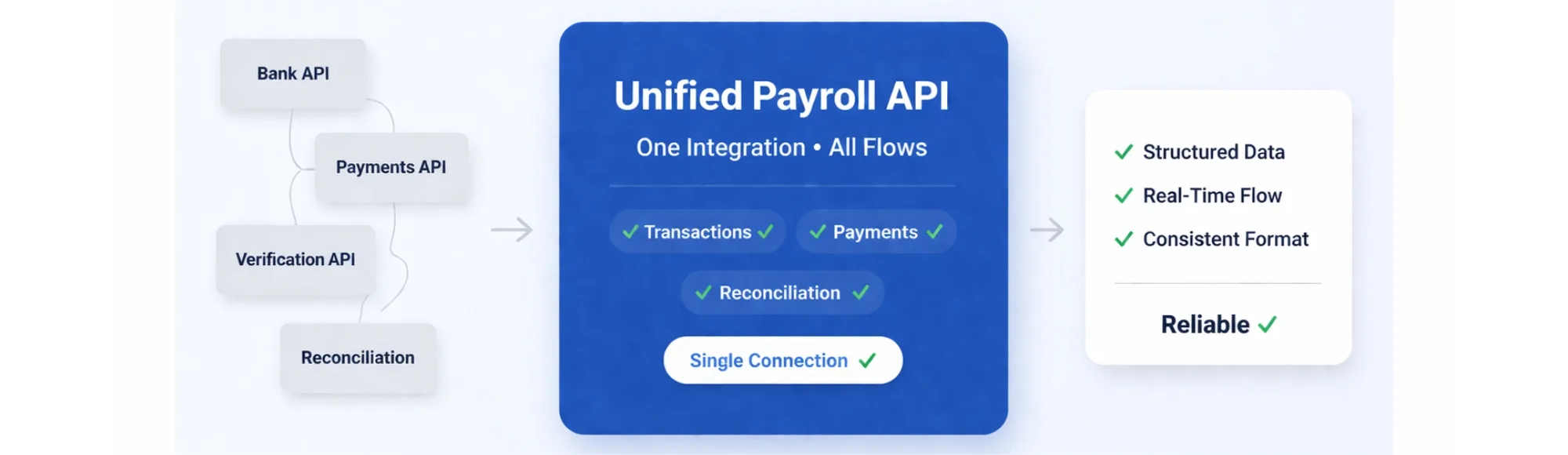
Fragmented payroll integrations are costing your platform engineering time and data reliability.
Finexer provides unified AIS and PIS infrastructure for payroll data, transactions, and disbursements.
Payroll data is not a single data type. It is a collection of financial flows – salary transactions, tax disbursements, deduction records, and payment confirmations – that most platforms try to access through separate integrations for each workflow.
At Finexer, I work with SaaS builders and fintech teams that have built payroll data infrastructure on three or four separate API connections. One for bank transaction data. One for payment initiation. One for income verification. Each integration adds maintenance overhead, creates data format inconsistencies, and introduces failure points the platform has to manage independently.
The consolidation argument is straightforward. What is payroll data operationally is a combination of read access to transaction history and write access to payment initiation – both covered by FCA-authorised AIS and PIS through a single integration. This blog covers why fragmented integration architecture fails at scale and how a unified API layer resolves it.
TL;DR
Payroll data covers salary transactions, income verification, disbursement flows, and reconciliation records. Most platforms access these through multiple separate integrations – creating engineering overhead, format inconsistencies, and independent failure points per connection. A unified API via FCA-authorised AIS and PIS consolidates payroll data access and payment initiation into a single integration layer. Finexer provides that infrastructure for UK payroll SaaS and fintech platforms.
Key Takeaways
What is payroll data at the platform infrastructure level?
Payroll data at infrastructure level is the combination of bank transaction records showing salary receipts, payment initiation for disbursements, and income pattern data used for verification and reconciliation. It is not a single dataset – it is multiple financial flows that need a consistent data layer.
Why do fragmented payroll integrations create engineering problems?
Each separate integration requires its own authentication, data format handling, error management, and maintenance cycle. At scale, managing three or four payroll data connections multiplies engineering overhead and creates data inconsistencies between systems.
What does a unified API replace in a payroll data stack?
A unified AIS and PIS integration replaces separate connections for transaction data retrieval, payment initiation, income verification, and disbursement confirmation – consolidating the full payroll data workflow into one API layer with consistent outputs.
Which platforms have the most to gain from consolidating payroll data infrastructure?
Payroll SaaS platforms initiating disbursements and reconciling salary transactions, fintech tools building income verification features, and ERP systems managing multi-employer payroll workflows all benefit from reducing integration complexity to a single connection.
Why Does Fragmented Payroll Data Infrastructure Fail at Scale?
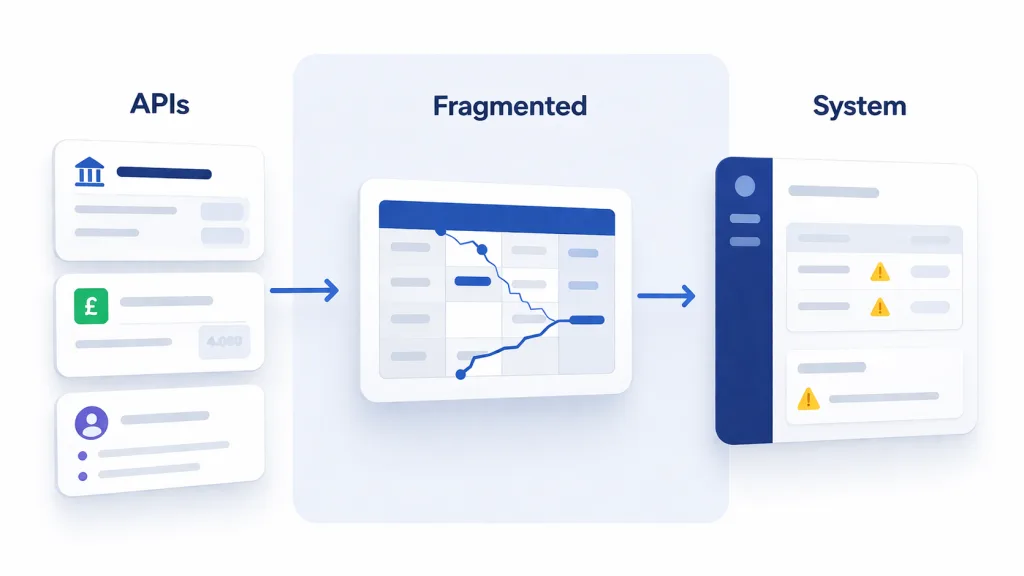
What Does Fragmentation Actually Look Like in a Payroll Platform?
Most payroll platforms did not start with a fragmented architecture. They started with one integration – typically bank transaction data access – and added connections as feature requirements expanded.
Income verification required a separate data provider. Disbursement initiation required a payment API. Reconciliation required another transaction feed. Each addition made sense at the time. The problem compounds when each of those connections needs to be maintained, monitored, and debugged independently.
A typical fragmented payroll data stack looks like this:
- Bank transaction feed via one AIS provider for income verification
- Separate payment initiation API for salary disbursements
- Another data connection for reconciliation and reporting
- Manual steps to normalise data formats between each source
“At Finexer, I work with payroll SaaS teams that spend a meaningful portion of their engineering sprint on integration maintenance rather than product development. The problem is not any single integration – it is the accumulated overhead of managing multiple separate connections that were never designed to work together.” – Ravi, Finexer
Why Do Format Inconsistencies Compound Across Multiple Integrations?
What is payroll data worth operationally if transaction records from one provider do not match the format expected by the reconciliation layer built on another?
Each API provider returns payroll data in its own schema. Transaction references, amount representations, date formats, and categorisation logic all differ. Platforms building on multiple sources inherit the normalisation problem – engineering resource spent translating between schemas rather than building product features.
How payroll data platforms verify salary using bank transaction data covers the verification workflow specifically – the data consistency problem is the same foundation issue.
What Happens When One Payroll Integration Fails?
Fragmented integration infrastructure does not fail gracefully. When a single integration in the stack becomes unavailable – bank feed downtime, API rate limits, authentication failures – the downstream workflows that depend on it break independently.
A disbursement confirmation that depends on one API and a reconciliation check that depends on another cannot both be guaranteed at the same time. Each independent failure point requires independent monitoring, alerting, and recovery logic.
Open Banking payroll disbursement API for payroll platforms covers the disbursement side specifically – the consolidation argument is the same regardless of which workflow is primary.
What Is Payroll Data in a Unified API Context?
Why Do AIS and PIS Together Cover the Full Payroll Workflow?
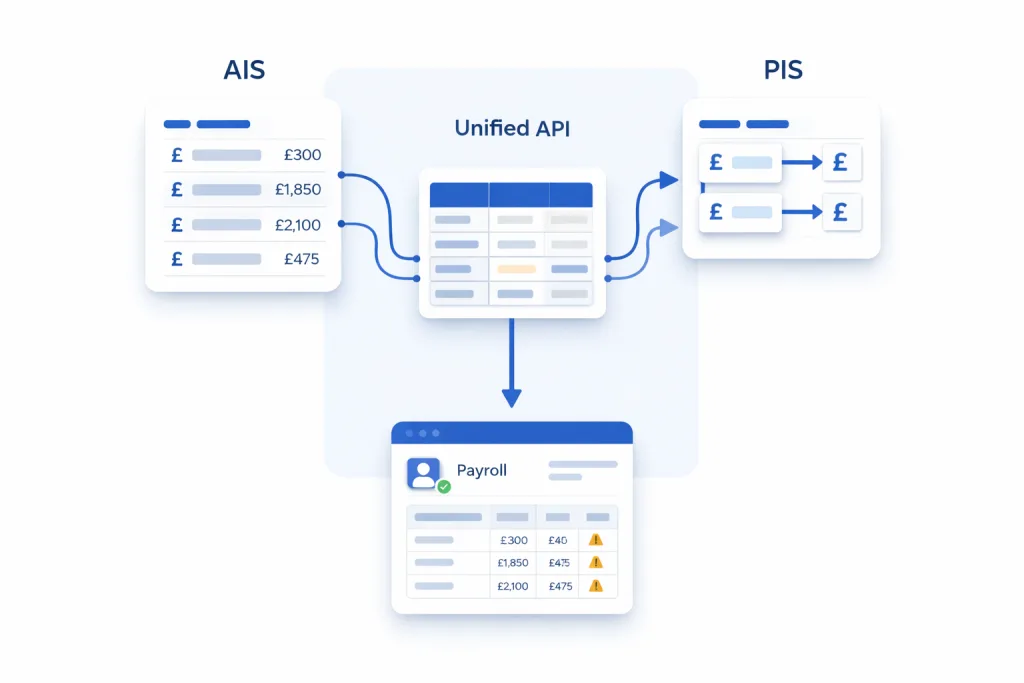
What is payroll data from a unified API perspective? It is the combination of two regulated Open Banking services that together cover every workflow a payroll platform needs:
- AIS (Account Information Services) – read-only access to bank transaction history. Salary receipt identification, income pattern analysis, balance verification, historical transaction data for reconciliation.
- PIS (Payment Initiation Services) – payment initiation from bank accounts. Salary disbursements, bulk payouts, contractor payments, tax disbursements via Faster Payments.
Both services run through a single FCA-authorised provider. One integration. One authentication flow. One data format. One point of maintenance.
| Payroll Data Workflow | Fragmented Approach | Unified API (AIS + PIS) |
|---|---|---|
| Salary transaction data | Separate AIS provider, own schema and authentication | Single AIS connection, standardised JSON output |
| Income verification | Separate provider or manual payslip upload | Same AIS connection – transaction history covers verification |
| Salary disbursement | Separate payment API, own integration and error handling | PIS via same provider – one integration covers initiation |
| Reconciliation data | Third connection or manual export from bank statement | AIS transaction feed with timestamps and references per event |
| Integration maintenance | 3-4 separate connections to monitor and maintain | Single provider relationship – one point of maintenance |
| Data format consistency | Normalisation required between each source | Consistent schema across AIS and PIS outputs |
What Does GOV.UK Require from Payroll Records?
GOV.UK payroll records guidance sets out the regulatory requirements for what payroll data employers must maintain – covering payment records, tax deductions, and national insurance contributions.
For platforms, this means the platform infrastructure must produce records that are not just operationally useful but audit-ready. A unified API that delivers structured, timestamped transaction data with payment references provides a better foundation for compliance records than fragmented data sources that require manual reconciliation before they can support regulatory review.
How Does Finexer Support Unified Payroll Data Infrastructure?
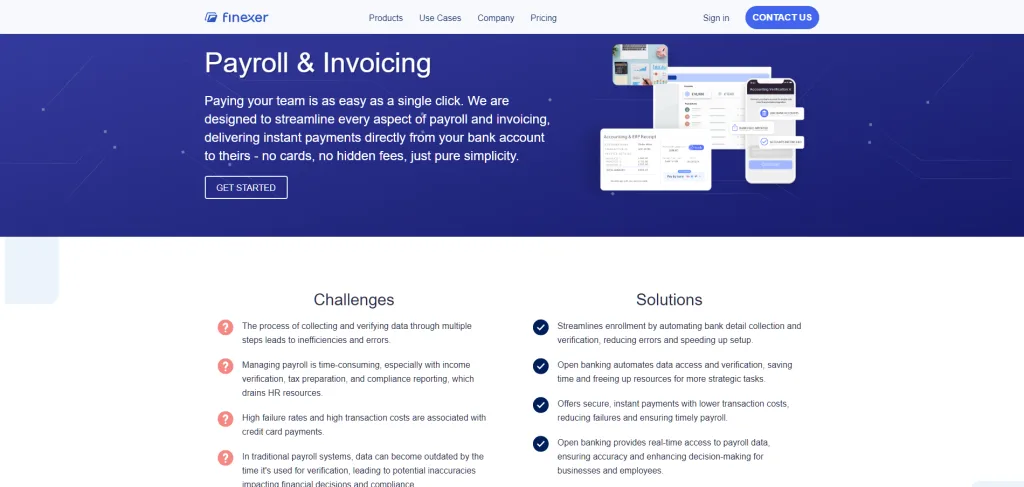
For payroll SaaS platforms and fintech teams building payroll data workflows – Finexer’s FCA-authorised AIS and PIS provides the unified infrastructure layer that replaces multiple fragmented integrations with a single connection covering transaction data, payment initiation, and reconciliation.
Payroll reconciliation automation for UK platforms covers how platforms build reconciliation workflows on top of unified bank data infrastructure.
What Does Finexer’s Unified Infrastructure Provide?
- FCA-authorised AIS and PIS – both services through a single integration
- Salary transaction identification from bank transaction history
- Bulk Payout and Payout for salary and contractor disbursements via Faster Payments
- Real-time webhooks for disbursement confirmation and transaction events
- Standardised JSON output – consistent schema across AIS and PIS
- Connects to almost all major UK banks – high street, challenger, and business banking providers
- Up to 7 years of transaction history for income verification and compliance
- White-label consent flows under the platform’s own brand
- Usage-based pricing – no fixed monthly minimums, scales with volume
- 3-5 weeks onboarding support to reach production deployment
“The payroll platforms that consolidate onto a single AIS and PIS provider stop spending engineering resources on integration maintenance and start spending it on products. That is the operational shift unified infrastructure makes possible.” – Ravi, Finexer
What I Feel
What is payroll data for most SaaS builders is a product requirement list – transaction history, disbursement API, reconciliation feed. Each item gets an integration. The integrations accumulate. The maintenance burden compounds quietly until it becomes a recurring sprint cost.
The infrastructure consolidation argument is not about Finexer specifically. It is about the engineering economics of running three or four separate connections versus one.
Open Banking for payroll and invoicing platforms covers the broader workflow consolidation case for platforms managing both payroll and invoicing data through Open Banking infrastructure.
Platforms that consolidate early spend less engineering time on plumbing and more on the product features that actually differentiate them. The ones that delay do not – they spend it on maintaining integrations that were never designed to work together.
Common Use Cases
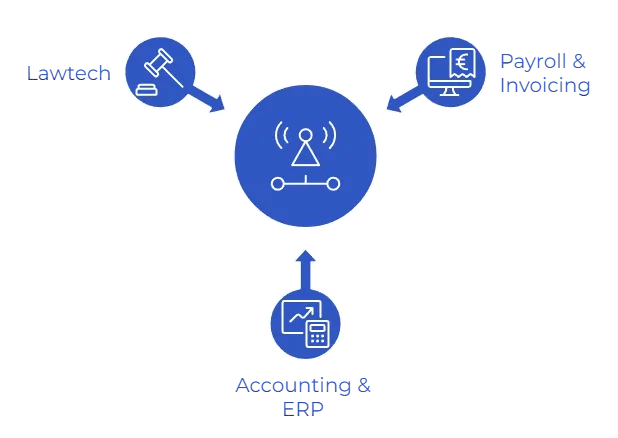
Payroll & Invoicing Platforms
Multiple integrations for transaction data, disbursements, and reconciliation create engineering overhead that compounds with client volume. Finexer’s unified AIS and PIS eliminates separate connections – covering salary data access and disbursements through a single integration with consistent structured outputs.
Accounting & ERP Platforms
ERP platforms managing payroll data for multiple employer clients need consistent transaction records across all client bank accounts. Finexer’s AIS delivers standardised transaction records per account – removing the normalisation overhead of multiple payroll data sources.
Lawtech Platforms
LawTech platforms verifying client income and employment records for case preparation need verified salary transaction history that is independently confirmable. Finexer’s FCA-authorised AIS provides bank-authenticated salary transaction history with consent logs – supporting income verification without document dependency.
What is payroll data for UK SaaS and fintech platforms?
Payroll data at platform level is the combination of bank transaction records showing salary receipts, payment initiation capability for disbursements, and income pattern data for verification and reconciliation. It covers multiple financial flows that ideally run through a single unified API layer.
What is meant by payroll data in the context of Open Banking?
In an Open Banking context, payroll data refers to salary transactions accessible via FCA-authorised AIS – verified bank records showing payment amounts, dates, frequency, and employer references. PIS extends this to initiating salary disbursements directly from bank accounts via Faster Payments.
Why do fragmented payroll integrations create problems at scale?
Each separate integration requires independent authentication, format handling, error management, and maintenance. At scale, the accumulated overhead of managing multiple connections reduces engineering capacity for product development and creates data consistency problems between systems.
Replace fragmented payroll integrations with unified AIS and PIS infrastructure.
About the Author

Ravi Ranjan
Ravi Ranjan is Co founder & CEO of Finexer