
Pay employees with confidence.
Payroll doesn’t end when the payslip is generated. Discover how modern payroll processing software combines RTI reporting with efficient payment execution, helping employers replace manual banking tasks with automated, API-driven salary payments.
TL;DR: Payroll Processing is more than calculating salaries. It combines gross-to-net calculations, Real Time Information (RTI) submissions to HMRC and the secure movement of employee payments. While many employers focus on payroll calculations, the biggest operational difference often lies in how salaries are actually paid, whether through traditional BACS files or API-driven Faster Payments infrastructure.
Introduction
Payroll only feels invisible when it works.
Employees expect to be paid accurately and on time. Finance teams expect payroll to close without last-minute corrections. HMRC expects Real Time Information (RTI) submissions before employees are paid. Miss any one of those expectations and payroll quickly becomes the most visible process in the business for all the wrong reasons.
“Payroll isn’t finished when salaries are calculated. It’s finished when employees receive the right amount, HMRC has the correct information, and finance teams know every payment has settled exactly as expected.” – Ravi Ranjan, Finexer
At Finexer, we work with payroll, accounting and ERP providers integrating Open Banking payment infrastructure into their products. Across these implementations, one lesson appears repeatedly: calculating payroll has become highly automated, but payment execution often remains tied to manual banking processes that haven’t kept pace with modern software.
The Challenge with Payroll Processing Today
Modern Payroll Processing succeeds only when calculations, compliance and payments work together.
Most payroll software calculates tax, National Insurance contributions, pension deductions and net salary accurately. The bottleneck usually appears afterwards, when salary payments must leave the payroll system and reach employee bank accounts.
Many employers still follow a familiar process:
- Complete payroll calculations.
- Generate payslips.
- Export a BACS payment file.
- Log into an online banking portal.
- Upload the payment file manually.
- Wait for confirmation.
The calculations may take minutes.
The payment process can still take days.
For organisations running payroll across multiple legal entities, contractors or international teams, those manual steps introduce unnecessary operational risk. Incorrect files, missed cut-off times and delayed payment confirmations create work that payroll software alone cannot eliminate.
What Payroll Processing Actually Includes
Payroll Processing is the complete workflow that transforms employee pay information into compliant salary payments.
Although many employers associate payroll with payslips, the process involves several distinct stages.
1. Gross-to-net calculations
Payroll software calculates:
- Income Tax
- National Insurance contributions
- Workplace pension deductions
- Student loan repayments
- Other deductions and benefits
These calculations determine each employee’s net pay.
2. RTI submission
Before employees are paid, employers submit Real Time Information (RTI) to HM Revenue & Customs (HMRC).
RTI allows HMRC to receive payroll information whenever employees are paid, helping maintain accurate tax records throughout the year.
3. Salary payment execution
Once calculations and reporting are complete, salaries must move from the employer’s bank account to employees’ accounts.
This stage is often overlooked during software selection, yet it has a direct impact on payment speed, operational efficiency and employee experience.
What to Look for in Payroll Processing Software
Choosing payroll processing software should involve more than comparing payroll calculations.
Use these five criteria when evaluating solutions.
1. Accurate payroll calculations
The software should correctly calculate PAYE, National Insurance, pensions and statutory payments while remaining aligned with current HMRC requirements.
2. RTI support
RTI submission should be fully integrated into payroll workflows, allowing employers to submit Full Payment Submissions (FPS) and other required returns without leaving the software.
3. Flexible payment execution
Good software should support the payment methods that match your operational needs, whether that means traditional BACS workflows or API-driven payment execution.
4. Multi-business capability
Growing organisations often need to manage multiple companies, payroll schedules or currencies from a single environment.
Software should support that growth without forcing separate implementations.
5. Integration with finance systems
Payroll rarely operates in isolation.
Integration with accounting, ERP and finance systems reduces duplicate work and improves financial reporting.
BACS or Faster Payments: Which Is Better for Payroll?
The right payment method depends on your operational priorities.
| Feature | BACS | Faster Payments |
|---|---|---|
| Typical processing | Three-working-day cycle | Instant via Faster Payments |
| Submission method | Batch file upload | API-triggered payment initiation |
| Confirmation | After settlement | Immediate status updates |
| Manual intervention | Usually required | Can be automated |
| Suitable for | Established payroll schedules | Modern software-driven payroll |
Neither approach is universally better.
BACS remains a dependable choice for many employers running predictable payroll cycles.
However, organisations building payroll platforms, embedded payroll products or businesses requiring greater flexibility increasingly evaluate API-based payment execution because it removes manual file handling and provides faster confirmation of payment status.
The Gap: Why Payroll Software Doesn’t Always Solve Payroll Payments
Most payroll processing software excels at calculations and compliance.
The gap appears after payroll has been approved.
Imagine it’s payday.
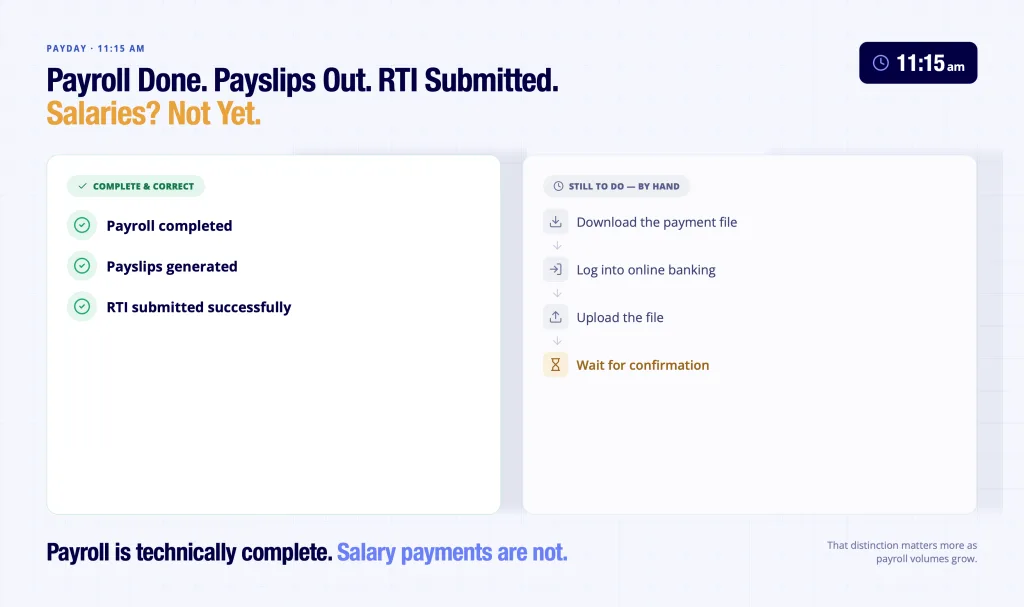
Your finance team completes payroll at 11:15 am.
Payslips have been generated.
RTI has been submitted successfully.
But someone still needs to download a payment file, log into an online banking portal, upload the file, authorise the transaction and wait for settlement.
Payroll is technically complete.
Salary payments are not.
That distinction matters.
As payroll volumes increase, the payment layer becomes another operational workflow requiring manual intervention, approval processes and post-payment verification.
Modern payroll infrastructure increasingly aims to automate that final stage as well, not by replacing payroll calculations, but by improving how authorised salary payments are executed.
Finexer’s Payments Infrastructure: Automating the Final Step in Payroll
Calculating payroll accurately is only part of the challenge.
Employees still need to be paid.
That’s where payment infrastructure becomes just as important as payroll logic.
Finexer provides the Open Banking payment infrastructure that enables payroll platforms to initiate salary payments programmatically, replacing manual banking workflows with API-driven payment execution.
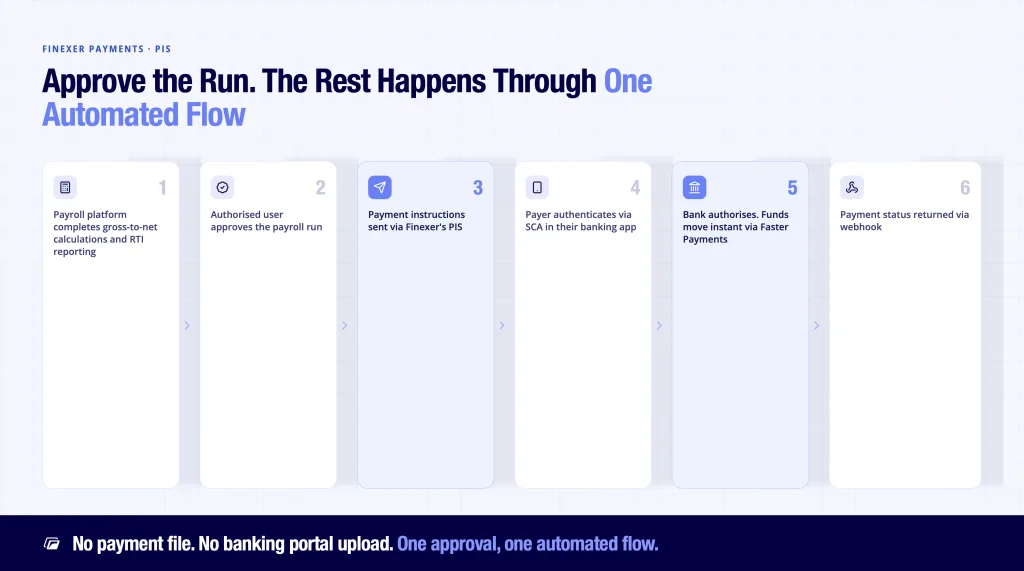
Here’s how the mechanism works:
- The payroll platform completes gross-to-net calculations and RTI reporting.
- An authorised user approves the payroll run.
- The platform sends payment instructions through Finexer’s Payment Initiation Service (PIS).
- The payer authenticates through their bank using Strong Customer Authentication (SCA).
- The bank authorises the payment.
- Funds move instant via Faster Payments.
- Payment status is returned to the payroll platform through webhooks, allowing finance systems to update automatically.
Instead of creating payment files and uploading them to banking portals, payroll platforms can manage the entire payment workflow programmatically.
For organisations evaluating embedded payment capabilities, our guide to the automated payroll processing API explains how API-driven salary payments integrate into payroll software architecture.
Why organisations choose API-driven payroll payments
Using the evaluation criteria discussed earlier, API-based payment infrastructure helps payroll platforms reduce manual intervention without changing how payroll itself is calculated.
Relevant capabilities include:
- FCA-authorised AISP and PISP (FRN925695)
- API-triggered payment initiation
- Low-latency webhook notifications
- Usage-based pricing
- 3–5 weeks onboarding support
- Almost all UK banks covered
If you’re exploring embedded salary payments, see Finexer’s Payments product for more information.
Likewise, our Payroll & Invoicing use case demonstrates how payment infrastructure supports payroll, contractor payments and business disbursements across modern finance platforms.
What Is Payroll Processing Software?
Payroll processing software calculates employee pay, manages statutory deductions and supports payroll compliance.
Modern instant payroll processing software automates gross-to-net calculations, produces payslips and submits Real Time Information (RTI) to HMRC. Such software, which is ubiquitous today in all its varied forms, also integrates with accounting systems, pension providers and HR platforms to reduce duplicate administration.
The biggest difference between payroll products often isn’t the payroll calculations themselves; they’re largely mature across established providers. The distinction increasingly lies in what happens after payroll has been approved.
Some solutions stop once payment files have been generated.
Others integrate directly with payment infrastructure, allowing authorised salary payments to be initiated programmatically without manual banking uploads.
For employers running predictable monthly payroll, traditional workflows may remain entirely appropriate. For payroll SaaS providers, multi-entity organisations and embedded finance platforms, API-based payment execution can reduce operational overhead while providing faster confirmation that salaries have reached employees.
If reconciliation after payment is your primary concern, our guide to payroll reconciliation explores how businesses validate payroll payments once they’ve been made.
Businesses analysing recurring salary patterns may also find our article on recurring transaction detection useful for understanding how recurring payment behaviour supports broader financial workflows.
Choosing Between HMRC Tools and Dedicated Payroll Software
Different employers need different levels of payroll capability.
| Solution | RTI Support | Payment Execution | Best Suited For |
|---|---|---|---|
| HMRC Basic PAYE Tools | Yes | External banking required | Small employers (fewer than 10 staff) with straightforward payroll |
| Xero Payroll | Yes | Bank export supported | SMEs already using Xero |
| Sage Payroll | Yes | BACS-compatible workflows | Growing UK businesses |
| QuickBooks Payroll | Yes | Integrated payroll workflows | SMEs using QuickBooks |
| API-enabled payroll platforms | Yes | API-driven payment initiation | SaaS platforms, embedded payroll products, large-scale payroll operations |
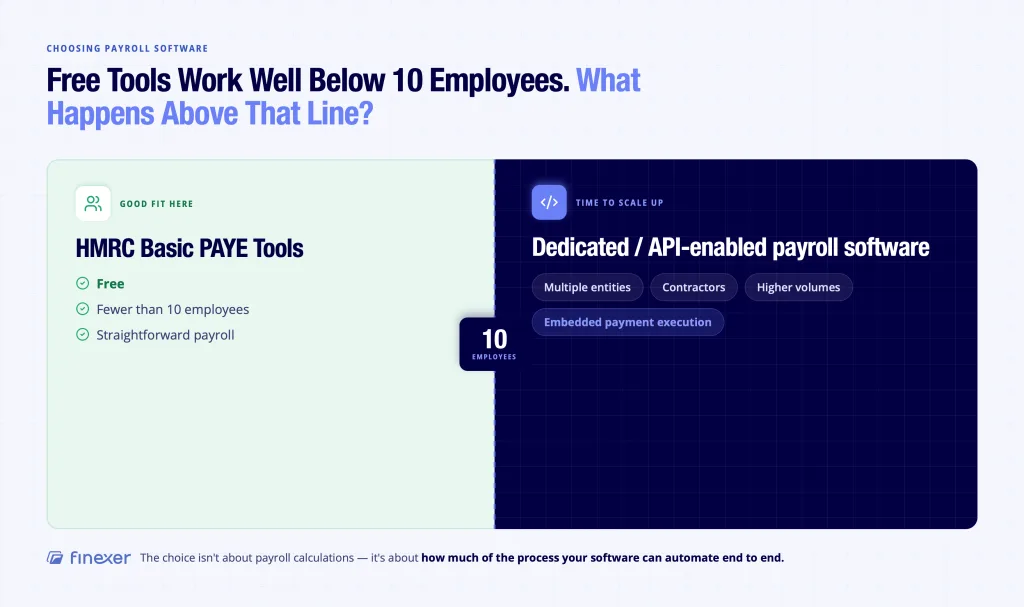
HMRC’s Basic PAYE Tools remain a free option for smaller employers with relatively simple payroll requirements.
As payroll complexity increases, with multiple entities, contractors, higher employee volumes or embedded payroll capabilities, dedicated payroll software generally offers greater automation, reporting and integration options.
The choice isn’t simply about payroll calculations.
It’s about how much of the payroll process your software can automate from beginning to end.
How does RTI work?
Real Time Information (RTI) requires employers to send payroll information to HMRC each time employees are paid. Payroll software typically prepares and submits these returns automatically as part of the payroll workflow.
How much does payroll processing software cost per employee?
Pricing varies considerably between providers. Many cloud payroll systems charge a monthly subscription plus an additional fee per employee, while enterprise payroll platforms may use custom pricing based on organisation size and functionality.
Is HMRC Basic PAYE Tools enough for small businesses?
Yes, for many small employers. HMRC Basic PAYE Tools supports RTI reporting and PAYE administration, although businesses with more complex payroll requirements often benefit from dedicated payroll software that offers broader automation and integration capabilities.
What’s the difference between BACS and Faster Payments for payroll?
BACS follows a three-working-day processing cycle and commonly relies on payment files. Faster Payments allows authorised bank transfers to be executed instantly via Faster Payments, making it suitable for organisations seeking greater payment flexibility and faster confirmation.
Can payroll software automate salary payments?
Many payroll systems automate payroll calculations but still depend on manual banking workflows. Platforms integrated with Open Banking payment infrastructure can automate payment initiation after payroll approval while maintaining appropriate authorisation controls.
Modern payroll deserves modern payment infrastructure.
See how Finexer’s Payments product helps payroll platforms automate salary payments through Open Banking, replacing manual banking workflows with API-driven payment execution and real-time payment status.
Explore with AI
About the Author

Ravi Ranjan
Ravi Ranjan is Co founder & CEO of Finexer