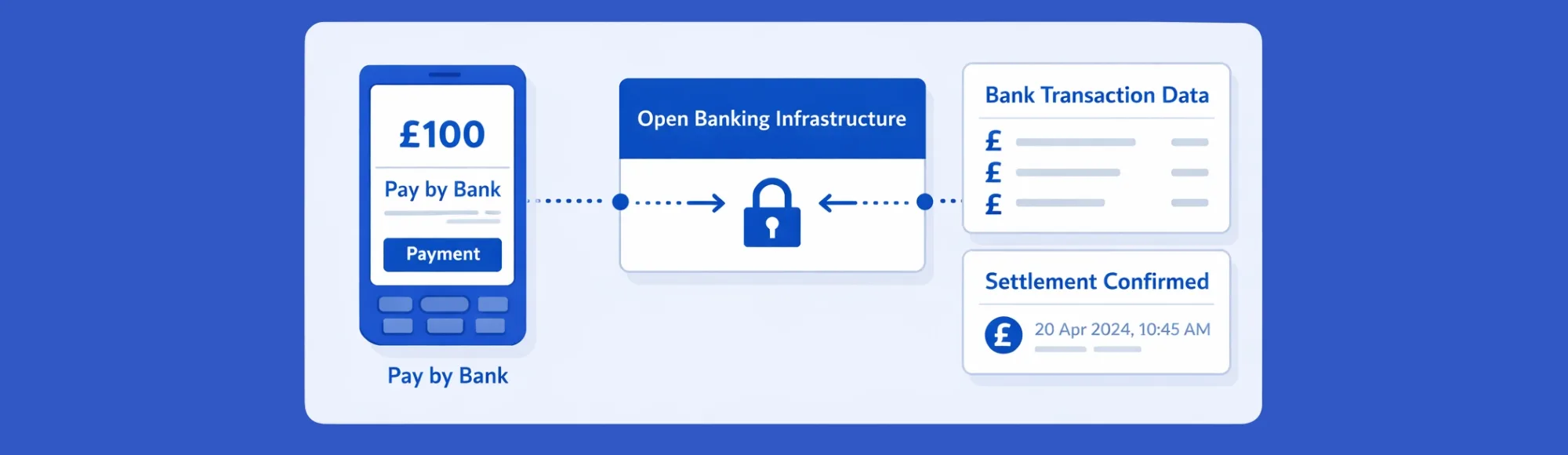
Processing Pay by Bank payments at POS?
Finexer gives EPOS platforms verified bank transaction data – instant confirmation, API-ready.
Accepting a payment is step one. Confirming it settled, matching it to the right record, and reconciling it against your POS system is where the operational complexity starts.
For EPOS platforms and retail payment systems processing Pay by Bank payments, the gap between payment initiation and verified settlement creates reconciliation problems that card payment workflows did not have. POS bank statement data fills that gap – giving platforms bank-verified confirmation of every transaction.
At Finexer, we work directly with EPOS platforms and POS software providers integrating pay by bank open banking infrastructure into their payment workflows. The reconciliation question comes up consistently – how do you confirm settlement and match transactions without waiting for end-of-day reports?
This blog is written for Product Managers and Engineering teams at EPOS platforms and retail payment systems evaluating Open Banking infrastructure for Pay by Bank payments and transaction reconciliation.
TL;DR
A pos bank statement contains the bank transaction records generated from POS payments – confirming settlement, merchant details, and transaction amounts from source. Finexer provides FCA-authorised PIS infrastructure for pay by bank open banking payments and AIS for bank transaction verification – enabling EPOS platforms to automate reconciliation and confirm settlement in real time.
Key Takeaways
What is a POS bank statement for EPOS platforms?
A pos bank statement refers to the bank transaction records generated when POS payments settle – showing confirmed transaction amounts, merchant identifiers, and settlement timestamps directly from the bank account.
Why is POS payment reconciliation difficult without bank transaction data?
Card payment settlements arrive through intermediary processors with variable timing. Without direct bank transaction visibility, POS platforms cannot confirm settlement instantly or detect mismatches until end-of-day reports arrive.
How does pay by bank open banking improve POS reconciliation?
Pay by bank open banking initiates payments directly from the customer’s bank account. Combined with AIS bank transaction data, EPOS platforms receive both payment initiation confirmation and settlement verification in one infrastructure layer.
What causes reconciliation mismatches in POS systems?
Delayed settlement data from card processors, inconsistent transaction references across payment methods, and manual matching processes that cannot keep pace with transaction volume all contribute to POS reconciliation errors.
How does Finexer support EPOS platforms with POS reconciliation?
Finexer provides PIS for pay by bank open banking payment initiation and AIS for bank transaction verification – giving EPOS platforms real-time settlement confirmation and structured transaction data for automated reconciliation.
What Is a POS Bank Statement?
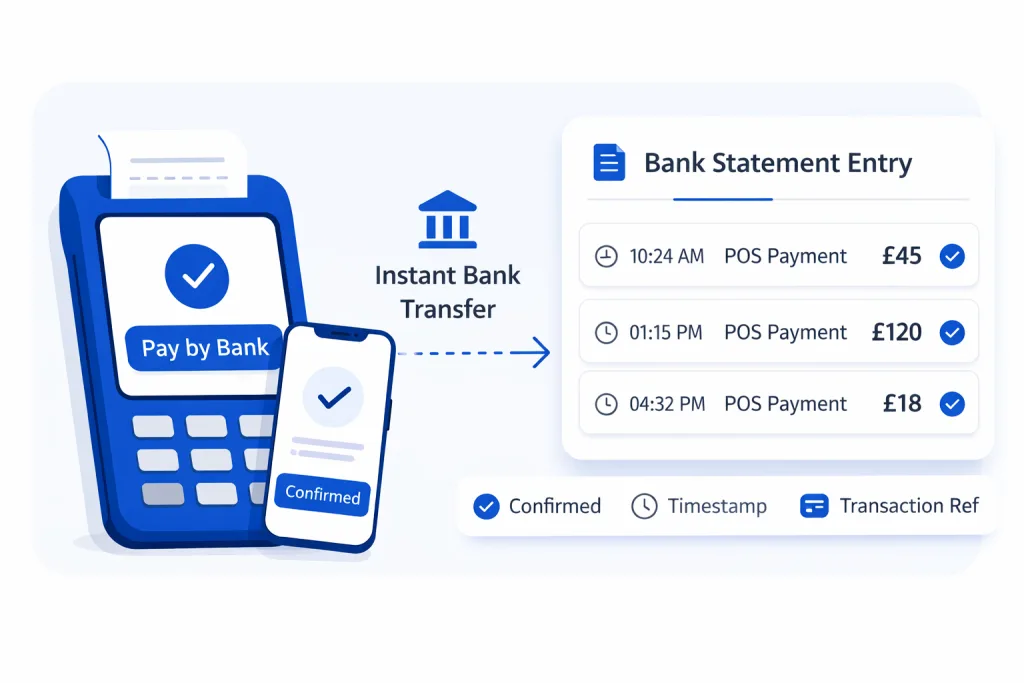
A pos bank statement is the record of transactions that appear in a bank account when POS payments settle. For EPOS platforms, these records are the source of truth for payment confirmation.
When a customer pays using Pay by Bank at a POS terminal, the transaction flows directly from their bank account to the merchant’s account via Open Banking. The resulting pos bank statement entry confirms:
- Payment amount and settlement timestamp
- Merchant identifier and transaction reference
- Account details of both payer and payee
- Payment status – completed, pending, or failed
This is different from card payment records, which pass through processor networks before appearing in bank accounts. Pay by bank open banking transactions appear directly in bank statement data – with no intermediary delay.
“A pos bank statement entry from a Pay by Bank transaction is as close to real-time settlement confirmation as a platform can get.” – Finexer, working with UK EPOS infrastructure teams
Why Is POS Payment Reconciliation Difficult Without Bank Data?
Most EPOS platforms begin with card-based payment infrastructure. Reconciliation works by matching POS records against processor settlement reports – a process that is functional but slow and prone to mismatches.
The Core Reconciliation Problems
Settlement timing gaps. Card processor settlement reports typically arrive at end of day or later. POS platforms cannot confirm individual transaction settlement in real time – creating a window where payment status is unknown.
Mismatched transaction references. Card payments generate multiple reference numbers across terminal, processor, and bank. Matching these references manually across systems creates reconciliation errors at volume.
Refund and chargeback visibility. Refunds and chargebacks appear in processor reports with variable timing. Without direct bank transaction visibility, EPOS platforms discover discrepancies after the fact – not at point of transaction.
Manual reconciliation at scale. For platforms processing hundreds or thousands of daily transactions, manual matching consumes significant ops resource and introduces errors that compound over time.
How EPOS systems evolve with Open Banking explains how payment infrastructure changes when platforms move from card-only to Open Banking-enabled payment acceptance.
How Does Pay by Bank Open Banking Work in POS Systems?
Pay by bank open banking replaces card payment initiation with a direct bank-to-bank transfer. The customer pays from their bank account rather than through a card network.
The payment flow works like this:
- Customer selects Pay by Bank at POS checkout
- Customer is redirected to their bank’s authentication screen
- Strong Customer Authentication is completed via banking app
- Payment is initiated directly from the customer’s bank account via PIS
- POS platform receives real-time payment confirmation via webhook
- Bank transaction record is generated confirming settlement
No card network. No processor intermediary. No end-of-day settlement report.
For EPOS platforms, this changes reconciliation entirely. Payment confirmation arrives in real time. The pos bank statement entry is generated at point of transaction – not hours later.
Open Banking for EPOS retail payments covers the payment initiation layer in detail.
How Should EPOS Platforms Evaluate POS Reconciliation Infrastructure?
| Criteria | Why It Matters | What to Look For |
|---|---|---|
| Payment Initiation Speed | POS environments require instant payment confirmation at point of transaction | Real-time PIS confirmation; webhook-driven payment events; instant settlement signals |
| Bank Transaction Verification | Reconciliation requires bank-verified settlement data, not just initiation confirmation | AIS connectivity; structured pos bank statement data; real-time transaction feeds |
| UK Bank Coverage | Pay by Bank only works if the customer’s bank is supported | 99% UK bank coverage; CMA9 and challenger banks; consistent across institutions |
| Refund and Failure Handling | EPOS platforms need real-time visibility into failed payments and refund status | Webhook failure notifications; refund transaction tracking; instant status updates |
| Structured Data Output | Automated reconciliation requires consistently formatted transaction records | Structured JSON outputs; merchant identifiers; transaction references; amount data |
| Integration Speed | Faster deployment reduces time-to-value for payment engineering teams | 2-3x faster integration vs alternatives; 3-5 weeks onboarding support |
How Does Finexer Enable POS Bank Statement Reconciliation?
Finexer provides FCA-authorised Open Banking infrastructure combining PIS for pay by bank open banking payments and AIS for bank transaction verification – giving EPOS platforms both sides of the reconciliation workflow in one integration.
What Finexer Provides for EPOS Platforms
- PIS infrastructure for Pay by Bank payment initiation at POS
- Real-time payment confirmation via webhooks at point of transaction
- AIS connectivity for bank transaction verification and pos bank statement data access
- 99% UK bank coverage for consistent payment acceptance across customers
- Structured transaction outputs with merchant identifiers and settlement data
- Instant failed payment detection via webhook-driven transaction events
- White-label capability for branded payment journeys
- 2-3x faster integration with 3-5 weeks onboarding support
- Usage-based pricing with no minimum volume commitments
Platforms integrate once and get both payment initiation and transaction verification from the same infrastructure layer. Engineering teams do not need separate providers for PIS payments and AIS reconciliation data.
Finexer does not provide POS terminal software, payment front-ends, or merchant reporting tools. EPOS platforms build those product layers on top of Finexer’s payment and transaction infrastructure.
Finexer EPOS use cases covers the full product capabilities available for EPOS platform integration.
What We See in Practice
EPOS platforms integrating pay by bank open banking infrastructure follow a consistent pattern. Initial deployment focuses on payment acceptance – enabling Pay by Bank as an alternative to card at checkout.
The reconciliation benefit becomes clear within the first weeks of transaction volume. Real-time pos bank statement data eliminates the end-of-day settlement report dependency that card payment infrastructure requires. Finance teams confirm settlement at transaction level – not batch level.
A pattern we observe consistently: a UK EPOS platform moves from card-only payment acceptance to Finexer’s PIS infrastructure for Pay by Bank. Within six weeks, the same platform integrates AIS to automate daily reconciliation – removing the manual matching process that previously consumed significant ops time at month end.
“Pay by bank open banking does not just reduce card processing costs. It changes how reconciliation works – settlement confirmation arrives with the payment, not after it.” – Finexer, working with UK EPOS and retail payment platforms
EPOS platforms combining Finexer’s PIS and AIS infrastructure report:
- Real-time payment confirmation replacing end-of-day settlement reports
- Fewer reconciliation mismatches from automated bank transaction matching
- Reduced card processing costs from Pay by Bank adoption
- Earlier failed payment detection through webhook-driven transaction events
Common Use Cases
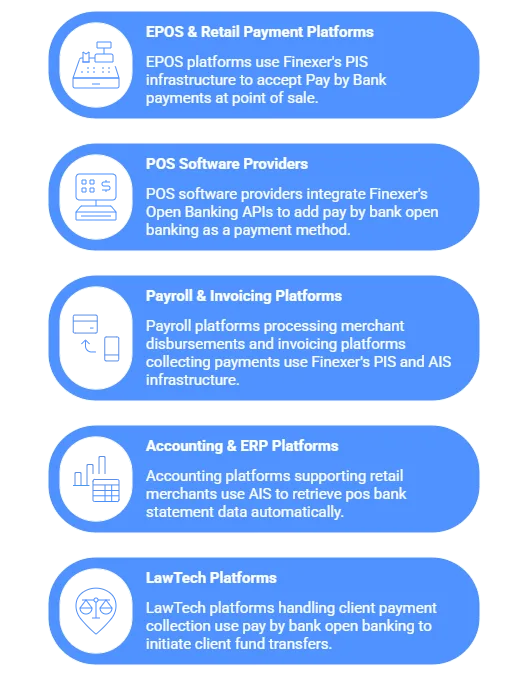
EPOS & Retail Payment Platforms
EPOS platforms use Finexer’s PIS infrastructure to accept Pay by Bank payments at point of sale. Real-time payment confirmation via webhooks eliminates settlement delays. AIS connectivity provides pos bank statement data for automated transaction matching – replacing manual end-of-day reconciliation processes.
POS Software Providers
POS software providers integrate Finexer’s Open Banking APIs to add pay by bank open banking as a payment method alongside existing card acceptance. Structured bank transaction data powers reconciliation reporting directly within the POS software – without requiring merchants to download separate settlement reports.
Payroll & Invoicing Platforms
Payroll platforms processing merchant disbursements and invoicing platforms collecting payments use Finexer’s PIS and AIS infrastructure to initiate payments and verify settlement. Pos bank statement data confirms each transaction completed – supporting accurate financial records for accounting and audit workflows.
Accounting & ERP Platforms
Accounting platforms supporting retail merchants use AIS to retrieve pos bank statement data automatically – replacing manual bank statement uploads for reconciliation. Verified transaction records from POS payments map directly to accounting entries without manual data entry.
LawTech Platforms
LawTech platforms handling client payment collection use pay by bank open banking to initiate client fund transfers and AIS to verify settlement. Bank-confirmed pos bank statement records support the compliant financial audit trails that regulated legal workflows require.
What is POS on a bank statement?
POS on a bank statement refers to a Point of Sale transaction – a payment made using a debit or credit card at a physical or digital checkout. Under Open Banking, POS payments made via Pay by Bank appear as direct bank-to-bank transfers in the pos bank statement – with real-time settlement confirmation rather than delayed processor reports.
How does pay by bank open banking work at point of sale?
Pay by bank open banking works by initiating a direct payment from the customer’s bank account at checkout via Payment Initiation Services. The customer authenticates through their banking app, the payment is initiated instantly, and the EPOS platform receives real-time confirmation via webhook – with bank transaction data confirming settlement.
Is Finexer suitable for EPOS platforms processing Pay by Bank payments?
Yes. Finexer is FCA-authorised and provides both PIS for pay by bank open banking payment initiation and AIS for bank transaction verification – covering 99% of UK banks. EPOS platforms integrate Finexer’s infrastructure to accept Pay by Bank payments and automate pos bank statement reconciliation within one API integration.
Automate POS reconciliation with verified bank transaction data.
About the Author

Finexer
The Finexer Team is a collective of fintech engineers, payments specialists, and Open Banking experts working on financial infrastructure for UK businesses. Finexer builds API-driven solutions that allow companies to access real-time bank data, initiate Pay by Bank payments, and integrate financial services directly into their products.