Stop reconciling stale numbers.
See the balance that’s actually there before you act on it.
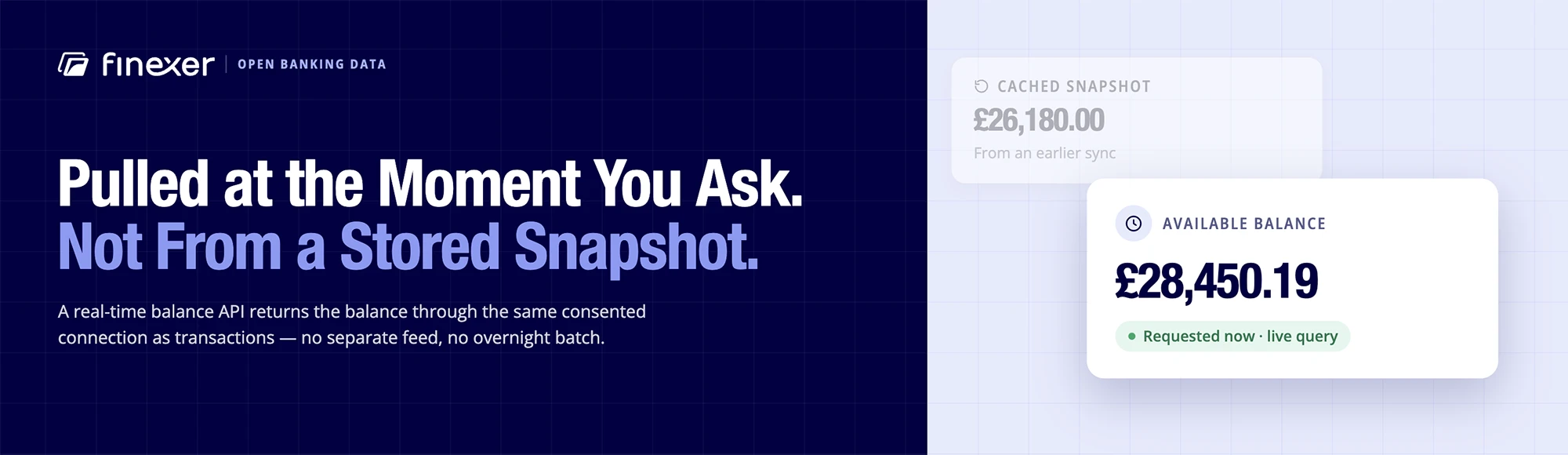
A real-time balance API returns balance data through the same consented connection used for transactions, pulled at the point you request it rather than from a stored snapshot. There’s no separate feed and no overnight batch involved.
That single design choice is what separates a live balance check from a cached one, and it’s worth understanding before it affects a payment decision.
| Balance Type | What It Shows | When It Changes |
|---|---|---|
| Current balance | Confirmed, cleared funds | Only on settled transactions |
| Available balance | Current balance minus pending holds | Updates as pending transactions clear or drop off |
Why Do Current and Available Balance Differ?
Current balance reflects only cleared, settled transactions. The available balance subtracts anything pending: a card authorisation, a hold or a payment that’s left the account but hasn’t fully settled.
The gap between the two is where most balance-related errors happen. A platform reading the current balance alone can see funds that are already spoken for elsewhere.
What Does a Balance Check Actually Tell You?
A balance check is a point-in-time figure. It confirms what the account shows at the moment of the request, nothing more.
It does not guarantee the funds will still be there a minute later. Another transaction, standing order or card payment can clear in between the check and any action taken on it.
This is not a gap in the data. It’s how any live account works, banking data included, and platforms that treat a balance check as a hold on funds are building on an assumption the check itself doesn’t make.
Where Do Platforms Use Real-Time Balance Data?
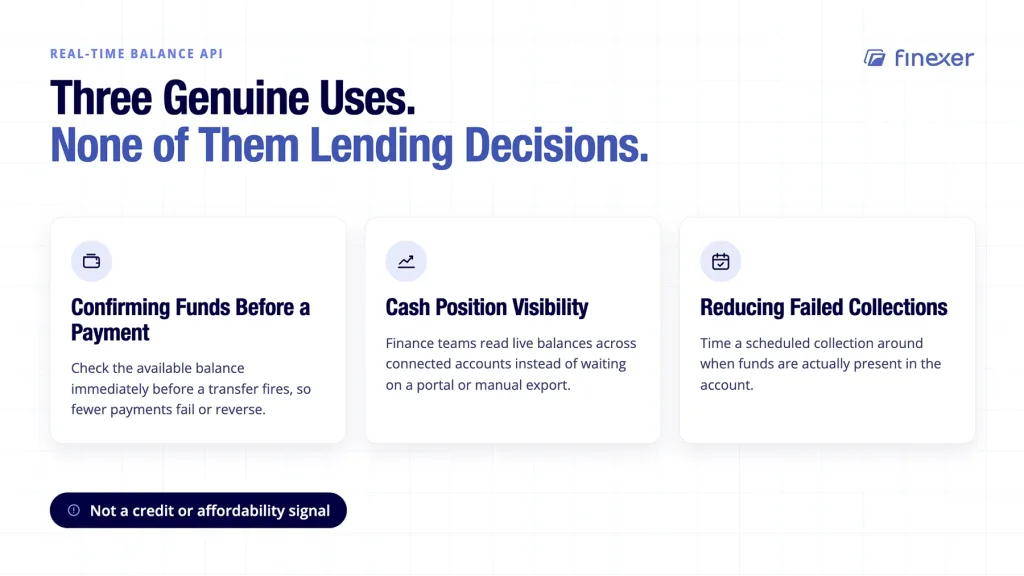
Three use cases account for most production requests against balance data:
- Confirming funds before initiating a payment. Checking the available balance immediately before a transfer reduces the chance of a failed or reversed payment.
- Cash position visibility. Finance teams pull live balances across connected accounts instead of waiting on a banking portal or a manual export.
- Reducing failed collections. Subscription and invoicing platforms check the balance ahead of a scheduled collection date, timing the attempt around when funds are likely present.
None of these are credit or affordability decisions. A balance check confirms funds at a moment in time; it isn’t a signal for lending eligibility, and using it that way misreads what the data actually represents.
How Does the Refresh Constraint Work?
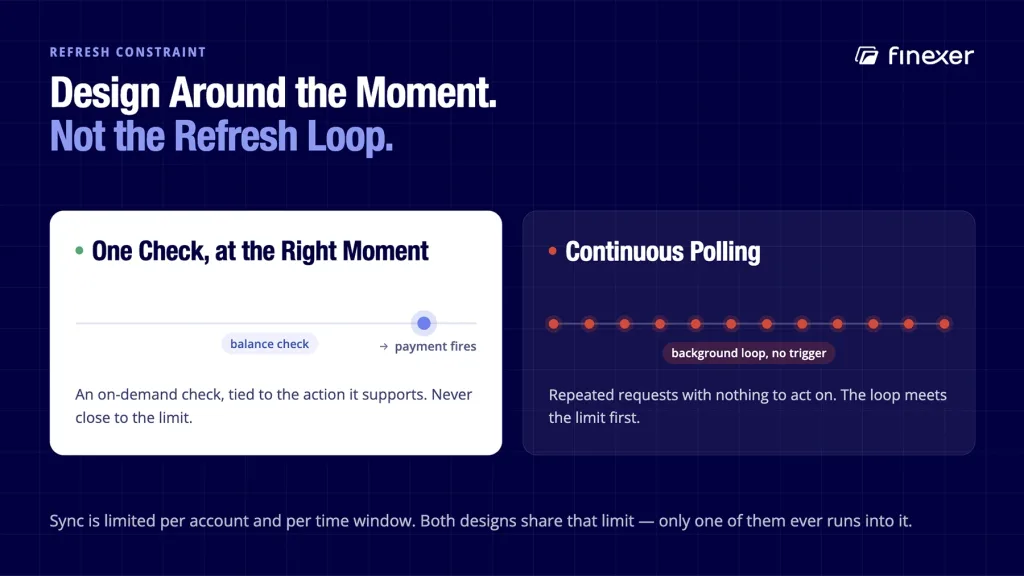
Bank account sync is limited per account and per time window. The exact figures vary by bank and change without much notice, so the number itself isn’t the useful part.
What matters is the design implication: A real-time balance API is built for on-demand checks at meaningful moments, such as immediately before a payment fires, but not for continuous polling in the background.
Platforms that poll constantly hit the same limit that platforms checking once, at the right moment, never approach. Design the balance check around the action it supports and not around a refresh loop.
How Does This Compare Across Providers?
Not every provider handles balances in the same manner. Two designs dominate the market, and the difference matters more than most buyer checklists capture:
- Live query on request: The provider calls the bank at the moment you ask, returning what the account shows right then.
- Cached or batched balance: The provider stores a balance from an earlier sync and serves that until the next scheduled refresh.
A cached balance can be minutes or hours old by the time it’s read, which defeats the purpose for a pre-payment check. The gap rarely shows up in a demo, since demo accounts don’t move money in real time, but it shows up fast once real transactions start clearing mid-session.
Finexer’s bank data API uses the live query model: each balance request calls the bank at that moment, rather than serving a stored figure from an earlier sync.
Standard bank transaction data and balance data typically share the same consented connection, which is why platforms building an AIS API for SaaS platforms usually request both together rather than integrating them separately.
Balance visibility also sits alongside how people track money from day to day. Many buyers researching this compare it against what third-party banking apps already show consumers and then ask why their own platform can’t offer the same view natively.
Does checking a balance count as initiating a payment?
No. A balance check is an account information request. Initiating a payment is a separate action, handled through a different consent and a different API call.
Can real-time balance data be used for credit or affordability decisions?
No. It confirms funds at a point in time and not creditworthiness. Lending and affordability decisions need a different kind of assessment entirely.
How is balance data different from a bank statement PDF?
A PDF statement is a static document generated on a schedule. Balance data reflects the account at the exact moment of the API request.
Does available balance include pending transactions I haven’t seen yet?
It includes any pending transaction already recognised by the bank’s own systems. It cannot show a transaction the bank hasn’t processed at all.
Confirming funds after a payment fails is too late
Finexer’s banking data API returns live balance data through the same connection as transactions, so platforms check before they act and not after they reconcile.
Explore with AI
About the Author

Yuri
Yuriy Yakushko is a fintech founder and software engineer with over 20 years of experience building financial technology. He’s passionate about creating scalable, secure infrastructure that helps businesses modernise how they access financial data and manage payments.