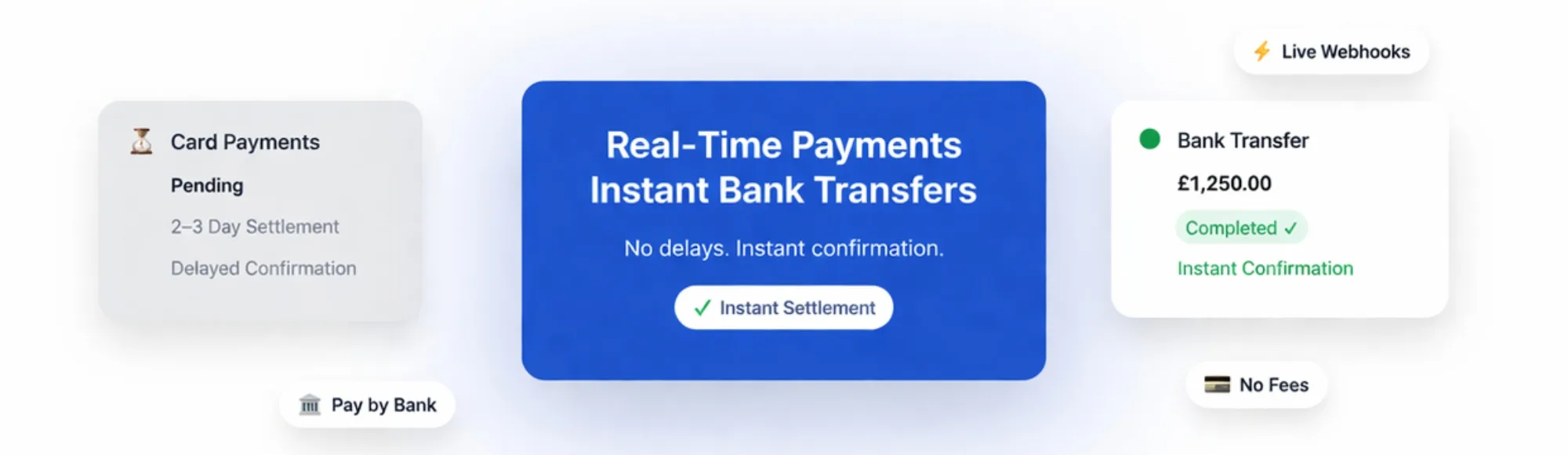
Card settlement delays are a structural problem, not an inconvenience.
Build on FCA-authorised infrastructure for instant bank transfers, Pay by Bank, and real-time payouts.
Real time payments uk are redefining how platforms handle settlement and transaction confirmation. The shift is not simply about payment speed – it is about the structural gap between when a platform initiates a payment and when it can confirm, reconcile, and act on that payment with confidence.
Card-based settlement introduced that gap as a standard operating condition. Instant bank transfers through Open Banking eliminate it.
For EPOS platforms, payroll systems, and fintech products managing payment flows at scale, what is real time payments means in practice is the difference between settlement that takes days and confirmation that arrives in seconds.
TL;DR
Real time payments operate through the UK’s Faster Payments System, enabling account-to-account transfers that settle in seconds rather than days. What is real time payments for platforms is an infrastructure question – whether payment initiation, settlement confirmation, and reconciliation happen in real time or whether card-based delays create operational and financial gaps. Finexer’s FCA-authorised PIS provides instant Pay by Bank payments, real-time confirmation via webhooks, and bulk payout initiation across 99% of UK banks.
Key Takeaways
What is real time payments in the UK?
Real time payments uk are account-to-account bank transfers that settle instantly through the UK’s Faster Payments System. Unlike card payments, which settle over one to three business days, real-time bank transfers confirm and clear within seconds of initiation.
Why do card settlement delays create operational problems for platforms?
Card settlement introduces a gap between payment initiation and confirmed receipt – during which platforms cannot reconcile accurately, release goods or services with confidence, or manage cash flow reliably. At scale, this gap becomes a structural operational risk.
What infrastructure do platforms need for real time payments uk?
Platforms need FCA-authorised PIS infrastructure that initiates bank-to-bank payments directly, delivers instant confirmation via webhooks, supports bulk payout initiation, and maintains reliable connectivity across UK banks – without dependency on card networks or their settlement timelines.
What is the difference between card payments and real-time bank transfers for platforms?
Card payments route through card networks with one to three day settlement cycles, interchange fees, and chargeback exposure. Real-time bank transfers via Open Banking settle instantly, carry no interchange fees, and confirm directly through the payment infrastructure – removing the settlement gap entirely.
How does Pay by Bank fit into real time payments uk infrastructure?
Pay by Bank is the consumer-facing implementation of real-time bank transfers. It enables customers to authorise payments directly from their bank account at the point of checkout or invoice – delivering instant confirmation to the platform without card network involvement.
What Are Real Time Payments in the UK?
The Settlement Infrastructure
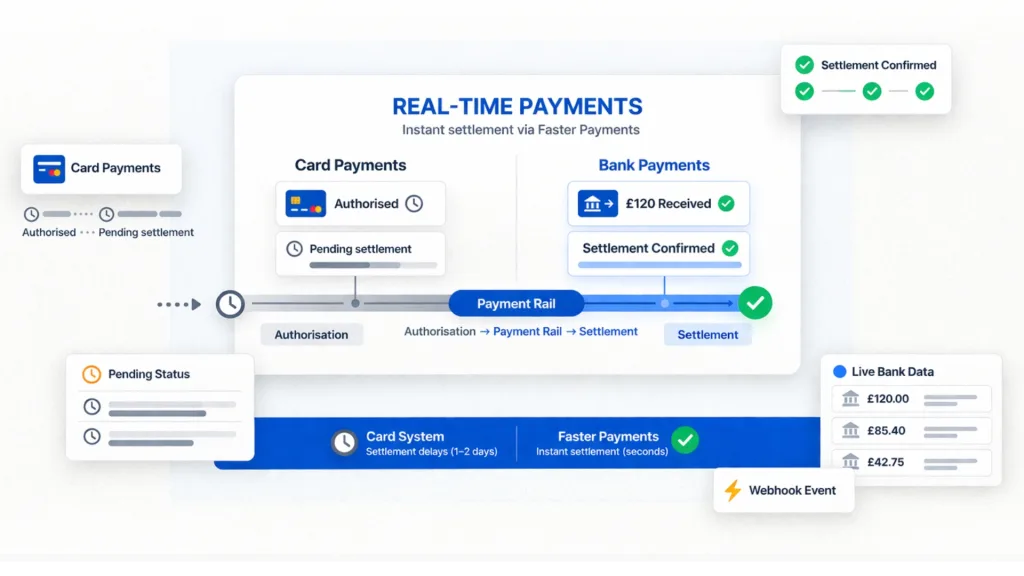
Real time payments operate through the Faster Payments System – the UK’s real-time payment rail that processes account-to-account transfers around the clock. Payments initiated through Faster Payments settle within seconds, with confirmation delivered to both sender and recipient immediately on completion.
What is real time payments from a platform perspective is a settlement confirmation question. The Faster Payments System does not just move money faster – it confirms settlement in real time, enabling platforms to trigger downstream actions – releasing orders, updating reconciliation records, initiating payouts – on the basis of confirmed payment rather than pending card authorisation.
How real-time payment flows work for UK platforms covers the technical payment flow in detail. The operational implication is what matters most for platforms evaluating their payment infrastructure.
What Real Time Payments Replace
Card-based payments introduced settlement delay as a default condition. A card payment authorised at checkout does not confirm cleared funds until one to three business days later, depending on the card network and acquiring bank involved. During that period, the platform carries settlement risk, cannot reconcile accurately, and operates on authorisation data rather than confirmed payment.
Real time payments uk through Open Banking remove that delay. Payment is initiated directly from the customer’s bank account, settled through Faster Payments, and confirmed to the platform via webhook – within seconds of the customer authorising the transaction.
“The settlement gap that card payments create is not a minor operational inconvenience for platforms managing volume. It compounds into reconciliation delays, cash flow uncertainty, and dispute exposure that real-time bank transfers eliminate at the infrastructure level.” – Ravi, Finexer
Why Does Card Settlement Create Structural Problems for Platforms?
The Operational Cost of Settlement Delay
Card settlement delay is not a minor timing issue for platforms processing payments at scale. It creates operational gaps that affect reconciliation accuracy, cash flow management, and payout reliability across every transaction.
For EPOS platforms processing in-store payments, end-of-day reconciliation depends on confirmed settlement data. Card settlement files arrive the following business day – meaning reconciliation operates on previous-day data rather than real-time transaction confirmation.
For payroll and payout platforms initiating salary or contractor disbursements, card-based payment rails are not a viable option. Bulk payouts require direct bank-to-bank infrastructure that confirms delivery to recipient accounts – not card authorisation codes that require days to settle.
For fintech platforms managing merchant payouts or revenue distribution, settlement delay creates a float that compounds with volume – tying up capital and creating cash flow exposure that instant bank transfers eliminate entirely.
What Is Real Time Payments Solving at the Platform Layer
Real time payments are a confirmation problem, not just a speed problem. Platforms need to know – in real time – that a payment has settled, cleared, and been received. Card networks do not provide that confirmation at initiation. Faster Payments through Open Banking does.
| Payment Method | Settlement Timeline | Confirmation for Platform | Operational Impact |
|---|---|---|---|
| Card payments | 1-3 business days | Authorisation only at initiation – settlement confirmed later | Reconciliation delay, settlement risk, interchange fees, chargeback exposure |
| BACS bank transfer | 3 business days | No real-time confirmation – batch processing only | Significant settlement delay, no instant payout capability |
| Real time payments uk via Open Banking | Seconds | Instant settlement confirmation via webhook on completion | Real-time reconciliation, no interchange fees, no chargeback exposure |
How Do Platforms Build Real Time Payment Infrastructure?
The Open Banking Payment Layer
Real time payments through Open Banking operate through PIS – Payment Initiation Services. FCA-authorised PIS infrastructure allows platforms to initiate bank-to-bank payments directly from customer accounts, route them through the Faster Payments System, and receive instant confirmation on settlement.
Finexer’s payment infrastructure for UK platforms covers the full PIS capability set. The operational components platforms require for real time payments are:
- Payment initiation – direct bank-to-bank transfer initiated from the customer’s account without card network involvement
- Instant confirmation – settlement confirmation delivered via webhook within seconds of payment completion
- Bulk payout initiation – disbursement of multiple payments simultaneously to recipient bank accounts
- Pay by Bank at checkout – customer-facing payment flow enabling bank authorisation at the point of purchase
- Recurring payment support – VRP (Variable Recurring Payments) for platforms managing ongoing payment mandates
What Platforms Need From Real Time Payment Infrastructure
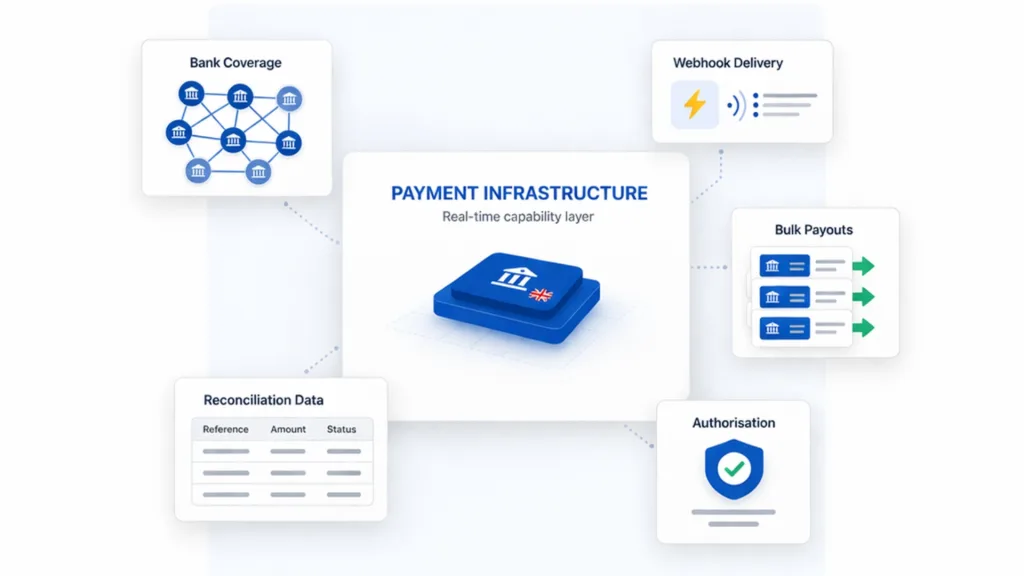
Not all real-time payment infrastructure delivers equivalent operational capability. Platforms evaluating providers for real time payments uk should assess:
- UK bank coverage – gaps in coverage directly affect payment reach across customer and recipient accounts
- Webhook reliability – instant confirmation requires consistent, low-latency webhook delivery on every payment event
- Bulk payout capability – high-volume payout platforms require batch initiation without per-payment manual processing
- FCA authorisation status – PISP authorisation is a regulatory requirement for payment initiation, verifiable on the FCA register
- Reconciliation data quality – structured payment references and transaction metadata are required for automated reconciliation workflows
“Real-time payment infrastructure is only as reliable as the bank connectivity and webhook delivery underpinning it. Platforms that evaluate on price alone discover the operational cost of unreliable confirmation after go-live.” – Ravi, Finexer
How Does Finexer Support Real Time Payments UK?
Finexer is an FCA-authorised Open Banking infrastructure provider with PISP authorisation for payment initiation. For platforms requiring real time payments uk capability across Pay by Bank, instant payouts, and bulk disbursements, Finexer provides the PIS infrastructure layer across 99% of UK banks.
What Finexer’s Payment Infrastructure Provides
- FCA-authorised PIS – PISP status verifiable on the FCA register
- Pay by Bank payment initiation at checkout and invoice
- Instant settlement confirmation via real-time webhooks
- Bulk payout initiation for payroll, contractor, and merchant disbursements
- Variable Recurring Payments (VRP)
- 99% UK bank coverage including challenger banks and building societies
- Usage-based pricing with 3-5 weeks onboarding support
What I Feel
Real time payments are not a product feature – they are an infrastructure decision. The platforms that treat them as the former build on card rails and manage the operational consequences of settlement delay indefinitely. The platforms that treat them as the latter move to bank-to-bank infrastructure and eliminate the settlement gap at source.
What is real time payments ultimately offer platforms is not just faster money movement. It is the ability to confirm, reconcile, and act on payment data in real time – which changes how products are built, how cash flow is managed, and how reliably platforms can operate at scale.
Common Use Cases
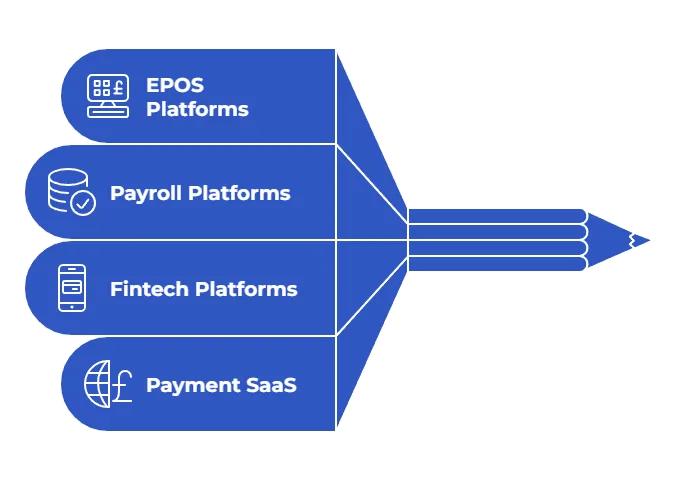
EPOS and Retail Platforms
EPOS platforms processing in-store and online payments require real-time settlement confirmation for end-of-day reconciliation. Finexer’s PIS enables Pay by Bank at checkout with instant confirmation via webhook – replacing card settlement delays with real-time transaction data per payment, per store, per day.
Payroll and Payout Platforms
Payroll and contractor payout platforms require bulk bank transfer capability with confirmed delivery to recipient accounts. Finexer’s bulk payout initiation supports simultaneous disbursement across 99% of UK banks – with real-time confirmation per payment rather than batch settlement files.
Fintech Payment Platforms
Fintech platforms managing merchant payouts, revenue distribution, or platform-to-platform transfers require reliable real time payments uk infrastructure with structured payment references for automated reconciliation. Finexer’s PIS delivers instant confirmation and structured transaction data on every payment initiation.
Payment Infrastructure SaaS
Payment SaaS platforms embedding bank transfer capability into their products require FCA-authorised PIS infrastructure with white-label payment flows. Finexer’s white-label Pay by Bank enables platforms to offer real-time bank payment capability under their own brand without separate FCA authorisation.
Does the UK have real-time payments?
Yes. Real time payments uk operate through the Faster Payments System, which processes account-to-account bank transfers around the clock with settlement completing within seconds. Open Banking PIS infrastructure enables platforms to initiate Faster Payments directly from customer bank accounts.
What are examples of real time payments for UK platforms?
Examples of real time payments uk include Pay by Bank at checkout, instant contractor or payroll disbursements, merchant revenue payouts, invoice payment via bank transfer, and platform-to-platform transfers – all settled through the Faster Payments System with real-time confirmation.
What are real time payments and how does it differ from BACS?
Real time payments uk settle within seconds through the Faster Payments System, with instant confirmation delivered to the initiating platform. BACS is a batch payment rail with a three business day settlement cycle and no real-time confirmation capability – unsuitable for platforms requiring instant payment confirmation or same-day payout delivery.
Build real-time payment and payout infrastructure on FCA-authorised Open Banking rails.
About the Author

Ravi Ranjan
Ravi Ranjan is Co founder & CEO of Finexer