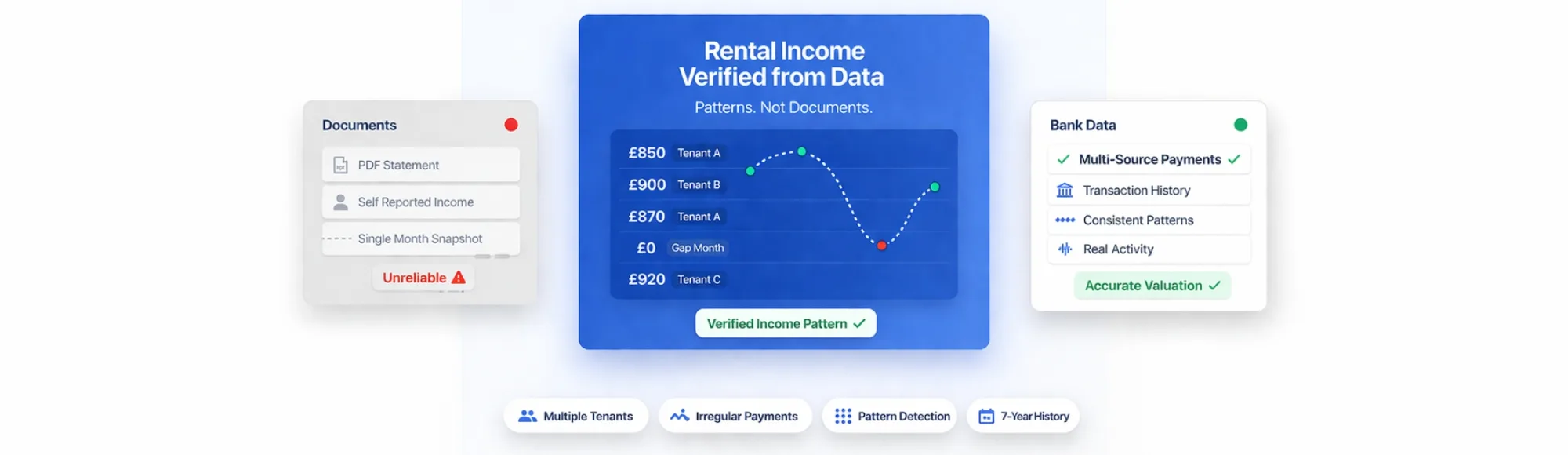
Rental income documents are easy to manipulate. Verify directly from the bank
Finexer provides bank transaction data infrastructure for rental income verification.
Rental income verification is harder than salary verification. Salary arrives monthly, from one employer, in a predictable amount. Rental income arrives irregularly, from multiple tenants, in varying amounts, often across different accounts – and none of that is visible from a single bank statement PDF.
For PropTech platforms running affordability checks and accounting platforms preparing management accounts, this inconsistency creates a data quality problem. Self-reported rental income figures are unverifiable without access to the actual transaction history.
This blog covers where rental income verification breaks down for platforms, what rental income valuation requires from a data perspective, and how FCA-authorised bank transaction data infrastructure makes consistent, verifiable rental income assessment practical at scale.
TL;DR
Rental income verification fails when platforms rely on client-submitted documents that cannot be confirmed against actual bank activity. Accurate rental income valuation requires transaction-level visibility – recurring payment patterns, income frequency, and source consistency identified directly from bank transaction history. Finexer’s FCA-authorised AIS infrastructure provides consent-based access to verified bank transaction data covering 99% of UK banks, supporting rental income verification workflows for PropTech and accounting platforms.
Key Takeaways
What makes rental income verification harder than salary verification?
Rental income is irregular, multi-source, and not captured by standard payslip-based checks. Amounts vary by tenant, payment timing shifts monthly, and landlords often hold rental receipts across multiple accounts – none of which is visible from a single document submission.
What does accurate rental income valuation require from a data perspective?
Rental income valuation requires transaction history showing payment frequency, amount consistency, source patterns, and any gaps in rental receipts. A single bank statement cannot provide this – only a full transaction history per account does.
Why do self-reported rental income figures create risk for platforms?
Self-reported figures reflect what a landlord claims to receive. Bank transaction data reflects what was actually cleared. Discrepancies – unreported voids, partial payments, irregular receipts – are invisible without verified transaction history.
How does bank transaction data support rental income verification for platforms?
FCA-authorised AIS retrieves transaction history directly from the landlord’s bank with consent. Rental receipts are identifiable from recurring payment patterns, amount ranges, and counterparty references – providing a verifiable income picture without document handling.
Why Does Rental Income Verification Fail for Most Platforms?
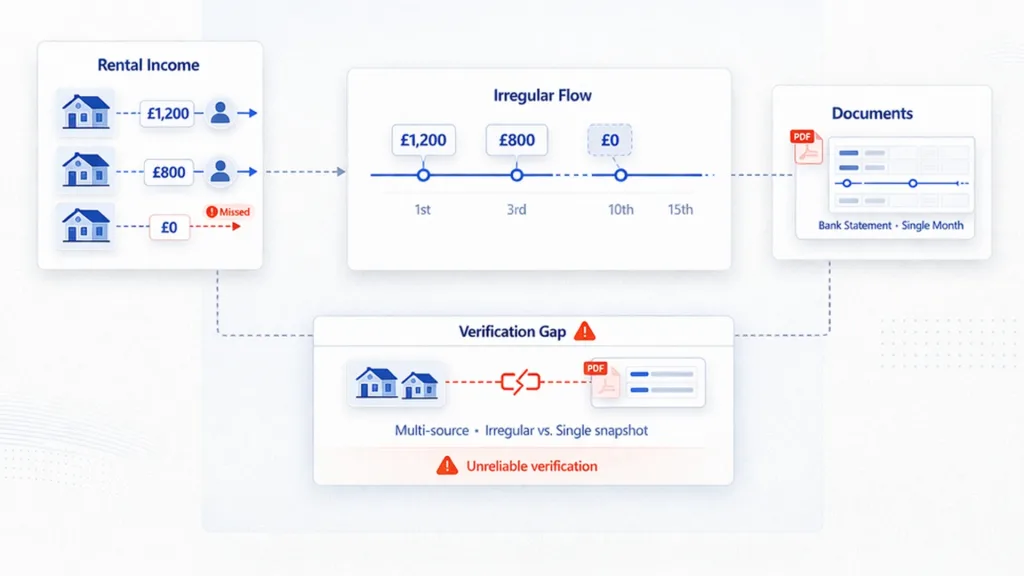
The Irregular Income Problem
Salary income is predictable. The same employer deposits the same amount on the same date every month. Rental income is the opposite. A landlord with three properties receives varying amounts from different tenants, on different dates, sometimes late, occasionally missed entirely.
Document-based rental income verification cannot capture this complexity. A bank statement covering one month shows one snapshot. A self-assessment tax return shows declared income from the previous year. Neither confirms the current rental income picture – how many properties are actively tenanted, what the actual receipt pattern looks like, or whether voids are affecting income consistency.
For PropTech platforms making affordability decisions based on rental income declarations, this creates a structural accuracy risk. For accounting platforms preparing management accounts or cash flow forecasts for landlord clients, it creates a reporting reliability problem.
Platforms must also ensure tenant identity checks meet UK regulatory requirements –GOV.UK right to rent guidance covers the identity verification obligations that sit alongside income checks.
“At Finexer, I work with PropTech and accounting platforms that run rental income checks on hundreds of clients monthly. The gap between what landlords declare and what actually appears in their transaction history is consistent and significant.” – Ravi, Finexer
Why Document-Based Checks Cannot Solve the Valuation Problem
Rental income valuation – establishing a reliable, repeatable income figure for financial assessment or reporting purposes – requires more than a point-in-time income declaration. It requires pattern recognition across a transaction history: how often payments arrive, from how many sources, whether amounts are consistent, and whether there are gaps that affect the reliable income figure.
How PropTech platforms use Open Banking for tenant affordability covers the broader tenant verification workflow. The rental income side of that workflow – verifying landlord income for management accounts, portfolio reporting, or affordability assessments – requires the same transaction-level data access.
A PDF bank statement covers 30 days. A full AIS transaction history covers up to seven years. The difference in valuation reliability is not marginal – it is structural.
What Does Rental Income Valuation Actually Require?
Transaction-Level Visibility Across Accounts
Accurate rental income valuation for a landlord with multiple properties requires transaction visibility across all accounts where rental receipts land. A single-account statement misses income held elsewhere. A platform that can only see one account cannot confirm the full rental income picture.
FCA-authorised AIS provides consent-based access to all accounts a landlord chooses to share. Transactions across those accounts are returned in a structured format – counterparty references, payment amounts, dates, and categorisation data – that rental income pattern identification can run against.
| Verification Approach | What It Shows | What It Misses | Suitable for Valuation? |
|---|---|---|---|
| Self-assessment tax return | Declared rental income for previous tax year | Current year activity, voids, partial payments, multi-account income | No – historical, declared only |
| Single bank statement (PDF) | 30-day transaction snapshot from one account | Other accounts, prior period patterns, income gaps | No – insufficient history and coverage |
| Tenancy agreements | Contracted rental amounts and tenancy terms | Actual payment behaviour, voids, arrears, underpayments | No – contract value, not actual receipt |
| Bank transaction data via AIS | Full transaction history across consented accounts, up to 7 years | Accounts not included in consent scope | Yes – pattern, frequency, and amount verified at source |
Identifying Rental Receipts from Transaction Patterns
Rental payments have identifiable characteristics in a transaction feed. They arrive from counterparties with consistent references – tenant names, property addresses, or letting agent references. Payment frequency, amounts, and timing vary by tenancy – which is exactly why pattern analysis across a full transaction history is more reliable than any single document submission.
This pattern identification is what makes bank transaction data operationally useful for rental income valuation. A platform can identify likely rental receipts, confirm their consistency over time, flag gaps or partial payments, and produce a reliable recurring income figure – all from structured transaction data, without manual document review.
Income verification API for UK platforms covers the broader income verification infrastructure that rental income checks sit within. For platforms already running salary verification via AIS, rental income verification uses the same data access layer with rental-specific pattern logic applied.
How Does Finexer Support Rental Income Verification for UK Platforms?
Finexer is an FCA-authorised Open Banking infrastructure provider. For PropTech platforms and accounting platforms that need verified rental income data for affordability assessments, management accounts, or portfolio reporting, Finexer’s AIS infrastructure provides consent-based access to bank transaction history that supports structured rental income verification and valuation workflows.
See how Finexer supports PropTech and real estate platforms with verified bank data infrastructure.
What Finexer’s Infrastructure Provides
- FCA-authorised AIS – verifiable on the FCA register, read-only bank data access
- Up to 7 years of transaction history for rental income pattern analysis
- 99% UK bank coverage across retail and challenger banks
- Consent-based access with full consent logs and timestamps per retrieval
- Real-time webhooks for transaction data delivery
- Structured transaction data with counterparty references and categorisation
- White-label consent flows embeddable under the platform’s own brand
- Usage-based pricing – scales with client volume
- 3-5 weeks onboarding support to reach production deployment
“The rental income valuation problem is not complex once you have the right data. The issue is that most platforms are trying to derive a reliable income figure from documents that were never designed to support valuation logic. Transaction history solves that directly.” – Ravi, Finexer
What I Feel
Rental income verification gets treated as a document collection problem when it is actually a data quality problem. The question is not whether a landlord has provided a bank statement – it is whether the bank statement they provided reflects the full picture of what is actually arriving in their accounts.
Bank transaction data accessed via FCA-authorised AIS answers the rental income valuation question that documents cannot: how much, from how many sources, how consistently, over what period. That is the data foundation that reliable rental income assessment requires.
Common Use Cases
Proptech & Real Estate Platforms
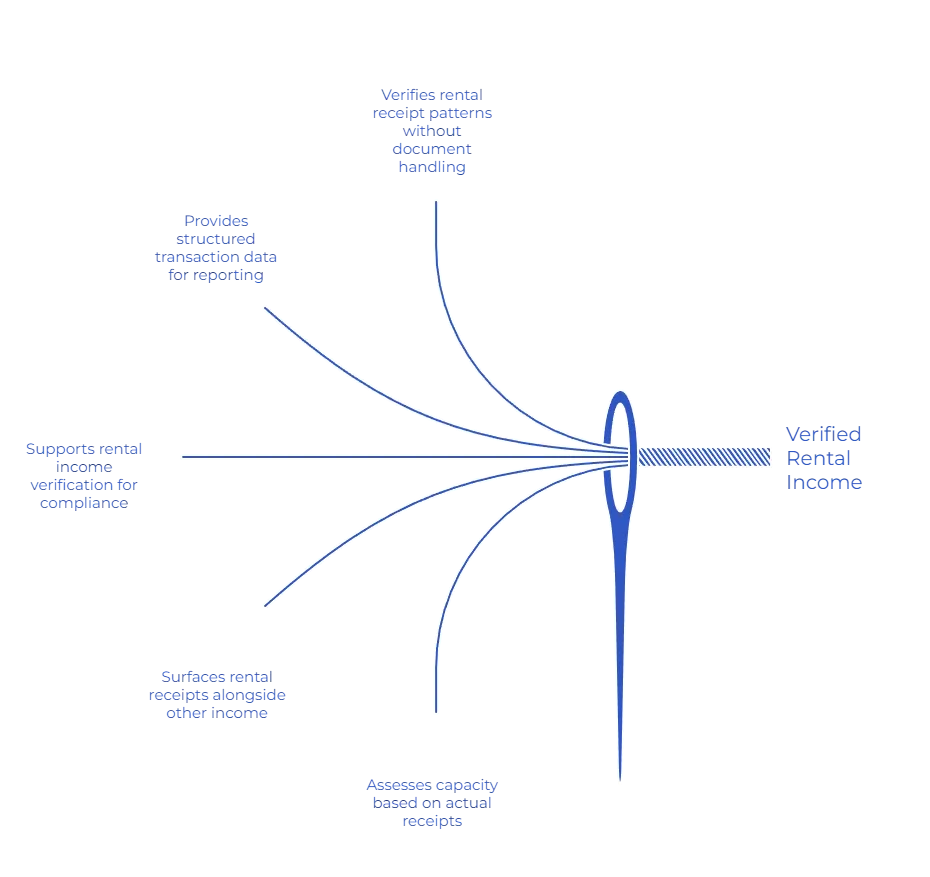
Manual rental income checks miss voids, partial payments, and multi-account income. Finexer’s AIS delivers up to 7 years of transaction history per consented account – enabling platforms to verify rental receipt patterns without document handling.
Accounting & ERP Platforms
Landlord clients submit inconsistent bank statements that make accurate management accounts difficult. Finexer’s AIS provides structured transaction data across all consented accounts, giving accountants a verified rental income valuation picture for reporting and cash flow forecasting.
Lawtech Platforms
Source-of-funds checks on property transactions require confirmed rental income history. Finexer’s FCA-authorised AIS provides bank-authenticated records with consent logs and timestamps – supporting rental income verification evidence for compliance documentation.
Payroll & Invoicing Platforms
Self-employed clients with rental income as a secondary source cannot prove it via payslips. Finexer’s AIS surfaces rental receipts alongside other income in the same transaction feed – giving platforms a complete verified income picture.
Utility Billing Platforms
Landlords managing multiple properties need capacity assessments based on actual receipts, not declarations. Finexer’s AIS provides recurring payment pattern data per account, supporting rental income verification without relying on self-reported figures.
Can platforms verify rental income without requesting documents from landlords?
Yes. FCA-authorised AIS provides consent-based access to bank transaction history directly – no PDF uploads, no manual statement requests, no document authenticity checks required.
What checks are done when verifying rental income for financial assessment?
Payment frequency, amount consistency, source patterns, and gaps in receipts – all of which require transaction history, not a single bank statement.
How does Open Banking improve rental income verification accuracy?
Open Banking AIS retrieves transaction data directly from the landlord’s bank, eliminating document falsification risk and giving platforms verified rental receipt patterns in structured form.
Verify rental income directly from bank transaction data with FCA-authorised infrastructure.
About the Author

Ravi Ranjan
Ravi Ranjan is Co founder & CEO of Finexer