
Pay by Bank. No card fees. Instant settlement.
Open Banking payments and bank data for UK platforms moving beyond traditional payment gateways.
Most businesses searching “payment gateway vs PSP” are not confused about definitions. They are confused about which one to buy, how much it costs, and whether the whole three-layer infrastructure is even necessary.
The short answer: often it is not. For UK businesses paying or collecting from UK bank accounts, a fourth path now exists – direct bank-to-bank payments that bypass the payment gateway, processor, and card network entirely.
At Finexer, I work with UK platforms, fintech teams, and finance ops leads evaluating payment infrastructure. The payment gateway vs PSP question comes up constantly – not as an academic exercise, but as a real commercial decision. This guide gives you a clear breakdown and a practical framework for choosing.
“Most businesses do not need to understand every layer of how card payments work. They need to know which product fits their workflow – and whether Open Banking removes the question entirely.” – Ravi, Finexer
TL;DR
A payment gateway authorises card transactions. A payment processor moves the money after authorisation. A PSP bundles both into one system. For UK businesses accepting payments from UK bank accounts, Open Banking Payment Initiation Services (PIS) offer a direct bank-to-bank alternative – no card network, no multi-layer infrastructure, instant settlement via Faster Payments.
Key Takeaways
What is a payment gateway?
A payment gateway is the security and routing layer between a customer’s card and the bank. It encrypts card data, sends it for authorisation, and returns an approval or decline. It does not move money – it verifies the transaction can proceed. Most modern PSPs include a payment gateway built in.
What is the difference between a payment gateway and a PSP in the UK?
A payment gateway handles authorisation only. A PSP – Payment Service Provider – combines the gateway, payment processor, and merchant account in one integrated system. The payment gateway vs PSP difference is control versus convenience. A gateway gives modular flexibility. A PSP is faster to deploy and manage.
What does a payment processor do that a payment gateway does not?
After the payment gateway authorises a transaction, the payment processor executes it – moving funds from the customer’s bank to the merchant’s bank via the card network. A PSP manages this step as part of a bundled service. A standalone processor gives more control but requires separate integration with a payment gateway.
When does Open Banking replace a payment gateway?
When the payment is UK bank-to-bank and does not require a card. Open Banking PIS initiates a direct bank transfer authenticated at the customer’s bank. No card details, no payment gateway, no processor. Settlement is instant via Faster Payments. For UK businesses collecting from UK bank accounts, this removes the entire card payment stack.
What Does a Payment Gateway Actually Do?
How Does a Payment Gateway Work?
A payment gateway is the entry point for any card-based transaction. When a customer enters card details at checkout, the payment gateway takes over.
It does four things:
- Encrypts the card data so it travels securely across networks
- Routes the encrypted data to the card network and issuing bank for authorisation
- Receives the approval or decline response
- Returns the result to the merchant’s checkout system
The payment gateway never moves money. That is the processor’s job. The payment gateway is the authorisation and data transmission layer – nothing more.
A payment gateway can be standalone or built into a PSP. Standalone payment gateways give developers more architectural control. PSP-bundled payment gateways are faster to set up but less customisable at the infrastructure level.
Technical standards every payment gateway must meet:
- PCI DSS compliance – card data handling under Payment Card Industry Data Security Standard
- Strong Customer Authentication (SCA) – mandatory for UK and EU card payments under PSD2
- 3D Secure – additional cardholder authentication layer for online transactions
| Component | Payment Gateway | Payment Processor | PSP |
|---|---|---|---|
| Primary function | Authorise and route card data | Execute fund transfer post-authorisation | Full stack: gateway + processor + merchant account |
| Moves money? | No | Yes | Yes – managed end to end |
| Merchant account | Separate – needed | Separate – needed | Included |
| Card network access | Via processor | Direct (Visa, Mastercard) | Included |
| Setup complexity | Moderate – requires processor | High – requires payment gateway + merchant account | Low – single integration |
| Best for | Custom payment infrastructure builds | Enterprise with existing payment gateway | Most businesses – fast setup, full coverage |
What Does a Payment Processor Do?
How Does a Payment Processor Differ From a Payment Gateway?
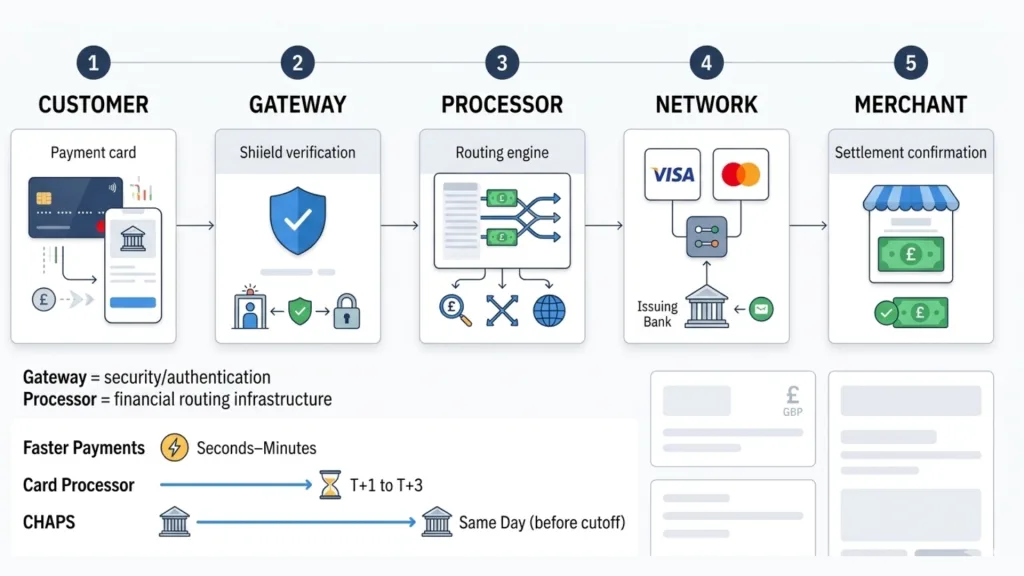
The psp vs payment processor comparison starts with understanding that the processor is one component of the PSP – not a separate product you choose instead of it. The wider psp vs payment processor and payment gateway confusion comes from all three appearing in the same transaction – just handling different steps.
Once the payment gateway has authorised a transaction, the payment processor takes over. It contacts Visa, Mastercard, or American Express to initiate the fund transfer.
The network communicates with the customer’s issuing bank. The issuing bank confirms funds are available and releases them. The processor routes those funds to the merchant’s acquiring bank.
The payment processor is the financial plumbing. The payment gateway is the security checkpoint.
In practice, most businesses never need a standalone payment processor. PSPs bundle processor functionality into their product. You only need a standalone processor if you are building custom payment infrastructure at scale, switching processors while keeping an existing payment gateway, or operating at volumes where direct processor relationships reduce per-transaction costs.
UK payment settlement timelines by method:
- Faster Payments (bank transfers): seconds to minutes
- Card payments via processor: T+1 to T+3 depending on the provider
- CHAPS (high-value same-day): before 3pm cutoff on business days
What Is a PSP and How Does It Compare?
What Does a PSP Include That a Standalone Payment Gateway Does Not?
A Payment Service Provider (PSP) is the complete payment stack in one product. It includes a payment gateway, a payment processor, and a merchant account – plus fraud detection, reporting tools, and support for multiple payment methods.
The payment gateway vs PSP choice is control versus convenience. A standalone payment gateway gives modular control. A PSP trades that control for a single integration, a single contract, and one support relationship.
For most UK businesses without dedicated payment engineering teams, a PSP is the practical choice. For high-volume platforms building custom workflows, a standalone payment gateway with a direct processor relationship offers more flexibility and lower per-transaction cost at scale.
For a full breakdown of what PSPs provide in the UK market, the payment service providers guide covers how PSPs handle merchant accounts, fraud detection, and recurring billing.
Which UK Payment Providers Should You Consider in 2026?
How Do Stripe, Worldpay, and Finexer Compare?
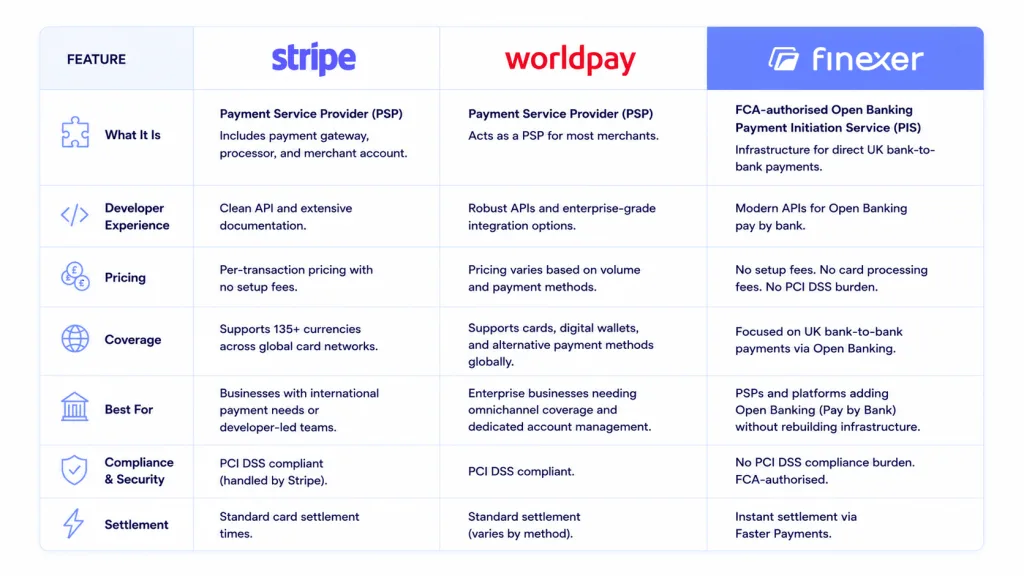
The payment gateway vs PSP vs payment processor debate becomes clearest when you look at real providers.
- Stripe is a PSP that includes its own payment gateway, processor, and merchant account. Developers get a clean API and extensive documentation. Pricing is per-transaction with no setup fees. It supports 135+ currencies across global card networks. For UK businesses with international payment needs or developer-led teams, Stripe is a strong default.
- Worldpay is one of the UK’s largest payment processors, operating as a PSP for most merchants. It handles large transaction volumes across cards, digital wallets, and alternative payment methods. It suits enterprise businesses needing omnichannel coverage and dedicated account management.
- Finexer is not a payment gateway or traditional PSP. Finexer provides FCA-authorised Open Banking PIS – the infrastructure for direct UK bank-to-bank payments without a payment gateway, card network, or processor in the middle. No PCI DSS compliance burden. No card processing fees. Instant settlement via Faster Payments.
For PSPs looking to add Open Banking as a payment method alongside their existing payment gateway, the white-label payment API guide for PSPs covers how to embed Pay by Bank without rebuilding the existing infrastructure.
When Should a UK Business Move Beyond the Payment Gateway?
Is Open Banking Replacing Payment Gateways for UK Transactions?
For card payments and international transactions, no. A payment gateway remains necessary wherever card networks are involved.
For UK bank-to-bank payments, the case for a payment gateway weakens considerably.
Open Banking PIS initiates a direct transfer from the customer’s UK bank account to the merchant’s account. The customer authenticates in their banking app. No card details entered. No payment gateway routing card data. No processor. Settlement is instant via Faster Payments.
The cost difference is significant. Card processing via payment gateway and processor typically runs at 1.5-3.5% per transaction. PIS per-payment costs are a flat pence amount – far lower at any meaningful volume.
For UK platforms evaluating the shift from card-based PSPs to Open Banking, the PSP to Open Banking guide covers the cost comparison, settlement speed difference, and what changes in the checkout workflow when the card layer is removed.
How Does Finexer Fit This Picture?
What Does Finexer Provide for UK Payment Workflows?
Finexer is not a payment gateway, card processor, or traditional PSP. Finexer provides FCA-authorised Open Banking PIS – the payment initiation infrastructure for UK platforms that need direct bank connectivity without the card payment stack.
For UK platforms whose customers pay from UK bank accounts, Finexer replaces the payment gateway, processor, and card PSP with one FCA-regulated integration.
- Pay by Bank – customers authenticate in their banking app, instant settlement via Faster Payments
- Bulk Payout – multiple recipients in one API call, individual payment references per recipient
- Payment Links – per-invoice shareable links with pre-filled references
- Usage-based pricing, no setup fees, 3-5 weeks to production, FCA-authorised (FRN 925695)
“The payment gateway vs PSP question changes completely once a platform realises that most of its UK customers can pay directly from their bank account. The card infrastructure was solving a problem that Open Banking now handles at lower cost and higher speed.” – Ravi, Finexer
What I Feel
The payment gateway vs PSP conversation has been the same for ten years. Gateway or bundled PSP. Control or convenience. Both still assume card payments are the baseline.
For UK-to-UK payments, that assumption is increasingly wrong.
Direct bank payments have become a viable default for UK B2B platforms. The payment gateway stack exists because card data needs to be routed and secured. If the payment never involves a card, that stack is unnecessary overhead.
The psp vs payment processor comparison, the gateway vs PSP debate – none of it matters if your customers can pay directly from their bank. The question worth asking first is “do my customers need to pay by card at all?”
Common Use Cases
Fintech SaaS Platforms
For platforms billing UK business customers, Pay by Bank removes card processing fees and T+1-3 settlement delays. Payment initiates via Open Banking PIS, confirms via webhook, reconciles automatically – no payment gateway or processor in the chain.
ERP and Billing Systems
Supplier and invoice payments between UK businesses do not require a card network or payment gateway. ERP platforms using Finexer’s PIS initiate bank transfers programmatically – referenced, confirmed, and reconciliation-ready at settlement.
PSP Platforms
PSPs adding Open Banking alongside their existing payment gateway can white-label Finexer’s PIS infrastructure. One additional integration adds Pay by Bank as a payment rail – no change to the existing card stack.
EPOS and Retail
For QR-based or in-person payments from UK bank accounts, Open Banking provides an alternative to card terminal fees. Instant settlement. No PCI DSS card data handling required at the point of sale.
What is a payment gateway used for?
A payment gateway encrypts card data and routes it for authorisation between the customer’s card and the issuing bank. It does not transfer funds – that is the payment processor’s role. Most PSPs include payment gateway functionality as part of their bundled service, so businesses typically deal with the PSP layer rather than a standalone payment gateway.
Do I need a separate payment gateway if I use a PSP?
No. Most PSPs include a payment gateway as part of their bundled offering. You only need a standalone payment gateway if you are building custom payment infrastructure with a separate processor relationship, or if you need specific payment gateway functionality that your PSP does not support. For most UK businesses, the PSP handles everything the payment gateway would otherwise provide.
Is Open Banking replacing payment gateways in the UK?
For UK bank-to-bank payments, often yes. Open Banking PIS initiates a direct bank transfer without a payment gateway or card processor. For card payments and international transactions, a payment gateway and PSP remain necessary. Most UK platforms use both approaches – cards via a PSP for some customers, Open Banking for others.
How does a PSP differ from a payment processor?
The psp vs payment processor distinction is simpler than it sounds. The processor handles one job – fund movement after authorisation. The PSP manages the full lifecycle including the processor, payment gateway, merchant account, and reporting. Standalone processors suit large enterprises with existing payment gateway infrastructure wanting direct settlement control.
See how Finexer supports UK payment workflows without card payment gateway infrastructure.
About the Author

Ravi Ranjan
Ravi Ranjan is Co founder & CEO of Finexer