Card fees are a percentage. A2A fees aren’t.
See what switching from 1.5–3.5% card fees to A2A payments actually saves at your transaction volume.
UK businesses are facing a real problem with payment costs. Transaction fees A UK merchant loses £750 to £1,750 a month to card fees before a single chargeback even happens, and most UK merchants have no idea that their uptake of the alternative trails that of the EU significantly. A2A payments close that gap but only if the provider underneath them actually holds up past the pilot stage.
TL;DR: Not all A2A payment providers deliver the same results once transaction volumes grow. Compare providers on five key criteria, which are UK bank coverage, fee structure, settlement speed, Strong Customer Authentication (SCA) and dispute handling, to identify the option that offers the best long-term value for your platform.
By Ravi, Head of Platform Partnerships at Finexer
“Platforms come to A2A payments assuming the hard part is the technical integration. It’s usually not. The hard part is picking a provider whose bank coverage and success rates hold up once you’re processing real volume, not sandbox transactions.”
Why UK A2A Payments Still Lag Behind Europe
A UK merchant processing £50,000 a month in card payments loses roughly £750 to £1,750 to interchange and processing fees before a single chargeback happens. Account-to-account payments remove that percentage entirely, replacing it with usage-based pricing regardless of value.
Yet UK adoption of A2A payments trails EU adoption significantly. Technology isn’t the barrier. Most platforms that tried A2A and stalled picked a provider that couldn’t deliver on coverage, success rate, or pricing once volume scaled past a pilot.
The Weighted Evaluation Checklist for A2A Payment Providers
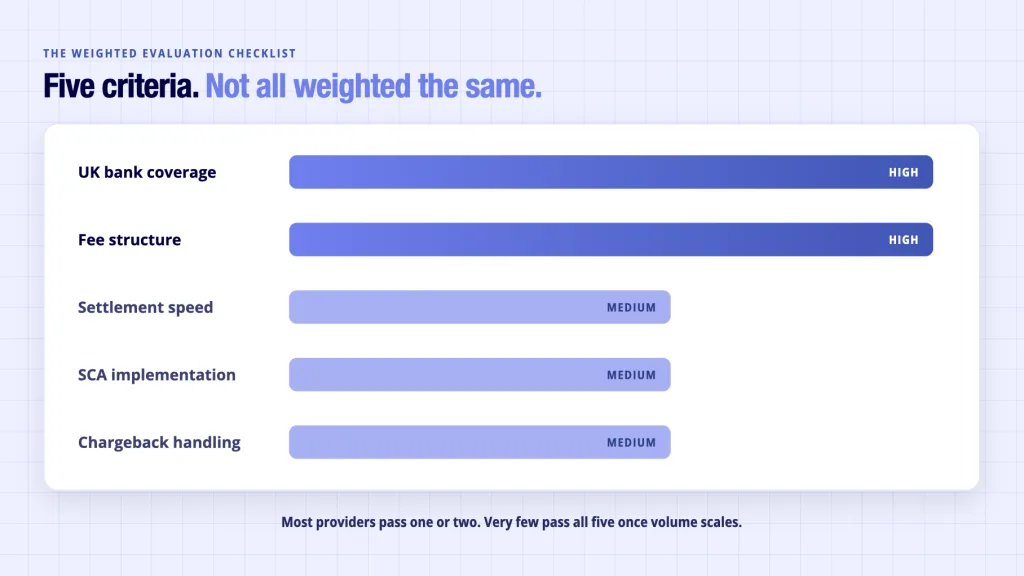
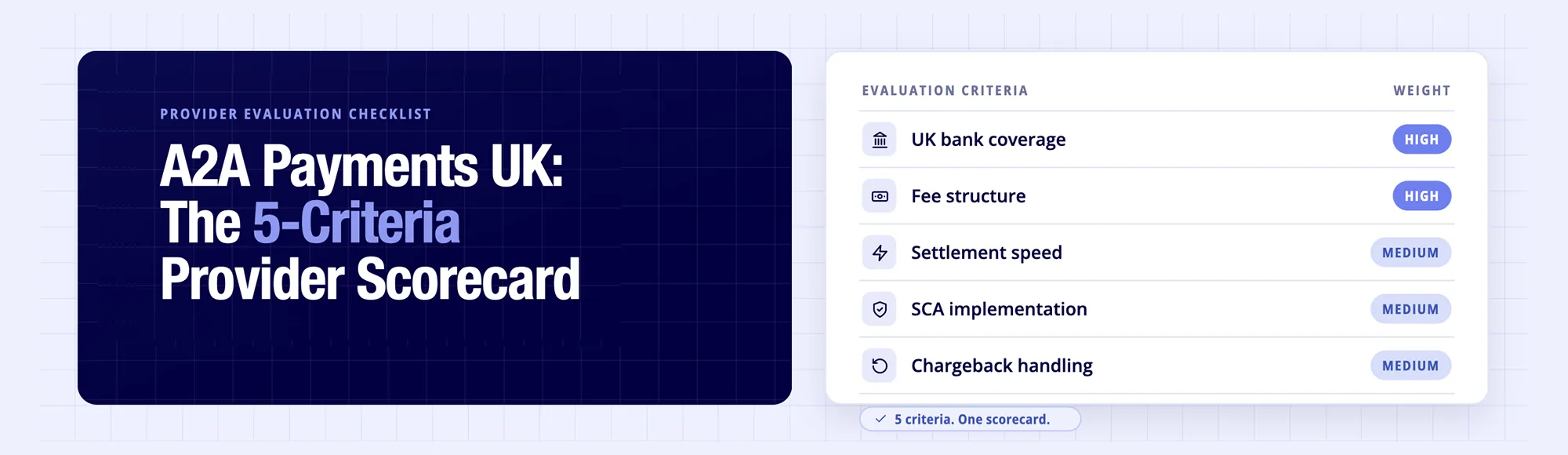
Five criteria, weighted by how much each one actually affects the business case, separate a provider that works at scale from one that only works in a demo.
- UK bank coverage (high weight) – Does the provider connect to the high-street banks and digital challengers your actual customer base uses, or only the three or four largest names? Partial coverage means lost transactions at checkout, not just a support ticket.
- Fee structure (high weight) – Usage-based pricing doesn’t scale as a percentage that erodes the savings A2A is meant to deliver? This is the entire economic case for switching off cards.
- Settlement speed (medium weight) – Does the payment settle via Faster Payments in seconds, or does the provider quote a vague “same-day” window that leaves reconciliation waiting?
- SCA implementation (medium weight) – Is Strong Customer Authentication handled inside the customer’s own banking app as a natural part of the flow or bolted on as an extra redirect that increases drop-off?
- Chargeback handling and dispute process (medium weight) – A2A payments carry no chargeback mechanism by design, so does the provider offer a clear refund and dispute process instead or leave that gap unaddressed?
Most providers score well on one or two of these. Very few score well across all five once transaction volume moves past a few hundred a month.
A2A vs Card Payments: What the Fee Structure Actually Costs
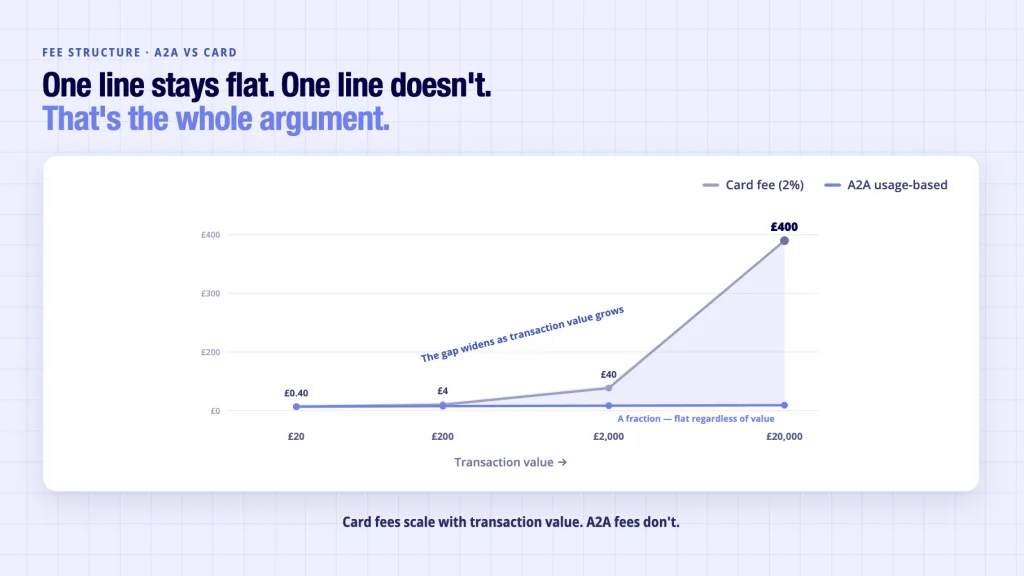
Card payments charge 1.5% to 3.5% per transaction, scaling directly with transaction value. A2A payments via Open Banking typically run on usage-based pricing that doesn’t move with the size of the payment.
On a £200 transaction, a 2% card fee costs £4. The equivalent A2A transaction, based on usage-based pricing, costs a fraction of that regardless of whether the payment is £20 or £2,000. This is the core economic argument for switching, and it’s also where providers differ most in how transparently they price.
The Chargeback Trade-Off Platforms Need to Plan For
A2A payments settle account-to-account with Strong Customer Authentication built into the bank’s own app, which removes the fraud vector that chargebacks exist to police in the first place. But it also means there’s no card-network chargeback mechanism to fall back on if a customer disputes a transaction.
Providers handle this differently: some offer no dispute infrastructure at all, leaving the platform to build its own refund process; others provide a structured refund flow that mirrors what a chargeback would resolve, without the card network’s involvement. This is a genuine trade-off, not a hidden flaw, and it belongs on the evaluation checklist rather than being discovered after go-live.
Provider Comparison: Scoring Against the Checklist
| Criterion | What Weak Coverage Looks Like | What a Strong Provider Delivers |
|---|---|---|
| UK bank coverage | Major banks only, challengers unsupported | 99% of UK banks, including challengers and business accounts |
| Fee structure | Percentage-based or tiered enterprise pricing | Usage-based pricing |
| Settlement speed | Vague “same-day” claims | Instant via Faster Payments |
| SCA implementation | Redirect-heavy flow, added friction | Native in-app authentication, minimal added steps |
| Chargeback/dispute handling | No structured process | Clear refund and reconciliation path |
| Deployment timeline | Months of back-and-forth | Weeks, with dedicated onboarding support |
For platforms specifically evaluating this in an accounting context, PISP platforms for accounting firms cover how the same criteria apply to a narrower vertical use case built on the same payout API infrastructure.
The Gap: Why Most A2A Evaluations Stop at Coverage Numbers
Every provider comparison in this space leads with a bank coverage percentage, because it’s the easiest number to market. What the coverage stat alone doesn’t show is whether the payment actually settles reliably, whether the fee structure holds up once volume scales, or what happens when a customer wants a refund.
For a platform processing 5,000 A2A payments a month, usage-based pricing saves meaningfully more than pricing that rides on a provider quoting the same headline coverage but is actually based on hidden percentage tier. The checklist above exists specifically to surface that gap before a contract is signed, not after the first invoice.
Finexer’s Payments (PIS): Built Against This Checklist
Platforms evaluating A2A payment providers need a Payment Initiation Service that clears all five weighted criteria at once, not just the coverage headline.
Finexer’s Payments (PIS) product initiates payments directly from a customer’s bank account via Faster Payments: the customer authenticates inside their own banking app, the bank authorises the payment and funds move account-to-account without a card network in between. Settlement fires instant via Faster Payments, and per-payment webhooks confirm status without the platform polling for updates.
- Instant via Faster Payments, with per-payment webhook confirmation
- Usage-based pricing, rather than as a percentage
- White-label deployment, so customers stay inside the platform’s own branded checkout
- Native SCA inside the customer’s banking app, no redirect-heavy flow
- Almost all UK banks covered
- FCA-authorised AISP and PISP (FRN925695)
- 3–5 weeks onboarding support
For platforms sending A2A payments to multiple recipients rather than collecting them, bulk A2A payouts cover the same underlying infrastructure applied to supplier, contractor and marketplace disbursements.
What Are Account-to-Account (A2A) Payments?
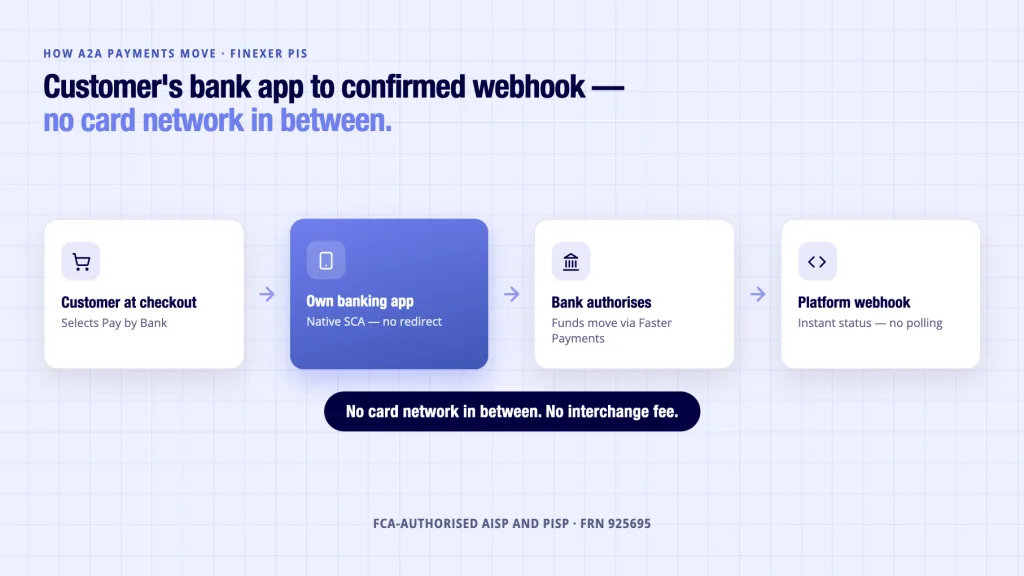
Account-to-account payments move funds directly between bank accounts via Open Banking, without a card network sitting in between.
The customer authenticates with their own bank, the bank authorises the transfer and funds settle instantly via Faster Payments, rather than passing through card processing mechanisms. Because the payment never touches a card network, there’s no interchange fee and no chargeback mechanism, which is the trade-off platforms need to weigh against the cost savings when choosing between A2A and card payments for their checkout.
What are A2A payments?
A2A, or account-to-account, payments move money directly from one bank account to another via Open Banking, without a card network involved. In the UK, they typically settle instantly via Faster Payments rather than the days-long clearing cycle associated with some card transactions.
Are A2A payments safe?
Yes, A2A payments run on FCA-authorised payout API infrastructure, with Strong Customer Authentication. Finexer’s FCA-authorised PIS shifts authentication to the customer’s bank for Open Banking payments, rather than a third-party page. The customer authenticates directly with their bank each time, and the payment provider never sees their login credentials.
How are A2A payments different from card payments?
A2A payments settle directly between bank accounts with usage-based pricing, while card payments route through card networks and charge 1.5% to 3.5% of the transaction value. A2A payments also don’t carry a chargeback mechanism, which providers address with their own refund and dispute processes instead.
Why is UK A2A adoption lower than the EU average?
UK A2A payment adoption trails EU A2A payments adoption significantly, a gap driven more by provider quality than by the lack of demand or infrastructure. Platforms that evaluate providers against coverage, fee transparency and settlement reliability tend to see stronger adoption results than the ones that don’t.
How long does it take to integrate an A2A payment provider?
Integration timelines vary by provider, but Finexer’s onboarding support typically takes 3-5 weeks from integration start to go-live. Platforms should treat a vendor’s stated timeline as part of the evaluation checklist, since vague or open-ended estimates often signal a longer real-world integration.
See how Finexer’s Payments (PIS) scores against every item on this checklist, for your actual transaction volume.
Explore with AI
About the Author

Ravi Ranjan
Ravi Ranjan is Co founder & CEO of Finexer