
Raw bank transactions blocking your automation?
Finexer enriches B2B bank transactions into structured supplier intelligence – API-ready.
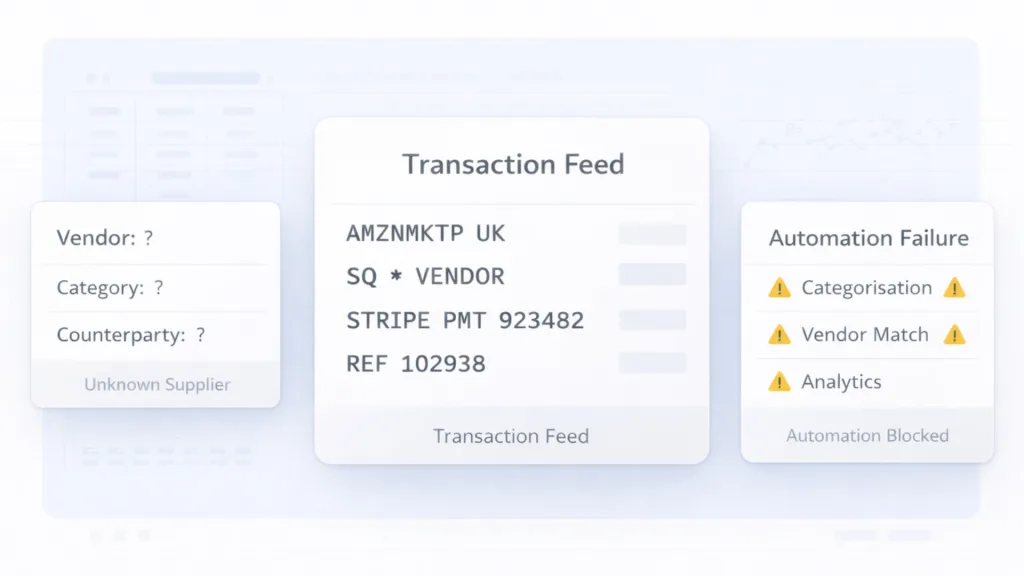
Most B2B financial platforms hit the same problem early. Raw bank transactions arrive like this:
STRIPE PMT 923482 | SQ VENDOR 84733 | PAYMENT REF 102938
No supplier name. No category. No counterparty. Just truncated strings.
This is the core problem that merchant data enrichment solves. At Finexer, we work directly with UK accounting platforms, cash-flow analytics tools, and B2B lending infrastructure teams dealing with exactly this. Unstructured transaction data blocks automation, reconciliation, and supplier reporting at scale.
B2b data enrichment tools mean very different things depending on who is asking. For sales teams, enrichment means appending contact data to CRM records. For financial platforms, it means resolving raw payment strings into structured merchant intelligence. This blog is written for CTOs, Product Leads, and Founders building financial automation on top of verified UK bank data.
TL;DR
Most b2b data enrichment tools target sales and CRM teams. Financial platforms need merchant data enrichment that identifies suppliers, counterparties, and transaction categories from verified bank data. Finexer provides FCA-authorised, Open Banking-connected enrichment covering 100M+ merchants at 95%+ categorisation accuracy.
Key Takeaways
What is merchant data enrichment for B2B financial platforms?
It transforms raw bank transaction strings into structured supplier intelligence, covering merchant identity, business category, and counterparty recognition.
How do b2b data enrichment tools for financial platforms differ from sales tools?
Sales tools enrich CRM contacts with firmographics. Financial tools enrich bank transactions with merchant identifiers and business category codes for automated workflows.
What should accounting SaaS platforms look for in enrichment infrastructure?
Structured merchant IDs, business-level categorisation, API-first JSON outputs, 99% UK bank coverage, and sub-100ms processing latency.
Why can’t financial platforms use raw bank transaction data as-is?
Descriptors are truncated and inconsistently formatted. Without an enrichment layer, supplier matching and automated categorisation both fail at scale.
What does structured merchant data output include?
Merchant name, category code, counterparty classification, transaction type, and structured metadata – all API-ready for downstream financial workflows.
Why Do B2B Financial Platforms Struggle With Raw Transaction Data?
Raw bank transactions are designed for banking systems. Not for business logic.
UK platforms ingesting data from Barclays, HSBC, and Lloyds receive truncated descriptor codes. AMZNMKTP UK could be office supplies, inventory, or marketing spend. SQ * could represent any Square-enabled vendor in any category.
Without enrichment, automated categorisation fails at scale. This creates four compounding problems for B2B workflows:
- Supplier identity is unclear at point of ingestion
- Business counterparties cannot be matched to known vendors
- Expense reporting requires manual review at volume
- Supplier spend analytics are impossible without clean data
“B2B transaction enrichment is a different problem from consumer enrichment. It requires business counterparty recognition, not just name normalisation.” – Finexer infrastructure team
What Separates Merchant Data Enrichment From Generic B2B Data Enrichment?
Most b2b data enrichment tools on the market are sales tools. ZoomInfo, Apollo, Clay – all built for appending contact details and firmographics to prospect lists. That is a different problem entirely.
Merchant data enrichment works at transaction level. It answers one question: what business is behind this payment? Not: who is this contact?
Different Inputs, Different Outputs
Sales enrichment takes a name or email and returns job title, company revenue, and firmographic data. Transaction enrichment takes a raw payment string and returns merchant identifier, category code, and counterparty classification.
For accounting SaaS, expense platforms, and B2B lenders using Open Banking, the enrichment layer sits between raw bank data and automated financial workflows. Not between a form fill and a CRM record.
How Should Financial Platforms Evaluate B2B Data Enrichment Tools?
| Criteria | Why It Matters | What to Look For |
|---|---|---|
| Merchant Database Coverage | Wider coverage means fewer unmatched transactions and less manual review | 100M+ merchant entries; UK market specialisation; regular updates |
| Categorisation Accuracy | Inaccurate categories break downstream automation and financial reporting | 95%+ accuracy; business-level category codes, not just consumer MCCs |
| Processing Latency | Real-time workflows cannot wait for batch enrichment | Sub-100ms response times; webhook support for event-driven pipelines |
| UK Bank Compatibility | UK descriptor formats vary by institution and require specific pattern matching | Coverage across Barclays, HSBC, Lloyds, NatWest transaction formats |
| API Output Structure | Financial platforms need consistent, structured data for downstream logic | Structured JSON with merchant ID, category, counterparty type, and metadata |
| Regulatory Alignment | Enrichment infrastructure must operate within UK FCA and data frameworks | FCA-authorised connectivity; GDPR-compliant handling; consent management |
How Does Finexer Enable B2B Merchant Data Enrichment?
Finexer provides Open Banking-connected enrichment infrastructure. Financial platforms retrieve verified bank transaction data and enrich it with merchant intelligence in one workflow.
Key Capabilities for B2B Financial Platforms
- Merchant identification across 100M+ business entries with UK market depth
- 95%+ categorisation accuracy across UK bank descriptor formats
- Sub-100ms enrichment latency for real-time platform workflows
- Structured API outputs: merchant ID, category code, counterparty classification
- Real-time webhooks for reconciliation and reporting pipelines
- AIS connectivity covering 99% of UK bank accounts
- Up to 7 years of historical transaction access for supplier analysis
Finexer retrieves verified bank transactions via FCA-authorised AIS infrastructure. Each transaction is enriched with structured merchant intelligence and returned via API. Platforms control their own categorisation rules and downstream logic.
For platforms requiring payment functionality, Finexer’s PIS infrastructure enables Pay By Bank and account-to-account payments. This creates a complete workflow: payment initiation, transaction enrichment, financial reporting.
Finexer does not provide accounting software or reporting applications. Platforms build those products on top of Finexer’s enriched transaction infrastructure.
What We See in Practice
Financial platforms integrating transaction enrichment APIs follow a consistent pattern. Initial deployment covers one workflow – expense categorisation or supplier spend display.
Within six to nine months, most platforms extend enrichment to reconciliation automation and accounts payable matching. The structured supplier intelligence becomes the foundation for features they had not initially planned.
A pattern we observe consistently: a UK cash-flow analytics platform begins enrichment to clean up transaction display. That same structured data then powers supplier concentration risk reporting – a feature that only became possible once merchant identifiers were consistent across the feed.
“Merchant enrichment changes what is buildable. Platforms discover product features they could not see when working from raw transaction strings.” – Finexer, working with UK financial platforms
Platforms moving from manual categorisation to Finexer’s Open Banking-connected enrichment report:
- Fewer unmatched transactions requiring manual intervention
- Faster reconciliation once supplier identities are confirmed
- New analytics capabilities from structured counterparty data
- Lower engineering overhead versus rules-based categorisation
Common Use Cases
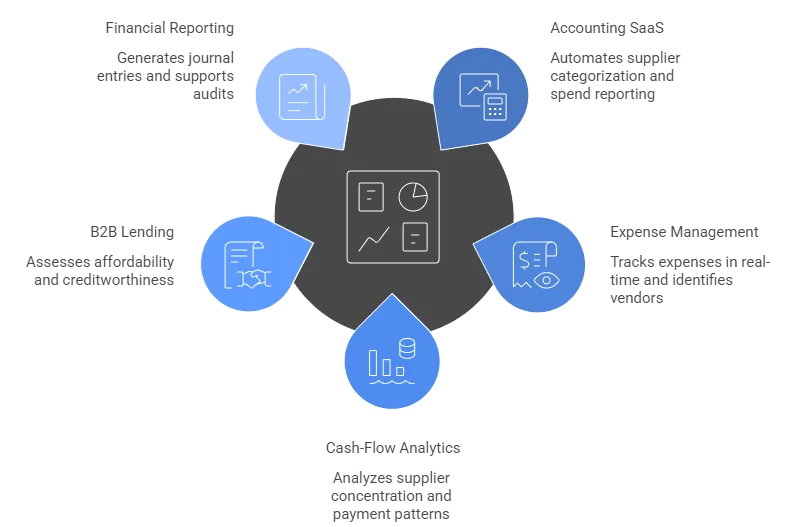
Accounting SaaS Platforms
- Automated supplier categorisation from raw bank feeds
- Merchant-level spend reporting for business clients
- Accounts payable matching via enriched counterparty identifiers
- Historical supplier spend analysis using 7 years of transaction data
- Reconciliation automation via enriched transaction webhooks
Expense Management Platforms
- Real-time business expense categorisation at transaction point
- Vendor identification for policy compliance checking
- SaaS subscription tracking via recurring merchant pattern recognition
- Procurement reporting using structured category codes
- Multi-entity supplier consolidation using merchant identifiers
Cash-Flow Analytics Platforms
- Supplier concentration analysis from enriched counterparty data
- Recurring payment identification for forecasting models
- Business spending pattern analysis by merchant category
- Outgoing payment classification for financial health dashboards
- Counterparty risk flagging via structured merchant intelligence
B2B Lending and Underwriting Platforms
- Business transaction analysis for affordability assessment
- Supplier relationship mapping via enriched counterparty data
- Recurring expense identification for income verification
- Spend pattern analysis for credit decisioning support
- Historical payment behaviour data for underwriting workflows
Financial Reporting and ERP Integrations
- Structured metadata for automated journal entry generation
- Merchant category codes for chart of accounts mapping
- Counterparty identification for intercompany matching
- Supplier payment trails for audit support
- Category-level spend reporting for management accounts
What is the difference between b2b data enrichment tools for sales and for financial platforms?
Sales enrichment appends contact and firmographic data to CRM records for lead generation. Financial enrichment identifies merchant entities and counterparty relationships from raw bank transactions – a separate function for financial automation, not outbound sales.
How does merchant data enrichment work with Open Banking data?
AIS connectivity retrieves verified bank transaction records. Enrichment infrastructure matches each string against a merchant database and returns structured identifiers, category codes, and metadata via API in sub-100ms.
Is Finexer suitable for regulated UK financial platforms?
Yes. Finexer is FCA-authorised. Its Open Banking connectivity operates within the UK regulatory framework. Platforms access verified bank data through compliant consent management workflows.
Transform raw bank data into structured supplier intelligence with Finexer.
About the Author

Ravi Ranjan
Ravi Ranjan is Co founder & CEO of Finexer