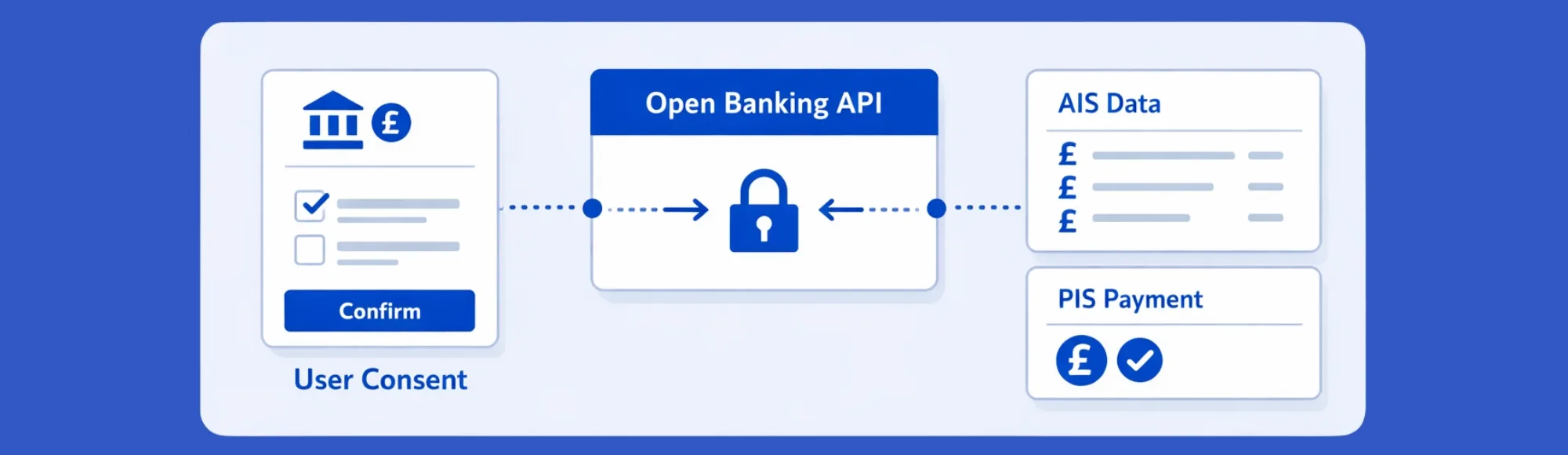
Ready to build on Open Banking?
Finexer gives UK platforms FCA-authorised AIS and PIS access – fast to integrate, API-ready.
Most guides explaining how does open banking work are written for consumers. They explain budgeting apps and faster payments.
That is not useful if you are a Product Manager or Engineering Lead building financial workflows into a SaaS platform.
This guide explains how open banking works from a platform perspective – how AIS and PIS APIs work, what open banking uses look like in practice, and where Finexer fits as the infrastructure layer.
TL;DR
Open banking works by giving regulated providers secure API access to bank accounts with user consent. Open banking uses include AIS to retrieve bank transaction data and PIS to initiate account-to-account payments. Finexer provides FCA-authorised AIS and PIS infrastructure for UK platforms across accounting, LawTech, payroll, PropTech, EPOS, and utility billing sectors.
Key Takeaways
How does open banking work in the UK?
Open banking works by allowing FCA-authorised providers to connect to bank accounts via secure APIs with explicit user consent. Platforms retrieve bank data through AIS and initiate payments through PIS – both operating under the UK Open Banking framework.
What are the two core open banking services for platforms?
Account Information Services (AIS) provide read-only access to bank transaction data and account balances. Payment Initiation Services (PIS) enable account-to-account payments directly from bank accounts – without card networks.
What open banking uses are most common for UK SaaS platforms?
Bank feed automation, financial verification, source-of-funds checks, Pay by Bank payments, affordability assessments, and invoice payment automation are the most common open banking uses across Finexer’s platform verticals.
What makes open banking data more reliable than documents?
Open banking data is retrieved directly from the bank with user consent. It cannot be altered before submission – unlike payslips, PDF statements, or manually uploaded files.
How does Finexer support open banking integration for platforms?
Finexer provides FCA-authorised AIS and PIS infrastructure covering 99% of UK banks – with structured API outputs, real-time webhooks, and 2-3x faster integration than alternative providers.
How Does Open Banking Work?
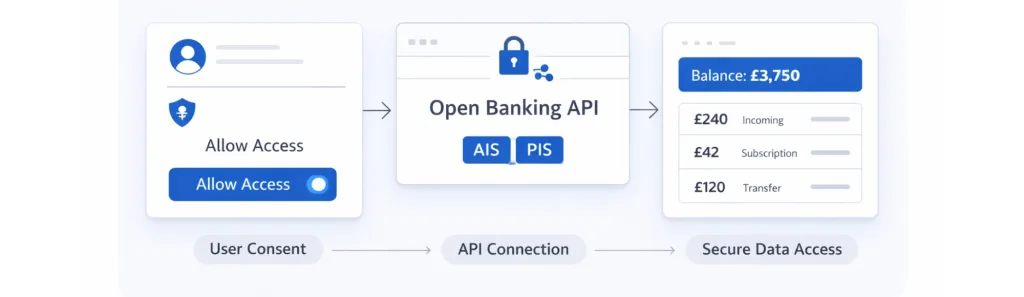
Open banking works on a simple principle. Banks hold financial data. Platforms need it. Open banking creates a secure, regulated way to connect the two.
Here is how it works in three steps:
- A user gives consent for a platform to access their bank account data
- The platform connects to the bank via a regulated Open Banking API
- Bank data is retrieved and delivered to the platform in structured format
No screen-scraping. No manual uploads. No shared login credentials.
The Open Banking framework is regulated by the FCA and operates under the Payment Services Regulations 2017. Only FCA-authorised providers can access bank data – giving platforms and users a secure, compliant infrastructure layer.
Two services power everything:
- AIS – Account Information Services – for bank data access
- PIS – Payment Initiation Services – for account-to-account payments
Why Does the UK Regulatory Framework Matter for Platforms?
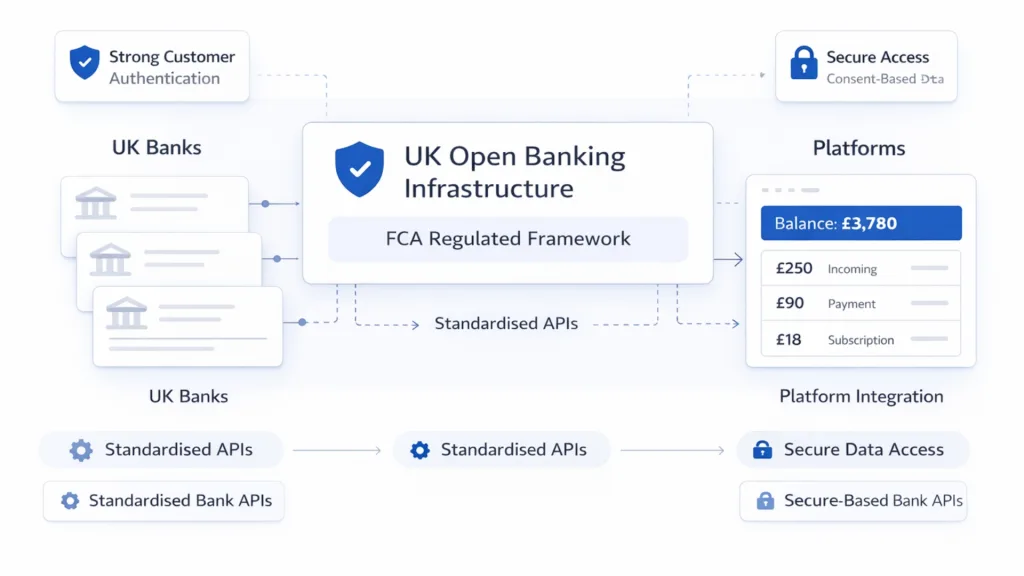
UK open banking is regulation-driven. Every major UK bank is required to provide open banking API access. Platforms do not negotiate individual agreements with each bank.
This matters for product teams because:
- All UK banks follow the same technical standards – one integration works across institutions
- FCA authorisation is mandatory for any provider accessing bank data – no unregulated shortcuts
- Strong Customer Authentication (SCA) is a regulatory requirement – not optional – reducing fraud risk for platforms and users
- Banks cannot charge platforms for API access to consented data – keeping integration costs predictable
This is a significant advantage. UK platforms build on stable, standardised infrastructure rather than fragmented bank-by-bank arrangements.
Upcoming regulatory changes – including PSD3 and the Payment Services Regulation (PSR) – are expected to expand open banking capabilities further. Platforms planning long-term integrations should factor these into their infrastructure decisions.
What Is AIS and How Does It Work?
AIS stands for Account Information Services. It is the read-only side of open banking.
A platform using AIS can retrieve:
- Bank account balances across one or multiple accounts
- Transaction history – income, outgoings, transfers
- Payee and merchant details per transaction
- Account identifiers, sort code, and account number data
AIS cannot move money. It only reads and retrieves.
For platforms, this means replacing manual bank statement collection entirely. Instead of asking users to upload PDFs or CSV files, the platform connects directly to the bank account with consent.
How open banking verification works using AIS explains how platforms use this data for financial verification workflows.
What Is PIS and How Does It Work?
PIS stands for Payment Initiation Services. It is the payment side of open banking.
A platform using PIS can:
- Initiate account-to-account payments directly from a user’s bank
- Enable Pay by Bank at checkout or invoice
- Process bulk payouts to multiple recipients
- Confirm payment settlement via bank transaction data
PIS removes the card network from the payment flow. Payments move directly between bank accounts – faster and without card processing fees.
The complete guide to open banking payments covers PIS payment workflows in detail.
How Does the Open Banking Consent and SCA Flow Work?
Understanding consent matters for any platform building user-facing open banking workflows.
The process works like this:
- Platform requests bank access via the open banking API
- User is redirected to their bank’s authentication screen
- Strong Customer Authentication (SCA) is completed – via banking app or biometric confirmation
- User grants consent for specific data – transactions, balances, or payments
- Authorised provider retrieves data and returns it to the platform via API
- Consent is time-limited and can be revoked instantly by the user
SCA is a regulatory requirement under UK open banking rules. It mandates two or more authentication factors – making open banking significantly more secure than alternatives like screen-scraping or manual document collection.
The platform never sees bank login credentials. Consent is granular – users control exactly what is shared and for how long.
How open banking authentication works explains the SCA and consent process in detail.
What Are the Open Banking Uses for UK Platforms?
Open banking uses vary by platform type. Here are the most common use cases across Finexer’s verticals.
| Platform Type | Open Banking Use | AIS or PIS |
|---|---|---|
| Accounting & ERP | Automatic bank feed retrieval and reconciliation | AIS |
| LawTech | Source-of-funds verification and client financial history | AIS |
| EPOS & Payments | Pay by Bank at checkout and merchant settlement | PIS |
| Payroll & Invoicing | Automated invoice payments and contractor disbursements | PIS + AIS |
| Proptech & Real Estate | Tenant affordability checks and income verification | AIS |
| Utility Billing | Request-to-Pay billing and payment behaviour analysis | PIS + AIS |
How Does Finexer Enable Open Banking for UK Platforms?
Finexer is an FCA-authorised Open Banking infrastructure provider. Platforms integrate Finexer’s AIS and PIS APIs to access bank data and initiate payments – without building direct bank connections themselves.
What Finexer Provides
- AIS connectivity covering 99% of UK bank accounts
- PIS infrastructure for Pay by Bank and account-to-account payments
- Up to 7 years of transaction history via AIS
- Real-time webhooks for live data and payment events
- Structured JSON outputs with merchant identification and category data
- FCA-compliant SCA consent flows with granular permissions
- White-label capability for branded platform journeys
- 2-3x faster integration with 3-5 weeks onboarding support
- Usage-based pricing – no fixed volume commitments
Platforms connect once to Finexer’s infrastructure and get access to both AIS data and PIS payments. Engineering teams do not need to build and maintain individual bank connections.
Open banking API integration guide for UK platforms covers technical implementation steps in detail.
Finexer does not provide accounting software, payment front-ends, or financial reporting tools. Platforms build those products on top of Finexer’s verified bank data and payment infrastructure.
What We See in Practice
Platforms integrating open banking infrastructure follow a consistent pattern. Most start with one open banking use – bank feed automation or Pay by Bank payments.
Within two to three months, the same infrastructure extends to additional workflows. A payroll platform that started with payment automation adds AIS to verify contractor account ownership. An accounting platform that started with bank feeds adds payment initiation for client invoice settlement.
A pattern we observe consistently: a UK accounting platform asks how does open banking work in practice before integration. Within a quarter of going live with Finexer’s AIS, the same API connection powers client financial verification and reconciliation – workflows they had not originally planned because the data was not previously accessible.
“Open banking works best when platforms treat it as infrastructure – not a feature. One integration. Multiple open banking uses built on top.” – Finexer, working with UK SaaS and platform teams
Platforms using Finexer for open banking integration report:
- Faster product deployment versus building direct bank connections
- More reliable financial data from verified bank sources
- New workflow capabilities from structured transaction data
- Lower transaction costs compared to card payment processing
Common Use Cases

Accounting & ERP Platforms
Accounting platforms use Finexer’s AIS to retrieve client bank transactions automatically – replacing manual CSV and PDF uploads. Understanding how does open banking work in practice starts here – bank feeds arrive structured and categorised, powering reconciliation and financial reporting without manual data entry.
LawTech Platforms
LawTech platforms – including insolvency practices – use AIS to access client bank transaction history for source-of-funds verification and KYC checks. These are among the most regulated open banking uses – verified transaction data replaces manually submitted bank statements during client onboarding and compliance workflows.
EPOS & Payment Platforms
EPOS platforms use Finexer’s PIS infrastructure to enable Pay by Bank at point of sale – removing card processing fees and enabling instant payment confirmation. Merchant settlements are verified via AIS transaction data.
Payroll & Invoicing Platforms
Payroll platforms use PIS to automate contractor and employee disbursements and AIS to confirm settlement. These open banking uses reduce manual reconciliation workload significantly. Invoice platforms use PIS to enable instant Pay by Bank invoice payments directly from client bank accounts.
Proptech & Real Estate Platforms
PropTech platforms use AIS to verify tenant income, analyse spending behaviour, and assess affordability during rental onboarding. How does open banking work for tenant verification? It replaces manual payslip and bank statement requests with consent-based bank data access directly from source.
Utility Billing Platforms
Utility platforms use PIS to enable Request-to-Pay billing and AIS to analyse customer payment behaviour before onboarding. Both open banking uses support lower collection costs and more accurate billing risk assessment.
How does open banking work in the UK?
Open banking works by allowing FCA-authorised providers to access bank accounts via secure APIs with user consent. Platforms retrieve bank transaction data through Account Information Services and initiate account-to-account payments through Payment Initiation Services – both regulated under the UK Open Banking framework and Payment Services Regulations 2017.
What are the main open banking uses for business platforms?
The main open banking uses for UK platforms include bank feed automation, financial verification, source-of-funds checks, Pay by Bank payments, affordability assessments, and automated invoice payments. The specific use depends on whether the platform needs bank data access (AIS) or payment initiation (PIS).
Is open banking safe for UK platforms to use?
Yes. Open banking in the UK operates under FCA regulation. Strong Customer Authentication is a mandatory requirement – not optional. Only FCA-authorised providers can access bank data, and consent is explicit, granular, and revocable. The UK Government’s open banking framework outlines the full regulatory protections in place.
Start building on open banking with FCA-authorised infrastructure.
About the Author

Ravi Ranjan
Ravi Ranjan is Co founder & CEO of Finexer