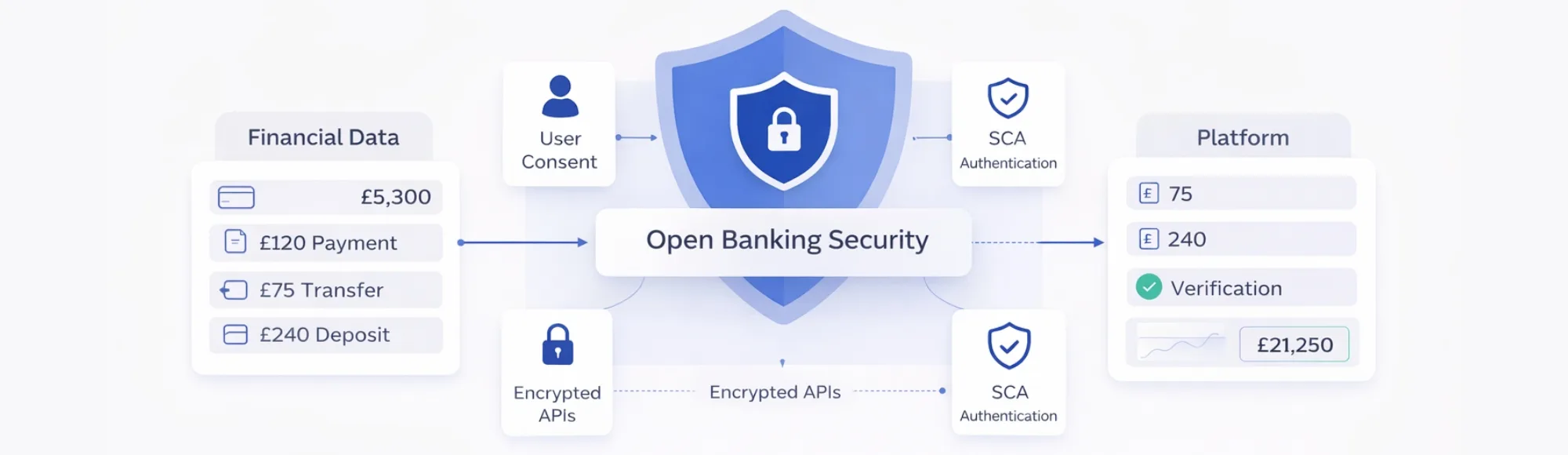
Evaluating Open Banking security for your platform?
Finexer is FCA-authorised – consent-based, encrypted, and compliant by design.
Is open banking safe? It is the first question most platform teams ask before integrating financial APIs – and it is the right question to ask.
The short answer is yes. Open Banking in the UK is designed with multiple security layers – regulatory oversight, consent-based access, encrypted API communication, and Strong Customer Authentication. It is structurally more secure than the legacy approaches it replaces.
At Finexer, we work with UK accounting platforms, LawTech tools, EPOS systems, and payroll infrastructure that have evaluated whether is open banking safe before integration. The security architecture is not marketing language – it is built into the regulatory framework that governs every FCA-authorised provider.
This blog explains the security infrastructure behind Open Banking and why it provides stronger data protection than manual bank statement collection, screen scraping, or credential sharing.
TL;DR
Is open banking safe? Yes. UK Open Banking operates under FCA regulation, uses consent-based API access rather than credential sharing, and mandates Strong Customer Authentication for every data access request. Is open banking secure compared to legacy methods? Significantly more so – AIS access is read-only, opt-in only, and authenticated directly at the bank. Finexer is FCA-authorised to provide account information and payment initiation services – built on the regulated security infrastructure that applies to every access event.
Key Takeaways
Is open banking safe for UK platforms to integrate?
Yes. Open Banking in the UK is regulated by the FCA. Only authorised providers can access bank data. Access requires explicit user consent and Strong Customer Authentication – making it significantly more secure than legacy data collection methods.
Is open banking secure compared to screen scraping?
Yes. Screen scraping requires users to share bank login credentials with third parties – creating security and data quality risks. Open Banking uses regulated API access with user consent and bank-level authentication. Credentials are never shared with the platform.
What security protections does Open Banking include?
Consent-based access control, Strong Customer Authentication, encrypted API communication, FCA authorisation requirements for all providers, data minimisation principles, and granular permission management with instant revocation.
Can platforms access bank data without user permission?
No. Open Banking is entirely opt-in. Access requires explicit user consent before any financial data can be retrieved. Users control which accounts are shared, what data is accessible, and for how long. Access can be revoked instantly at any point.
Is open banking safe for platforms using AIS for data access?
Yes. AIS provides read-only access – platforms can retrieve bank transaction data and balances but cannot modify, move, or alter any financial data in the connected account. Read-only access is a structural security protection, not a configurable setting.
Is Open Banking Safe? What It Is and How It Works
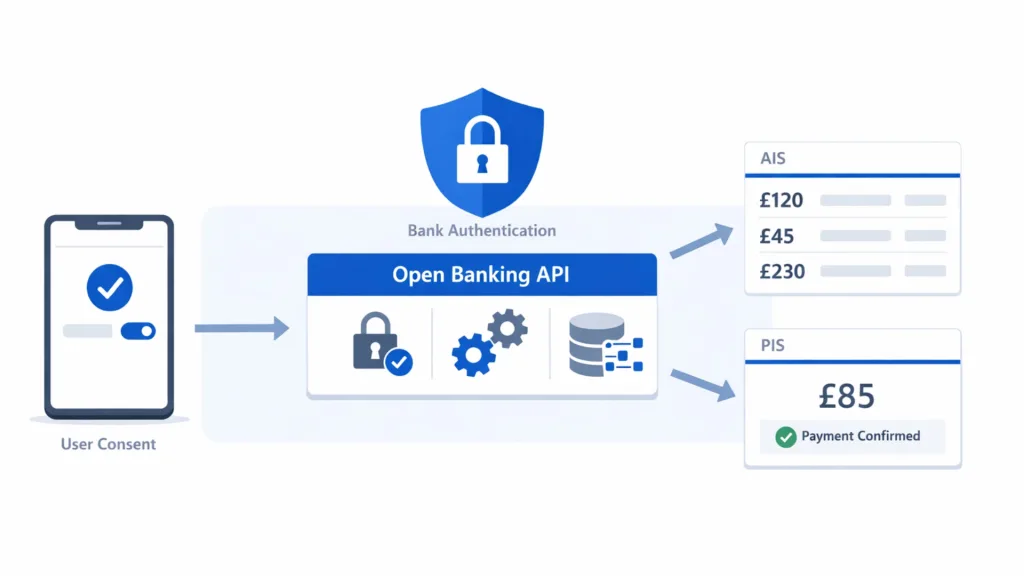
Before evaluating security, it helps to understand what Open Banking actually is.
Open Banking is a framework that allows FCA-authorised providers to access bank account data or initiate payments on behalf of a user – with the user’s explicit, opt-in consent. It is not automatic. No data is shared unless the user actively approves it.
Two services power Open Banking for platforms:
- AIS – Account Information Services – read-only access to bank transaction data and account balances. Platforms can view financial data but cannot modify, move, or interact with the funds in any way.
- PIS – Payment Initiation Services – initiates account-to-account payments directly from a user’s bank account with their consent.
Authentication for both services happens directly at the bank – not through the platform or the Open Banking provider. The platform never sees bank login credentials at any point in the process.
This is the core architectural difference between Open Banking and legacy methods. Is open banking secure at a structural level? Yes – because the bank remains the authentication layer throughout.
The Security Architecture Behind Open Banking
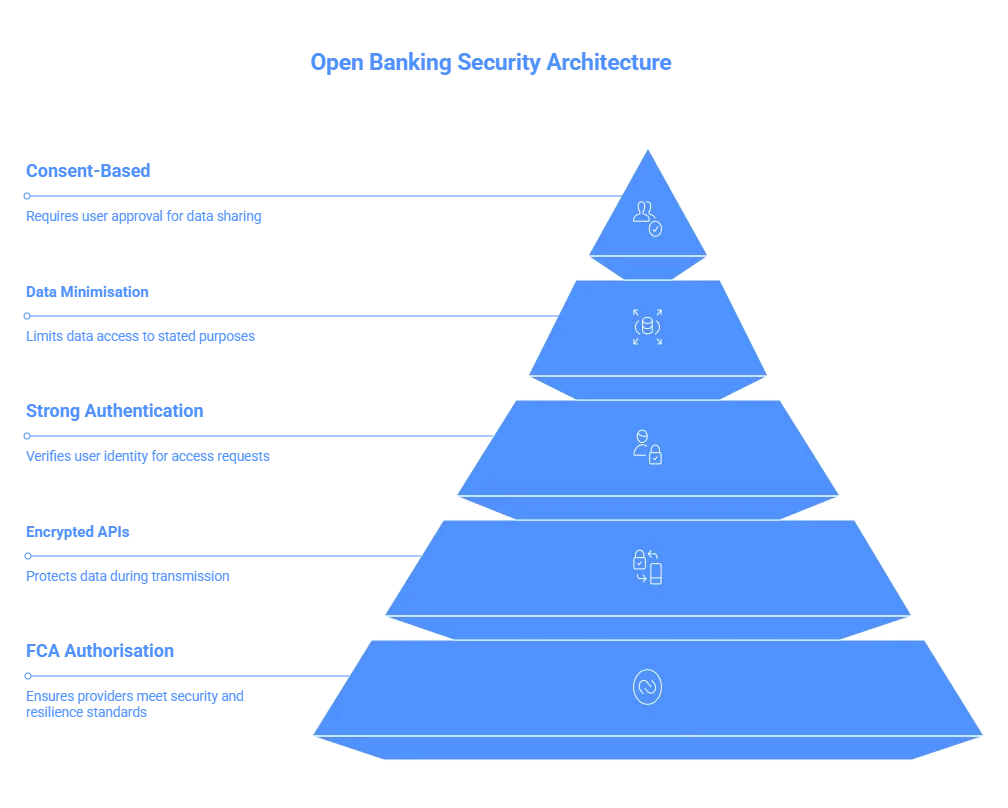
Open Banking security is a layered architecture built into the regulatory framework every authorised provider must follow.
Consent-Based and Opt-In Only
Open Banking participation is entirely voluntary. No platform can retrieve bank data without the user actively opting in and approving access. The consent process specifies which accounts are shared, what data types are accessible, and for how long.
Revocation removes platform access immediately – no data can be retrieved after consent is withdrawn.
Data Minimisation
Providers can only request data needed for the stated purpose. A platform cannot retrieve more financial information than the user consented to share. This is built into the consent framework – not left to individual provider discretion.
Strong Customer Authentication
Every Open Banking access request requires Strong Customer Authentication – a regulatory requirement, not optional. SCA mandates two or more authentication factors via the user’s banking app, biometric confirmation, or one-time passcode.
The platform never handles bank login credentials. Authentication happens directly between the user and their bank.
Encrypted API Communication
All Open Banking data transmissions use encrypted API communication. Financial data cannot be intercepted in transit – replacing screen scraping, which transmitted data through unencrypted session simulations, and manual exports, which produced unprotected files.
FCA Authorisation Requirements
Only FCA-authorised providers can access bank data. Authorisation requires security testing, operational resilience standards, consent management processes, and audit trail maintenance. If a provider loses FCA authorisation, bank access is revoked immediately.
“Is open banking secure? Under UK regulation, security is not optional – it is a condition of authorisation. Every access event operates within the same framework.” – Clare, Finexer
The Open Banking organisation’s guide to why Open Banking is safe covers the full protections in detail.
Why Open Banking Is More Secure Than Legacy Alternatives
| Legacy Method | Security Risk | Open Banking Replacement |
|---|---|---|
| Screen Scraping | Requires credential sharing; unreliable data; breaks when bank interfaces update | Consent-based API access; no credential sharing; regulated data retrieval |
| Manual Statement Upload | PDFs can be altered before submission; no verification layer; manual handling risk | Bank-verified transaction data retrieved directly from source with consent |
| CSV Batch Exports | Unencrypted files in transit; delayed data; no access control after export | Encrypted API transmission; real-time data; access controlled by consent framework |
| Banking Portal Credential Sharing | Credential exposure; no audit trail; unauthorised access risk if compromised | SCA-protected authentication; no credential sharing; full audit trail per access event |
How Does Finexer Provide Secure Open Banking Infrastructure?
Finexer is FCA-authorised to provide account information services and payment initiation services – operating within the full UK Open Banking security framework.
For platforms asking is open banking safe to integrate, what matters is not a feature list – it is whether the provider operates within the regulated framework that makes Open Banking secure by design.
What Finexer provides for secure platform integration:
- FCA-authorised AIS for read-only, consent-based bank data access across 99% of UK banks
- FCA-authorised PIS for account-to-account payment initiation
- SCA-enforced consent flows with granular permissions and instant revocation
- White-label consent journeys for compliant, branded user-facing flows
How Finexer operates as a secure Open Banking partner covers the operational standards in detail.
The truth about Open Banking security addresses common security misconceptions platforms encounter during evaluation.
Finexer does not provide security software, fraud detection tools, or compliance management systems. Platforms build those layers on top of Finexer’s regulated bank data infrastructure.
What I Feel
The security question deserves a direct answer. Is open banking safe? Yes – and the reason is structural.
UK regulation does not allow FCA-authorised providers to cut corners on security. Consent, SCA, data minimisation, encrypted APIs, and audit trails are conditions of operating in the ecosystem – not features a provider can choose to skip.
Platforms delaying integration over security concerns are often comparing Open Banking to an imagined risk rather than to the actual risks of the manual processes they currently run.
Common Use Cases
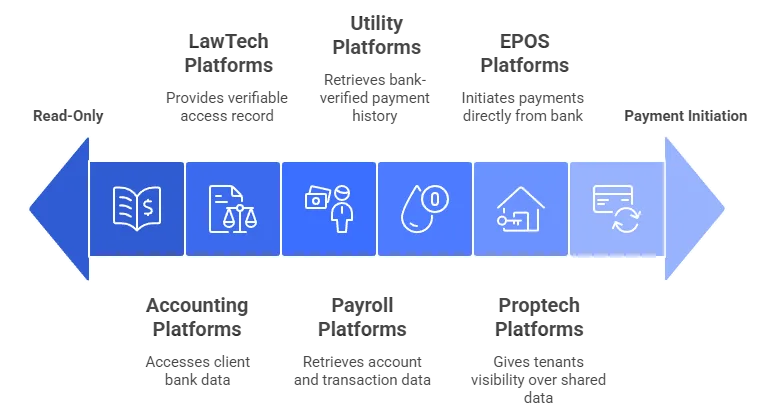
Accounting & ERP Platforms
Accounting platforms evaluating is open banking safe for client data access need confidence that every connection operates within a regulated consent framework. Finexer’s FCA-authorised AIS provides read-only access to client bank data – replacing manually uploaded statements that carry no equivalent access controls or audit trail.
LawTech Platforms
For LawTech platforms handling client due diligence, the audit trail behind data access matters as much as the data itself. Finexer’s consent-based AIS provides a verifiable access record for every client financial data retrieval – supporting the compliance documentation that regulated legal workflows require.
EPOS & Payment Platforms
EPOS platforms asking is open banking secure for payment processing need assurance that SCA-protected bank authentication replaces card credential handling entirely. Finexer’s PIS initiates payments directly from the customer’s bank account – no card details stored, no credential exposure at the merchant layer.
Payroll & Invoicing Platforms
Payroll platforms handling contractor financial data need regulated data access rather than self-reported bank details. Finexer’s AIS retrieves account and transaction data with explicit contractor consent – giving platforms bank-verified information without credential sharing or manual document collection.
Proptech & Real Estate Platforms
PropTech platforms accessing tenant financial data for affordability checks need consent frameworks that tenants understand and control. Finexer’s AIS consent flow gives tenants granular visibility over what is shared – with instant revocation available at any point during the tenancy workflow.
Utility Billing Platforms
Utility platforms collecting customer financial data for billing risk assessment need access methods that cannot be disputed or altered. Finexer’s AIS retrieves bank-verified payment history directly from source – data that carries the same evidential weight as a bank statement but without the manual submission risk. without the manual submission risk.
Is open banking safe for platforms handling sensitive financial data?
Yes. Open Banking in the UK is regulated by the FCA. Data access requires explicit opt-in consent, Strong Customer Authentication, and encrypted API communication. AIS access is read-only – platforms can view financial data but cannot modify accounts or move funds. Only FCA-authorised providers can retrieve bank data.
Is open banking secure compared to traditional bank data collection?
Open banking is more secure than legacy alternatives. Screen scraping requires credential sharing. Manual exports create unprotected files with no access control. Open Banking uses opt-in consent, read-only AIS access, SCA authentication, data minimisation, and encrypted transmission – all governed by FCA regulatory standards every authorised provider must meet.
How does Finexer ensure Open Banking security for UK platforms?
Finexer is FCA-authorised to provide account information and payment initiation services. All bank data access uses consent-based access, SCA authentication, and encrypted API communication. AIS access through Finexer is read-only – platforms retrieve verified bank data without any ability to modify connected accounts.
Open Banking is safe. Build on infrastructure that proves it.
About the Author

Clare Pearson
Clare Pearson is a senior payments professional with extensive experience across the global financial services and payments industry. She specialises in Open Banking, payment infrastructure, and financial technology transformation, with expertise spanning product delivery, operational strategy, regulatory compliance, and large-scale payments programmes. Clare currently serves as a Non-Executive Director at Finexer and a panel member for the Payment Systems Regulator (PSR), advising on the development of payment systems policy and innovation