Need reliable Open Banking coverage across UK banks?
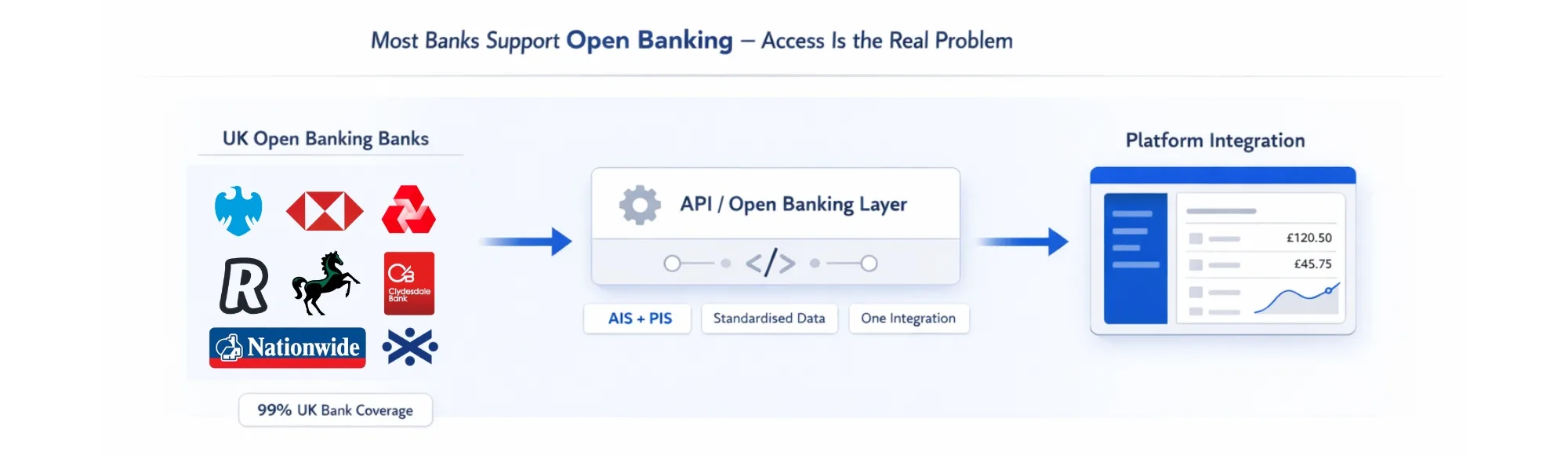
Finexer connects platforms to 99% of UK banks through a single API-FCA-authorised and production-ready.
Which banks use open banking in the UK is the right starting question – but it is rarely the question that actually matters for platforms building financial products.
Most major UK banks support Open Banking today. The CMA9 banks are mandated to provide Open Banking APIs. A large and growing number of digital banks also participate. So the answer to “which banks support Open Banking” is: most of them.
But at Finexer, I work with SaaS platforms, accounting tools, fintech teams, and ERP providers – and the question they are actually trying to answer is different. They want to know whether they can reach their users reliably, across all the banks those users hold accounts with, without building and maintaining separate integrations for each one.
That is a coverage and infrastructure question – not a bank list question. This blog addresses both.
TL;DR
Which banks use open banking in the UK? Most major high street banks, digital banks, and building societies support Open Banking APIs. Where is open banking available? In the UK, Open Banking is available through FCA-regulated infrastructure covering the vast majority of personal and business bank accounts. For platforms, the real question is how to access that coverage reliably – which is where a unified API layer covering 99% of UK banks becomes the practical answer.
Key Takeaways
Which banks use open banking in the UK?
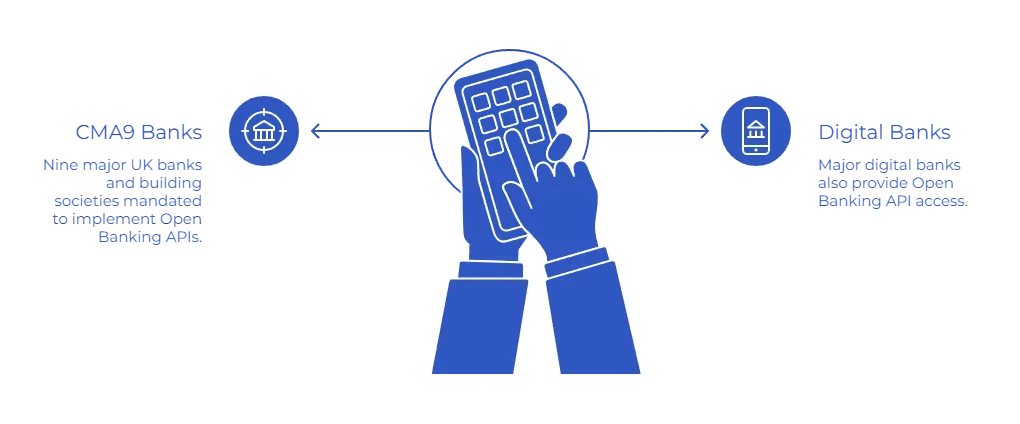
The CMA9 banks are mandated to support Open Banking APIs – including Barclays, HSBC, Lloyds Banking Group, NatWest Group, Santander, Nationwide, Danske Bank, AIB Group (UK), and Bank of Ireland (UK). Digital banks including Monzo, Starling, and Revolut also provide Open Banking API access.
Where is open banking available for platforms?
Open Banking is available across the UK through FCA-regulated APIs. For platforms, access is provided through authorised third-party providers – either via direct bank integrations or through a unified infrastructure layer covering multiple banks simultaneously.
What does open banking coverage actually mean for a platform?
Coverage for platforms means consistent, reliable API access across all the banks their users hold accounts with – not just whether a bank participates in Open Banking. API uptime, data consistency, and historical depth all factor into usable coverage.
Why do platforms avoid integrating with banks individually?
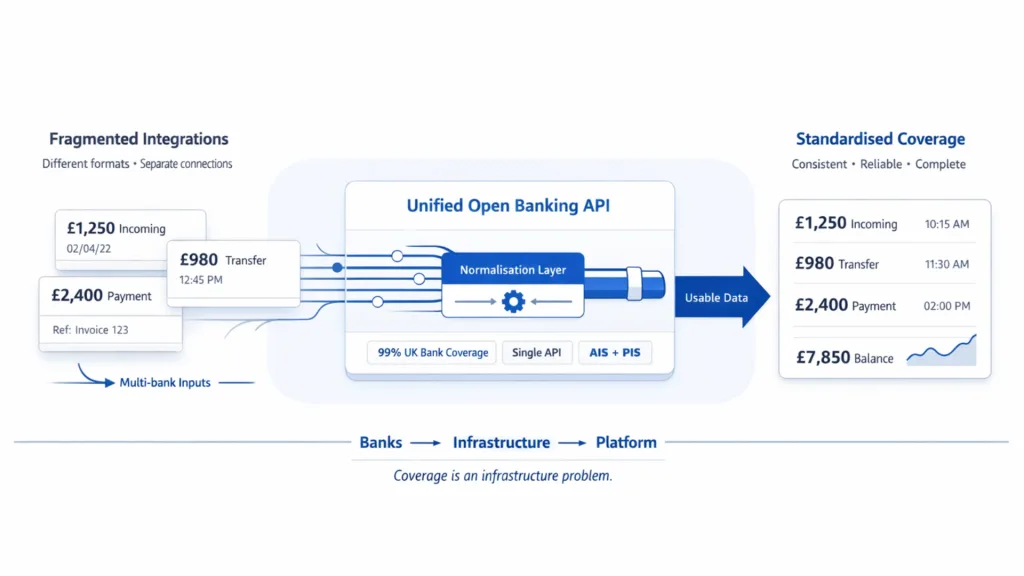
Each bank implements Open Banking standards differently – field names, timestamp formats, reference fields, and data structures vary per bank. Building and maintaining separate integrations creates fragmentation, ongoing maintenance overhead, and inconsistent data quality across users.
How does Finexer solve the coverage problem for UK platforms?
Finexer provides a single API connection covering 99% of UK banks – delivering standardised bank transaction data and payment initiation without requiring platforms to manage individual bank integrations.
Which Banks Use Open Banking in the UK?
The short answer: most of them.
CMA9 Banks (Mandated)
The Competition and Markets Authority required nine major UK banks and building societies to implement Open Banking APIs. These are the officially mandated CMA9:
- Barclays Bank plc
- HSBC Group
- Lloyds Banking Group plc
- NatWest Group plc
- Santander UK plc
- Nationwide Building Society
- Danske Bank (Northern Bank Limited)
- AIB Group (UK) plc / First Trust Bank
- Bank of Ireland (UK) plc
In September 2024, the CMA confirmed full completion of the Open Banking Roadmap – all nine mandated institutions now offer the complete suite of Open Banking payment and account information services including VRP for sweeping – Open Banking .
Digital Banks
Beyond the CMA9, major digital banks also provide Open Banking API access:
- Monzo
- Starling Bank
- Revolut
- Tide
- Mettle
The UK now has over 12 million users benefiting from Open Banking-powered apps, products, and services – a figure that reflects the breadth of bank participation across the ecosystem.
Finexer Open Banking Banks covers the full list of UK banks accessible through Finexer’s infrastructure.
Where Is Open Banking Available – And What Does That Mean for Platforms?
Where is open banking available is straightforward when asked about geography. In the UK, Open Banking is available nationwide – regulated by the FCA and built on standards maintained by Open Banking Limited (OBL).
But for platforms, “where is open banking available” has a more operational meaning.
Availability vs. Usability
A bank supporting Open Banking does not automatically mean a platform receives clean, consistent data from that bank.
This is a critical point that most bank list articles miss entirely.
Usable coverage for platforms means:
- API reliability – consistent uptime across all connected banks
- Data consistency – standardised transaction formats regardless of which bank the data comes from
- Historical depth – access to sufficient transaction history for the use case
- Business account support – not just personal accounts
Complete Guide to Open Banking Payments covers how Open Banking payment and data flows work in practice for UK platforms.
Why Does Direct Bank Integration Fail at Scale?
This is where which banks use open banking stops being a simple list question.
Every Bank Implements Open Banking Differently
UK banks all follow the Open Banking standard – but implementation varies significantly in practice.
Real differences across banks include:
- Timestamps – digital banks like Monzo, Starling, and Revolut provide full timestamps per transaction. Most high street banks return date only – meaning intraday transaction ordering is unreliable.
- Payment references – Revolut and Nationwide do not provide payment references in their API output. Barclays, Lloyds, and NatWest do – but in different formats.
- Running balances – high street banks generally provide running balances per transaction. Most digital banks do not.
- Merchant naming – transaction descriptions vary widely across banks for the same merchant.
For a platform building reconciliation, income verification, or KYC workflows, these inconsistencies require significant post-processing per bank – duplicating effort across every integration.
Ongoing Maintenance Burden
Banks update their APIs. Authentication flows change. New versions are released. Each update requires platform-side changes. Across ten or fifteen banks, this becomes a continuous engineering overhead with no direct product value.
Coverage Gaps
No platform can realistically maintain direct integrations across every UK bank their users hold accounts with. Users on smaller banks or newer digital banks fall outside coverage entirely without a unified layer.
How Do Platforms Actually Solve the Open Banking Coverage Problem?
Platforms solving this at scale do not integrate bank-by-bank. They connect to an infrastructure layer that handles bank connectivity on their behalf.
What a Unified Infrastructure Layer Provides
- Single API connection covering multiple banks simultaneously
- Standardised data output regardless of originating bank
- Managed API maintenance – bank updates handled at infrastructure level
- Consistent uptime monitoring across the bank estate
- Regulatory compliance managed through the infrastructure provider’s FCA authorisation
| Consideration | Direct Bank Integration | Unified Infrastructure (Finexer) |
|---|---|---|
| Bank Coverage | Limited to banks platform has individually integrated | 99% of UK banks via single connection |
| API Maintenance | Platform team manages updates per bank | Handled at infrastructure level |
| Data Consistency | Varies per bank – requires post-processing | Standardised output across all banks |
| Time to Coverage | Months per bank integration | 3-5 weeks onboarding support to go live |
| Regulatory Layer | Platform must hold or agent under FCA authorisation | FCA-authorised infrastructure – managed for you |
| Scalability | Each new bank requires separate integration work | Coverage scales without additional integrations |
How Does Finexer Provide Open Banking Coverage for UK Platforms?
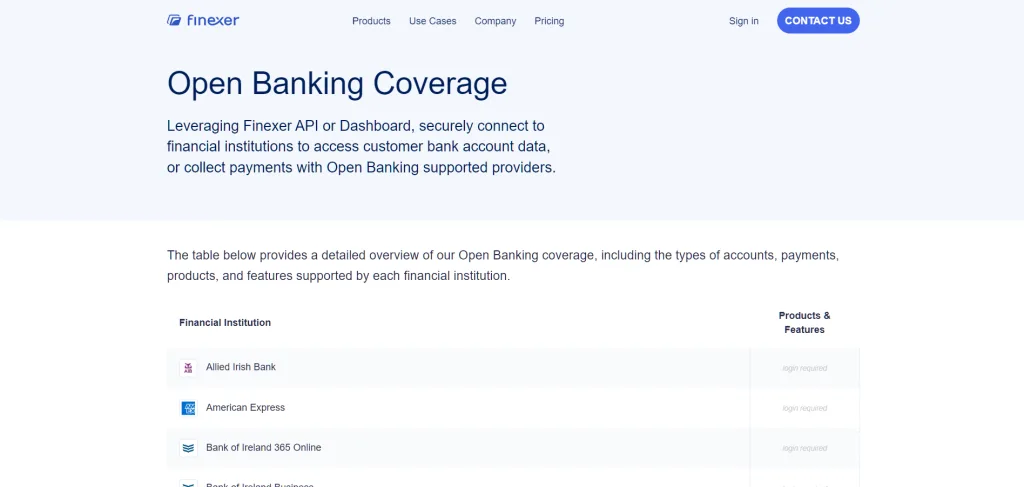
Finexer is an FCA-authorised Open Banking infrastructure provider giving platforms access to 99% of UK banks through a single API – covering both data access (AIS) and payment initiation (PIS).
What Finexer Provides
- Single API covering 99% of UK bank accounts
- Real-time bank transaction data with webhook delivery
- Transaction history up to 7 years
- Standardised data output across all connected banks
- Pay by Bank, Payout, and Bulk Payout via PIS
- White-label integration options
- Usage-based pricing
- 3-5 weeks onboarding support
FCA Open Banking Guidance covers the regulatory framework governing Open Banking infrastructure providers in the UK.
What I Feel
The shift I see most often is platforms arriving with a bank list question and leaving with an infrastructure question.
Which banks use open banking is a useful context. But the decision that actually determines whether a platform’s financial feature works reliably for all its users is this: how does the platform connect to those banks consistently, with clean standardised data, without building a bank integration team?
Where is open banking available is the easy part. Accessing it reliably at scale – across banks that all implement the standard differently – is where infrastructure choice makes the real difference.
Common Use Cases
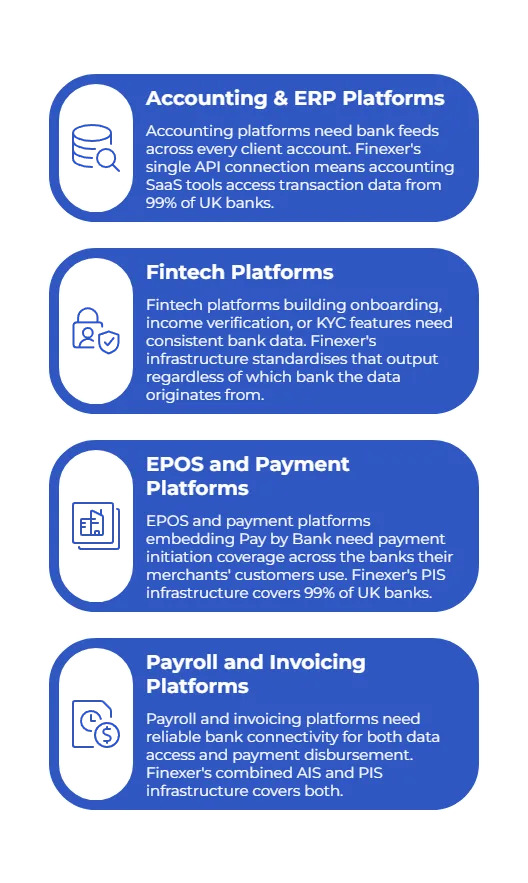
Accounting & ERP Platforms
Accounting platforms need bank feeds across every client account – regardless of which UK bank that client uses. Finexer’s single API connection means accounting SaaS tools access transaction data from 99% of UK banks without maintaining separate bank integrations. Standardised transaction data arrives ready for reconciliation and reporting workflows – no per-bank post-processing required.
Fintech Platforms
Fintech platforms building onboarding, income verification, or KYC features need consistent bank data across their entire user base. A user on Monzo and a user on Lloyds need to produce the same quality of verified transaction data. Finexer’s infrastructure standardises that output regardless of which bank the data originates from.
EPOS and Payment Platforms
EPOS and payment platforms embedding Pay by Bank need payment initiation coverage across the banks their merchants’ customers use. Finexer’s PIS infrastructure covers 99% of UK banks – meaning Pay by Bank works for the vast majority of a merchant’s customer base without requiring multiple payment provider integrations.
Payroll and Invoicing Platforms
Payroll and invoicing platforms need reliable bank connectivity for both data access and payment disbursement. Finexer’s combined AIS and PIS infrastructure covers both – bank transaction data for verification and Bulk Payout for disbursement – through the same single API connection.
Which UK banks use open banking?
Most major UK banks support Open Banking, including all nine CMA9 mandated institutions – Barclays, HSBC, Lloyds Banking Group, NatWest Group, Santander, Nationwide, Danske Bank, AIB Group (UK), and Bank of Ireland (UK) – as well as digital banks including Monzo, Starling, and Revolut.
Where is open banking available in the UK?
Open Banking is available nationwide across the UK through FCA-regulated APIs. Platforms access this coverage through authorised third-party providers – either via direct bank integrations or through a unified infrastructure layer that aggregates multi-bank connectivity through a single API connection.
Does Finexer cover all UK banks?
Finexer covers 99% of UK banks through a single API – including all CMA9 banks, major digital banks, and building societies. Platforms connect once and access full coverage without managing individual bank integrations.
Connect to 99% of UK banks through a single FCA-authorised API.
About the Author

Ravi Ranjan
Ravi Ranjan is Co founder & CEO of Finexer