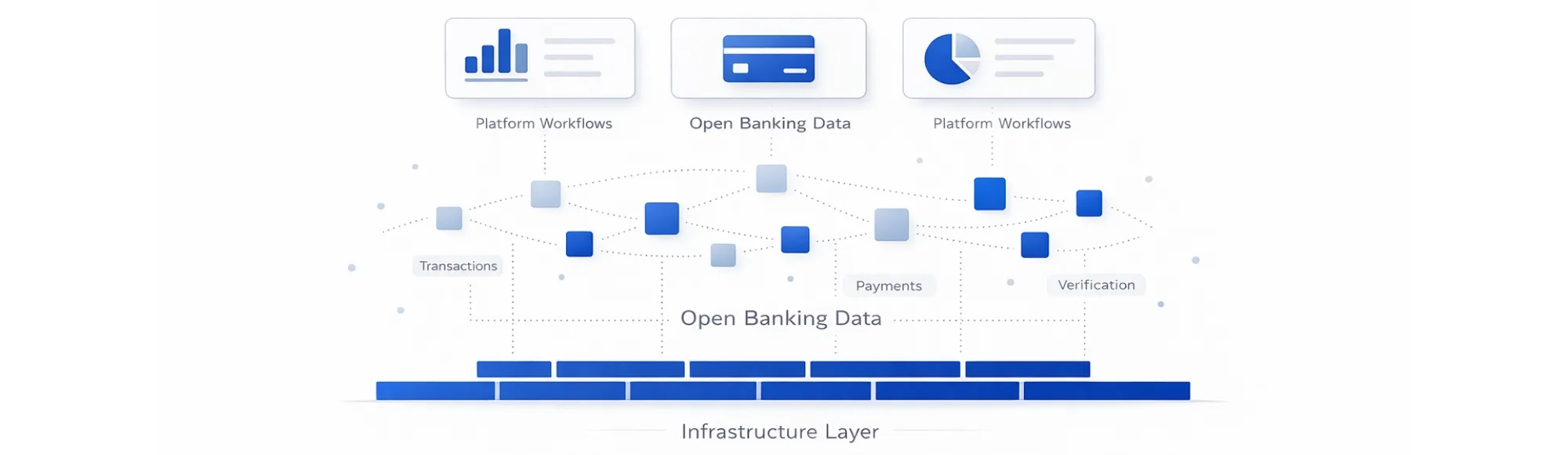
Most platforms integrate APIs. Few understand the infrastructure layer beneath them.
Build financial workflows on structured open banking data with FCA-authorised infrastructure.
Open banking infrastructure is the regulated system of APIs, consent flows, and data standards that allows platforms to access bank transaction data and initiate payments without building direct bank integrations. It is not a product. It is the foundation layer that financial products are built on top of.
For fintech founders and product teams, understanding this layer means understanding what sits between the bank and the platform – how open banking data flows, how it is structured, and what determines whether the workflows built on top of it are reliable at scale.
This blog explains what the infrastructure layer consists of at a system level, what open banking data platforms can access through it, what workflows are built on it, and where infrastructure quality determines product reliability.
TL;DR
Open banking infrastructure is the regulated API and consent layer that gives platforms access to bank transaction data and payment initiation across UK banks. Open banking data includes transaction history, account balances, and payment activity retrieved through this layer. For platforms building financial products, the quality of the foundation layer determines data consistency, workflow reliability, and scalability. Finexer provides FCA-authorised infrastructure covering 99% of UK banks with structured data output and real-time webhooks.
Key Takeaways
What is open banking infrastructure?
Open banking infrastructure refers to the regulated systems, APIs, and consent frameworks that allow platforms to access bank data and initiate payments securely. It acts as the foundation layer between UK banks and the financial products built on top of them.
What is open banking data?
Open banking data includes financial information retrieved from bank accounts through regulated APIs – covering transaction history, account balances, payment activity, and financial behaviour patterns. It is the raw material that platforms use to build financial workflows.
What do platforms build on this foundation layer?
Platforms build financial workflows including income verification, transaction reconciliation, payment tracking, financial reporting, and bank-based payment initiation on top of the regulated infrastructure layer.
Why does infrastructure quality affect platform products?
Infrastructure quality determines whether open banking data is consistent, structured, and reliable at scale. Poor infrastructure produces broken bank feeds, inconsistent transaction data, and workflow failures that cannot be fixed at the application layer.
What is the difference between an open banking API and infrastructure?
An open banking API is a single connection point. The infrastructure is the complete system – authentication, consent management, data standardisation, webhook delivery, and bank connectivity – that makes the API reliable and scalable for production use.
What Is Open Banking Infrastructure?
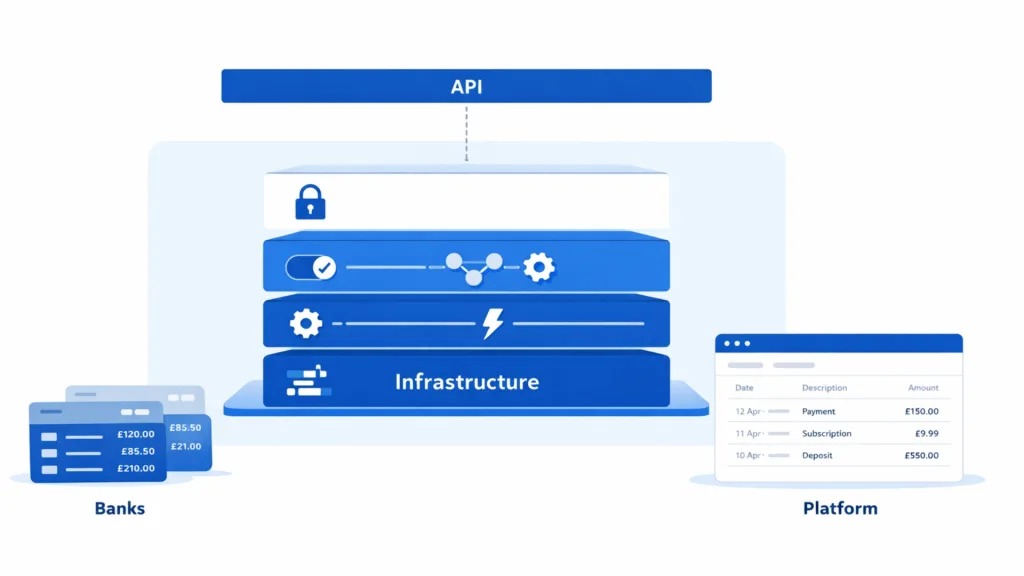
The System Layer Beneath the API
Open Banking in the UK was mandated by the Competition and Markets Authority in 2018, requiring the nine largest UK banks to open standardised APIs to authorised third-party providers. This created the regulatory and technical foundation that providers operate within today.
The infrastructure layer is not the API itself. It is the complete system that makes the API reliable – authentication flows, consent management, data standardisation, bank connectivity maintenance, webhook delivery, and structured output. A platform integrating with a provider gets access to all of these layers through a single integration point.
What the Infrastructure Layer Manages
When a platform integrates with an open banking infrastructure provider, the provider handles:
- Bank authentication and secure token management using Financial Grade API specifications
- Consent flow – user grants permission, scope is defined, access is time-limited
- Data retrieval from the bank and standardisation into consistent output format
- Webhook delivery for real-time transaction events
- Bank connection maintenance across 99% of UK banks
- Compliance with FCA authorisation requirements for AIS and PIS
The platform does not manage any of this directly. It consumes structured open banking data through a single API layer.
“When I work with engineering teams evaluating providers, the question is never just which banks are supported. It is what happens to the data after retrieval – how it is structured, how consistently it arrives, and how connection failures are handled. That is where providers differ.” – Yuri, Finexer
What Open Banking Data Does a Platform Access?

The Data Layer
Open banking data retrieved through FCA-authorised AIS infrastructure includes the financial information that platforms use to build product features and operational workflows.
AIS open banking infrastructure gives platforms access to:
- Transaction history – individual transactions with amounts, dates, merchant details, and payment references
- Account balances – real-time and historical balance data per account
- Account details – sort code, account number, IBAN, and BIC for verification workflows
- Payment activity patterns – recurring payments, income flows, and spending behaviour
- Multi-account access – data across multiple bank accounts per user through a single consent flow
This open banking data is retrieved directly from the bank – not from client-submitted documents or CSV exports. It reflects actual financial activity at source.
What Determines Data Quality
Not all open banking data is equal. Data quality is determined by infrastructure decisions, not application decisions.
- Bank coverage – gaps in coverage mean missing data for users whose bank is not supported
- Standardisation – raw bank data arrives in inconsistent formats; the infrastructure layer normalises this
- Enrichment – merchant identification, categorisation, and transaction tagging happen at this layer
- Webhook reliability – real-time transaction events require consistent delivery, not polling
Platforms cannot fix data quality problems at the application layer. They inherit the quality of the provider they integrate with.
What Do Platforms Build on This Infrastructure?
Financial Workflows Enabled by Bank Data
The value of the regulated layer is not the data itself – it is what platforms build with it. For fintech founders and product teams, structured open banking data enables financial workflows that document-based processes cannot support reliably.
| Workflow | What It Requires | Open Banking Data Used |
|---|---|---|
| Transaction reconciliation | Verified transaction records matched against internal ledger entries | Transaction history with amounts, dates, references, and merchant details |
| Income verification | Confirmed salary payments and consistent income patterns over time | Transaction history showing recurring credit patterns and payment frequency |
| Payment tracking | Real-time monitoring of incoming and outgoing payment activity | Webhook-delivered transaction events with instant balance updates |
| Financial reporting | Structured, categorised transaction data for reporting and analysis | Enriched data with categorisation, merchant IDs, and payment types |
| Bank-based payments | Payment initiation directly from user bank accounts | PIS layer for Pay by Bank, bulk payouts, and account-to-account transfers |
| KYC and verification | Bank-authenticated account and identity confirmation | Account details – sort code, IBAN, BIC – verified directly from the bank |
Bank API integration for financial data access at production scale requires a foundation that delivers consistent open banking data across all these workflow types simultaneously – not just in sandbox testing.
Where Foundation Quality Determines Product Reliability
Most platform failures on this layer are not API failures. They are data quality failures – inconsistent transaction formats, broken bank connections, missing webhook deliveries, or incomplete coverage for specific bank types.
These problems cannot be resolved at the application layer. A reconciliation workflow receiving inconsistently formatted transaction data will produce incorrect outputs regardless of how well the matching logic is built.
Foundation quality is a product decision, not just a technical one.
How Does Finexer Provide Open Banking Infrastructure?
Finexer is an FCA-authorised provider covering 99% of UK banks. For platforms building financial workflows on bank transaction data, Finexer provides the complete foundation layer – bank connectivity, consent management, data standardisation, enrichment, and webhook delivery – through a single API integration.
What Finexer’s Infrastructure Provides
- FCA-authorised AIS and PIS – verifiable on the FCA register
- 99% UK bank coverage including challengers and building societies
- Structured, categorised open banking data with merchant identification
- Real-time webhooks for transaction events and balance updates
- White-label consent flows with granular permissions and instant revocation
- Deploys 2–3x faster than market alternatives
- Usage-based pricing with 3-5 weeks onboarding support
“The foundation layer is where product reliability is decided. Engineering teams spend months building reconciliation and verification workflows – but if the open banking data arriving at the input is inconsistent or incomplete, the workflow cannot compensate for it. Infrastructure quality has to be right before product development starts.” – Yuri, Finexer
What I Feel
This layer is one of the most misunderstood parts of fintech product development.
Most product teams evaluate it like a commodity – coverage percentage, price per call, documentation quality. They find out what actually matters – data consistency, webhook reliability, structured output across bank types – after they have already built on top of it.
The platforms that get this right treat provider selection as a product decision. The open banking data quality they inherit from their chosen infrastructure becomes the ceiling on what their financial workflows can reliably do.
Choosing well at this layer is significantly cheaper than rebuilding after go-live.
Common Use Cases
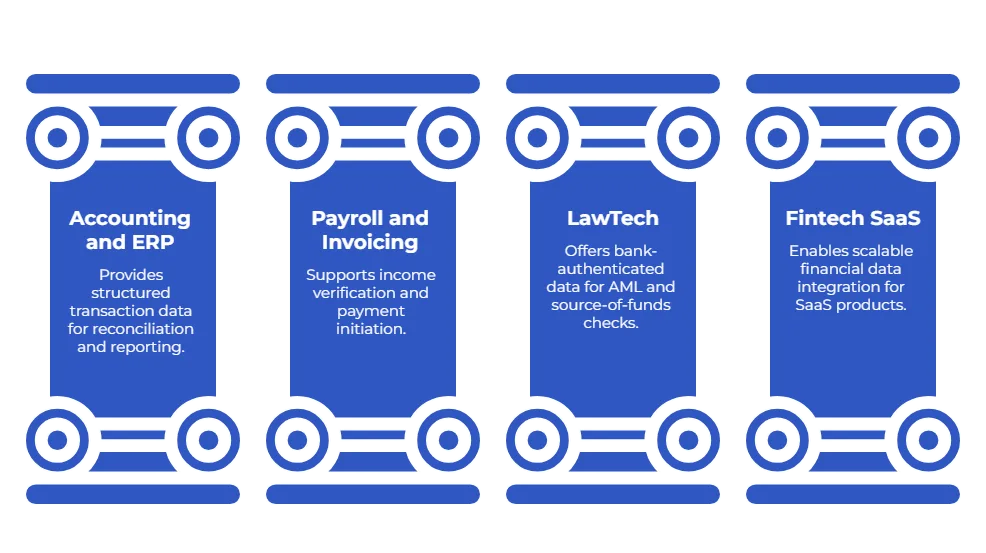
Accounting and ERP Platforms
Accounting and ERP platforms building bank feed and reconciliation features need a foundation layer that delivers consistent, structured transaction data across all major UK banks. Finexer’s AIS provides categorised open banking data with real-time webhooks – supporting automated reconciliation and financial reporting workflows without data inconsistency.
Payroll and Invoicing Platforms
Payroll and invoicing platforms use this layer for income verification, salary payment tracking, and payout initiation. Finexer’s FCA-authorised AIS and PIS supports both data retrieval and payment workflows through a single integration – covering bank feed access and bulk payout initiation.
LawTech Platforms
LawTech platforms building source-of-funds and AML workflows need open banking data with full transaction history, consent logs, and audit-ready access records. Finexer’s AIS provides bank-authenticated transaction data with structured output and access timestamps that support regulatory documentation requirements.
Fintech SaaS Platforms
Fintech SaaS platforms building financial data features need a foundation layer that scales with their product. Finexer’s usage-based pricing and white-label consent flows allow product teams to integrate bank data access without fixed-volume commitments or branded third-party redirects.
What is open banking infrastructure used for?
Open banking infrastructure is used by platforms to access bank transaction data and initiate payments through regulated APIs. It enables financial workflows including reconciliation, income verification, payment tracking, and bank-based payment initiation – without requiring direct integrations with individual banks.
What open banking data can platforms access through this layer?
Platforms can access transaction history, account balances, account details, and payment activity patterns through FCA-authorised AIS. This open banking data is retrieved directly from the bank with user consent and structured for use in financial product workflows.
How do platforms choose the right provider?
Platforms should evaluate UK bank coverage, open banking data quality and consistency, AIS and PIS authorisation status, webhook reliability, enrichment capabilities, and onboarding support. Infrastructure quality directly determines product reliability – evaluation should go beyond API documentation to production data consistency.
Build financial workflows on reliable open banking infrastructure.
About the Author

Yuri
Yuriy Yakushko is a fintech founder and software engineer with over 20 years of experience building financial technology. He’s passionate about creating scalable, secure infrastructure that helps businesses modernise how they access financial data and manage payments.