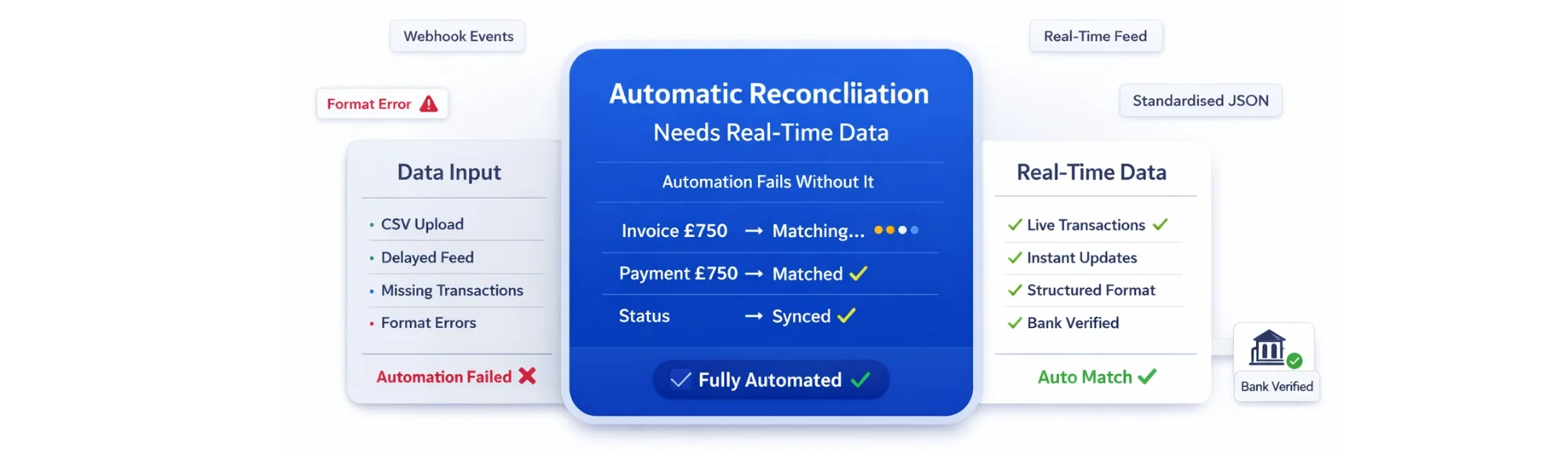
Your reconciliation automation is only as good as the data feeding it.
Finexer provides real-time bank transaction data for reliable automatic bank reconciliation.
Automatic bank reconciliation does not fail because the matching logic is wrong.
It fails because the data feeding it is delayed, incomplete, or pulled from sources that were never designed for automation.
When I work with engineering teams at accounting SaaS and ERP platforms, the pattern is consistent. Strong matching rules, clean exception handling, audit-ready outputs – and reconciliation failures every month-end. The engine is fine. The data layer is not.
This blog covers why automatic bank reconciliation breaks at the input stage, what reconciliation automation genuinely requires from the data layer, and how real-time bank transaction data via FCA-authorised AIS resolves the problem at source.
TL;DR
Automatic bank reconciliation fails at the data input stage, not the matching engine. CSV exports are batch-based, inconsistently formatted, and unverifiable at source. Reconciliation automation requires real-time, bank-verified transaction data – structured, continuous, and consistent across all connected UK banks. Finexer’s FCA-authorised AIS provides that data layer for UK accounting SaaS and ERP platforms.
Key Takeaways
Why does automatic bank reconciliation fail despite automation being in place?
The automation is running on delayed, inconsistently formatted data. CSV exports introduce latency and format gaps before matching logic ever runs. The engine is not the problem – the data input is.
What does reconciliation automation actually require from the data layer?
Real-time transaction data that is bank-verified, consistently structured, and automatically delivered. Not a scheduled CSV pull – a continuous feed that updates as transactions settle.
How does Open Banking AIS fix the data input problem?
FCA-authorised AIS retrieves bank transaction data directly from source, in real time, via webhooks. No manual export step. No format inconsistencies across banks. The same structured JSON schema every time.
Which platforms benefit most from real-time bank data for reconciliation?
Accounting SaaS platforms, ERP systems, and finance automation tools that process high transaction volumes and require accurate, scalable matching without manual data handling overhead.
Why Does Automatic Bank Reconciliation Break at the Data Layer?
Why Is the Data Input Stage the Weakest Point?
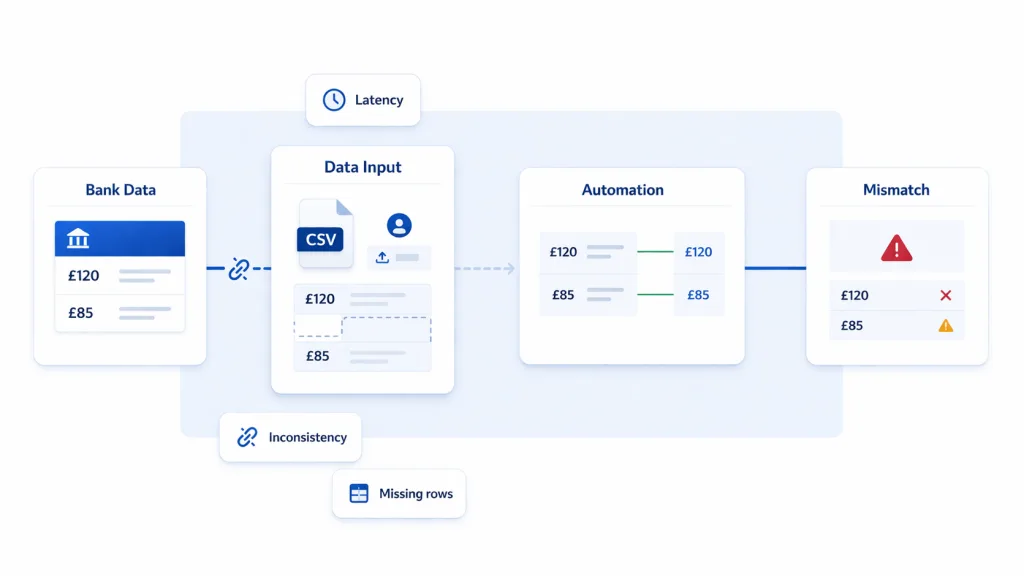
Most reconciliation automation pipelines have the same structural flaw. The matching engine is sophisticated. The exception workflow is well-designed. But somewhere upstream, there is a manual step.
A user logs into their bank portal. Downloads a CSV. Uploads it to the platform. The reconciliation engine runs.
That works – until the export is missed. Until the bank updates its CSV column structure. Until the wrong date range is selected. Until one account is accidentally excluded.
Automatic bank reconciliation breaks not because the automation failed. It breaks because the data the automation depends on was never reliable to begin with.
“When I work with engineering teams building reconciliation pipelines, the data layer problem is almost always the same. The platform has invested in matching logic and is running it against data that is two days old, formatted differently by every bank. The automation is sound. The data input is not.” – Yuri, Finexer
Why Do CSV Exports Fail Reconciliation Automation at Scale?
CSV exports from UK banks are not standardised. Column headers, date formats, reference field structures, and amount representations vary across every institution.
Reconciliation automation built on CSV inputs requires bank-specific parsing logic for every connected bank. That logic breaks silently when banks update their export templates.
At scale – hundreds of client accounts across multiple banks – the maintenance overhead becomes unsustainable. Format mismatches produce silent reconciliation failures that only surface during month-end review.
Why automatic bank reconciliation requires verified bank data covers the data infrastructure requirements for reconciliation at scale.
How Does Data Latency Break Real-Time Matching?
A CSV exported today reflects transactions up to yesterday. For platforms running automatic bank reconciliation that promises real-time matching – invoice confirmation, cash position visibility, same-day payment reconciliation – batch-based data is a structural blocker.
Latency cannot be solved at the matching layer. A reconciliation engine running on yesterday’s data will always produce yesterday’s results, regardless of how fast the matching logic runs.
Automated payment reconciliation for UK platforms covers the downstream workflow improvements that become possible once the latency problem is resolved.
What Does Reliable Reconciliation Automation Actually Require?
What Data Properties Make Automatic Bank Reconciliation Reliable?
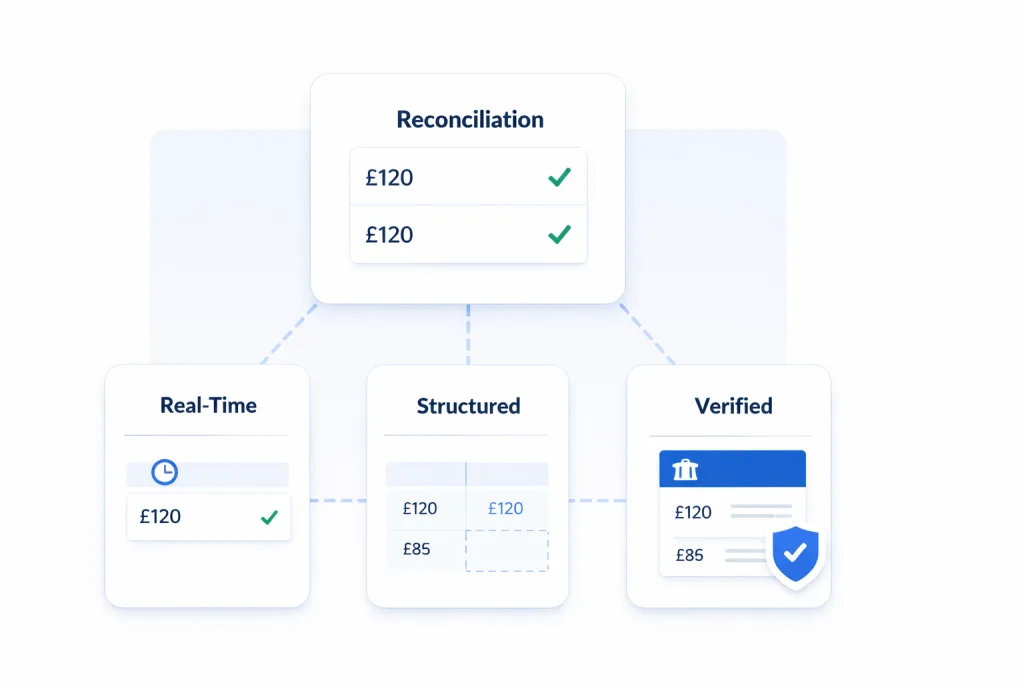
Reliable reconciliation depends on three data properties that CSV exports cannot provide consistently:
- Real-time – transactions arrive as they settle. A payment confirmed at 9am is visible to the matching engine at 9am, not the following morning’s export cycle.
- Consistent structure – identical JSON schema regardless of which UK bank the transaction originated from. Matching logic is written once and applied universally.
- Bank-verified – data retrieved directly from the bank via FCA-authorised AIS. Not a user-generated document. Not a screen-scraped feed. Bank-authenticated at source.
Automated client account reconciliation for UK platforms covers how these data properties enable compliant, scalable reconciliation workflows for regulated accounting platforms.
Why Does Schema Consistency Matter Across UK Banks?
Accounting SaaS and ERP platforms connect users holding accounts across the full range of UK banking institutions. High-street banks, challenger banks, business banking providers.
Each bank returns transaction data differently if accessed via CSV or screen scraping. That means reconciliation automation requires separate data normalisation logic per bank – logic that breaks on every bank UI or format update.
FCA-authorised AIS eliminates this problem at infrastructure level. The same structured output – merchant name, amount, date, counterparty reference, category code – arrives regardless of source bank. Matching logic is written once. It works everywhere.
| Data Input Method | Latency | Format Consistency | Bank-Verified? | Suitable for Reconciliation Automation? |
|---|---|---|---|---|
| CSV bank export | Batch – hours to days | Varies by bank and export version | No – user-generated | No – latency and format gaps |
| PDF bank statement | Manual – days | No standard structure | No – unverifiable document | No – requires OCR or manual entry |
| Screen scraping aggregator | Daily batch | Inconsistent – breaks on bank UI changes | No – not FCA-authorised | Partial – compliance and reliability risk |
| FCA-authorised AIS | Real-time via webhooks | Standardised JSON across all UK banks | Yes – bank-authenticated at source | Yes – current, complete, verifiable |
How Does Finexer Enable Automatic Bank Reconciliation for UK Platforms?
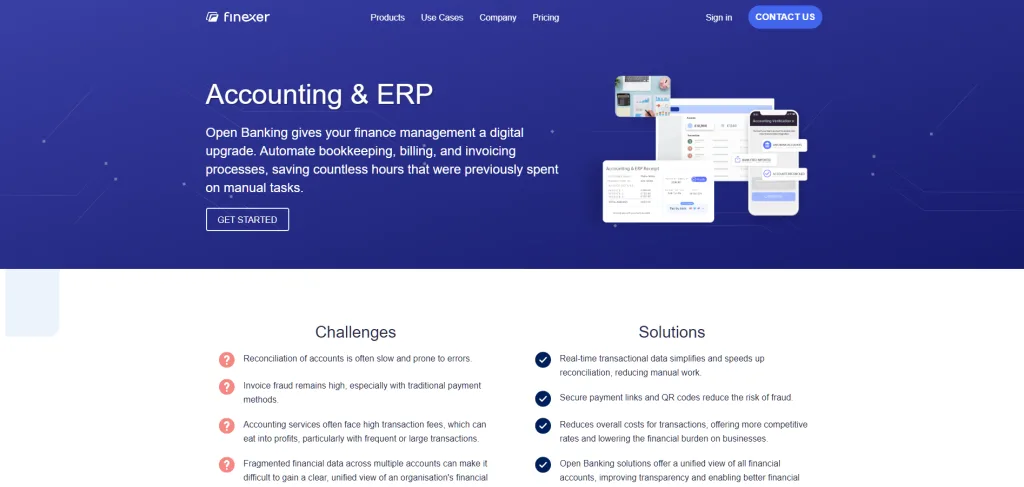
For accounting SaaS and ERP platforms that have built reconciliation automation and are still hitting data layer failures – Finexer’s FCA-authorised AIS is the infrastructure replacement that removes the manual step entirely.
See how platforms have implemented automatic bank reconciliation with Finexer for a real-world view of the data layer transition in practice.
How Finexer supports accounting and ERP platforms covers the full use case mapping for platforms building on Finexer’s AIS.
What Does Finexer’s AIS Infrastructure Provide?
- FCA-authorised AIS – verifiable on the FCA register, read-only bank data access
- Real-time webhooks delivering transaction events as they settle
- Standardised JSON output – consistent schema across all connected UK banks
- 99% UK bank coverage across retail, business, and challenger banks
- Up to 7 years of transaction history for onboarding and historical reconciliation
- Merchant identifiers and transaction category codes per transaction
- Multi-account connectivity from a single consent-based API connection
- Consent logs and timestamps per retrieval for audit trail support
- White-label consent flows under the platform’s own brand
- Usage-based pricing – scales with client volume
- 3-5 weeks onboarding support to reach production deployment
“The platforms that fix their automatic bank reconciliation failure rate are the ones that resolve the data layer first. Real-time, bank-verified transaction data is not a reconciliation automation upgrade. It is the prerequisite.” – Yuri, Finexer
What I Feel
I have reviewed reconciliation pipelines where the engineering team rebuilt the matching engine twice. New algorithms. Rewritten exception logic. Additional QA for month-end review.
None of it moved the failure rate. Because the engine was never the problem.
Cost reduction through automated bank reconciliation shows the operational cost impact when reconciliation automation is finally running on reliable data.
The data input was delayed, inconsistently formatted, and unverifiable. Any matching engine running on that foundation will produce unreliable outputs. The fix is not a better algorithm. It is a better data source.
Common Use Cases
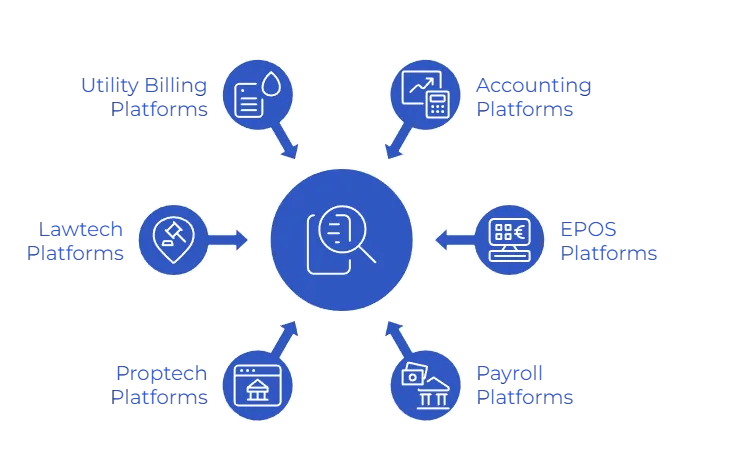
Accounting & ERP Platforms
CSV imports create format inconsistencies and latency gaps that break automatic bank reconciliation at scale. Finexer’s AIS delivers real-time, standardised transaction feeds per client account – enabling reconciliation automation that runs on current, bank-verified data without manual export steps.
EPOS Platforms
Daily sales reconciliation against bank receipts is blocked by end-of-day batch settlement files. Finexer’s AIS provides real-time transaction data per payment event – enabling automatic bank reconciliation against till records as payments clear.
Payroll & Invoicing Platforms
Confirming outbound payment clearance requires real-time bank visibility. Finexer’s AIS delivers webhook-based transaction events as disbursements settle – enabling reconciliation automation without manual statement checks.
Proptech & Real Estate Platforms
Multi-bank rental income reconciliation requires consistent transaction data across institutions. Finexer’s AIS provides a single structured feed across all consented accounts – removing the format inconsistency problem from the reconciliation workflow.
Lawtech Platforms
SRA client account reconciliation requires complete, timestamped, auditable transaction records. Finexer’s AIS provides consent-logged transaction data per account – supporting automatic bank reconciliation with a full audit trail.
Utility Billing Platforms
Matching incoming payments against billing records needs receipt confirmation at transaction level. Finexer’s AIS delivers real-time payment confirmation per event – enabling reconciliation automation without delayed settlement file dependency.
Why does automatic bank reconciliation fail even when automation is configured?
Because the data feeding it is delayed or inconsistently formatted. Reconciliation automation depends on the data input quality – CSV exports and batch feeds introduce the gaps that cause matching failures.
What is the difference between automatic bank reconciliation and reconciliation automation?
Automatic bank reconciliation is the outcome – transactions matched without manual effort. Reconciliation automation is the process that achieves it. Both require real-time, consistently structured bank data to work reliably at scale.
How does FCA-authorised AIS improve reconciliation automation accuracy?
AIS retrieves bank transaction data directly from source in real time – standardised JSON, bank-verified, delivered via webhook as transactions settle. It removes the latency and format inconsistencies that CSV-based inputs introduce into the reconciliation workflow.
Replace your CSV data layer with real-time bank transaction infrastructure.
About the Author

Yuri
Yuriy Yakushko is a fintech founder and software engineer with over 20 years of experience building financial technology. He’s passionate about creating scalable, secure infrastructure that helps businesses modernise how they access financial data and manage payments.