Secure your financial records at source, not just in storage.
FCA-authorised bank data infrastructure for accounting and ERP platforms.
Accounting software security failures rarely start in storage. They start at collections.
A client uploads a PDF bank statement. A team member pastes transactions from a CSV export. A manual journal entry reflects figures from a document nobody has independently verified.
The data enters the system. It looks correct. It sits in secure, encrypted storage. And nobody can confirm whether it reflects actual financial activity.
In my work building accounting and ERP integrations at Finexer, this is where financial record security breaks. Not at the firewall. At the data input layer – where the information that feeds every downstream report, audit, and compliance submission was collected.
TL;DR
Accounting software security covers how financial records are collected, stored, and accessed – not just where they sit. PDF uploads and manual CSV imports introduce unverifiable data into otherwise secure systems. Keeping financial records secure requires a data source that cannot be altered before it reaches the platform. FCA-authorised AIS retrieves bank transaction data directly from the bank via secure API, eliminating the manual input layer that creates integrity gaps.
Key Takeaways
What does accounting software security actually cover?
Accounting software security covers the full financial data lifecycle – collection, storage, and access. Secure storage of inaccurate or unverifiable data is not security. The integrity of the record depends on the reliability of how it was collected.
Why do PDFs and CSV imports create financial record security gaps?
PDFs and CSVs are prepared by the data subject before upload. They can be incomplete, selectively exported, or altered. Once in the system, they are treated as accurate. The accounting software has no mechanism to verify them against the actual bank record.
What does keeping financial records secure require at the data layer?
Keeping financial records secure requires a data source the platform controls – not one the client prepares. Bank transaction data retrieved via FCA-authorised AIS comes directly from the bank. It reflects actual account activity and cannot be modified before it reaches the platform.
How does bank-sourced data improve accounting software security?
Bank-sourced data via AIS is retrieved under consent with a full access log and timestamp per retrieval. The data has a verifiable origin. Each transaction record can be traced to its bank source – providing an audit trail that manual uploads cannot produce.
Why Does Accounting Software Security Start at Data Collection?
What Is the Risk of Manual Financial Data Input?
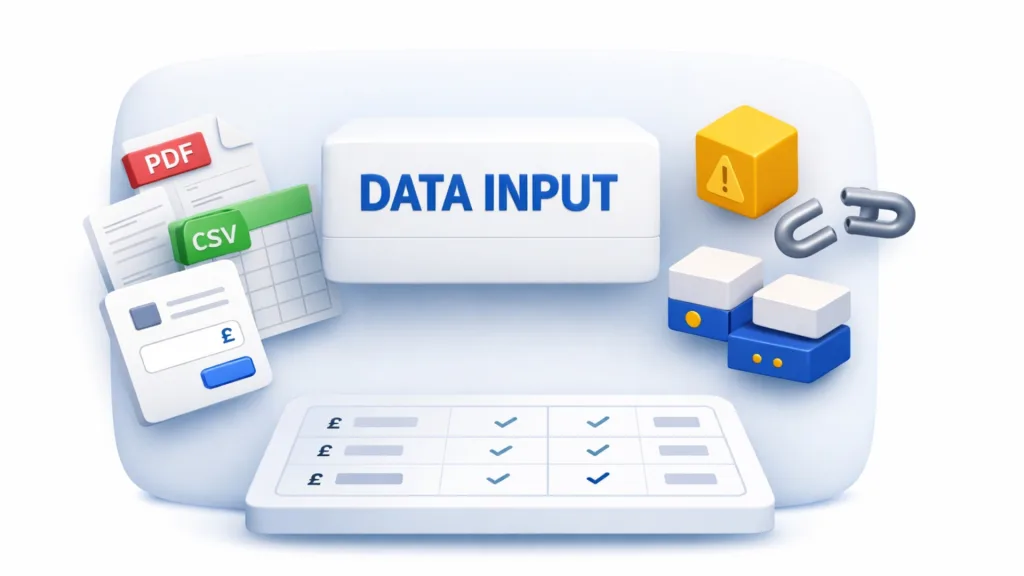
Manual data collection is the weakest point in accounting software security.
When a client submits a bank statement PDF, the platform receives what the client chose to export – from accounts they selected, covering periods they defined, in a format that carries no verification. The same is true for CSV imports and manual journal entries.
According to Open Banking data aggregation for accounting platforms, the shift from manual imports to API-sourced bank data eliminates the document handling layer entirely – and the integrity gaps that come with it.
Accounting software security that relies on client-submitted documents is only as reliable as those documents. That is a significant gap for platforms handling audit-ready financial records.
“In my experience building accounting integrations, the security questions engineering teams focus on are encryption, access controls, and authentication. The questions they underestimate are: where did this data come from, and can we verify it? Those are collection-layer questions, not storage-layer questions.” – Yuri, Finexer
What Makes Keeping Financial Records Unreliable With CSV Exports?
CSV exports are snapshots. They capture account activity at the moment of export – not continuously. A platform relying on periodic CSV uploads for keeping financial records has gaps between each import window.
Transactions that occurred between imports are not in the system. Corrections, reversals, and adjustments made at the bank after export are not reflected. The record is incomplete by design.
Historical financial data aggregation for UK platforms covers how continuous bank data access compares to periodic export-based imports for financial recordkeeping accuracy.
| Data Collection Method | Security Gap | Audit Risk | Bank AIS Fix |
|---|---|---|---|
| PDF bank statement upload | Client-prepared, unverifiable at origin | Cannot confirm against actual ledger | AIS retrieves directly from bank – no client handling |
| CSV export import | Point-in-time snapshot, gaps between imports | Missing transactions between export windows | Real-time webhooks deliver transactions as they occur |
| Manual journal entry | Human error, no source verification | No traceable origin for each figure | Structured JSON with unique transaction reference per bank event |
| Screen scraping | Credential sharing, session hijack risk | Not FCA-compliant, no consent log | FCA-authorised AIS – no credential sharing required |
How Does Finexer’s AIS Solve Accounting Software Security at the Data Layer?
The core accounting software security problem is unverifiable data entering the system at collection. Finexer’s FCA-authorised AIS removes that problem by retrieving transaction data directly from the bank – before the client handles it.
Unlocking Open Banking for accounting and ERP systems covers how accounting platforms integrate AIS to replace manual data collection with bank-sourced transaction feeds.
Finexer’s Data Aggregation product provides the AIS infrastructure layer that accounting SaaS and ERP platforms build on.
How Does Finexer’s AIS Secure the Financial Data Collection Layer?
The problem: financial records enter accounting systems via PDFs, CSVs, and manual entries – all unverifiable at source. Finexer’s FCA-authorised AIS solves this by retrieving transaction data directly from the client’s bank under consent, with no client handling in between.
- Direct bank retrieval via secure API – no credential sharing, no screen scraping
- Consent logs and access timestamps per retrieval – full audit trail from source
- Real-time webhooks – transactions delivered as they occur, no import gaps
- Structured JSON output – consistent schema, every transaction has a unique reference traceable to source
- Up to 7 years of transaction history – retrospective recordkeeping for compliance
- Covers almost all major UK banks – high street, challenger, business banking
- Multi-account access in one consent flow – full financial picture, not account by account
“The accounting software security question is not ‘is our database encrypted?’ It is ‘can we prove where each financial record came from?’ Bank-sourced AIS data has a verifiable origin. Every transaction traces back to the bank that produced it.” – Yuri, Finexer
What I Feel
Storage security gets all the attention in accounting software security discussions. Encryption levels, access controls, SOC 2 certifications.
These matter. But keeping financial records secure also requires knowing the data is accurate before it enters the system.
A perfectly encrypted record of an altered PDF is not a secure financial record. It is a securely stored inaccuracy.
The platforms that get this right treat data collection as a security decision, not just an operational one.
Common Use Cases

Accounting SaaS Platforms
Client-submitted bank statements and CSV imports create unverifiable inputs across every client account. Finexer’s AIS retrieves transaction data directly from each client’s bank under consent – replacing manual uploads with bank-sourced records that carry a verifiable origin and audit trail.
ERP Platforms
ERP financial modules that process high transaction volumes cannot manually verify every imported record. Finexer’s AIS delivers real-time, structured transaction feeds with consistent JSON schema – enabling automated reconciliation against records that were bank-verified at source.
How long should financial records be kept in the UK?
HMRC requires most businesses to keep financial records for at least 6 years from the end of the accounting period. Self-employed individuals must keep records for 5 years after the 31 January submission deadline. Records must be accurate and retrievable on request.
What makes accounting software secure for financial data handling?
Accounting software security covers encryption, access controls, and audit trails – but also data collection integrity. Software that retrieves bank transaction data via FCA-authorised AIS provides records that are bank-verified at source, with consent logs and timestamps per retrieval.
How does Open Banking improve keeping financial records?
FCA-authorised AIS retrieves transaction data directly from the bank via secure API – no credential sharing, no manual upload. Records arrive in structured format with a verifiable bank origin, replacing client-submitted documents with bank-sourced data that holds up under audit.
Build accounting software on a secure, verifiable data foundation.
About the Author

Yuri
Yuriy Yakushko is a fintech founder and software engineer with over 20 years of experience building financial technology. He’s passionate about creating scalable, secure infrastructure that helps businesses modernise how they access financial data and manage payments.