Your category list is fine. Your category data is not.
Structured bank transaction data for accurate expense categorisation.
Business expense categories are not your problem.
You have a list. Salaries. Rent. Software. Travel. Marketing. It is set up in the accounting system. Transactions are supposed to flow into each bucket automatically.
But at month-end, something is always wrong. A supplier payment sits in the wrong category. A software subscription is split across two lines. A travel expense lands in professional services. Someone manually corrects it. Next month, the same thing happens.
The list is fine. The data behind it is broken.
TL;DR
Business expense categories define how spending is tracked – but category accuracy depends on the quality of transaction data flowing into them. Raw bank descriptions are inconsistent, truncated, and unreliable for automated classification. Expense categories built on unstructured data require constant manual correction. Finexer’s Data Enrichment API applies merchant identifiers and category codes to each transaction before it reaches the accounting system – giving platforms accurate, consistent expense data without manual correction overhead.
Key Takeaways
What are the main business expense categories?
The standard business expense categories are: salaries and wages, rent and premises, software and technology, travel and transport, marketing and advertising, professional services, utilities, office supplies, financial costs, and cost of goods sold. Each category must be consistently populated with accurate transaction data to be useful for reporting.
Why do expense categories produce wrong data in real systems?
Expense categories break because raw bank transaction descriptions are not designed for accounting readability. The same supplier appears with different description strings across different payment methods – making automated rules unreliable. Categories fill up with incorrectly matched transactions that look correct until a manual review catches them.
What is the real cost of inaccurate expense categories?
Inaccurate expense categories produce wrong P&L line items, incorrect VAT calculations, unreliable budget reports, and flawed tax submissions. According to HMRC, businesses are required to keep accurate records for 6 years – inaccurate category data creates compounding compliance exposure across every period.
How does structured bank data fix business expense category accuracy?
Merchant identifiers and category codes applied at the transaction level give the accounting system consistent, normalised inputs. The same supplier is always identified correctly – regardless of how the bank description arrived. Category accuracy improves because the input is structured, not because the rules engine is more sophisticated.
What Are the Standard Business Expense Categories?
Which Expense Categories Do UK Accounting Platforms Need to Track?
Every accounting SaaS, ERP, and bookkeeping tool needs to handle these core business expense categories:
| Expense Category | What It Covers | Common Subcategories |
|---|---|---|
| Salaries & Wages | Staff payroll, PAYE, NIC | Permanent, contractors, benefits |
| Rent & Premises | Office, warehouse, storage | Rates, service charges, insurance |
| Software & Technology | SaaS subscriptions, hosting | Licences, IT support, hardware |
| Travel & Transport | Business mileage, rail, flights | Hotels, taxis, fuel |
| Marketing & Advertising | Ads, agency fees, content | PR, events, sponsorship |
| Professional Services | Legal, accounting, consulting | Advisory, audit, HR |
| Utilities | Electricity, gas, broadband | Water, phone, waste |
| Office Supplies | Stationery, equipment | Postage, printing, consumables |
| Financial Costs | Bank charges, loan interest | FX fees, card processing |
| Cost of Goods Sold | Materials, production costs | Freight, packaging, customs |
This is what competitors cover. Every listicle on this topic gives you this table.
What they do not cover is why this table breaks the moment real transaction data starts flowing through it.
Why Do Business Expense Categories Break in Real Accounting Workflows?
Why Does the Same Supplier Land in Different Expense Categories?
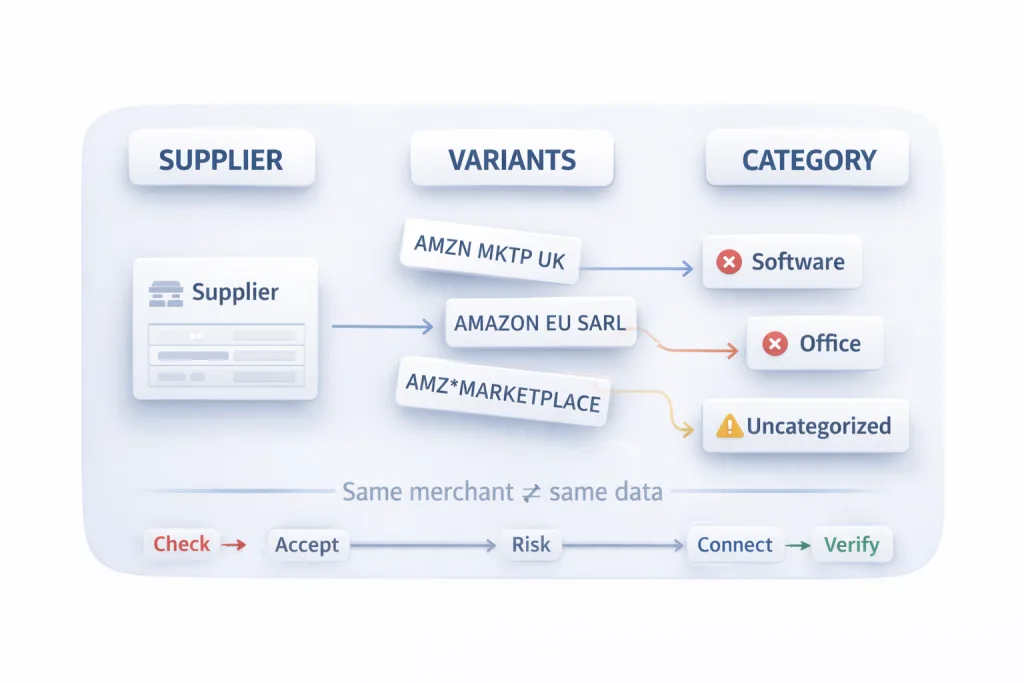
The core problem is this: the same supplier processes payments through different payment rails, acquirers, and regions. Each route generates a different bank description.
Amazon Business might appear as “AMZN MKTP UK”, “AMAZON EU SARL”, or “AMZ*MARKETPLACE” depending on how the purchase was made. A rules engine built to catch “Amazon” fails on all three variants.
The expense category that should read “Software & Technology” or “Office Supplies” fills with unmatched transactions instead.
How bank transaction categorisation fails in real workflows covers exactly this problem – same merchant, different descriptions, broken category logic.
“In my work with accounting and ERP platforms, I see the same pattern constantly. The expense category list is correctly set up. The data populating it is not. Teams spend hours each month correcting miscategorisations that the system was supposed to handle automatically.” – Yuri, Finexer
What Is the Business Impact of Wrong Expense Category Data?

Wrong expense categories compound quietly. A miscategorised supplier payment creates:
- A wrong P&L line – marketing spend appears in professional services, distorting both
- A wrong VAT calculation – expenses in the wrong category produce incorrect input VAT recovery
- A wrong budget report – the category appears under or over budget when the money was always there
- A wrong tax submission – HMRC penalties if incorrect expense categories lead to understated tax liability
Business finance management and expense tracking guide covers how expense category accuracy flows into financial reporting and cash flow management.
| Categorisation Failure | Root Cause | Business Impact | Fix |
|---|---|---|---|
| Same supplier, wrong category | Different bank descriptions per payment method | P&L distorted, budget reports unreliable | Merchant ID normalises all variants to one entity |
| Expense split across categories | Partial description matches two rules | Reporting inconsistency month to month | Category code applied at transaction level |
| Unknown supplier uncategorised | Rules engine has no match for new vendor | Grows as miscellaneous, requires manual review | 100M+ merchant database resolves new entities |
| Duplicate expense entry | Manual correction alongside automated import | Inflated costs in category, wrong profit margin | AIS delivers each transaction once – no parallel channel |
What Does Fixing Business Expense Category Accuracy Actually Require?
Why Do More Rules Do Not Solve the Categorisation Problem?
The instinct is to add more rules. More keyword matches. More exception handling. More manual overrides.
This does not fix the problem. It adds maintenance overhead to a system that is broken at the input level.
The categorisation rules engine is not the issue. The raw bank data it receives is the issue. Unstructured, inconsistent descriptions produce unreliable category matches regardless of how sophisticated the rules are.
The fix is upstream. Structured transaction data with merchant identifiers and category codes applied before the rules engine sees it.
Transaction enrichment API for structured bank data covers how merchant-level enrichment changes category accuracy across accounting and ERP platforms.
How Does Finexer Fix Business Expense Category Data at Source?
What Does Finexer’s Data Enrichment API Provide?
The problem: raw bank descriptions are inconsistent – the same supplier generates different strings across payment methods, breaking automated expense category rules. Finexer’s Data Enrichment API resolves this by matching each transaction against a 100M+ merchant database and returning a clean merchant ID and category code before the data reaches the accounting system.
- Merchant identifiers per transaction – normalises all description variants to a single entity
- Category codes per transaction – structured expense categories applied at source
- 95%+ categorisation accuracy across 100M+ merchants
- Under 100ms response time – no latency added to the data pipeline
- Works with AIS transaction feeds or existing bank data imports
- Consistent output schema – same structure regardless of originating bank or payment method
“Business expense category accuracy is a data input problem, not a rules engine problem. Once every transaction carries a merchant ID and category code, the categories fill correctly – without manual correction every month.” – Yuri, Finexer
What I Feel
Every accounting platform I work with has the same conversation at month-end.
The numbers are wrong. Something is in the wrong category. Someone is spending an afternoon fixing it.
The list of business expense categories is never the problem. It takes an hour to set up and it works fine. What takes hours every month is correcting the data behind it.
Fix the data. The categories take care of themselves.
Common Use Cases
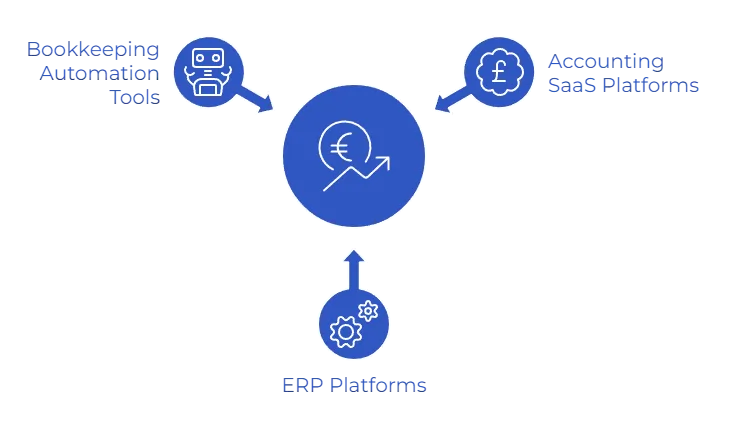
Accounting SaaS Platforms
Client bank feeds arrive with inconsistent merchant descriptions that break expense category rules across every account. Finexer’s Data Enrichment API applies merchant IDs and category codes per transaction – so business expense categories fill correctly from day one, without manual correction per client.
ERP Platforms
ERP financial modules processing high supplier payment volumes cannot manually resolve miscategorised expenses at scale. Finexer’s enrichment layer resolves merchant identity and category code per payment – enabling accurate expense categories that hold across payment method changes and new supplier relationships.
Bookkeeping Automation Tools
Bookkeeping tools that auto-categorise transactions for clients need reliable expense categories to reduce review time. Finexer’s 95%+ categorisation accuracy across 100M+ merchants means fewer uncategorised transactions and less manual correction overhead per client file.
What categories should I use for business expenses?
The standard UK business expense categories are: salaries and wages, rent and premises, software and technology, travel and transport, marketing, professional services, utilities, office supplies, financial costs, and cost of goods sold. Each category maps to specific HMRC-allowable expense types for tax purposes.
Why do expense categories produce incorrect data in accounting software?
Expense categories break because raw bank descriptions are inconsistent. The same supplier generates different description strings across payment methods, making automated rules unreliable. The fix is merchant-level enrichment – applying a consistent merchant ID and category code to each transaction before it reaches the rules engine.
How does Open Banking data improve business expense category accuracy?
FCA-authorised AIS retrieves bank transaction data with merchant identifiers and category codes per payment. Each transaction arrives pre-classified at source – directly reducing the common description-matching failures that produce wrong expense categories in accounting and ERP platforms, without manual correction.
Build accurate business expense categories on structured bank data.
About the Author

Yuri
Yuriy Yakushko is a fintech founder and software engineer with over 20 years of experience building financial technology. He’s passionate about creating scalable, secure infrastructure that helps businesses modernise how they access financial data and manage payments.