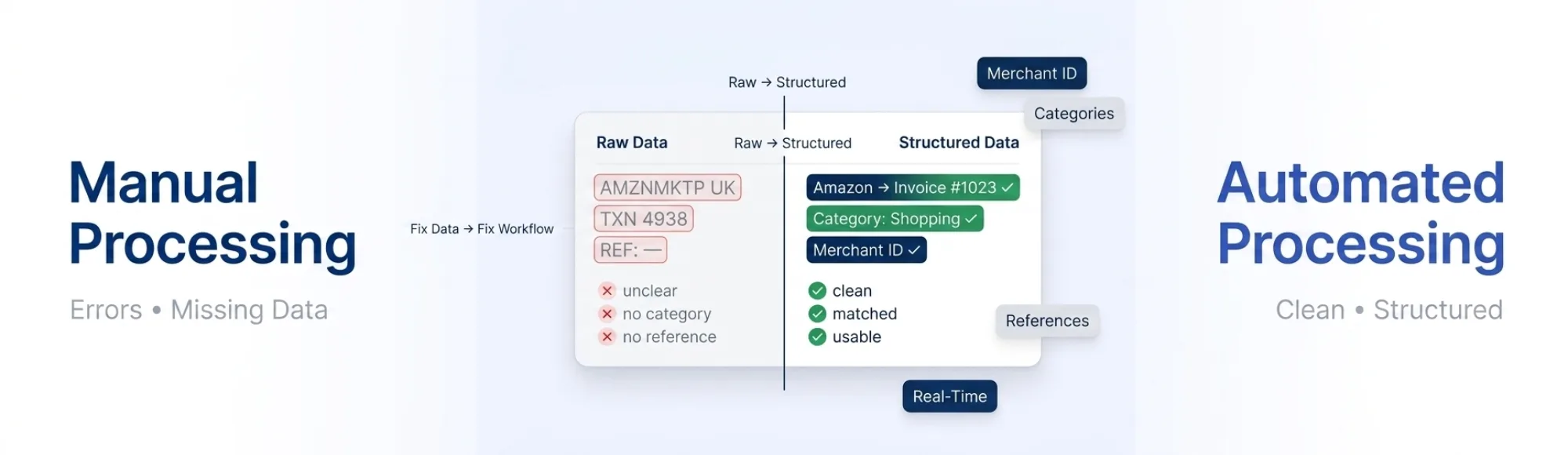
Stop fixing the process. Fix the data feeding it.
Bank transaction data infrastructure for accounting, ERP, billing, and Lawtech platforms.
Manual transaction processing is still one of the biggest operational drains inside financial platforms – and most teams are looking in the wrong place to fix it.
The problem is not the reconciliation tool, the ERP, or the automation logic.
It is the bank data those tools receive. Raw strings. Delayed feeds. Missing references. No merchant context.
UK open banking infrastructure processed 14 billion API calls in 2025 (Open Banking Limited, 2025) – yet finance teams across accounting SaaS, billing, and Lawtech platforms still correct transaction data by hand, because the data layer feeding their systems has never been fixed.
TL;DR
Manual transaction processing happens when bank data arrives raw, delayed, or inconsistently formatted. Adding automation on top generates exceptions faster – not fewer manual steps. The real transaction processing solution is upstream: structured, real-time bank data from Open Banking AIS that workflows can use without manual correction.
Key Takeaways
What causes manual transaction processing?
Bank data fragmentation across four points:
- No direct bank API access – data pulled from CSV exports or statement uploads, not live from the bank
- Delayed feeds – batch updates mean automation runs on yesterday’s figures, not today’s
- Inconsistent formats – same merchant, different string per bank and payment channel
- Missing references – no merchant IDs, no category codes, raw payment strings that nothing can match automatically
What is the real cost of manual transaction processing?
It is not just time. It compounds across the whole platform.
Finance teams spend time per period correcting transactions automation should have handled. Errors create reconciliation failures at month-end. Compliance workflows built on inaccurate transaction data carry audit risk. And platforms that depend on manual correction cannot scale without adding headcount.
What does a real transaction processing solution need?
Three things – in this order:
- Structured bank data at source – merchant IDs and category codes applied before data reaches the platform
- Direct bank access via API – live transaction data, not batched imports or statement exports
- Consistent schema across all UK banks – one format regardless of payment channel or institution
Why Does Manual Transaction Processing Persist?
What Breaks Inside Transaction Workflows?
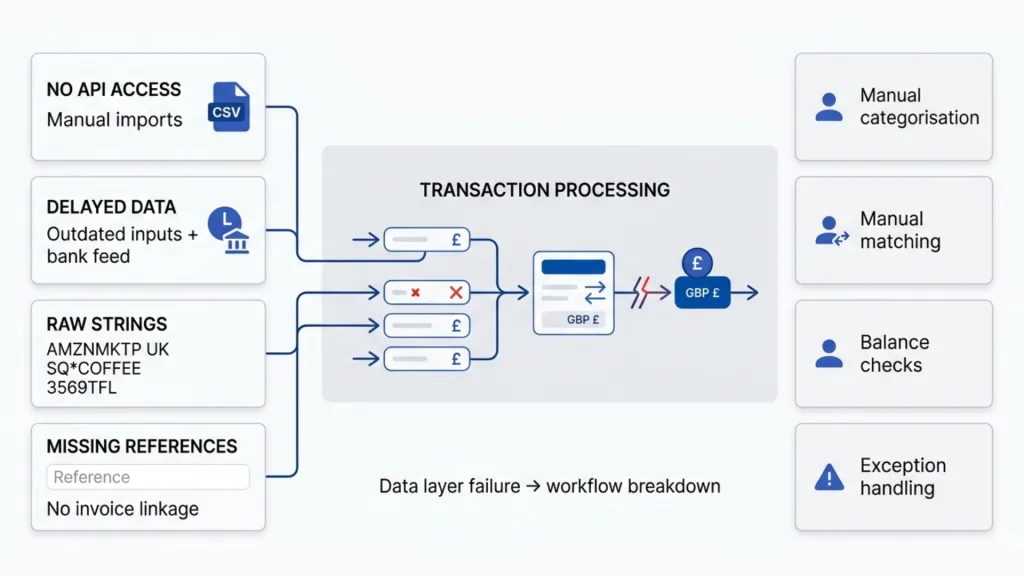
Most platforms treat manual transaction processing as a workflow problem. They add more automation rules, better matching logic, faster exception handling.
None of it works at the root.
Because the transactions arriving are unstructured. “AMZNMKTP UK”, “SQ*COFFEE”, “3569TFL” – raw bank strings that automated matching cannot identify or categorise. The same payment method produces different description formats across BACS, Faster Payments, and card channels – meaning different matching logic per channel, or manual correction to bridge the gaps.
| Data Problem | Where It Appears | Manual Step It Forces |
|---|---|---|
| No direct bank API access | Accounting SaaS, ERP | CSV import or statement upload each cycle |
| Delayed bank feed | Billing platforms, payroll | Manual balance check before processing |
| Raw transaction strings | All platforms | Manual categorisation per transaction |
| Missing payment reference | Billing, invoicing | Manual invoice-to-payment matching |
Manual reconciliation automation for UK financial platforms covers how data quality determines automation success rates in payment workflows.
What Is the Business Impact of Manual Transaction Processing?
How Does Manual Handling Damage Platform Performance?
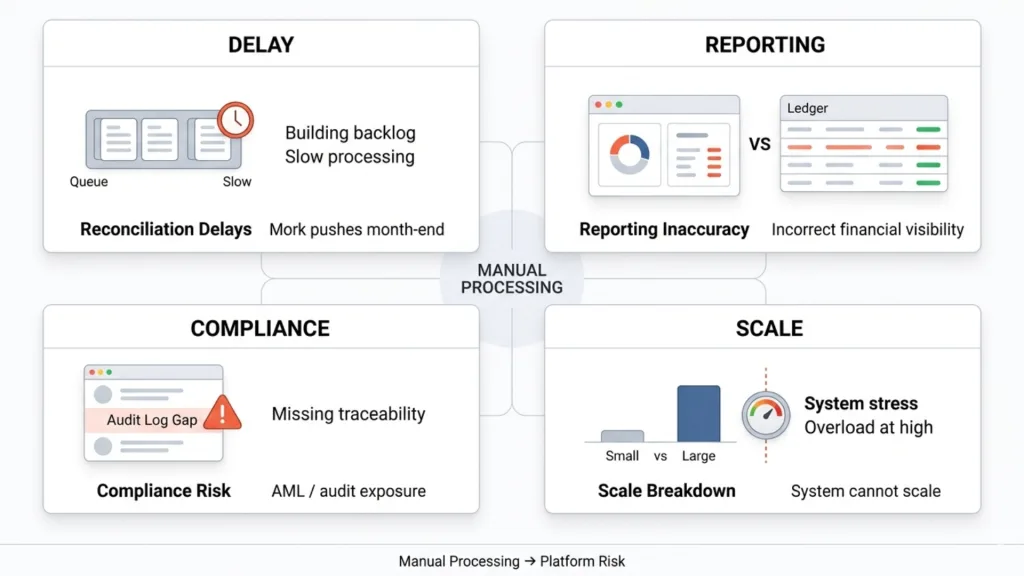
Manual transaction processing does not stay contained to the finance team. It cascades across the entire platform.
- Reconciliation delays – uncategorised transactions and missing references build up in manual queues, pushing month-end close further out
- Reporting inaccuracy – hand-corrected transactions introduce inconsistency between dashboards and reconciled records
- Compliance exposure – AML workflows and source of funds checks relying on manually corrected data carry audit risk when correction logs are missing
- Scale failure – a platform managing 10,000 transactions a month handles the correction overhead; at 100,000 it breaks
“The platforms that reduce manual transaction processing most effectively are not the ones that add more automation rules. They are the ones that fix the data arriving before those rules run – direct from the bank, structured at source.” – Ravi, Finexer
How Does Finexer Solve Manual Transaction Processing?
What Does Finexer’s AIS Provide as a Transaction Processing Solution?
Manual transaction processing is a bank data access problem. Finexer’s FCA-authorised AIS and PIS fix the data layer – without replacing existing accounting tools or ERP systems.
- Direct bank data access (AIS) – transaction data from the bank, not from CSV files or statement imports
- Merchant IDs per transaction – consistent counterparty identification across BACS, Faster Payments, and Open Banking
- Category codes at source – income, payroll, supplier, and VAT classified before data reaches the platform
- Real-time webhooks – each transaction delivered at occurrence, reconciliation always against current position
- Structured JSON – consistent schema across almost all major UK banks, one format across every channel
- Payment initiation (PIS) – Pay by Bank, Payment Links, Bulk Payout, and VRP with embedded references
- 99% UK bank coverage, usage-based pricing, 3-5 weeks to production
“When transaction data arrives structured – with merchant IDs, category codes, and payment references already in place – the manual intervention points disappear one by one. That is the transaction processing solution that actually works.” – Ravi, Finexer
Payment reconciliation for multiple invoices covers how direct bank data access changes invoice matching rates for billing platforms.
What I Feel
Every platform building on financial data hits the same wall.
The automation is live. The manual corrections keep happening.
The answer is almost always upstream. The data arriving at the automation layer is fragmented, raw, or delayed. Fix that first – and the transaction processing solution you already have starts working the way it was supposed to.
Common Use Cases
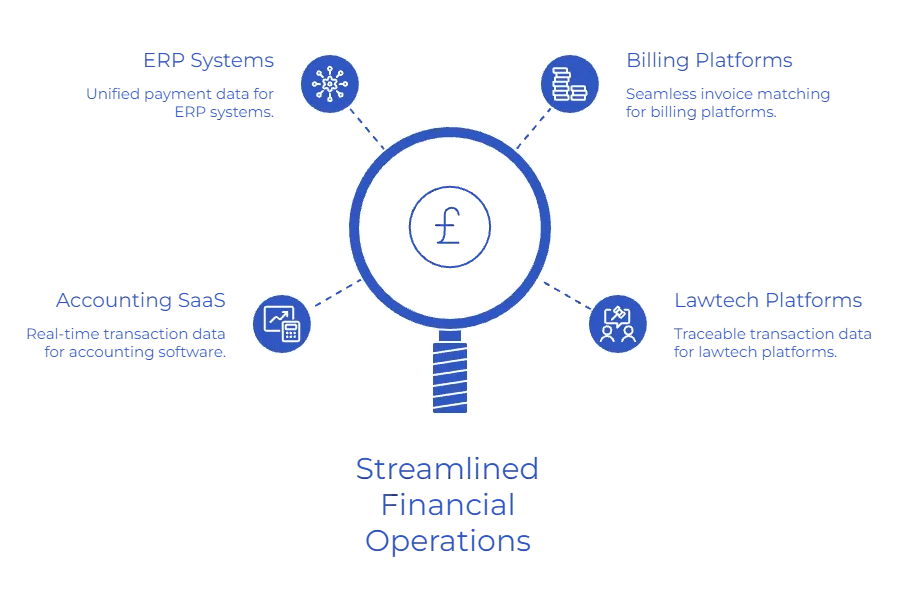
Accounting SaaS
CSV imports are always lagging. Finexer’s real-time AIS delivers structured transaction data continuously – merchant IDs and category codes at source, no import cycle, no manual categorisation queue.
ERP Systems
Multiple payment channels mean inconsistent schemas per channel. Finexer’s structured JSON covers virtually every major UK bank under one format, removing the normalisation overhead that creates period-end manual errors.
Billing Platforms
Invoice matching breaks when references arrive separately from funds. Finexer’s Payment Links embed invoice references in the Faster Payments instruction at initiation – the reference arrives with the payment.
Lawtech Platforms
Source of funds and AML workflows need traceable, structured transaction data with a consent log per retrieval. Finexer’s AIS delivers direct-from-bank history – no manual document collection, no unverified data.
Finexer for accounting and ERP platforms covers how Finexer’s AIS replaces manual bank data collection in accounting and ERP transaction workflows.
Finexer for utility billing platforms covers how Finexer’s AIS and PIS support billing platforms reducing manual transaction handling at scale.
What is manual transaction processing?
Manual transaction processing involves handling financial transactions through manual steps – data entry, validation, matching, and correction – instead of automated workflows. It occurs when transaction data is fragmented, delayed, or inaccessible via API, forcing platforms to retrieve and process data through manual intervention at each stage.
How is manual transaction processing different from automated processing?
Manual processing requires human intervention at one or more steps – entry, validation, matching, or correction. Automated processing handles these steps without manual input. The shift from manual to automated fails when underlying bank data is fragmented or unstructured, because automation tools cannot resolve incomplete inputs without a human override.
How does Open Banking reduce manual transaction processing?
Open Banking AIS delivers direct API access to bank transaction data with structured merchant IDs, category codes, and consistent schemas across UK banks. Real-time webhooks deliver each transaction at occurrence. Payment initiation embeds references at source. Together they remove the data gaps that force manual steps inside accounting, billing, ERP, and Lawtech workflows.
Stop manual transaction processing at the data layer, not the workflow layer.
About the Author

Ravi Ranjan
Ravi Ranjan is Co founder & CEO of Finexer