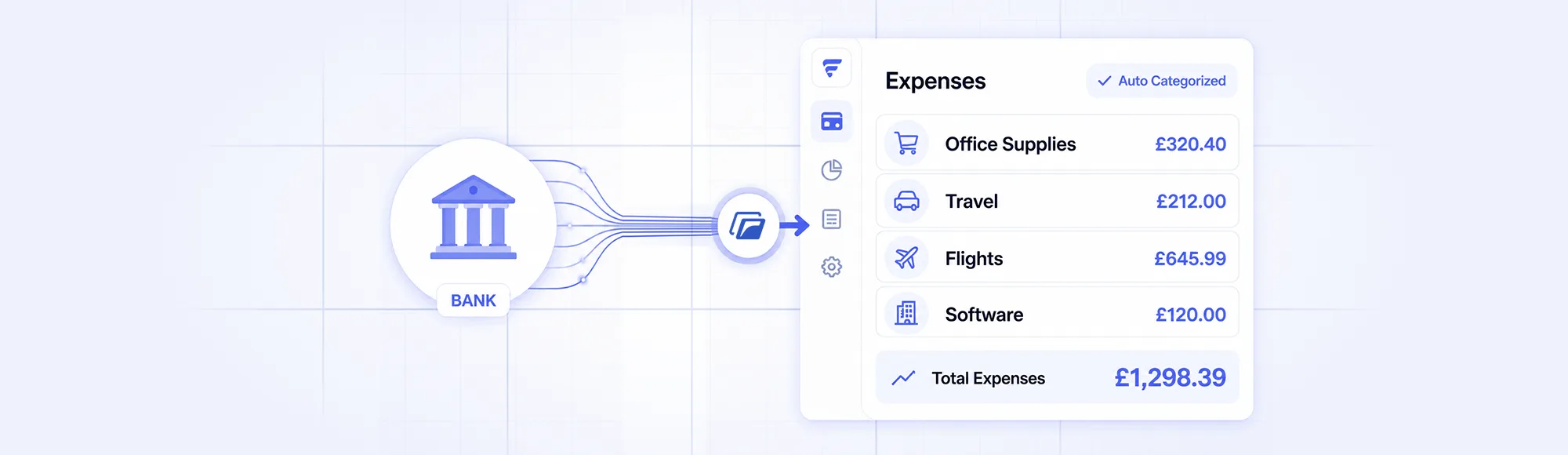
Real-time bank transaction data. Merchant IDs at source. Structured JSON.
Bank data infrastructure for automated expense systems in accounting SaaS, ERP, and expense management platforms.
Automated expense system accuracy depends almost entirely on the quality of data feeding it.
Most expense automation starts at the receipt. Employees submit receipts. OCR reads them. Categories are assigned. Approvals are routed.
That workflow handles submitted expenses. It does not handle unsubmitted ones, misrepresented ones, or the gap between what employees claim and what bank records show.
UK businesses are required under HMRC guidelines to ensure expenses are wholly and exclusively for business purposes. Automated expenses that rely solely on receipt submissions create a verification gap – there is no independent source confirming whether the claimed expense actually occurred and matches the bank record.
Structured bank transaction data closes that gap. Not by replacing expense software, but by providing the independent financial data layer that makes expense automation genuinely reliable.
At Finexer, I work with accounting SaaS platforms and ERP teams that have already built solid automation logic. The consistent finding: the logic works fine. The data feeding it is the problem.
TL;DR
An automated expense system manages and categorises business expenses with minimal manual input. Its reliability depends on the quality of the underlying transaction data. Receipt-based systems capture submitted claims. Bank transaction data captures actual financial activity – with merchant IDs, category codes, and timestamps applied at source before the data reaches the platform. For accounting SaaS, ERP, and expense management platforms, structured Open Banking AIS data is the infrastructure layer that makes automated expenses accurate, not just fast.
Key Takeaways
What is an automated expense system?
An automated expense system captures, categorises, validates, and reports business expenses without manual data entry at each step. Automation handles the processing – but its accuracy depends on the data inputs. An automated expense system built on submitted receipts is only as accurate as what employees submit. An automated expense system built on real-time bank transaction data is as accurate as the bank itself.
What data does an automated expense system need to work reliably?
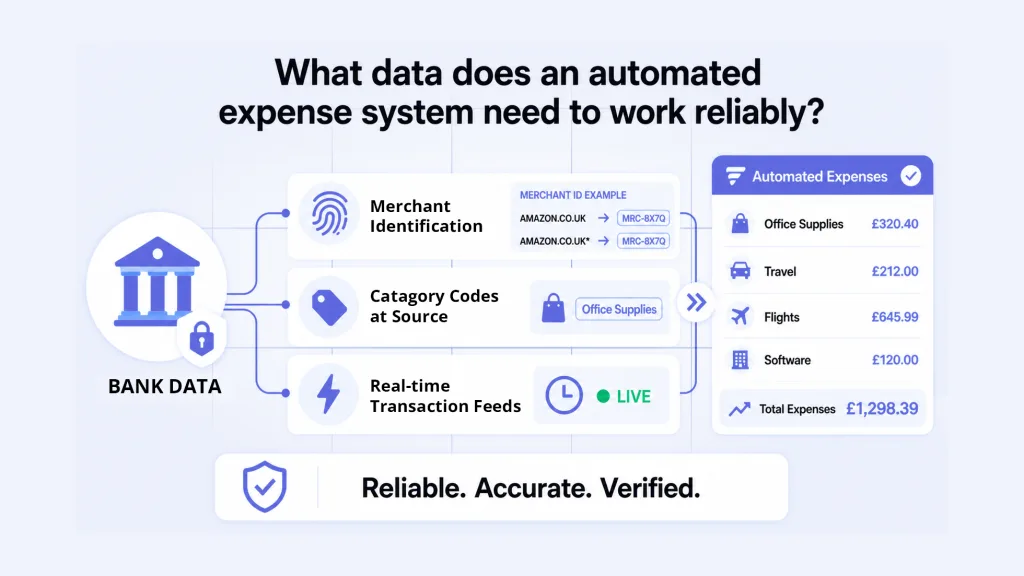
Three data inputs drive accuracy:
- Merchant identification – a consistent identifier per counterparty across all transactions, regardless of how the bank formats the description string. Without it, the same supplier maps to different categories across different transactions.
- Category codes at source – spending category applied before data reaches the platform. Without it, the categorisation engine builds rules on top of raw bank strings – a maintenance overhead that grows with transaction volume.
- Real-time transaction feeds – expense data available at the moment of transaction, not at the end of a statement cycle. Without it, automation operates on a delay and expense tracking drifts from actual financial position.
How does bank transaction data improve automated expenses?
Bank transaction data comes directly from the bank at the moment of consent. It is not submitted by the employee. It cannot be edited before delivery. Merchant IDs and category codes are applied at source by the data provider, not inferred from receipt text by the platform. The result is expense categorisation that reflects actual financial activity rather than submitted claims.
What Limits Receipt-Based Expense Automation?
Where Do Traditional Automated Expense Systems Break at Scale?
Receipt-based expense automation solves a real problem – reducing manual data entry for submitted expense claims. The limitation is not the automation. It is the data source.
Submitted receipts are incomplete by design:
Not every business expense generates a receipt. Subscription software, recurring vendor charges, and direct debits appear on bank statements without a corresponding receipt to scan. Receipt-based automation has no data source for these.
Receipt data requires normalisation:
OCR reads text from an image. That text varies by receipt format, font, language, and condition. The platform’s categorisation engine must interpret inconsistent inputs at scale. As transaction volumes grow, exception rates grow with them.
No independent verification:
A receipt submitted by an employee confirms the employee made a purchase. It does not confirm the purchase was for a legitimate business purpose or that the amount matches what the bank debited. Bank transaction data provides that independent confirmation.
| Data Input | Receipt-Based System | Bank Transaction Data System |
|---|---|---|
| Coverage | Submitted claims only | All bank transactions including recurring and direct debits |
| Merchant identification | OCR from receipt text – varies by format | Consistent merchant ID per counterparty at source |
| Category codes | Inferred from receipt text by platform logic | Applied at source by data provider before delivery |
| Independent verification | No – data comes from the employee | Yes – data comes directly from the bank |
| Real-time availability | On submission – depends on employee action | At transaction occurrence via webhook |
“The automated expense system question for platforms is not whether to automate – it is what to automate from. An automation engine receiving structured bank data with merchant IDs and category codes at source works correctly from the first transaction. The same engine receiving receipt text works correctly from the thousandth – after all the edge cases have been handled.” – Yuri, Finexer
Expense categorisation for accounting SaaS and ERP platforms covers how structured bank transaction data changes categorisation accuracy for automated expense workflows.
How Does Open Banking AIS Support Automated Expense Systems?
What Does Structured Bank Data Provide for Expense Automation Platforms?
Open Banking AIS delivers bank transaction data directly – structured, enriched, and independent. For platforms building automated expense systems, it provides the data layer underneath the automation logic.
What arrives per transaction:
- Merchant ID – consistent counterparty identifier matched against a 100M+ merchant database, regardless of how the bank formats the description string
- Category code – spending category (Travel, Utilities, Professional Services, Subscriptions) applied at source with 95%+ accuracy at under 100ms
- Structured JSON – consistent schema across virtually every UK bank – one format regardless of which bank the account holder uses
- Real-time webhook – transaction delivered at the moment of occurrence, not at end-of-day or end-of-statement
What this changes for the automated expense system:
- Categorisation rules work on structured inputs, not raw strings
- Merchant matching is consistent across all transactions from all banks
- Expense tracking reflects current financial position, not submitted claims
- Historical data available up to 7 years for trend analysis and audit
This is the data layer. The automated expense system sits on top of it and applies the platform’s own categorisation logic, approval workflows, reporting, and HMRC compliance rules.
Real-time bank data for expense claims covers how real-time bank transaction data improves expense claim accuracy for accounting and expense management platforms.
Expense management with Open Banking covers how Open Banking AIS integrates with expense management platforms to replace manual data collection workflows.
Where Does Finexer Fit in an Automated Expense System?
What Does Finexer’s AIS Provide for Expense Automation Workflows?
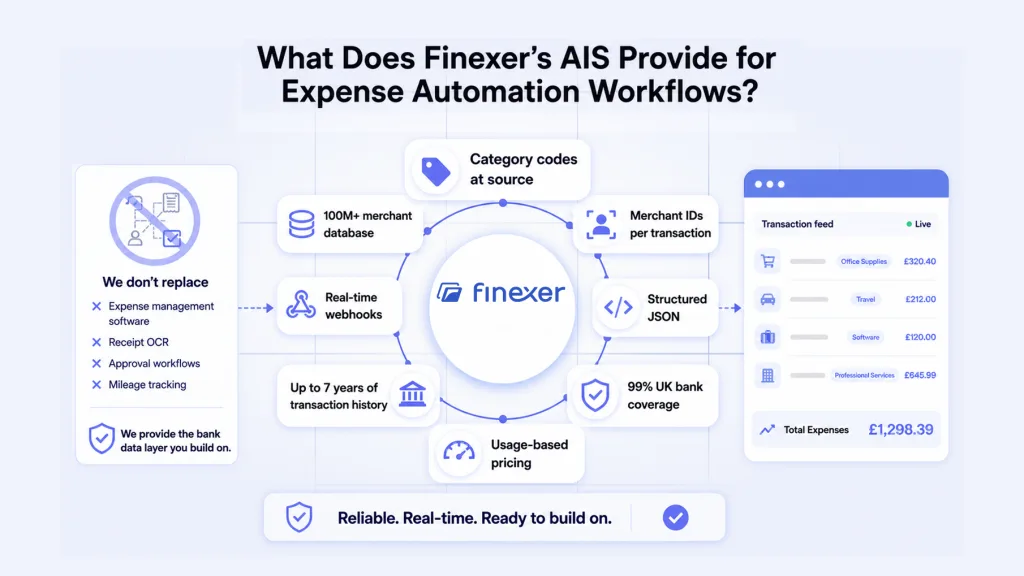
Finexer does not replace expense management software, handle receipt OCR, manage approval workflows, or automate mileage tracking. Finexer provides the bank transaction data layer that expense automation platforms build on.
Finexer AIS for automated expense systems:
- Category codes at source – spending category per transaction before it reaches the platform
- Merchant IDs per transaction – consistent counterparty identification across payment channels
- 100M+ merchant database – 95%+ categorisation accuracy, under 100ms processing latency
- Real-time webhooks – transaction delivered at occurrence for continuous expense tracking
- Structured JSON – consistent format across almost all major UK banks
- Up to 7 years of transaction history – historical depth for audit, reporting, and trend analysis
- 99% UK bank coverage – high street, challenger, and business accounts
- Usage-based pricing, no setup fees, 3-5 weeks to production
Finexer accounting and ERP use case covers how Finexer’s AIS integrates with accounting SaaS and ERP workflows for expense tracking, categorisation, and reconciliation.
What I Feel
Most automated expense system failures are blamed on the categorisation logic.
Build better rules. Train a better model. Add more exceptions.
The logic is rarely the problem. The data feeding it is the problem.
An automated expense system built on structured bank data with merchant IDs and category codes at source works correctly from the start. The same system built on receipt OCR and raw transaction strings spends its first year handling exceptions.
Fix the data layer first.
“The difference between an automated expense system that works and one that needs constant maintenance is almost always the data source – not the automation logic.” – Yuri, Finexer
Common Use Cases
Accounting SaaS Platforms
Structured bank transaction data with category codes at source feeds the automated expense system without manual classification. Merchant IDs provide consistent counterparty identification across all transactions. Expense categorisation is reliable from the first transaction, not after edge case handling.
Expense Management Platforms
Real-time webhooks deliver each transaction at occurrence – automated expenses reflect current financial position rather than submitted claims. The gap between actual spending and tracked expenses closes when data comes from the bank rather than from the employee.
ERP Systems
Structured JSON consistent across virtually every UK bank eliminates the per-bank normalisation overhead that breaks expense automation at scale. One schema covers all connected accounts. Category codes apply uniformly.
Financial Operations Tools
Up to 7 years of structured transaction history provides the depth for trend analysis, budget variance reporting, and HMRC audit trails. Automated expenses built on bank data carry the provenance trail that receipt-based systems cannot provide.
Why do automated expense systems need bank transaction data rather than just receipts?
Receipts capture submitted claims. Bank transaction data captures all transactions – including recurring subscriptions, direct debits, and vendor charges that never generate a receipt. Bank data also provides independent verification: the merchant ID and amount come from the bank, not from the employee. For accounting SaaS and ERP platforms, that independence is what makes automated expense validation reliable.
What makes automated expenses more accurate at scale?
Accuracy at scale requires merchant IDs and category codes applied at source before data reaches the platform. When these arrive with the transaction, the automated expense system has structured inputs for its categorisation rules. When they do not, the platform builds classification logic on top of raw bank strings – a maintenance overhead that grows with transaction volume.
What does Finexer provide for automated expense system workflows?
Finexer provides Open Banking AIS – structured bank transaction data with merchant IDs, category codes, real-time webhooks, and up to 7 years of history. Coverage across almost all major UK banks in one integration. It does not replace expense software or handle receipts. It provides the bank data layer that automated expense systems build categorisation and reporting on top of.
Build your automated expense system on structured bank data, not receipt submissions.
About the Author

Yuri
Yuriy Yakushko is a fintech founder and software engineer with over 20 years of experience building financial technology. He’s passionate about creating scalable, secure infrastructure that helps businesses modernise how they access financial data and manage payments.