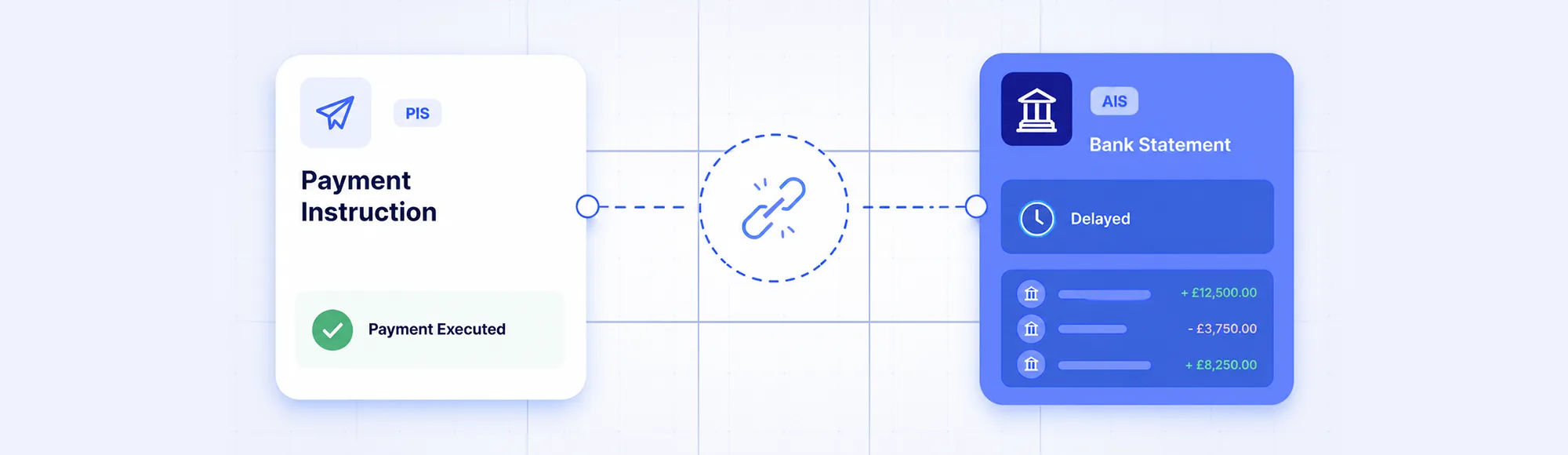
Payment initiation connected to real-time bank transaction data.
Open Banking payment and data infrastructure for fintech, billing SaaS, and ERP platforms.
Payment API integration is the point where most platform financial workflows either hold together or fall apart.
The sandbox works. It always does.
Production is different. In production, a payment executes – but the platform’s financial data does not reflect it until the bank statement arrives. Reconciliation runs on yesterday’s numbers. Cash position is always an estimate. Invoice matching is a manual process sitting on top of a delayed data feed.
The payment happened. The workflow does not know.
At Finexer, I work with product and engineering teams that have already integrated payments. The consistent pattern: the sandbox demo worked. The production reconciliation did not.
TL;DR
Payment API integration connects an application to payment rails – initiating transfers, confirming settlement, and triggering downstream workflows. The integration works in demo. It breaks in production when payment execution and financial data are handled separately: payments settle, but the platform does not receive structured transaction data confirming the settlement in real time. Open banking data sharing – AIS alongside PIS – closes this gap by delivering bank transaction data to the platform at the moment of settlement, not at the next bank statement cycle.
Key Takeaways
What breaks in payment API integration in production?
Three failure modes that do not appear in sandbox testing:
- Confirmation gap – payment executes successfully but the platform has no real-time signal confirming settlement. The system shows the payment as pending. Finance teams check manually.
- Reconciliation drift – settlements arrive in batches at the end of day. Invoice matching runs against yesterday’s bank data. By the time a mismatch is identified, the payment is 24 hours old.
- Cash position lag – the platform’s financial reporting reflects authorised amounts, not confirmed settled transactions. Every cash flow decision is made on stale data.
What is the difference between payment API integration and open banking data sharing?
Payment API integration (PIS) initiates the movement of money – the platform tells the bank to send funds, and the bank executes it. Open banking data sharing (AIS) retrieves the financial data around that movement – transaction confirmation, reference, amount, counterparty, and categorisation. PIS moves the money. AIS tells the platform what happened. Both are needed for a workflow that does not require manual reconciliation.
Why does payment API integration fail without connected data?
Because a payment confirmation is not the same as financial data. A webhook saying “payment succeeded” tells the platform the instruction was accepted. It does not tell the platform where the money came from, which invoice it matches, what the counterparty’s reference was, or whether the bank has confirmed settlement from the other side. That information lives in the bank transaction data – which requires AIS to retrieve it.
Where Does Payment API Integration Break in Practice?
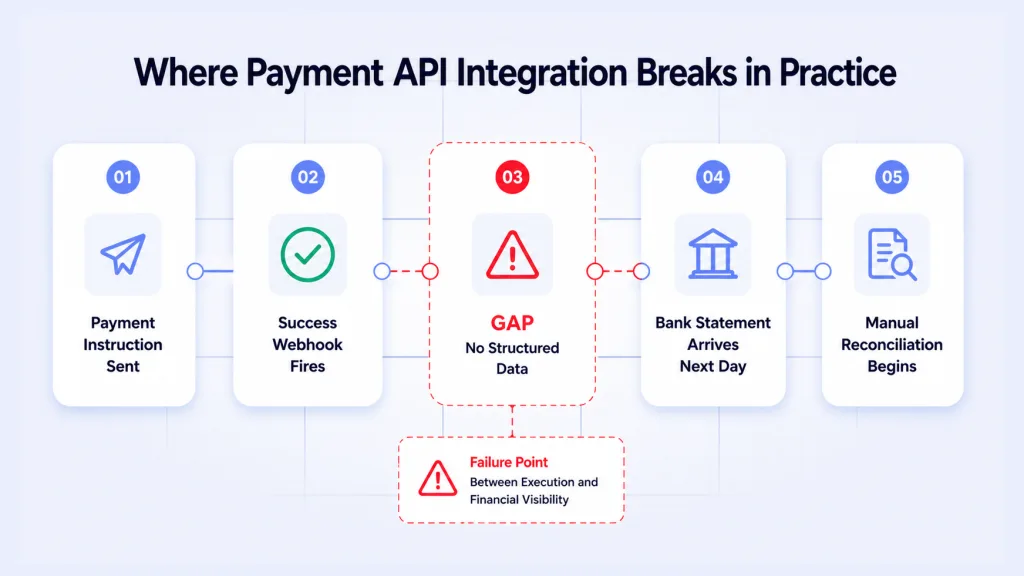
What Does Failure Look Like in a Real Workflow?
A billing SaaS sends a payment instruction via PIS. The webhook returns success. The platform marks the invoice as processing.
Then nothing.
The bank settles the payment – but the platform’s accounting layer does not receive structured confirmation until the end-of-day bank data refresh. Finance manually checks the bank statement. The invoice gets marked and paid the following morning.
For one payment, this is manageable. For 500 payments a week, this is the reconciliation backlog that slows period-end close and makes cash flow reporting unreliable.
The problem is structural. Paying one person through Open Banking is straightforward. Paying 500 workers every week, tracking failures, and reconciling it all is where the complexity begins – as one marketplace operations lead described during an Open Banking infrastructure evaluation.
Payment API integration that handles only the initiation step pushes the data work downstream. Someone – engineering, finance, or both – ends up building and maintaining the reconciliation layer separately. This is not a product feature. It is integration debt.
“Payment API integration that stops at payment execution is half a workflow. The second half – confirmation, reconciliation, cash visibility – requires financial data flowing from the bank at the same moment as the payment. That is what separates a working demo from a production-ready system.” – Yuri, Finexer
Developers building for production will recognise the patterns covered in the API integration challenges guide, which covers where bank data integrations break under real transaction volumes and bank-specific behaviour.
How Does Open Banking Data Sharing Connect the Payment Workflow?
What Does AIS Add to Payment API Integration?
| Workflow Step | PIS Only | PIS + AIS (Connected) |
|---|---|---|
| Payment initiated | Instruction sent to bank | Instruction sent to bank |
| Settlement confirmation | Webhook: “success” – no structured data | AIS webhook: transaction data with reference, amount, counterparty |
| Invoice matching | Manual – from end-of-day bank statement | Automated – reference embedded at initiation, matched at settlement |
| Cash position | Estimated – based on pending payments | Confirmed – based on cleared transactions in real time |
| Reconciliation | Next working day – after bank data arrives | At settlement – triggered by AIS webhook |
Open banking data sharing via AIS does not replace the payment instruction. It provides the structured financial data that makes the downstream workflow – confirmation, matching, reconciliation, reporting – work without manual intervention.
The pattern for AIS-connected payment workflows is documented in the banking API integration guide, which covers how Open Banking AIS data structures integrate with payment workflows in production systems.
What Does the Connected Payment Workflow Look Like in Practice?
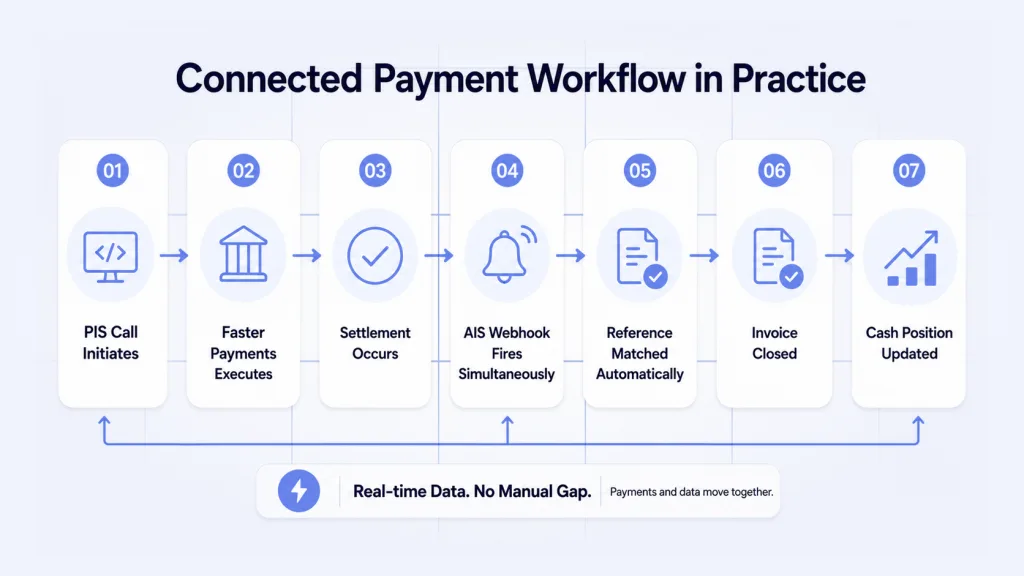
How Do PIS and AIS Work Together in a Platform Integration?
The connected workflow eliminates the gap between payment execution and financial visibility.
Payment initiation (PIS):
- Platform calls the PIS API with payment instruction – amount, recipient, reference
- Bank executes the Faster Payments transfer
- Webhook returns payment status
Bank data confirmation (AIS):
- AIS delivers the corresponding transaction to the platform at settlement – structured JSON with merchant ID, category code, reference, and timestamp
- Platform matches the incoming transaction to the original payment instruction automatically
- Invoice is marked paid. Cash position updates. Reconciliation is complete.
No manual bank statement check. No morning-after reconciliation job. No cash position estimate.
The reference is embedded at PIS initiation and appears in the AIS transaction data at settlement. The matching is automated by design – not by building a reconciliation layer on top of two disconnected systems.
“The difference between payment API integration that requires engineering maintenance and one that runs quietly in production is whether the data and the payment are connected from the start. One API for payments, one for data, no shared reference – that is the integration debt that compounds.” – Yuri, Finexer
The broader context of how Open Banking data networks support platform financial workflows is covered in the open banking data networks guide, which explains how AIS infrastructure connects to bank systems across different provider architectures.
How Does Finexer Support Payment API Integration?
What Does Finexer Provide for Connected Payment and Data Workflows?
Finexer is not a payment gateway. It is FCA-authorised Open Banking infrastructure – PIS and AIS in a single integration – built for platforms that need payments and financial data to work together from the first API call.
PIS – payment initiation:
- Pay by Bank – A2A transfer via Faster Payments, instant settlement
- Payment Links – shareable link with reference embedded at initiation
- Bulk Payout – multiple recipient payments via single API call, per-payment references
- VRP – pre-authorised recurring payments without per-cycle manual action
- Webhook confirmation per payment
AIS – connected financial data:
- Transaction data delivered at settlement via webhook – not in a batch
- Merchant IDs and category codes at source – consistent across virtually every UK bank
- Structured JSON – single schema regardless of the recipient’s bank
- Up to 7 years of transaction history for reconciliation and audit depth
- Consent logs per retrieval for compliance
Both PIS and AIS operate under a single integration. The payment reference flows from PIS initiation through Faster Payments and appears in the AIS transaction data at settlement – enabling automated invoice matching without a separate reconciliation layer.
Usage-based pricing, no setup fees. 3-5 weeks to production. 99% UK bank coverage.
The full picture of how Finexer’s payment and data API works in production is covered in the payment integration via API guide, which includes architecture notes for fintech platforms building on Open Banking PIS and AIS together.
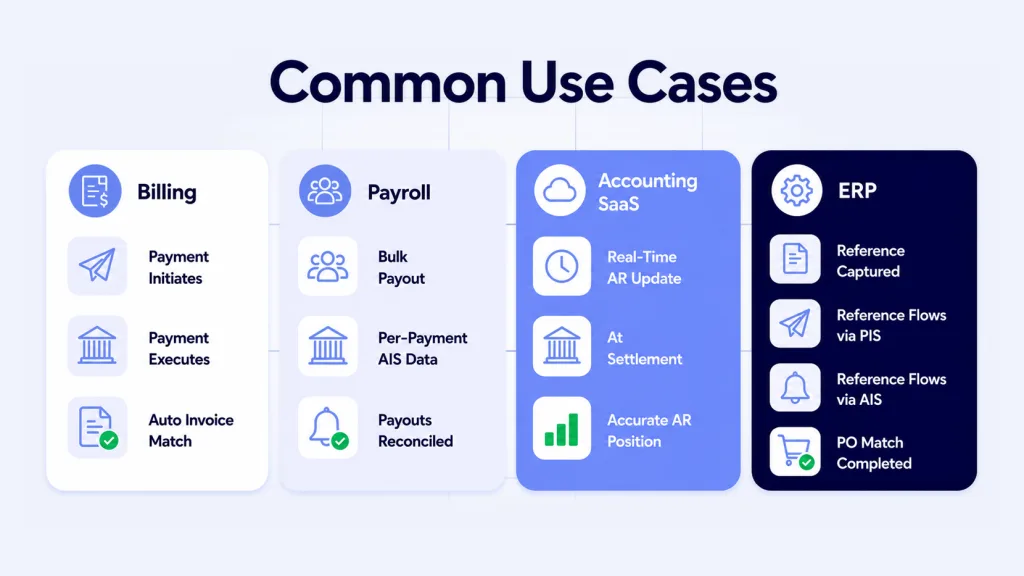
Common Use Cases
Billing and Invoicing Platforms
Payment API integration initiates the transfer. AIS confirms settlement with the invoice reference embedded. Matching is automated at the moment of receipt – no manual bank statement check, no overnight reconciliation job.
Payroll and Disbursement Platforms
Bulk Payout via PIS sends payments to multiple recipients in a single API call. AIS returns per-payment transaction data at settlement – failure identification and reconciliation reporting available immediately, not at end of batch.
Accounting SaaS
AIS bank transaction data updates the accounts receivable position at the moment each payment clears. Cash position reflects confirmed settlements – not authorised amounts sitting in a pending queue.
ERP Systems
Payment reference flows from PIS initiation through Faster Payments into the AIS transaction at settlement. Automated matching to purchase orders without a separate reconciliation layer or manual mapping step.
What I Feel
Most payment API integrations are built as payment-only systems.
The team integrates PIS. Payments flow. The demo works.
Then the finance team asks for a reconciliation report. Engineering builds a bank data feed separately. The payment reference does not match between the two systems. Someone builds a mapping layer. The mapping layer needs maintenance. The maintenance becomes a support burden.
That is not a product. That is integration debt that was avoidable from day one.
Start with payments and data connected. The reference that goes into the payment initiation should come back in the transaction data at settlement. That is the design that does not require a separate reconciliation layer six months later.
What is payment API integration?
Payment API integration connects an application to payment rails – enabling the platform to initiate transfers, receive confirmation, and trigger downstream workflows programmatically. In the UK, Open Banking PIS provides bank-authenticated A2A payment initiation via Faster Payments. Quality depends not just on execution but on whether structured financial data accompanies confirmation – enabling automated reconciliation without manual bank statement processing.
How does open banking data sharing improve payment API integration?
Most payment integrations confirm an instruction was accepted – not that it settled with structured data. Open banking data sharing via AIS delivers the bank transaction at settlement: merchant ID, reference, amount, and category code. When the PIS reference matches the AIS transaction at settlement, invoice matching is automated and the reconciliation layer does not need building separately.
What should engineering teams check before going live with payment API integration?
Confirm payment references flow from initiation through to settlement transaction data – not just within the PIS webhook. Test whether reconciliation runs automatically at settlement or depends on a separate batch bank feed. Check whether AIS and PIS share a reference schema. If not, the reconciliation layer will need to be built and maintained as a separate integration component.
Build payment API integration with payments and data connected from day one.
About the Author

Yuri
Yuriy Yakushko is a fintech founder and software engineer with over 20 years of experience building financial technology. He’s passionate about creating scalable, secure infrastructure that helps businesses modernise how they access financial data and manage payments.