
Real-time payment confirmation. Structured transaction data. Automatic reconciliation matching.
Open Banking PIS and AIS infrastructure for accounting SaaS, ERP platforms, and payment workflows.
Every finance team I speak to says the same thing: reconciliation takes too long.
They are usually fixing the wrong end of the problem.
Manual bank reconciliation is a symptom. The cause is what happens before a transaction reaches your ledger – how it was initiated, what reference it carried, and whether structured data arrived with it or not. Most transaction processing systems send a payment and call it done. The reconciliation problem starts there.
At Finexer, I work with accounting SaaS teams and ERP platforms that have built reconciliation workflows on top of broken transaction data. The pattern is always the same: payments that arrive without references, batch settlements that don’t map to individual invoices, bank descriptions that say nothing useful. You can’t automate matching when there’s nothing to match against.
From 7 May 2026, FCA PS25/12 requires payments and e-money firms to perform safeguarding reconciliations at least once per reconciliation day. Daily. Not monthly. The stakes for getting transaction processing right just got higher.
TL;DR
Manual bank reconciliation persists because transaction processing systems don’t provide the structured, real-time data that matching requires. Fix the data layer – consistent references, merchant-coded transactions, real-time confirmation – and reconciliation becomes automatable. Open Banking AIS and PIS together close the gap: payments initiate with embedded references, bank-verified transaction data arrives at settlement, and matching runs automatically.
Key Takeaways
Why does manual bank reconciliation still exist?
Because transaction processing systems weren’t built for reconciliation. Payments go out with inconsistent references. Settlements arrive in batches. Bank descriptions are truncated or generic. The reconciliation team receives unusable data and spends hours turning it into something matchable.
What is a transaction processing solution?
A transaction processing solution handles the initiation, routing, and confirmation of payments. In the context of reconciliation, a good one embeds references at initiation, confirms settlement in real time, and delivers structured transaction data to the receiving platform – making the downstream matching step automatable rather than manual.
What causes reconciliation failures in practice?
Three things: missing or inconsistent payment references, batch settlement data that doesn’t map to individual transactions, and delayed bank data that arrives hours or days after the payment is cleared. Each one forces a human to step in.
How does Open Banking reduce manual bank reconciliation?
PIS initiates payments with references embedded from the start. AIS delivers the bank-confirmed transaction at settlement – with merchant ID, amount, reference, and timestamp. The platform matches the outgoing payment to the incoming bank confirmation automatically. No manual step required.
Why Does Manual Bank Reconciliation Exist?
What Is the Transaction Processing Gap?
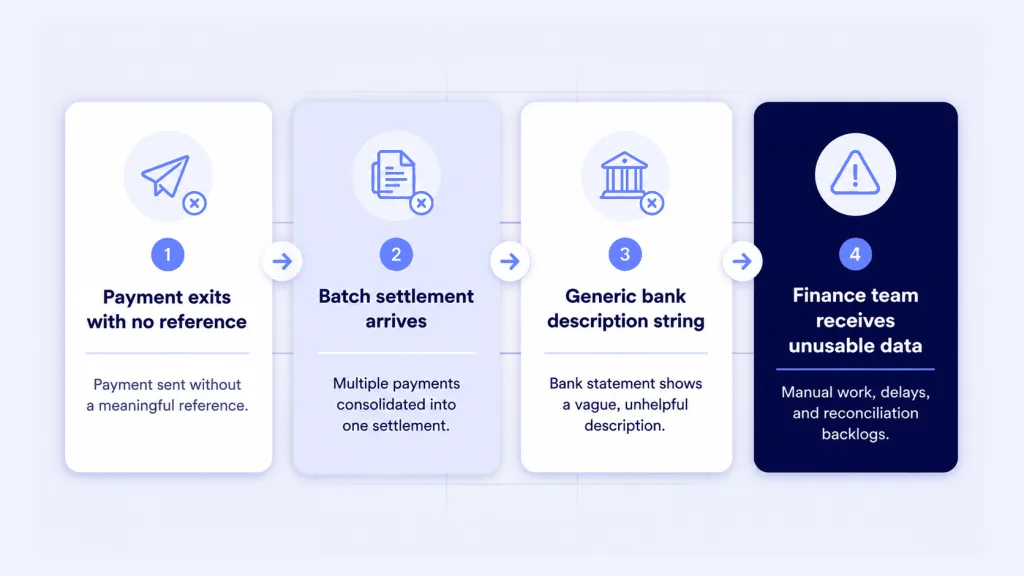
Here is what a broken reconciliation workflow actually looks like.
A payment goes out via bank transfer. The reference field is either blank, truncated, or set to something generic. The payment settles. The bank statement arrives in a batch at the end of day – or worse, the next morning. Your finance team opens it, sees “BACS 002847 ACCTS”, and starts manually cross-referencing invoices.
That is not a reconciliation problem. That is a transaction processing problem that landed on the reconciliation team.
A wire transfer confirmed by your bank may not yet appear in your ERP. A payment processor might batch settlements in ways that don’t map neatly to individual ledger entries. Descriptions vary – sometimes dramatically – between systems for the same underlying transaction. This is the gap that makes the reconciliation manual.
Three transaction processing failures drive almost all manual bank reconciliation backlogs:
- No reference at initiation. Payment goes out without a meaningful reference. The receiving end can’t match it to an invoice.
- Batch settlement. Multiple payments consolidated into one bank entry. Individual matching becomes impossible without manual decomposition.
- Delayed bank data. Settlement is confirmed, but the bank statement batch arrives hours later. Reconciliation runs on yesterday’s numbers.
“Manual bank reconciliation is what happens when the payment layer and the data layer are designed independently. It is a structural outcome, not a team failure. The payment executes. The data follows whenever. The finance team picks up the gap.” – Ravi, Finexer
What Does the Operational Impact Look Like?
How Much Does Poor Transaction Processing Cost in Practice?
Finance teams don’t just waste time. They make decisions on stale data.
When manual bank reconciliation runs on batch-processed, delayed transaction data, the cash position is always a lagging indicator. Reporting is based on what cleared yesterday, not what cleared this morning. For platforms scaling transaction volumes, this compounds fast.
The problem compounds with scale. Platforms that processed 200 payments a month two years ago are processing 2,000 now. The spreadsheet that worked then does not work now.
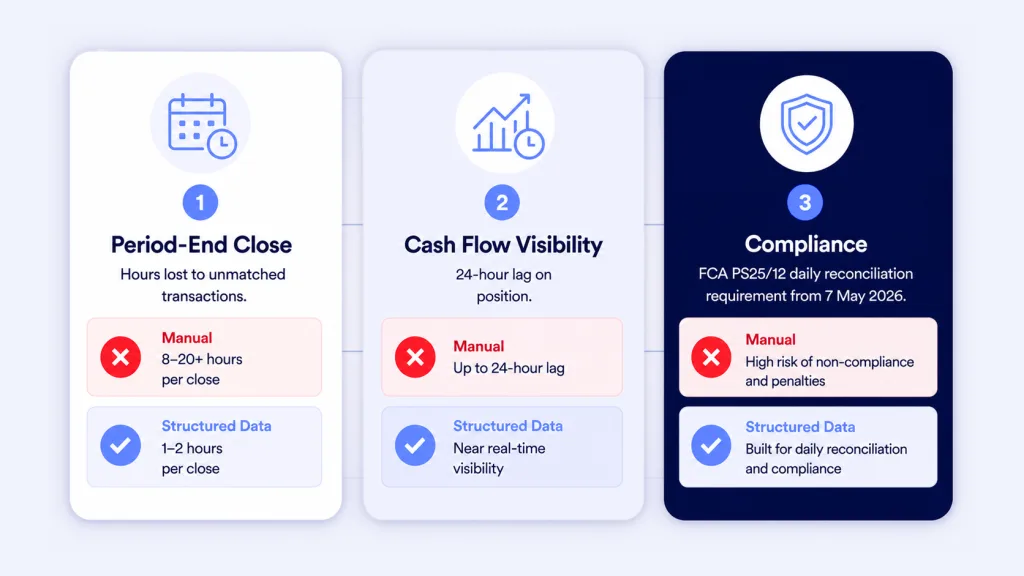
The operational cost shows up in three places:
- Period-end close. Every unmatched transaction at month-end needs manual investigation. At 50 transactions per day, a week of batch-settlement inconsistencies creates 350 potential mismatches before close even starts.
- Cash flow visibility. Manual bank reconciliation on T+1 bank data means cash position is always 24 hours stale. For treasury decisions, that matters.
- Compliance. From 7 May 2026, FCA PS25/12 requires daily safeguarding reconciliations for payments and e-money firms. At scale, that’s not feasible to manage manually.
The answer isn’t a better reconciliation tool. It’s better transaction processing – so that manual bank reconciliation has something to work with. Or doesn’t have to happen at all.
For platforms already managing manual reconciliation at scale, the manual reconciliation payments guide covers why automation still fails when the underlying transaction data is unstructured.
What Does a Good Transaction Processing Solution Provide?
What Changes When Transaction Data Is Structured?
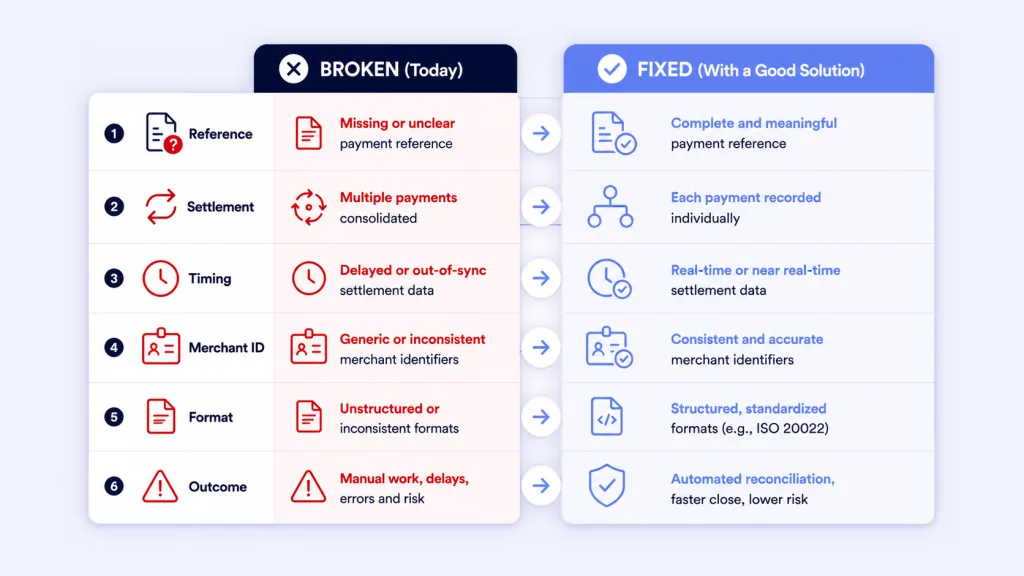
| Transaction Processing Element | Broken (Manual Reconciliation Result) | Fixed (Automated Matching Result) |
|---|---|---|
| Payment reference | Blank, generic, or truncated | Embedded at initiation – consistent across payment and bank data |
| Settlement data | Batch – multiple payments in one bank entry | Per-payment – individual transaction at settlement |
| Confirmation timing | End-of-day batch or T+1 | Real-time – webhook at settlement |
| Merchant identification | Raw bank description string | Merchant ID – consistent counterparty identification |
| Data format | Varies by bank – requires manual normalisation | Structured JSON – consistent across all UK banks |
| Reconciliation outcome | Manual matching – hours per cycle | Automatic matching – runs at settlement |
The difference is not automation software. It is what the transaction processing solution delivers upstream – and whether it gives the manual bank reconciliation layer something to work with.
Payment with reference. Per-transaction settlement. Structured JSON. The platform checks: does the outgoing reference match the incoming transaction? Yes. Match. Done. No human required.
For ERP platforms and billing systems building this into their workflow, the manual reconciliation automation solution guide covers the specific integration patterns that enable automatic matching at settlement.
How Does Finexer Support Reconciliation-Ready Transaction Processing?
What Does Finexer’s PIS and AIS Provide?
Finexer is not accounting software. It does not build ledgers, generate reports, or file tax returns.
Finexer provides FCA-authorised Open Banking PIS and AIS – the payment initiation and bank data infrastructure that removes the transaction processing gap that makes manual bank reconciliation necessary.
PIS – payment initiation with embedded references:
- Pay by Bank via Faster Payments – instant settlement, reference embedded at initiation
- Bulk Payout – per-payment references across multiple recipients in a single API call
- VRP – pre-authorised recurring payments, reference consistent across cycles
- Webhook confirmation per payment at settlement
AIS – structured bank transaction data:
- Per-payment transaction data delivered at settlement – not in end-of-day batch
- Merchant IDs at source – consistent counterparty identification across virtually every UK bank
- Category codes applied at source – 95%+ accuracy, under 100ms
- Structured JSON – same format regardless of which UK bank processed the payment
- Up to 7 years of transaction history for audit and historical matching
- 99% UK bank coverage – high street, challenger, and business accounts
- Usage-based pricing, no setup fees, 3-5 weeks to production
The reference embedded at PIS initiation reappears in the AIS transaction data at settlement. The platform matches outgoing to incoming automatically. No manual step required.
For payroll and disbursement platforms specifically, the payroll reconciliation automation guide covers how per-payment PIS references enable automatic payroll reconciliation against bank-confirmed transaction data.
What I Feel
Most platforms treat manual bank reconciliation as a workflow problem. They buy better reconciliation tools and wonder why the backlog remains.
It isn’t. It’s a data problem to be fixed upstream.
You can add matching rules, exception workflows, and approval queues to a broken transaction processing layer.
You will still be chasing unmatched entries at period-end. The rules cannot match what has no reference. The workflows cannot automate what arrives as a batch with no per-transaction breakdown.
“Every platform that has eliminated manual bank reconciliation has done the same thing – fixed what the payment carried, not what the reconciliation tool looked for.” – Ravi, Finexer
Fix the transaction processing. The reconciliation largely fixes itself.
Common Use Cases
Accounting SaaS
Payment reference flows from PIS initiation into AIS confirmation at settlement. The platform matches automatically – no manual step between payment execution and ledger update.
ERP Systems
Per-payment settlement data maps directly to purchase orders without a normalisation step. Consistent JSON across all UK banks replaces manual statement imports entirely.
Payment and Billing Platforms
Bulk Payout assigns a unique reference per recipient. AIS confirms per payment. Reconciliation runs per payment – not per batch, not manually.
Finance Ops Teams
Cash position reflects confirmed settlements, not yesterday’s batch. Period-end close runs against current data. The backlog disappears.
What is manual bank reconciliation?
Manual bank reconciliation is the process of matching a platform’s internal payment records against bank statement data by hand – checking references, amounts, and dates to confirm every transaction is accounted for. It is manual because the transaction processing layer doesn’t deliver structured, matched data automatically. When it does, reconciliation runs without human intervention.
What causes manual bank reconciliation to fail at scale?
Volume. At low transaction counts, a finance team can chase missing references and unmatched batch entries manually. At hundreds of payments per day, that process breaks. Unmatched entries accumulate, period-end close extends, and cash visibility degrades. The only scalable fix is structured transaction processing – references embedded at initiation, per-payment settlement data, real-time confirmation.
What is a transaction processing solution for reconciliation?
A transaction processing solution that supports reconciliation initiates payments with embedded references, confirms settlement per transaction in real time, and delivers structured data to the platform’s matching layer. Open Banking PIS and AIS together provide this: PIS for payment initiation with references, AIS for bank-confirmed transaction data at settlement.
How long does manual bank reconciliation take?
It depends entirely on data quality. With structured, referenced transaction data, matching is near-instant. With missing references and batch settlements, it becomes a daily manual task that grows with transaction volume. Structured transaction processing removes the bottleneck – reconciliation runs at settlement, not at the end of a human review cycle.
Fix the transaction processing layer. Manual bank reconciliation stops being a weekly problem – and often stops being a problem at all.
About the Author

Ravi Ranjan
Ravi Ranjan is Co founder & CEO of Finexer