See Where the Money Actually Goes.
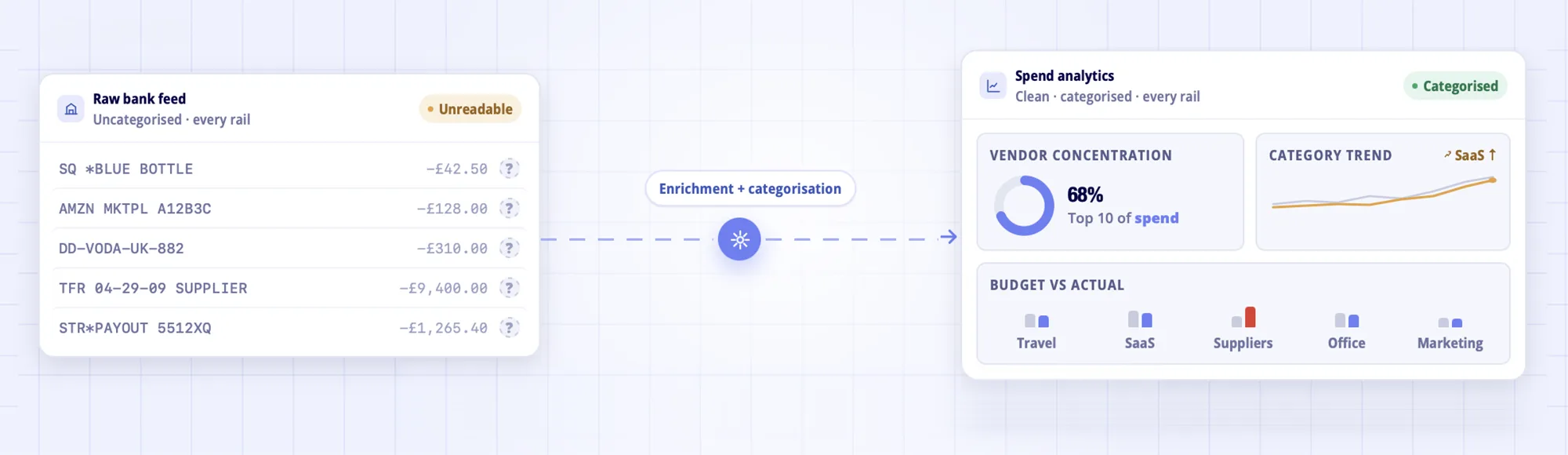
Spend analytics only works when the underlying bank data is clean and categorised across every payment rail, not just card spend.
Most finance teams I speak to already have an expense tool. Cards issued, receipts captured, approvals routed. The capture problem is largely solved.
What they cannot answer is the question that actually matters. Where is the money going, with whom, and is it on budget?
That gap is the spend analytics problem. Not captured. Visibility.
The reason is usually the same. Their expense tool sees card spend cleanly, but the bank transfers, Direct Debits, and supplier payments live in a separate feed that nobody has categorised. Half the spent picture is missing.
“Finance teams think they have a spend analytics problem. Usually they have a data quality problem wearing a spend analytics costume. The dashboard is only as good as the categorised feed underneath it, and most feeds are half card data, half cryptic bank strings nobody has cleaned.” – Ravi, Finexer
TL;DR
Spend analytics is the layer that turns aggregated transaction data into vendor concentration, category trends, and budget variance insight. It sits above expense management automation, which captures the spend. Card-issued expense tools only see card spend. Bank transfers, Direct Debits, and supplier payments need a clean, categorised bank-data feed. Without merchant identification and categorisation across every rail, the analytics are built on incomplete data.
What Is Spend Analytics?
Spend analytics is the process of aggregating, categorising, and analysing all companies spend to surface where money goes, with which suppliers, and against budget.
It answers questions a raw transaction list cannot. Which ten vendors account for most of the spend? Which categories are trending up month over month? Where is actual spend running ahead of budget, right now, not at period-end?
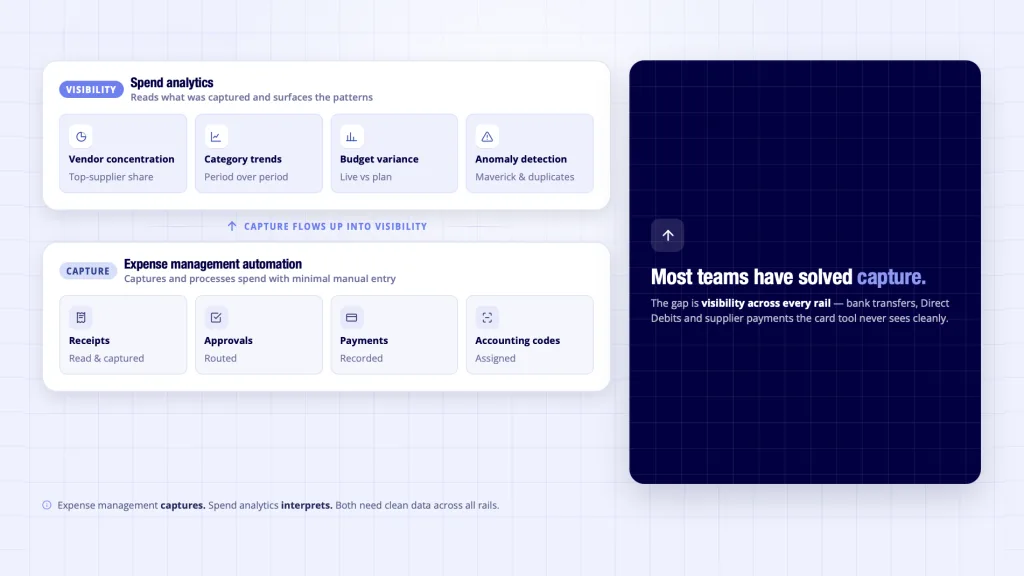
This is distinct from two adjacent things. Expense management captures spend – receipts, approvals, payments. Procurement analytics focuses on sourcing and supplier negotiation. Spend analytics is the visibility layer that sits across all of it.
The people who use it are finance directors, FP&A leads, controllers, and procurement leads. They are not looking for another capture tool. They want to see the spend they have already captured, clearly, across every rail.
How Is Spend Analytics Different from Expense Management?
The two are layers, not alternatives. One captures, the other interprets. Procurement analytics sits alongside, focused on sourcing.
| Layer | What it does | Example output |
|---|---|---|
| Expense management automation | Captures and processes spend – reads receipts, routes approval, records payment, assigns accounting code | A recorded, coded expense |
| Spend analytics | Reads what has been captured and surfaces the patterns | Vendor concentration, category drift, budget variance, anomalies |
| Procurement analytics | Focuses on sourcing and supplier negotiation | Supplier performance, contract compliance |
Most spend management platforms include basic analytics dashboards. Pleo, Spendesk, Soldo, and Payhawk all show category breakdowns and budget tracking.
Specialist tools like CostBits, Anvil Analytical, and Spendkey go deeper into procurement-grade analysis, vendor benchmarking, and savings identification.
The catch is that both layers depend on the same thing: clean, categorised data across every payment rail.
Why Do Card-Only Expense Tools Fall Short for Analytics?
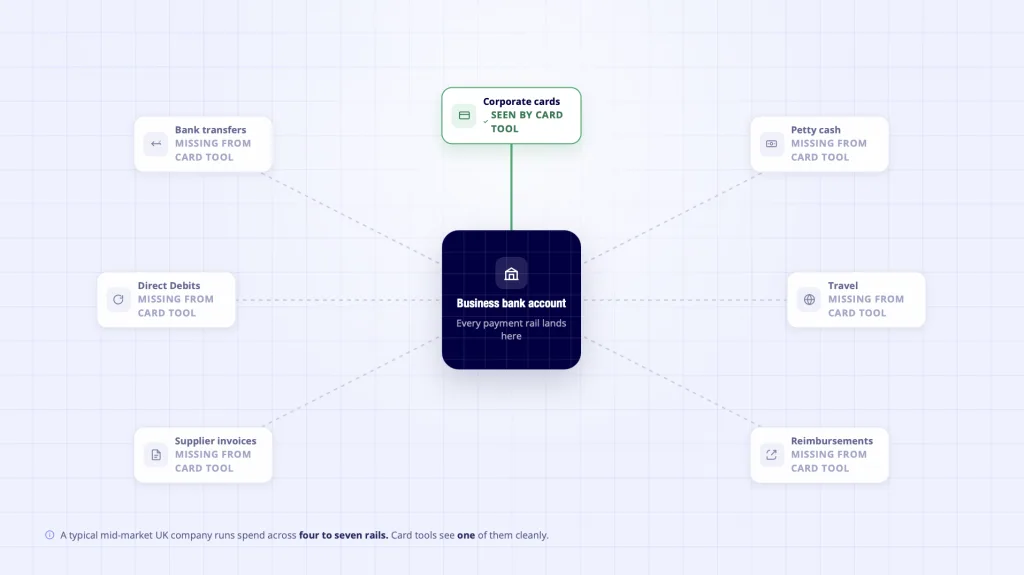
Card-issued spend tools capture card spend beautifully. The problem is that card spend is only part of the picture.
A typical mid-market UK company runs spend across four to seven rails. Corporate cards, bank transfers, Direct Debits, supplier invoice payments, petty cash, travel, and reimbursements. Card tools see one of these cleanly.
The rest lives in the business bank account as a separate feed. Bank transfers to suppliers, recurring Direct Debits, one-off vendor payments. To bring these into the analytics, someone has to pull the bank statement and categorise it manually.
This is not a small slice. Around 52% of UK B2B payments still move by bank transfer (UK Finance, ukfinance.org.uk).
Cards tend to cover subscriptions, online services, and one-off expenses rather than supplier settlements. A card-led tool sees the minority of the spend, not the majority.
That manual step breaks at scale. A bank feed arrives as cryptic strings – things like “SQ *BLUE BOTTLE” or “AMZN MKTPL A12B3C”.
A human can guess the first is a card reader payment and the second is Amazon. An analytics dashboard cannot, unless transaction categorisation has run across the feed first to assign each payment a clean category.
So the unified spend view that finance leaders actually want requires a clean bank-data feed across every rail, not just card spend.
What Does Good Spend Visibility Actually Show?
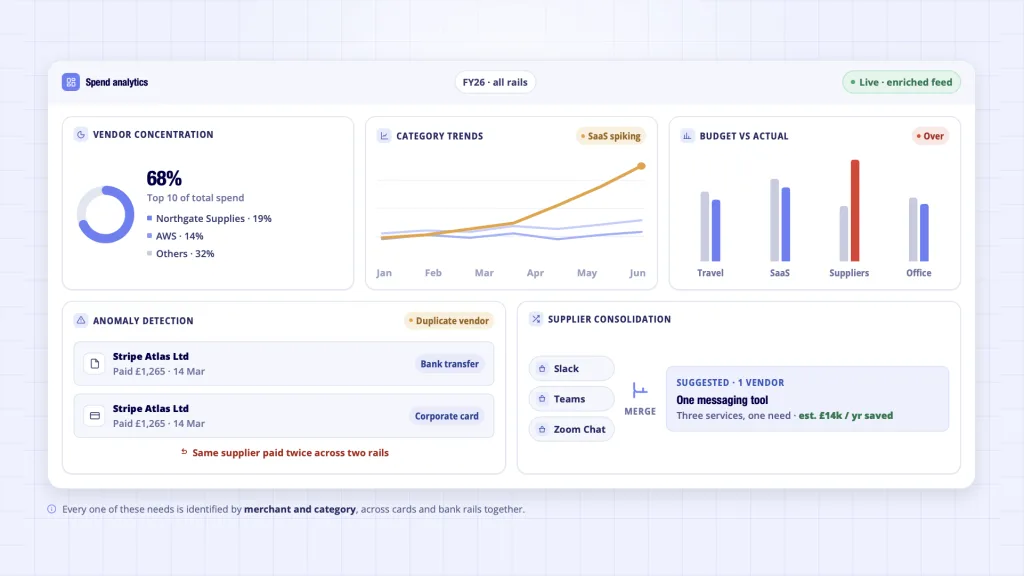
When the underlying data is clean across all rails, spend analytics surfaces five things that change decisions.
- Vendor concentration: the top ten suppliers as a share of total spend, flagging single-supplier dependency risk
- Category trends: spend by category period over period, with anomaly flags when a line jumps
- Budget versus actual: live tracking as transactions land, not a reconciliation done at month-end
- Anomaly detection: unusual spend, maverick spend bought outside agreed suppliers, duplicate vendors paid through different rails
- Supplier consolidation: the same service bought from three vendors that could be one
The common thread is that every one of these needs is identified by merchant and category, across cards and bank rails together.
Consider a company with £2m of annual B2B spend. If around half moves through bank transfers, Direct Debits, and supplier payments – in line with the UK Finance bank-transfer figure – that is roughly £1m the card tool never sees cleanly.
A vendor-concentration report built on the card feed alone is therefore working from about half the picture. It hides the large supplier paid by bank transfer.
Getting this right needs automated financial data categorisation running across the full feed before any dashboard renders.
What Data Quality Does It Require?
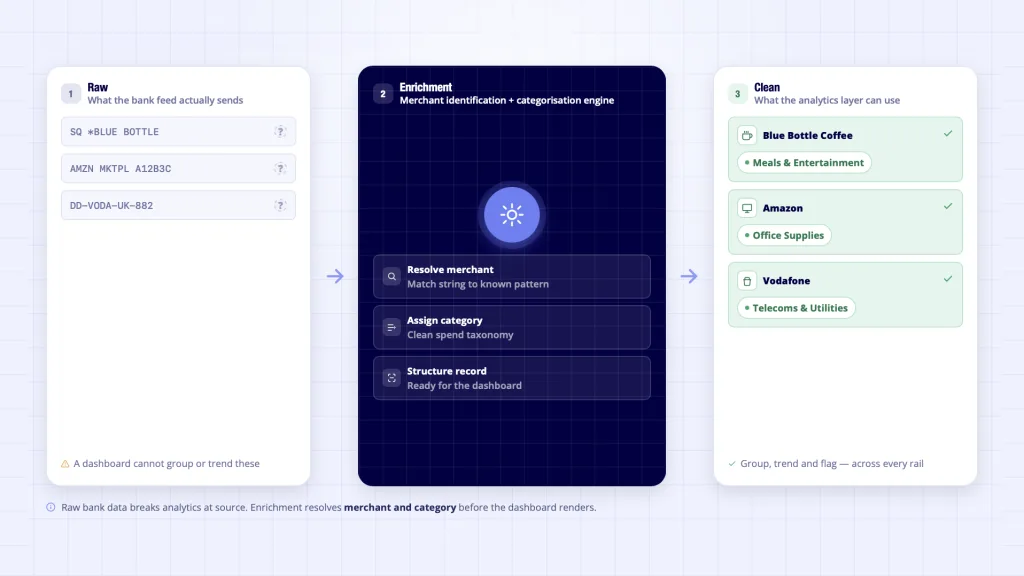
Useful spend analytics has one prerequisite: a clean, categorised feed that covers every rail.
Raw bank data does not arrive clean. A payment to a supplier shows up as a truncated reference, a card acquirer string, or a payment processor descriptor. At a handful of transactions a month, a person can sort this. At hundreds or thousands, it breaks.
This is where transaction enrichment matters. It resolves a cryptic bank string into a clean merchant name, a category, and a structured record the analytics layer can actually use.
“SQ *BLUE BOTTLE” becomes “Blue Bottle Coffee, category: meals and entertainment”. The dashboard can then group, trend, and flag it. Clean data first, analytics second.
Which Spend Analytics Tools Do UK Finance Teams Use?
The market splits into three groups, and the right choice depends on the depth of analysis needed.
| Group | Examples | What it does | Best for |
|---|---|---|---|
| Spend management with built-in analytics | Pleo, Spendesk, Soldo, Payhawk | Captures card spend, offers category dashboards and budget tracking on top | Teams whose spend is mostly card-led |
| Specialist spend analytics | CostBits, Anvil Analytical, Spendkey, ProcureVue | Procurement-grade analysis – vendor benchmarking, savings identification, deeper category intelligence | Finance and procurement teams needing deep analysis |
| ERP-embedded analytics | NetSuite, Sage Intacct | Spend reporting inside the existing finance stack | Teams already running their finance on that ERP |
Anvil, for example, classifies spend with high accuracy and maps it to a standard taxonomy for benchmarking.
The common limitation across all three is the same. Their analytics are only as complete as the spent data feeding them.
If the bank-rail spend is missing or uncategorised, the dashboard tells half the story.
How Does Finexer Fit Into Spend Analytics?
Finexer is not a spend analytics tool. Finexer is the bank-data and enrichment layer that powers spend analytics tools.
If you are a finance team, your dashboard is Pleo, Spendesk, CostBits, or your ERP. If you are a platform building spend analytics features, or a finance team whose tool only sees card spend, Finexer is the feed underneath that makes the analytics complete.
What Finexer provides for spend analytics workflows:
- AIS for a unified bank-data feed across every rail – cards, transfers, Direct Debits, supplier payments – pulled directly from the business bank account
- Transaction Enrichment that resolves cryptic bank strings into clean merchant names and spend categories, ready for the dashboard
- Structured, categorised output that analytics tools and BI layers can group, trend, and benchmark without manual cleanup
- Coverage across 99% of UK banks through one API connection
The mechanism: a spend analytics tool or finance team connects to Finexer once, receives the full bank feed across every rail, already enriched and categorised. The vendor-concentration report now includes the large supplier paid by bank transfer. The budget tracker sees Direct Debits, not just card spend.
For platforms weighing build versus buy on the data layer, B2B data enrichment tools sets out what to evaluate before committing.
Finexer is FCA-authorised AISP and PISP (FRN 925695). PSD2-compliant. Usage-based pricing, commercial terms agreed based on use case. 3 to 5 weeks of hands-on onboarding support for platforms embedding the feed.
“The platforms winning in spend analytics are not the ones with the most dashboard widgets. They are the ones whose data feed sees every rail and arrives already categorised. The intelligence layer is commoditising. The clean feed underneath is the hard part.” – Ravi, Finexer
This blog covers the analytics layer. The capture layer is a separate decision, handled by the platforms in the expense management with Open Banking comparison.
Where Does Spend Analytics Actually Get Used?
Four common patterns, each with the same underlying data need.
A SaaS CFO running live budget tracking needs every rail in one view, so the budget tracker reflects supplier bank transfers, not just team card spend.
A mid-market finance team running vendor consolidation needs accurate vendor concentration across cards and bank payments, to spot the same service bought three ways.
An accounting platform adding spend analytics as a product feature needs a clean categorised feed to power it, rather than building enrichment from scratch.
A finance platform feeding a BI tool needs structured, categorised transaction data that the BI layer can model without manual cleanup.
What is the best spend analytics tool in the UK?
There is no single best. Pleo, Spendesk, and Payhawk suit card-led spend with built-in dashboards. Specialists like CostBits and Anvil go deeper on procurement analysis. The right fit depends on spend complexity and how many payment rails you run.
What is expense management automation?
Expense management automation captures and processes spend with minimal manual entry – reading receipts, routing approvals, recording payments, and assigning accounting codes. Spend analytics then turns that captured data into insight.
How does AI categorise expenses?
AI reads a transaction’s merchant string, amount, and metadata, matches it against known merchant patterns, and assigns a spend category. Enrichment resolves cryptic bank descriptors into clean merchant names before the categorisation runs.
How does Open Banking improve spend analytics?
Open Banking provides a direct, real-time feed of all bank-rail spend – transfers, Direct Debits, supplier payments – that card tools miss. Combined with enrichment, it gives spend analytics a complete, categorised view across every rail.
If your spend analytics only sees card spend, Finexer’s bank-data and Transaction Enrichment layer can give it a clean, categorised feed across every payment rail.
About the Author

Ravi Ranjan
Ravi Ranjan is Co founder & CEO of Finexer