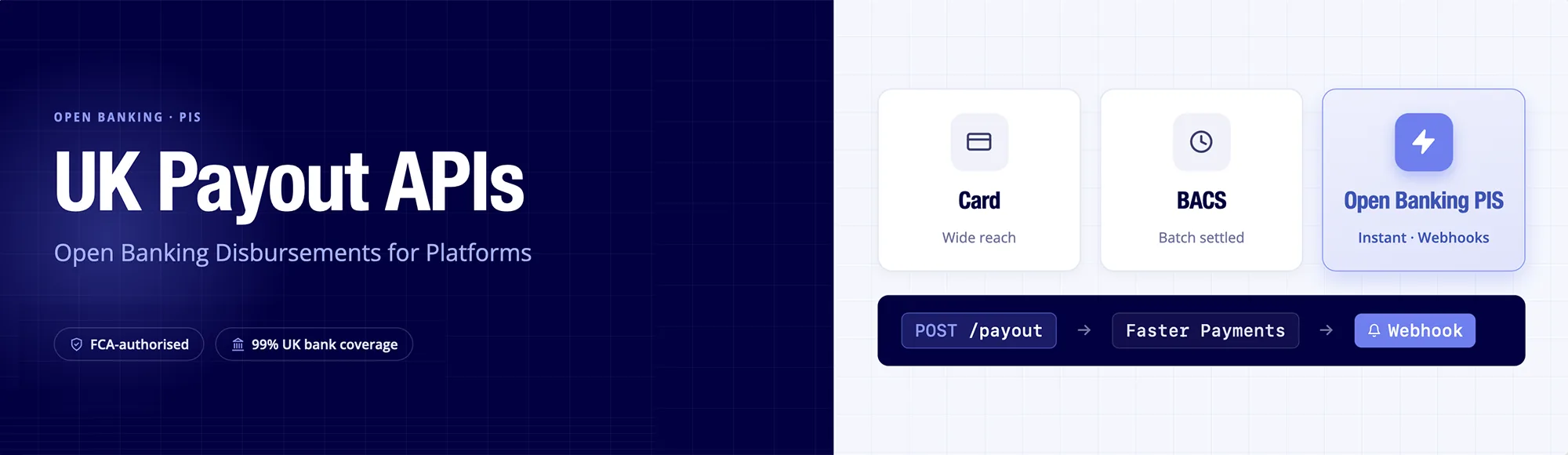
A payout API gives platforms programmatic control over outbound disbursements – initiating payments to recipients via API call rather than manual bank portal uploads.
For UK platforms, Open Banking PIS adds per-payout webhook status and Faster Payments settlement on top. This guide covers how UK payout APIs work and what engineering should evaluate before choosing a provider.
Ready to automate UK payouts with real-time visibility?
Explore how Open Banking PIS can help your platform send faster, track every payout and reduce manual reconciliation
Developers and CTOs assessing a payout API are hard pressed not on how to send money, but rather on how to identify that one payout infrastructure which is reliable with regard to updates, compliance with the regulations laid down by law, and a go-live period that’s just right for their product to succeed.
UK Open Banking Payment Initiation Services (PIS) have turned on its head the approach platforms took for payments. Rather than rely on BACS, which is amenable to manual intervention, or on card payments, both of which raise costs by an order of magnitude, platforms now program APIs linked to Faster Payments to start payouts.
This guide explains what a payout API is, how the UK payout infrastructure works, and what developers should evaluate when choosing a provider.
What Is a Payout API?
Payout APIs are interfaces that can be programmed to enable platforms to make payouts to recipients without manual steps being involved.
Instead of visiting a banking portal, uploading CSV files or individually rendering a payout, the platform can now send an API request with the receiver’s particulars and payout directives. Thereafter, the payout provider initiates the payment and provides updates at every event in the payment’s duration.
Typical recipients include:
- Payouts by the shift to temporary or freelance workers
- Settlements to sellers on the market
- Authorised payouts to insurance claimants
Automation is a key win for everyone here. Platforms now initiate payouts from the workflows of their own apps instead of relying on manual intervention.
Payroll SaaS
Payouts to contractors can be automated for payout workflows incorporated into payroll systems. Those with similar needs might want to check out this payroll disbursement API.
Payment API vs Payout API
A payment API targets the money entering a platform. Customers’ payments infuse funds into the platform. A payout API triggers the egress of money from the platform to recipients. Teams assessing payout infrastructure ought to dwell upon the nuanced purposes of payouts rather than overall payment API integration.
How Do UK Payout API Options Compare?
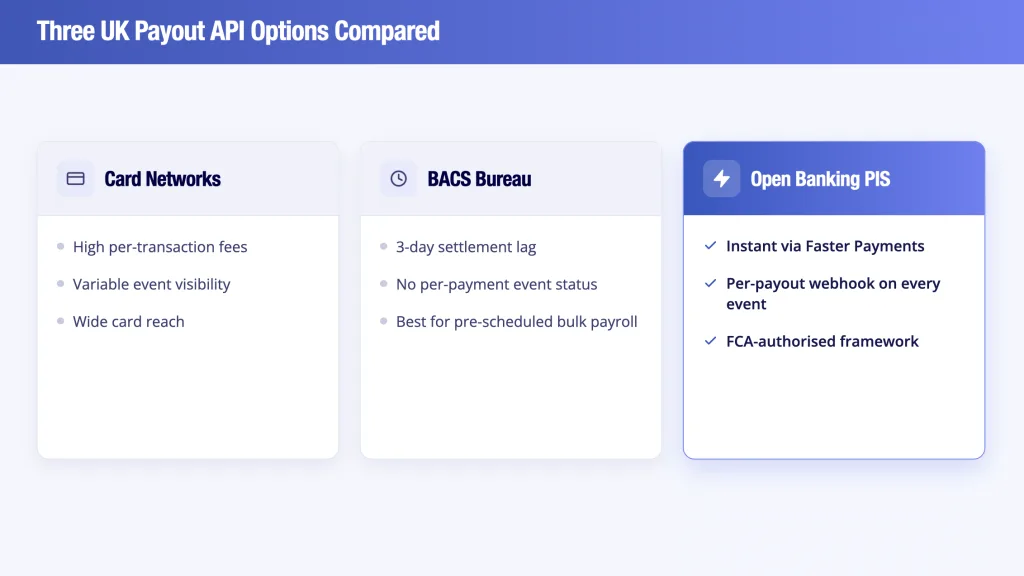
The following three approaches are at the basis of the programmed payouts offered by the UK market.
Card Networks
Card payouts provide reach that extends to the ends of the market, but are way more expensive than A2A payments. Event status visibility for each payout is not predictable and depends on extraneous factors.
BACS Bureau Providers
BACS is still the mainstay of bulk payment. However, BACS delays settlements for platforms that require faster payments at the receiver’s end.
Operations are affected by lags in confirmation, making reconciliation and support workflows, from initiation to completion, challenging.
Open Banking PIS
Open Banking PIS providers employ Faster Payments in the UK to trigger A2A transfers.
For platforms, this is a combination of the following functionalities:
- Instant payments via Faster Payments
- API-driven initiation
- Per-payment status visibility
- Webhook-based event notifications
- FCA-authorised regulatory framework
Consequently, Open Banking PIS providers are increasingly the choice of modern platforms in the work-in-progress payout workflows landscape.
How a UK Payout API Works
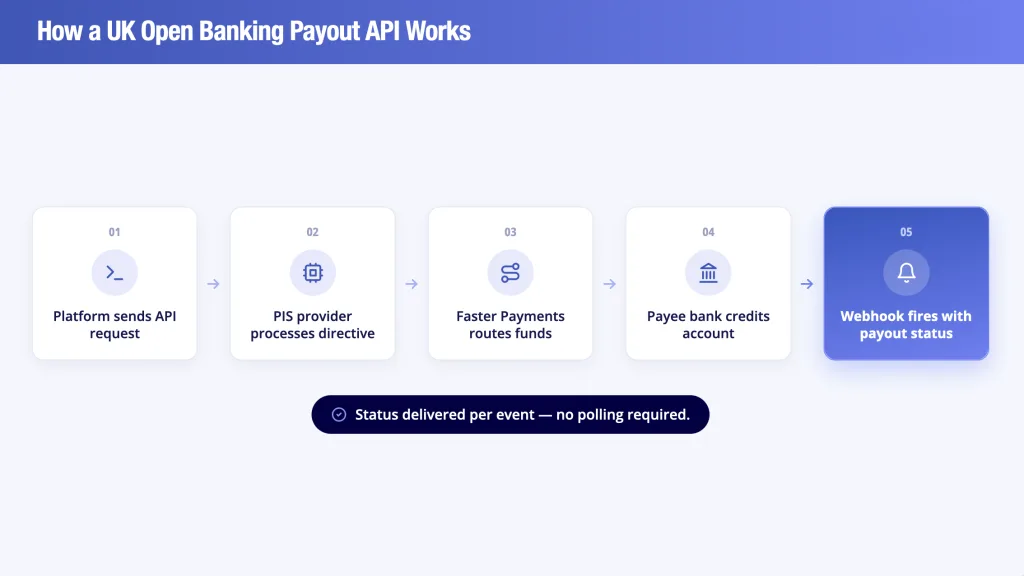
An Open Banking payout workflow follows five steps:
- Platform transmits a payout API request.
- The PIS provider processes the directives.
- The funds are routed to the payee’s bank by Faster Payments.
- Receiver (payee) bank credits the account.
- The firing of a webhook upon an event transmits the payout’s exact status to the platform.
The fundamental difference with respect to traditional modes of payout is visibility.
Instead of waiting for reconciliation reports, Open Banking PIS notify platforms of payment events even as they unfold, permitting automatic reaction by Operations.
As Yuri, one of Finexer’s API specialists, explains:
“The first thing engineering teams ask about during payout integrations is not payment speed. It’s whether they can reliably track every payout event without building polling infrastructure.”
Developer Evaluation Checklist for a Payout API
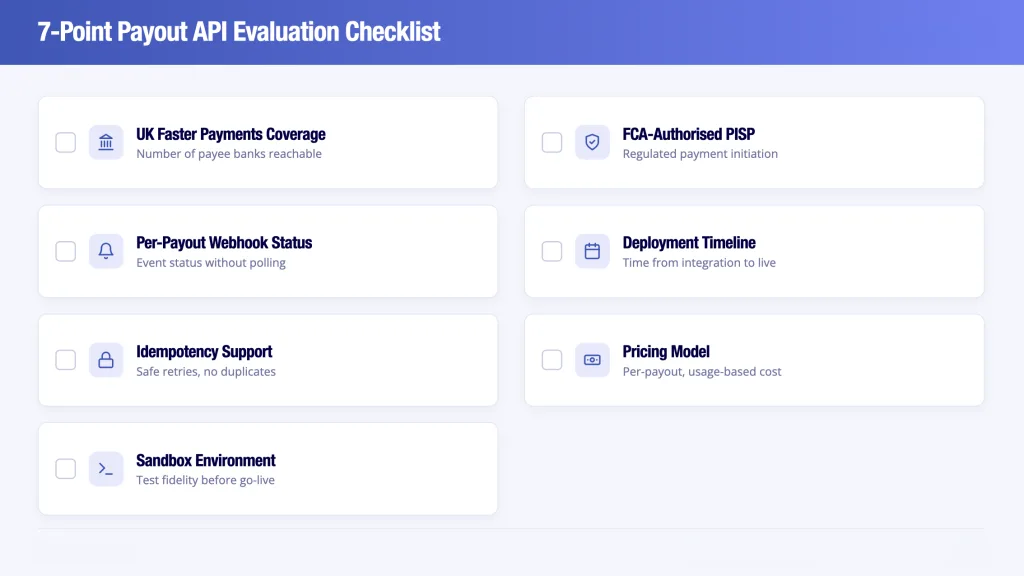
When assessing how Open Banking PIS providers stack up against one another, developers should evaluate the payment infrastructure layer beneath, instead of only looking toward API documentation.
1. UK Faster Payments
Coverage actually refers to the number of payee banks that can receive payouts through an Open Banking PIS provider.
Broad-based bank coverage reduces exceptions and further costs. Open Banking providers with widespread UK connectivity, in general, don’t spring unwanted surprises.
2. Per-Payout Webhook Status
Webhook support is the most important assessment parameter.
Every payout should generate status updates that can be consumed by operational systems. This improves monitoring, reconciliation, support workflows, and auditability.
Those who want to go further into webhook-driven workflows should review the ways in which payment status tracking is performed over the payout duration.
3. Idempotency
Idempotency avoids duplicate payouts with the vagaries of internet connections.
In case idempotency keys are not used, retry logic could create multiple payments. The payout API should permit clients to retry requests without the fear of duplication.
4. Sandbox Environment
Sandbox environments should reflect production behaviour.
Engineering requires true-to-life testing conditions prior to being deployed. Wide disparities between sandbox and production environments are often responsible for lags in integration.
5. FCA-Authorised PISP Status
In the UK, PIS providers operate under strict regulation.
Providers offering PIS must be FCA-authorised. This is a non-negotiable requirement for organisations assessing Open Banking payout substructure.
6. Deployment Timeline
A robust API can also face problems if onboarding is a long-drawn-out affair.
Engineering must assess how much time the onboarding and integration will take during procurement itself.
7. Pricing Model
Prices range far and wide between providers.
Common models include:
- Per-payout pricing
- Flat platform fees
- Volume-based pricing
Understanding the scaling of costs in tandem with increasing numbers of transactions is vital to vendor assessment.
Assessing Finexer for UK Payout APIs
Most UK platforms can send payouts. The challenge is per-payout visibility, regulatory compliance, and deploying without months of bank connection work.
Finexer’s Payment Initiation Service infrastructure is designed for platforms that need programmable UK payouts via Open Banking.
The payout workflow operates through a single API integration:
- Platform submits payout directive
- Payment is initiated through FCA-authorised PIS infrastructure
- Funds move via Faster Payments
- Status of events is delivered through webhooks
- Platform receives real-time visibility in operations
The following are Finexer’s PIS capabilities:
- FCA-authorised PISP (FRN 925695)
- Per-payout webhooks
- Idempotency support
- Sandbox environment
- 3–5 weeks onboarding support
- Usage-based pricing
- 99% UK bank coverage
Platforms that require bank account data access as well, can avail of Finexer’s AIS and PIS capabilities without running iterations of incorporation. More information is available in the Finexer AIS API overview.
One might want to consider that Finexer’s payout infrastructure focuses on UK bank accounts. Businesses assessing cross-border disbursements might want to review this international payments API solution.
A lot more is expected of a payout API than just sending money.
Engineering must note that the most important parameters on which to assess UK Open Banking Payout API providers are speed, visibility, idempotency, quality, regulatory compliance, deployment, and pricing.
Open Banking PIS has become a practical alternative for many UK payout workflows, combining Faster Payments, API-driven initiation and webhook-based payment visibility.
As today’s organisations increasingly deal with payout workflows brought about by marketplaces, temporary and freelance workers earning by the shift, insurance claimants and contractors, Open Banking payout APIs are now more than ever practical in automating UK payouts, even as the organisations get visibility across every payout event.
Can Open Banking payout APIs handle refund or reversal flows?
Yes. Providers should expose reversal/end-of-life operations (cancel, refund, or clawback) via API and webhooks. They should confirm latency, idempotency behaviour, and whether reversals require payer-bank‑initiated actions or whether they pass through the provider’s reconciliation workflow.
How should platforms design retries and failure handling for payouts?
Use idempotency keys, exponential backoff, and deterministic state machines driven by webhook events. Record each webhook, reconcile asynchronously, surface human-review queues for exceptions (failed, expired, needs-review), and avoid polling production endpoints.
What operational telemetry and audit data must a provider supply?
Request per-payout audit logs, webhook delivery history, event timestamps (created, authorised, submitted, received, matched, settled), return codes, and raw bank receipts. These support dispute resolution, reconciliation, and regulatory audits.
Are there onboarding limits or volume throttles to plan for?
Yes – check sandbox-to-production rate limits, per-second throughput, and initial production caps. Confirm staged ramp-up plans from providers (soft limits, dedicated lanes) and any quota-increase SLAs to avoid throttling at go‑live.
Faster Payments, webhook-driven status updates and FCA-authorised Open Banking support. All you can ask for.
Explore with AI
About the Author

Yuri
Yuriy Yakushko is a fintech founder and software engineer with over 20 years of experience building financial technology. He’s passionate about creating scalable, secure infrastructure that helps businesses modernise how they access financial data and manage payments.