
Your finance team spends three days a month manually matching bank statements to invoices. Your checkout loses 2 percent of revenue to card interchange fees. A customer typed their account number wrong and the refund went to a stranger. These are three different problems, and treating them as one “open banking project” is why so many integrations stall at the planning stage before a line of code gets written.
Open banking api solutions are not a single feature you switch on. Each business problem maps to a specific underlying capability, and most real fixes require more than one capability working together to close the loop end-to-end. This guide maps problems to capabilities so you can scope the right build before comparing open banking API providers, rather than after discovering mid-integration that your chosen provider only solves half the problem.
Key Takeaways
- Open banking API solutions solve distinct problems: AIS for data visibility, PIS for payment collection, verification for fraud prevention.
- Most real-world fixes combine two or more capabilities, such as AIS with data enrichment for clean reconciliation.
- A 2026 government framework shift gives the FCA direct open banking rule-making powers, changing how long-term platform decisions should be scoped.
- Evaluate open banking api providers on FCA authorisation, combined capability support, and single-integration architecture, not on feature count alone.
What Problems Do Open Banking API Solutions Actually Solve?
The mistake most buyers make is starting with “we need open banking” instead of naming the specific problem they are trying to fix. Open banking API solutions address distinct business problems, with each one requiring a different underlying capability. Treating them as the same is where scoping often goes wrong.
| Business Problem | Capability Needed | What You Must Build |
|---|---|---|
| Manual bank reconciliation | AIS (Account Information) | Transaction matching logic against invoices |
| High card processing fees | PIS (Payment Initiation) | Pay by Bank checkout flow with redirect handling |
| Payments sent to wrong account | Verification (Confirmation of Payee) | Pre-payment name-match check |
| Late visibility on failed collections | PIS + Webhooks | Real-time status listener and dunning trigger |
| Messy, unreadable transaction descriptions | AIS + Data Enrichment | Merchant name and category normalisation layer |
| Recurring billing with variable amounts | PIS + VRP consent | Consent lifecycle tracking against agreed limits |
This table is the starting point for any serious build conversation with open banking API providers. Before choosing a provider, identify the problem your business is trying to solve. For example, a property platform collecting rent usually needs both payment collection and real-time visibility into failed payments.
The table below shows which businesses benefit from different open banking services:
| Business Type | Typical Problem | Open Banking Capability |
|---|---|---|
| Accounting software | Manual reconciliation | AIS + Enrichment |
| Property platforms | Rent collection | PIS + VRP |
| Payroll | Account verification | Verification |
| Lending | Affordability checks | AIS |
| Marketplaces | Payouts | Payment Initiation |
Why Do Most Open Banking API Solutions Need More Than One Capability?
A single capability rarely solves a complete business problem alone. PIS alone confirms a payment succeeded or failed, but not why an account showed insufficient funds three times this month. Combining PIS with AIS adds the account context behind it, turning reactive dunning into a proactive process.
Similarly, account data, balance data, and transaction data without a data enrichment API layer return unreadable merchant codes instead of clean, categorised transactions. A description like “SAINY 1234 LONDON” means nothing to a matching rule; “Sainsbury’s, Groceries” does.
The table below provides quick clarity:
| Capability | Solves Alone? | Best Used With |
|---|---|---|
| AIS | Transaction visibility | Data enrichment, Reconciliation |
| Payment Initiation (PIS) | Payment collection | Webhooks, AIS |
| Verification | Account validation | PIS |
| Data Enrichment | Merchant categorisation | AIS |
| Webhooks | Payment status updates | PIS, AIS |
| VRP | Flexible recurring payments | Payment Initiation |
The Reason Why the Right Open Banking API UK Provider Matters
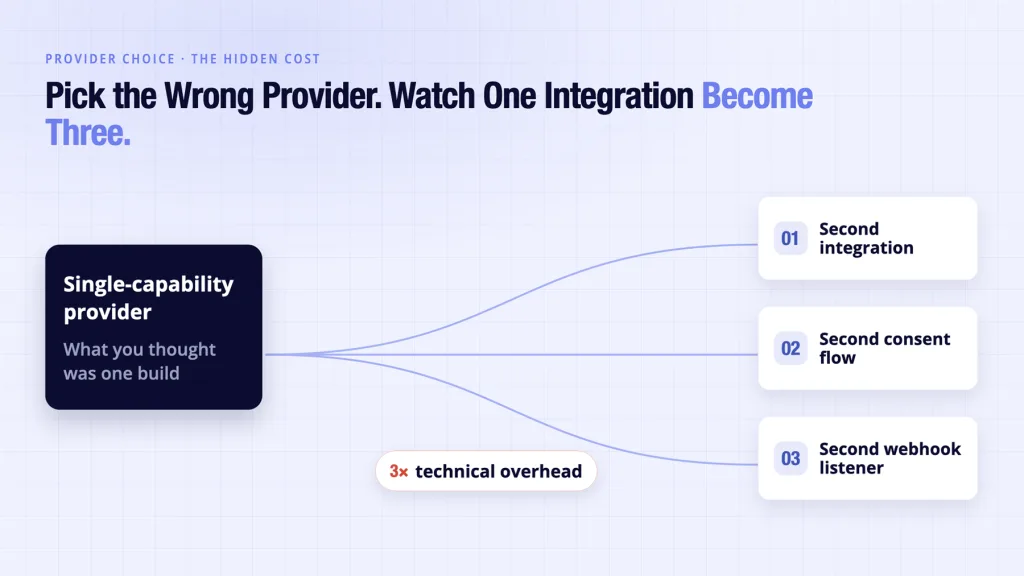
This is why platforms researching individual open banking solution providers often discover mid-build that their chosen capability alone will not close the loop. A simple open banking aggregator that only pulls account data will not solve a payment collection problem, no matter how many banks it connects to.
The build then expands: a second integration, a second consent flow, a second webhook listener, doubling technical overhead for what should have been a single connected workflow from the start.
Reconciliation Is A Combined-Capability Problem, Not A Single-Feature One
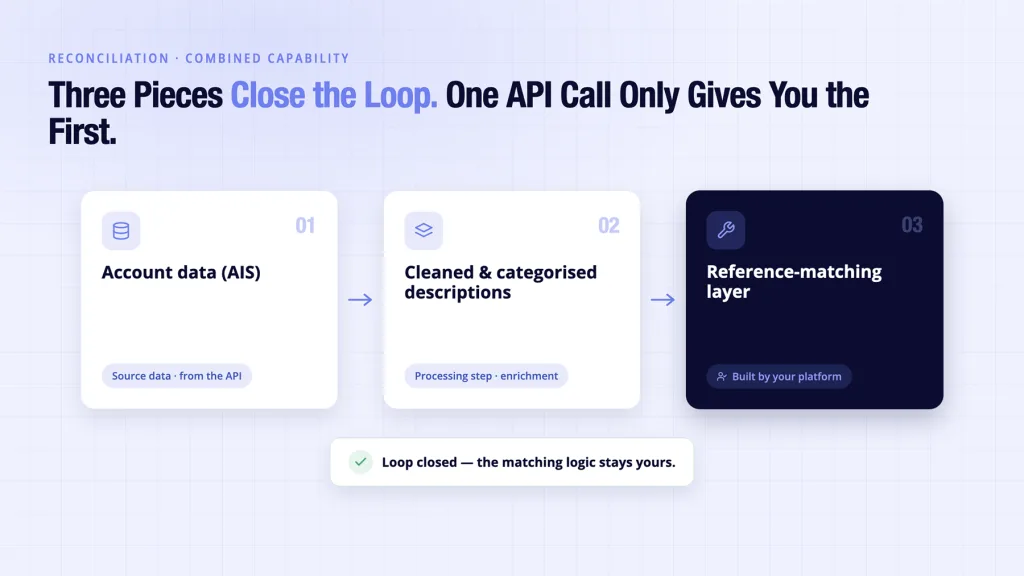
Automated invoice matching needs three things working together:
- Raw transaction data (AIS),
- Cleaned and categorised descriptions (data enrichment)
- A reference-matching layer your team builds on top.
No single API call replaces this workflow entirely; it replaces the manual labour inside it, while the matching logic itself still belongs to your platform.
How Do Account-To-Account Payments Reduce Cost And Failure Compared To Cards?
Pay by Bank, the account-to-account (A2A) payment method built on PIS, removes card interchange fees entirely and settles instantly via Faster Payments rather than the multi-day card settlement cycle. For platforms processing high transaction volumes, this is often the single highest-impact capability to deploy first, ahead of the more complex combined workflows described above.
Example: Consider a utility provider collecting monthly payments from thousands of households. Card processing on that volume typically costs 1.5 to 2 percent per transaction, plus chargeback exposure on disputed payments. Account-to-account collection through Pay by Bank removes both the fee and the chargeback risk, since the payer authenticates directly with their own bank.
Reasons Why UK Platforms Are Increasingly Adopting Account-to-Account Payments
In June 2026, UK open banking processed 40.16 million payments and 2.81 billion API calls in a single month, pushing the ecosystem past one billion cumulative payments and 100 billion cumulative API calls since launch. That scale is the clearest signal that account-to-account collection has moved from experimental to default infrastructure for UK platforms.”
A 2026 shift in the UK regulatory framework strengthens the case for building on this now. Following the Data (Use and Access) Act 2025, HM Treasury is granting the FCA direct rule-making powers over open banking in 2026, replacing the interim committee-led structure.
The government has also proposed consolidating the Payment Systems Regulator into the FCA. Separately, the UK Payments Initiative, formed by 31 firms across the ecosystem, is expanding variable recurring payments into new use cases including utility billing, with first live transactions expected in early 2026.
What Should You Evaluate In Open Banking API Providers?
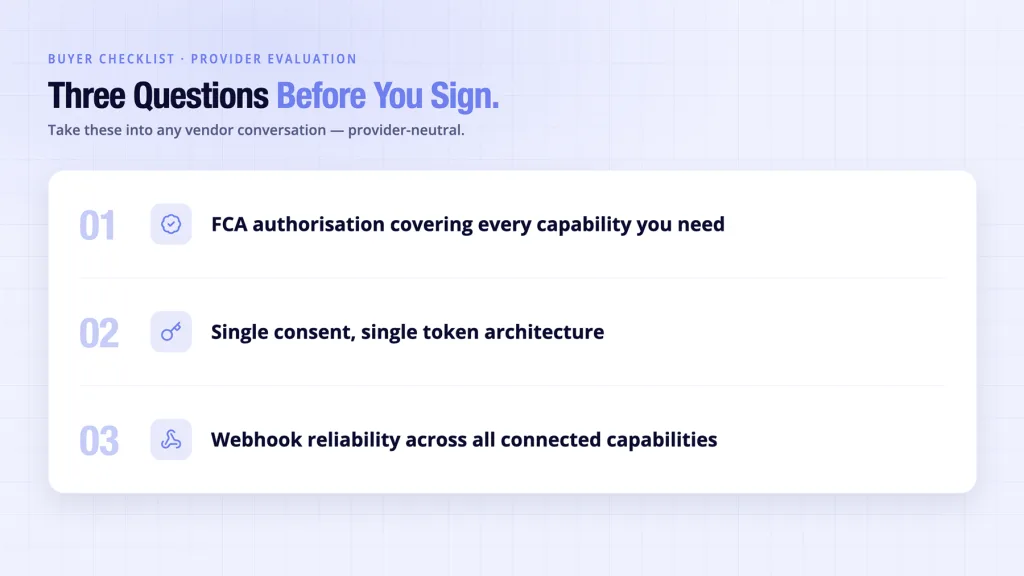
Not every provider among the available open banking api providers supports combined capabilities under one integration, and this is where most scoping mistakes surface late in a build rather than early. Any open banking API UK evaluation should start with these three factors, since they determine whether a given open banking api provider fits a combined-capability problem or only a single-feature one.
- FCA authorisation covering every capability you need: Some open banking api providers hold authorisation for AIS but resell PIS through a third party, adding latency and a second point of failure.
- Single consent, single token architecture: If AIS and PIS require separate authentications, your engineering overhead doubles, and your customer sees two separate bank login screens instead of one.
- Webhook reliability across all connected capabilities: A payment webhook and a transaction-refresh webhook should behave identically in retry logic, not follow inconsistent standards depending on which capability triggered them.
Comparing open banking providers against these three factors narrows the field faster than working through a generic feature checklist, since it forces the comparison back to the specific problem row identified earlier.
How Does Finexer Address These Combined-Capability Gaps?
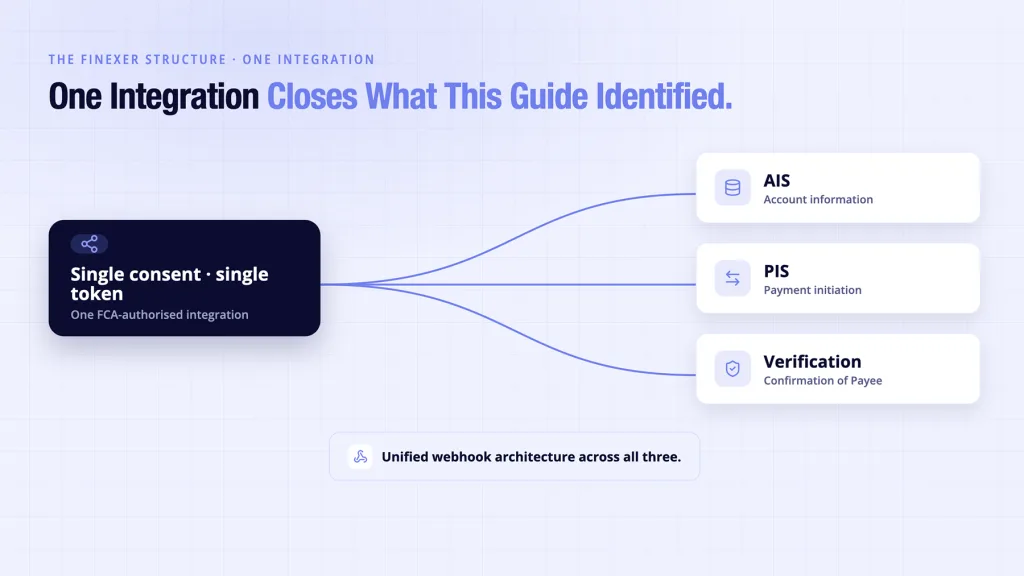
Most open banking API solutions on the market solve one problem well and leave the second half of a combined workflow for the platform to build separately. A basic open banking aggregator stops at data retrieval; it was never built to also initiate payments or verify account holders. Finexer closes that gap directly.
- One FCA-authorised integration covers AIS, PIS and Verification together, so reconciliation, collection and fraud-prevention workflows share a single consent and token.
- Built-in enrichment on account data helps turn raw merchant information into clean, categorised transaction data, without needing a separate normalisation layer.
- Unified webhook architecture across all three capabilities, so payment status and account refresh events follow the same reliability model.
- Finexer Data supports the combined AIS-plus-enrichment pattern described above out of the box, closing the most common reconciliation gap platforms hit mid-build.
- 99% UK bank coverage across major and challenger banks.
- Usage-based pricing that scales with transaction volume.
- White-label consent journeys that match your product experience.
- Sandbox access and developer documentation to speed up implementation.
- 3 – 5 week onboarding assistance for most UK platforms.
See open banking api use cases for how these capabilities apply across accounting, payroll and proptech platforms specifically.
The Bottom Line
Open banking api solutions are not chosen by feature count; they are chosen by matching the right capability, or combination, to the problem in front of you. Reconciliation needs AIS plus enrichment. Cost reduction needs PIS built on account-to-account rails. Fraud prevention needs verification layered on payment initiation. Most platforms discover this only after picking a single-capability open banking aggregator and hitting a wall mid-build. Scope the problem first, then evaluate open banking api providers against combined-capability support, not isolated features.
What Is The Difference Between Open Banking Platforms And Open Banking API Solutions?
Open banking platforms are the software layer, dashboards and reporting. Open banking api solutions are the underlying capabilities, AIS, PIS and verification, that power them.
Are Open Banking Services The Same As Payment Initiation?
No. Open banking services is a broader term covering account data, payment initiation and identity verification together. Payment initiation is one specific service within that category, focused solely on moving money between accounts.
Do Open Banking API Solutions Require Separate Contracts For Each Capability?
Not with every provider. Some open banking api providers require separate agreements for AIS and PIS, which increases both cost and integration time. Providers offering all capabilities under one FCA-authorised agreement, like Finexer, avoid this duplication.
Can Open Banking API Solutions Replace Manual Reconciliation Entirely?
They remove the manual data-gathering step but do not replace the matching logic itself. Your platform still needs rules that map transactions to invoices; open banking api solutions simply supply clean, reliable data for those rules to run against.
Is Open Banking API UK Regulation Different From Other Markets?
Yes. Open banking API UK activity is governed by the FCA under the Data (Use and Access) Act 2025, with its own authorisation and consent standards. Providers authorised elsewhere in Europe under PSD2 equivalence still need separate UK-specific FCA authorisation to operate here.
Ready to combine AIS, PIS and Verification under one integration? See how Finexer maps to your specific business problem.
Explore with AI
About the Author

Ravi Ranjan
Ravi Ranjan is Co founder & CEO of Finexer