
Your customer is at the checkout. Instead of entering a 16-digit card number, they tap one button, confirm with Face ID, and the payment lands in your account instantly. No card network. No intermediary. No chargeback risk. That is open banking payment initiation working exactly as designed.
Open banking payment initiation is the mechanism that makes this possible -a regulated process under PSD2 where a licensed third party starts a payment directly from a customer’s bank account on their instruction. It is one of the two core capabilities of Open Banking UK, and it fundamentally changes how money moves between buyers and sellers.
If you want to understand how it works under the hood, this guide covers the full mechanism, what a payment initiation service can and cannot do, and what to look for when choosing a provider.
Key Takeaways
- Open banking payment initiation uses a licensed PISP to start a payment from a customer’s bank -the PISP never holds or touches the funds
- Settlement is instant via Faster Payments; the payment goes directly from the customer’s bank to yours
- Strong customer authentication (SCA) is built into every payment, making it more secure than card entry
- PIS and AIS are the two halves of Open Banking UK: PIS initiates payments, AIS reads account data
What Is Open Banking Payment Initiation?
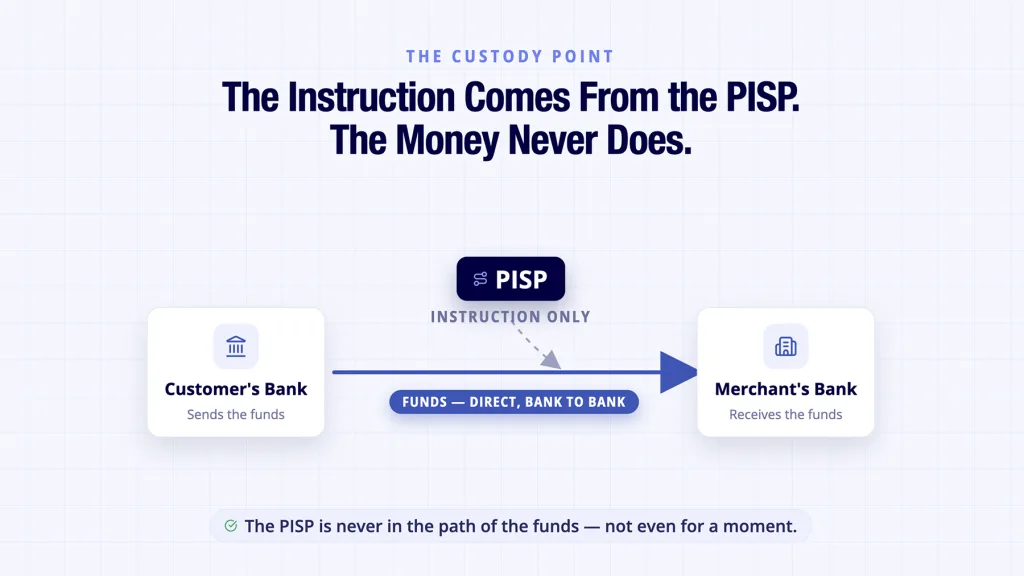
Open banking payment initiation is the process of starting a bank payment on behalf of a customer using a regulated third-party provider. Under PSD2 regulation in the UK, this third party is called a Payment Initiation Service Provider (PISP). The payment initiation service works by connecting your checkout to the customer’s bank -with their explicit consent -and instructing the bank to send a payment.
The key point most explanations miss: a PISP payment never involves the PISP holding funds. The money travels directly from the customer’s bank to the merchant’s bank. The payment initiation service only sends the instruction. It never touches the actual money. For a broader commercial overview, see open banking payments.
This is what makes open banking payment initiation fundamentally different from card processing, where funds flow through multiple intermediaries before reaching the merchant.
For a detailed regulatory breakdown, see psd2 regulation UK.
PIS vs AIS: The Two Halves of Open Banking UK
Open Banking UK is built on two permission types:
| Permission | Type | What It Does | Who Provides It |
|---|---|---|---|
| PIS | Write | Initiates payments from a bank account | PISP |
| AIS | Read | Reads account data and transaction history | AISP |
A payment initiation service (PIS) has write access: It can instruct a bank to send money. Account Information Services (AIS) has read-only access: it can retrieve data but cannot move funds. Many providers hold both licences, but they are separate regulatory permissions.
For a full breakdown, see aisp vs pisp.
How Does a PISP Payment Work Step by Step?
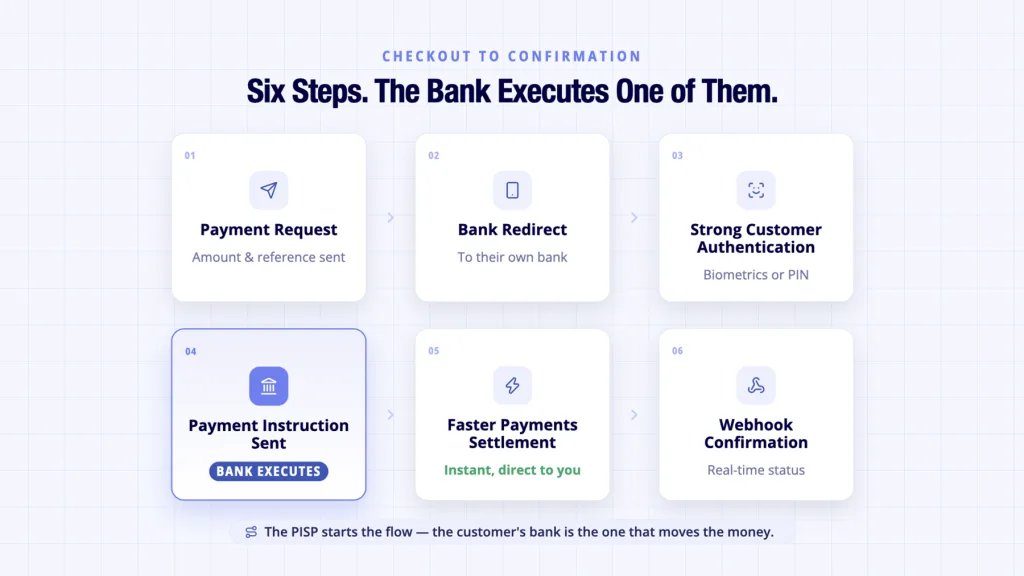
This is the mechanism competitors consistently fail to explain clearly. Here is exactly how open banking payment initiation flows from checkout to confirmation:
Step 1: Payment Request
Your platform sends a payment request to the payment initiation service provider (PISP), specifying the amount, recipient account, and reference.
Step 2: Bank Redirect
The customer is redirected to their bank’s authentication interface. This is not a third-party screen -it is the customer’s actual bank, the same environment they use for online banking.
Step 3: Strong Customer Authentication
The customer completes strong customer authentication (SCA) -typically biometrics (Face ID, fingerprint) or a PIN. Strong customer authentication at the bank level is more secure than card entry because the customer is authenticating directly with their bank, not submitting card details to a third party.
Step 4: Payment Instruction Sent
Once the customer confirms, the PIS sends the payment instruction to the bank via the Open Banking API. The bank validates the instruction and executes the transfer.
Step 5: Faster Payments Settlement
The payment moves via Faster Payments -instant via Faster Payments, directly from the customer’s account to yours. No card network, no settlement delay.
Step 6: Webhook Confirmation
Your platform receives a webhook confirming payment status. This is where good payment initiation service providers separate from poor ones: reliable webhooks fire per payment in real time. Batched or delayed confirmation means you don’t know payment status until hours later.
For details on payment authentication standards, see our dedicated guide.
What Can You Use Pay by Bank UK For?
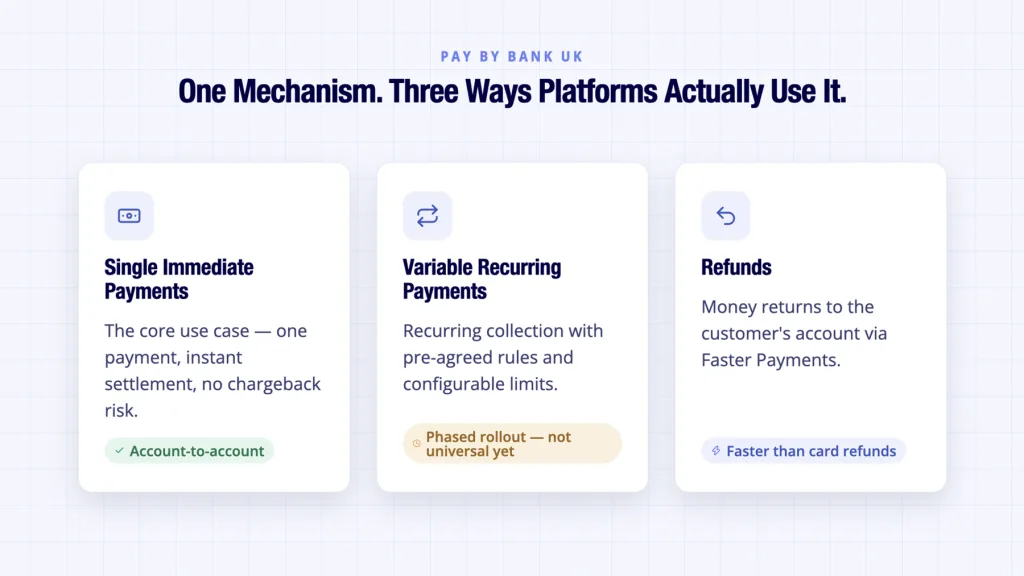
Pay by Bank UK is the consumer-facing name for open banking payment initiation at checkout. It applies across several use cases:
Single Immediate Payments
The core use case. A customer pays an invoice, completes a purchase, or makes a top-up. One PISP payment, instant settlement, no chargeback risk. Unlike card payments, these are account-to-account payments with no intermediary network involved.
Variable Recurring Payments (VRP)
VRP uses PIS to collect recurring payments with pre-agreed rules -similar to Direct Debit but with real-time settlement and configurable limits. In Open Banking UK, VRP is in phased commercial rollout. It is not universally available yet.
Refunds
A payment initiation service can initiate refunds back to the customer’s bank account via Faster Payments. Refunds land in the customer’s account faster than card refunds, which typically take 3-5 business days.
For small business applications, see payment initiation services.
What Should You Look for in a Payment Initiation Service Provider?
Most providers list the same features. These are the criteria that actually matter:
| Criterion | What to Check | Red Flag |
|---|---|---|
| FCA Authorisation | Must hold PISP licence on the FCA Register, verify independently | Website badge without a valid FRN |
| UK Bank Coverage | Does it support your customers’ banks (including challengers)? | Thin coverage on business or challenger accounts |
| Webhook Reliability | Per-payment real-time webhooks, not batch | Hourly or daily batch delivery |
| Error Handling | Clear error codes for failed or declined payments | Generic “payment failed” with no detail |
| SCA Compliance | Full strong customer authentication flow built in | SCA optional or incomplete |
| Custody Clarity | Explicit confirmation the PISP never holds funds | Vague settlement descriptions |
Selecting payment initiation service providers on these criteria rather than feature lists reduces integration risk significantly. For a full technical checklist, see what to look for in a Pay by Bank provider.
How Does Finexer Handle Open Banking Payment Initiation?
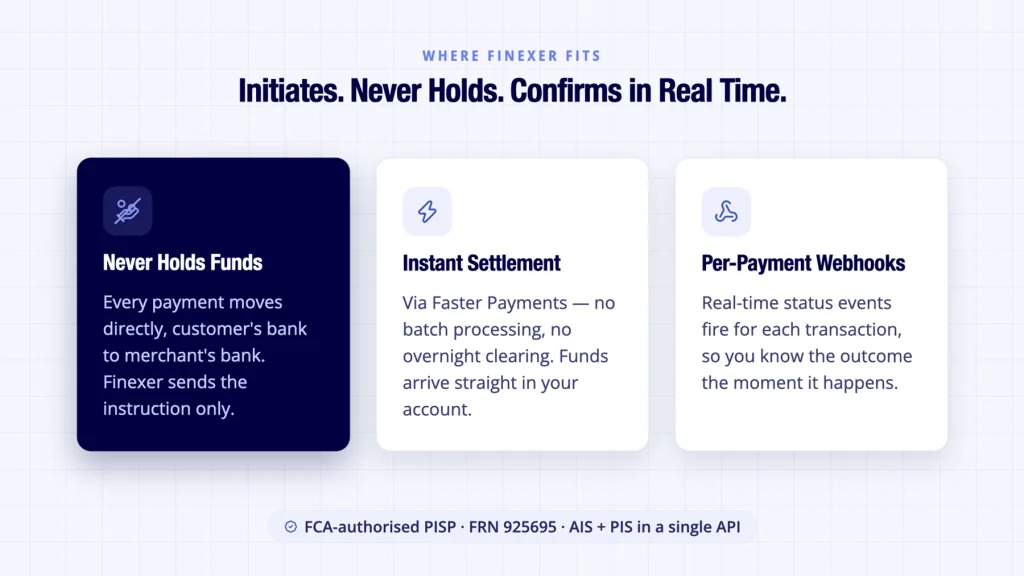
Finexer is an FCA-authorised PISP (FRN 925695) operating under the Payment Services Regulations 2017. Here is where Finexer specifically fills the gaps most payment initiation service providers leave open:
- Never holds funds: Every PISP payment through Finexer goes directly from the customer’s bank to the merchant’s bank. Finexer sends the instruction only
- Instant settlement via Faster Payments: No batch processing, no overnight clearing -funds arrive in your account directly
- Per-payment webhooks: Real-time status events fire for each transaction, so you know payment outcomes the moment they happen
- Strong customer authentication built in: SCA is embedded in every open banking payment initiation flow, not optional
- 99% UK bank coverage: Consumer, business, and challenger accounts supported across almost all major UK banks
- AIS + PIS in a single API: Data and payments in one integration; no need to manage two providers
- PCI DSS-compliant infrastructure: Secure by design, with banking credentials kept separate from the data Finexer retrieves and processes
- 3-5 weeks onboarding assistance: Purpose-built for mid-market SaaS and fintech platforms; not an enterprise-only product
- Transparent pricing (no hidden charges): Based on direct, one-to-one bank connections.
As of March 2026, Open Banking UK processed 37.46 million payments monthly, with 17.94 million active user connections -confirming that open banking payment initiation is now mainstream infrastructure, not a niche alternative (Open Banking Limited, openbanking.org.uk/api-performance).
See Finexer Payments to explore how this integrates into your platform.
Conclusion
Open banking payment initiation is not a complicated mechanism once the custody point is clear: a payment initiation service sends the instruction, the bank executes it, and the money goes directly from customer to merchant. The PISP is never in the middle of the funds flow.
For platforms comparing providers, focus on webhook reliability, FCA authorisation, and bank coverage -these are the criteria that determine whether a PIS integration holds up at volume.
What is open banking payment initiation?
Open banking payment initiation is a regulated process where a licensed PISP instructs a bank to send a payment on behalf of a customer, with their explicit consent. The payment initiation service never holds the funds -the money moves directly from the customer’s bank to the merchant’s bank via Faster Payments.
Is a PISP payment safe?
Yes. Every PISP payment includes strong customer authentication at the bank level -typically biometrics or a PIN. Because customers authenticate directly with their bank, PIS is more secure than card payments where card details are entered into third-party forms. Finexer as an FCA-authorised PISP (FRN 925695) operates under PSD2 and the Payment Services Regulations 2017.
What is the difference between PIS and AIS?
PIS (Payment Initiation Services) has write permission: it can instruct a bank to send money. AIS (Account Information Services) has read permission: it can retrieve transaction data and account balances but cannot move funds. Many platforms use both. For a full comparison, see aisp vs pisp.
How does Pay by Bank UK differ from a regular bank transfer?
Pay by Bank UK is automated open banking payment initiation: the customer selects their bank, authenticates, and confirms -all within your checkout. A regular bank transfer requires the customer to manually enter your account details into their banking app. The outcome (Faster Payments) is the same, but the experience is entirely different.
Can a payment initiation service provider refund payments?
Yes. A payment initiation service can initiate a refund back to the customer’s account via Faster Payments. Refunds settle faster than card refunds (which take 3-5 business days via card networks). The refund goes from your account directly to the customer’s bank.
Finexer is FCA-authorised (FRN 925695) as both AISP and PISP. Start with a sandbox or speak to our team about your integration.
Explore with AI
About the Author

Ravi Ranjan
Ravi Ranjan is Co founder & CEO of Finexer