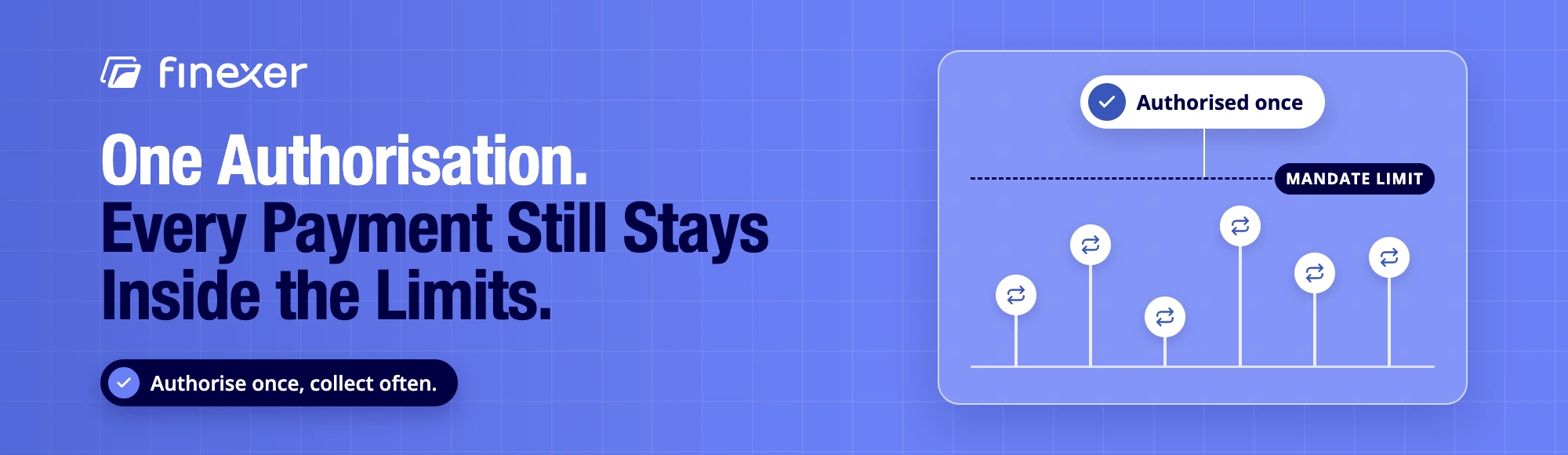
How does VRP work? A customer gives one authorisation for future payments within agreed limits, so a business can collect on a schedule without asking for approval every time. That’s the entire mechanism. Variable recurring payments open banking is not a new payment rail. It’s a consent structure sitting on top of the UK’s existing open banking infrastructure, and it’s the part of the market moving fastest right now.
Key Takeaways
- Variable recurring payments open banking lets a customer give one authorisation covering future payments within agreed limits, so a business collects without re-approval each time.
- There are two categories: sweeping, which moves money between a customer’s own accounts, and commercial, which pays a third-party business.
- A VRP mandate sets a maximum amount per payment, a cumulative amount limit, a frequency limit and a validity period, and the customer can revoke it at any time.
- Commercial VRP is the expansion the market is working toward, with the FCA welcoming the UK Payments Initiative (UKPI) as an industry-led framework in June 2026.
- Finexer Payments supports VRP for recurring collection with near-real-time settlement via Faster Payments.
What Is Variable Recurring Payments Open Banking?
Open banking variable recurring payments let a third party initiate multiple payments from a customer’s bank account, inside limits the customer set once. No blank cheque.
Every payment has to fit inside the boundaries the customer agreed to, and the customer can pull consent at any time. That’s the whole model that makes variable recurring payments open banking different from a standing instruction: it’s bounded, revocable, and programmatic.
For the pillar view of how this fits into open banking payments UK more broadly, that guide covers the wider payment landscape this sits inside.
How Does a VRP Mandate Actually Work?
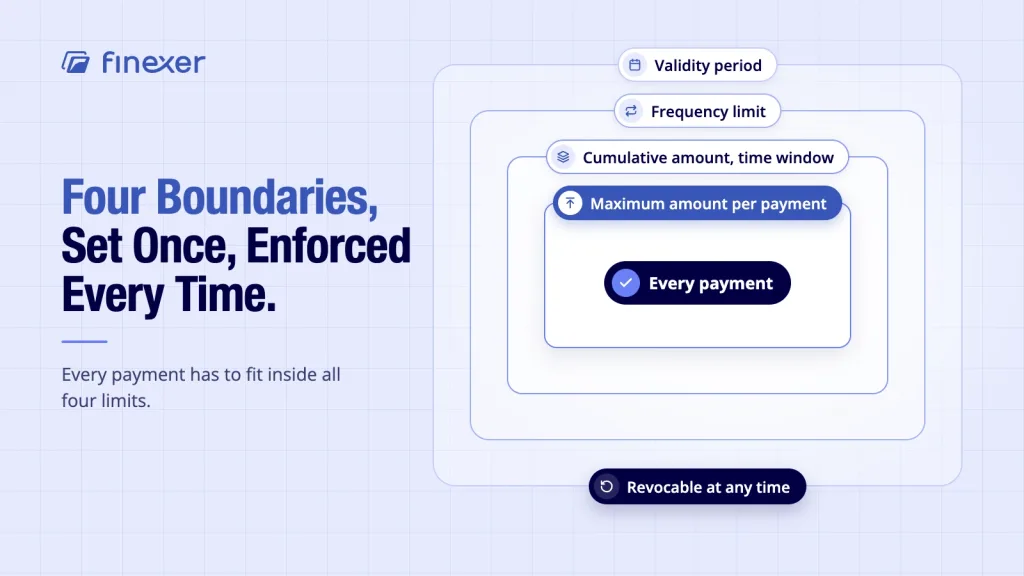
How does VRP work at the mandate level, specifically? A VRP mandate is set up once, through the customer’s own bank, using the same open banking payment initiation flow behind any bank-authorised payment.
Four parameters define what the business can and can’t do afterward, and together they are what makes variable recurring payments open banking safe by design rather than by policy:
- Maximum Amount Per Payment: The single largest sum any one payment can take.
- Cumulative Amount / Time Window: The total amount allowed within a specified period (e.g., £500 per month).
- Frequency Limit: How often a payment can be collected within a given period.
- Validity Period: How long the mandate stays active before it needs renewal.
Every subsequent payment has to fit inside all four. The customer can revoke at any time, directly through their bank’s consent-management interface, without involving the business.
Sweeping VRP vs Commercial VRP: What’s the Difference?
Variable recurring payments open banking splits into two distinct categories, and mixing them up is the most common mistake in this space.
| Point of Distinction | Sweeping VRP | Commercial VRP |
|---|---|---|
| Moves money to | The customer’s own other account | A third-party business |
| Mandated for the CMA9 | Yes | No, voluntary |
| Typical use | Savings automation, overdraft cover | Subscriptions, variable billing |
| Where it stands today | Live and established | Expanding; framework progressing toward rollout |
Sweeping VRP has been mandated for the UK’s nine largest banks since 2022. Commercial VRP is the expansion the market has been working toward.
In June 2026, the FCA welcomed the launch of the UK Payments Initiative (UKPI), an industry-led initiative established by 31 firms including all major UK retail banks, specifically to support commercial VRP framework development. The FCA expects the first commercial VRP scheme to launch following this groundwork.
Is VRP the Same as Direct Debit? How Does It Compare to Cards?
Is VRP the same as Direct Debit? No. They solve a similar problem through different mechanics and consent structures.
| Point of Distinction | VRP | Direct Debit | Card-on-file |
|---|---|---|---|
| Authorisation | Bank-authenticated mandate with customer-set limits | Signed mandate (paper or electronic) | Stored card token |
| Customer revocation | Customer can revoke their VRP consent at any time through their bank’s consent-management interface | Customer can cancel via their bank, building society, or by contacting the business | Contact business or card issuer |
| Settlement | Near-real-time via Faster Payments | Follows collection timetable (usually within 5 business days) | Depends on acquirer (typically 1-3 business days) |
| Amount flexibility | Variable, within agreed limits set by the customer | Variable or fixed; advance notice given for changes (UK Direct Debit scheme) | Fixed or variable by provider |
| Common failure cause | Revoked consent, limit reached | Insufficient funds, cancelled mandate | Expired card, issuer decline |
Key differences: The consent structure differs markedly. VRP is bank-authenticated with upfront customer-set limits; Direct Debit is a signed mandate where the biller must give advance notice of changes. VRP revocation flows directly through the bank’s consent system; Direct Debit can be cancelled through the bank, building society, or via the biller. Settlement timing also differs: VRP moves money within minutes, while Direct Debit follows the scheme’s collection cycle.
Where Does Open Banking Variable Recurring Payments Fit Best?
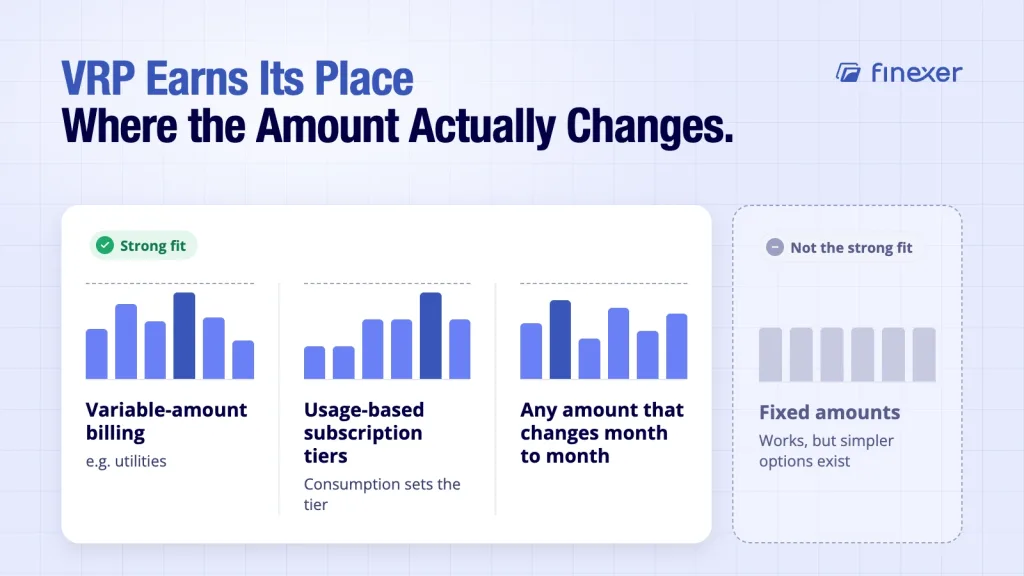
Variable recurring payments open banking earns its place wherever the billed amount genuinely changes, not just where a recurring charge exists. Open banking variable recurring payments work best in these three cases, and open banking variable recurring payments underperform outside them:
- Variable-amount billing, such as utilities, where the amount owed changes with usage rather than sitting at a fixed figure.
- Subscription billing with usage-based tiers, where the amount changes month to month based on consumption.
- Any case where the amount changes, and the customer would otherwise need to re-authenticate each time the figure moves (as opposed to receiving advance notice, as with Direct Debit).
For the commercial case around reducing failed payments and involuntary churn specifically, our dedicated guide to VRP paymentscovers that angle directly. If you’re comparing collection mechanisms more broadly, including Direct Debit bureaux and card platforms side by side, see our recurring payment solutions comparison.
What Should Platforms Get Right When Implementing VRP?
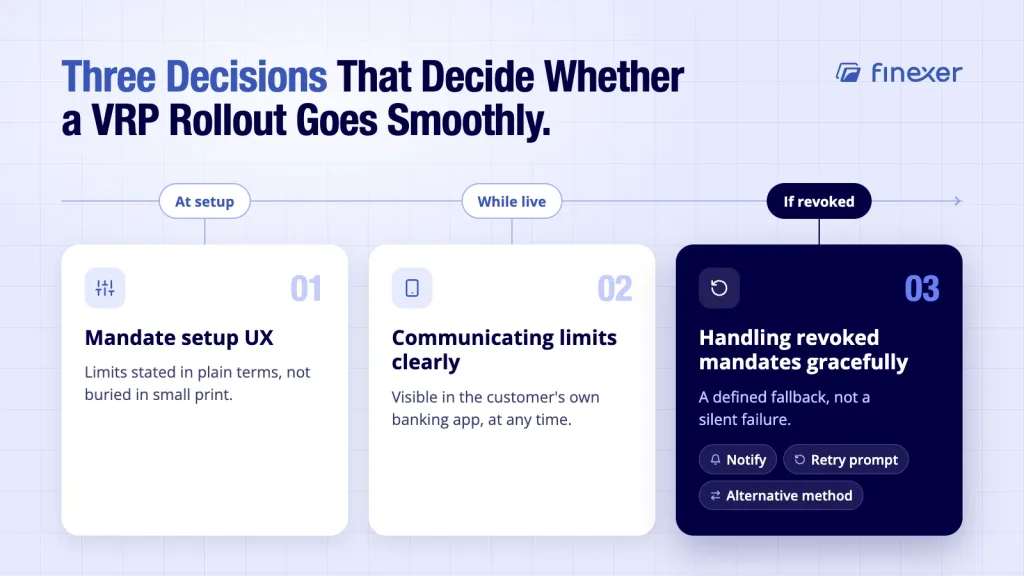
Three practical points decide whether a VRP rollout goes smoothly:
- Mandate Setup UX: The limits being agreed to should be stated in plain terms during setup, not buried in small print the customer skims past.
- Communicating Limits clearly: Customers should always be able to see, in their own banking app or consent-management interface, exactly what they’ve authorised and for how long.
- Handling Revoked Mandates Gracefully: A revoked mandate needs a defined fallback: a notification, a retry prompt, or an alternative collection method, not a silent failed payment.
Where Does Finexer Fit for VRP?
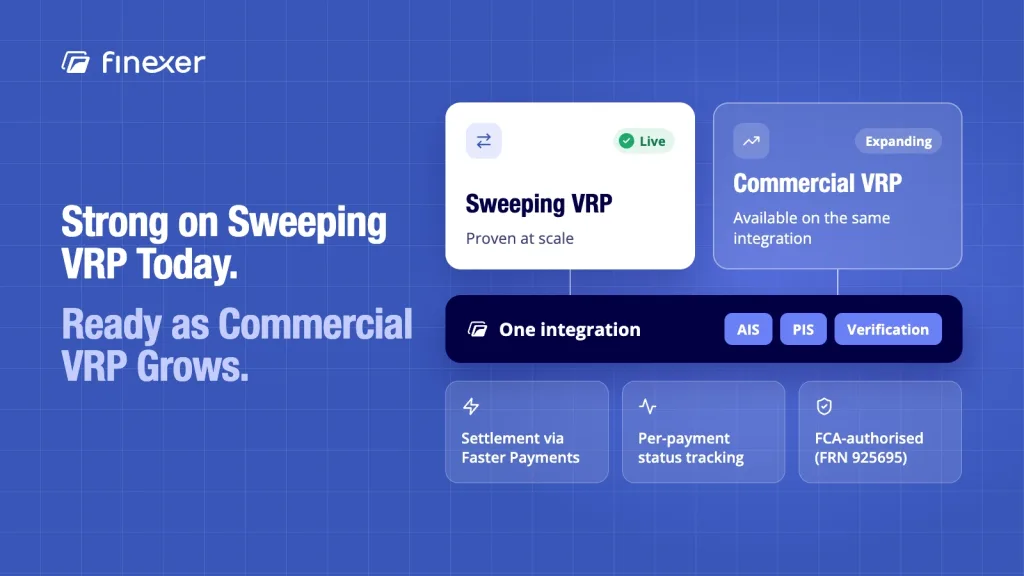
Finexer supports VRP as part of variable recurring payments open banking for recurring collection through Finexer Payments, with near-real-time settlement via Faster Payments and per-payment status tracking. Open banking variable recurring payments implemented this way sit inside the same integration as everything else on the platform. What sets that apart from the wider market:
| Factor | Finexer |
|---|---|
| VRP support | VRP support available; commercial VRP availability depends on use case and bank coverage |
| Settlement | Near-real-time via Faster Payments |
| Integration | AIS, PIS and verification in one API |
| Authorisation | FCA-authorised (FRN 925695) |
| UK bank coverage | Most of the UK banks |
| Pricing | Transparent pricing with no hidden charges |
The table above is open banking variable recurring payments in practice, not theory.
Commercial VRP is early for the whole market, not just for Finexer. Some providers, like Yapily, have publicly named early commercial launches, such as their Ant International/HungryPanda partnership (launched in 2024). Finexer’s VRP support today is proven at scale on sweeping VRP, with commercial VRP available on the same integration as the market develops.
Finexer’s distinction is different: VRP sits inside one FCA-authorised integration alongside account data and verification, rather than as a standalone payments product bolted onto a separate data layer.
For platforms already handling reconciliation, banking data and payments across separate vendors, that consolidation is often the bigger operational win than the payment rail itself.
Bottom Line
Variable recurring payments open banking gives businesses a bank-authenticated way to collect variable amounts without repeated customer approval, bounded by a mandate the customer controls completely. Sweeping VRP is mandated and mature. Commercial VRP is the expansion in motion, with the FCA welcoming UKPI as the industry-led framework in June 2026, with the first commercial scheme expected to follow.
Compared to Direct Debit and cards, VRP offers distinct advantages in settlement speed, consent control, and use-case fit- each mechanism has its place depending on the payment pattern and customer base. Finexer supports VRP as part of one FCA-authorised integration covering account, balance, transaction data, payments and verification together, so platforms get the collection mechanism without adding a separate vendor.
How does VRP work in practice?
A customer authorises a mandate once, through their own bank, setting a maximum amount, frequency and validity period. The business then collects within those limits without asking for fresh approval each time, and the customer can revoke consent directly through their banking app.
Is VRP the same as Direct Debit?
No. Both are recurring collection methods, but VRP is bank-authenticated with customer-set limits and instant settlement, while Direct Debit relies on a signed mandate and a slower collection timetable. Cancellation also differs: VRP revokes unilaterally through the bank, Direct Debit typically routes through the business.
What is commercial VRP and is it live yet?
Commercial VRP lets a business collect payments from a customer’s bank account, distinct from sweeping, which only moves money between a customer’s own accounts. Sweeping is mandated for the CMA9. Commercial VRP participation is currently voluntary, though the UK Payments Initiative is actively working toward a wider commercial scheme.
Can a customer stop a VRP payment at any time?
Yes. The customer can revoke a VRP mandate directly through their own banking app at any point, without needing to contact the business collecting the payment. This is one of the clearest differences from Direct Debit, where cancellation usually involves the business or a bank dispute.
Does variable recurring payments open banking work for fixed amounts too?
It can, but it’s built for variable amounts specifically. If your billing is genuinely fixed every cycle, Direct Debit or card-on-file may be simpler. VRP earns its advantage where the amount owed changes and re-authentication would otherwise be required.
Near-real-time, bank-authenticated recurring collection with customer-controlled limits, built into one FCA-authorised API.
Explore with AI
About the Author

Ravi Ranjan
Ravi Ranjan is Co founder & CEO of Finexer