Settled and Matched
Unique references on every invoice payment.
An invoice can look paid in your system while still sitting open in your books. The difference often comes down to whether the money cleared against the right invoice.
To settle the invoice means paying the full amount owed, which means the balance reaches zero and the invoice can close. To settle invoice balances correctly, distinguish payment from settlement and reconciliation.
TL;DR: Sending money alone does not settle the invoice. The full amount must arrive, the payment must point to the correct invoice and the record must be matched in the ledger. A partial payment is not a settled invoice, while a settled payment can still await reconciliation.
Why the distinction matters
Finance teams work with money, references, statuses and records that must agree before they can settle the invoice.
Open Banking Limited recorded 42.03 million payments in August 2026, up 1.9% over July, and 2.97 billion API calls.
Paid, settled or reconciled?
These terms describe different points in the payment lifecycle.
| Status | What it means | Example |
|---|---|---|
| Paid | Money has been sent | £1,000 payment initiated |
| Settled | The full £1,000 has arrived and the balance is zero | Invoice can be closed |
| Reconciled | The payment has been matched to the correct invoice in the ledger | Invoice and bank record agree |
An invoice may be marked paid after a payment is sent, but £800 against a £1,000 balance does not settle the invoice. It may also be settled but unreconciled if the £1,000 has arrived and nobody has matched it to the invoice.
For the wider workflow, see our invoice processing guide.
How does an invoice get settled?
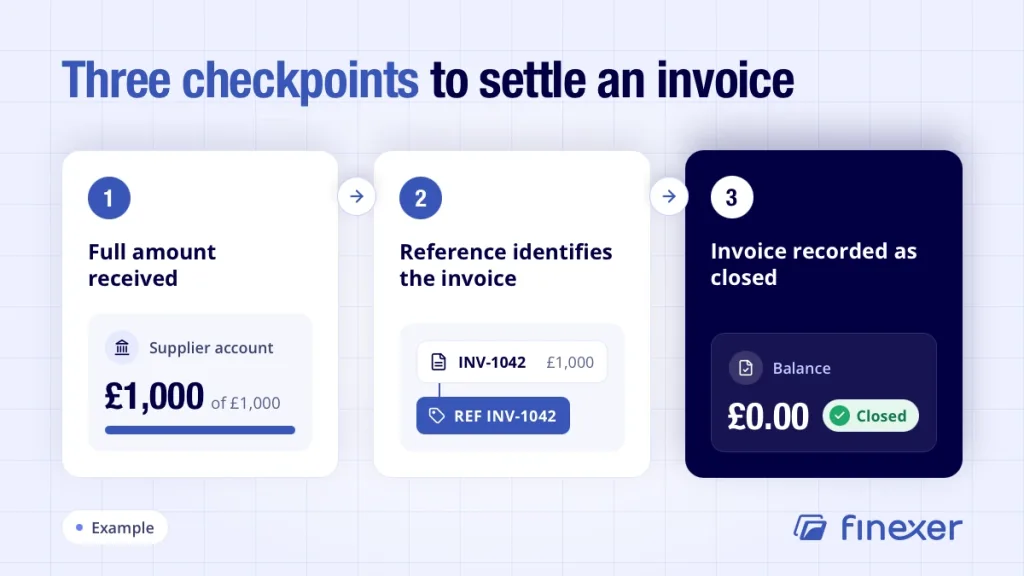
To settle the invoice, the process passes three checkpoints:
- The supplier receives the full amount owed.
- The payment reference identifies the invoice.
- The supplier records the invoice as closed.
Miss the second checkpoint and the money can reach the right account while the finance team still cannot tell which invoice it belongs to. Without that link, nobody can settle the invoice with confidence.
A reference can matter almost as much as the payment itself.
Why does the payment reference matter?
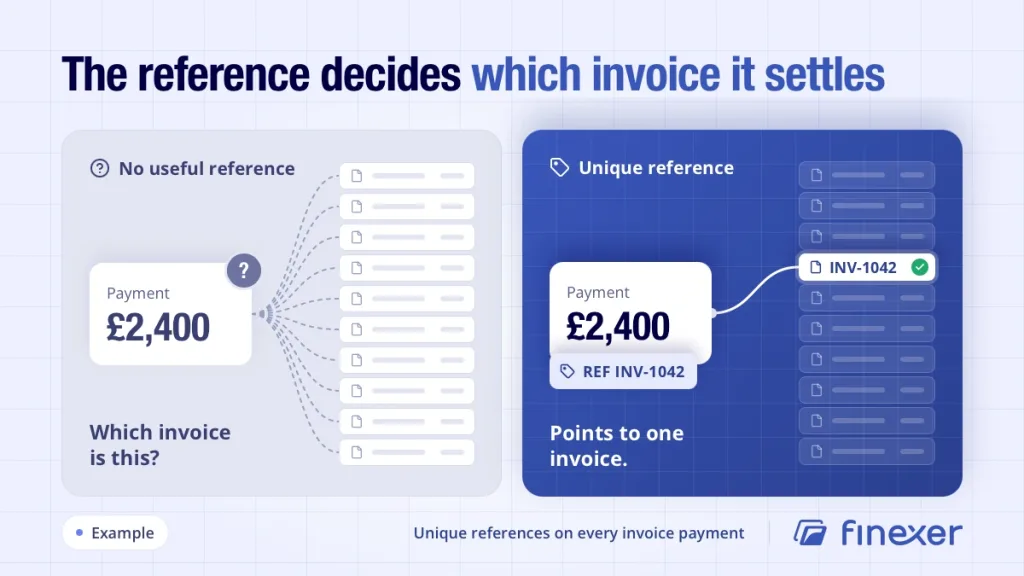
Imagine 10 open invoices sit in one supplier account. A £2,400 payment arrives with no useful reference.
The money is real, but the invoice remains open. With no reference or a wrong one, nobody knows which invoice the money settles, so it sits unreconciled and someone chases an invoice that has already been paid.
A wrong reference creates a similar problem. The payment may be matched to the wrong invoice, leaving one account apparently overpaid and another apparently overdue.
This is where invoice payment details matter. Clear payment instructions make the intended invoice easier to identify, which helps suppliers settle invoice balances faster.
What if the customer pays only in part?
A partial payment does not settle the invoice and should remain visible as a partial payment. If an invoice is £1,000 and £750 arrives, forcing the match would close the invoice while £250 pounds is still owed.
An overpayment also needs flagging: £1,100 against a £1,000 invoice clears the balance but leaves £100 to handle under the business’s normal process.
Settled is not reconciled
The settlement answers the question “Has the full amount arrived?” Reconciliation answers the question “Has that amount been matched to the right record?”
That is why payment reconciliation deserves its own step. Matching turns a bank movement into an accounting record that teams can audit.
How Finexer fits into invoice settlement
For platforms handling invoice payments, the difficult part is often preserving the reference and payment data needed to link a transaction to the right record and settle the invoice correctly.
Finexer attaches a unique reference to each invoice payment and supplies the payment and Account Information Service (AIS) data the platform uses to match it. The platform builds the workflow and matching logic that help its users settle invoice payments, while Finexer supplies the FCA-authorised API and event layer.
With Finexer Payments, platforms can initiate account-to-account payments that settle via Faster Payments. The invoice-linked payment carries a unique reference for the receiving system.
Finexer is FCA-authorised as an Authorised Payment Institution under the Payment Services Regulations 2017, FRN 925695.
Relevant points include:
- Unique references attached to invoice payment requests
- AIS-based matching of received payments
- Received and matched payment statuses
- Exception states for partial, overpaid, failed and expired cases
- Almost all major UK banks covered
Does settling an invoice mean the same thing as paying it?
Not always. Paying can describe money being sent, while settling means the full amount has arrived and cleared the outstanding balance. Finance teams benefit from keeping those states distinct.
Can an invoice be settled but not reconciled?
Yes. The full payment can arrive and bring the balance to zero before anyone matches the transaction to the correct invoice in the ledger. The invoice is settled, but the record needs reconciliation.
Final takeaway
To settle the invoice, think beyond the payment itself. The amount, reference and accounting record all need to point to the same obligation.
For platforms handling invoice payments, that distinction can separate a transaction that merely arrived from one that finance teams can confidently close.
See how Finexer’s Invoice Tracker attaches a unique reference to every invoice payment. So settled invoices match back to your ledger without manual searching.
Explore with AI
About the Author

Ravi Ranjan
Ravi Ranjan is Co founder & CEO of Finexer