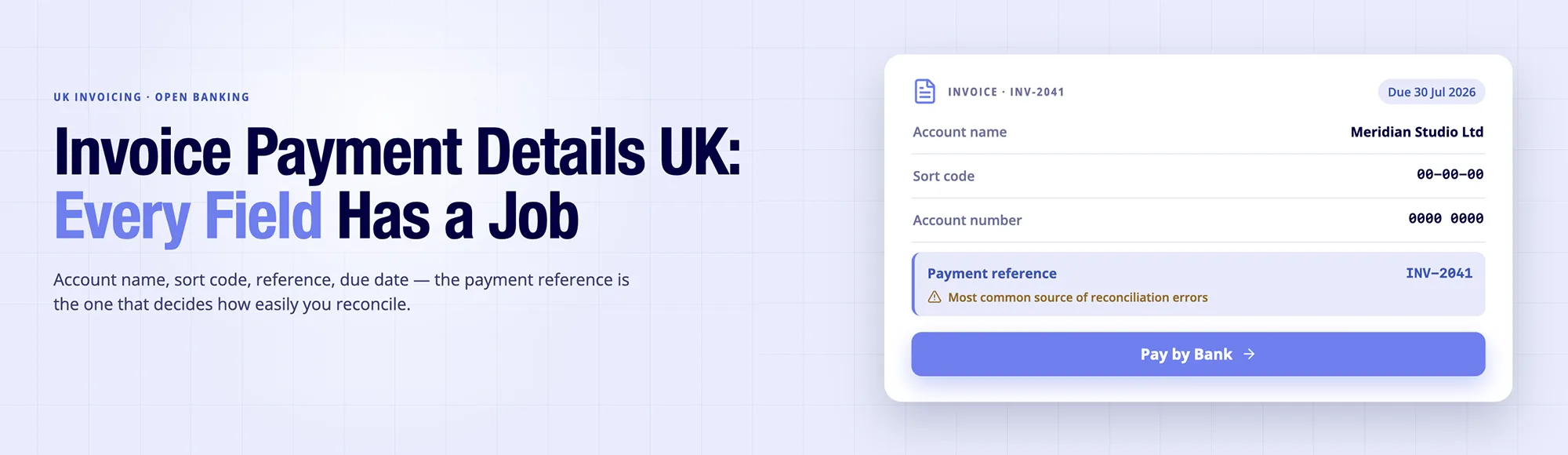
Get Invoice Payments Right the First Time
See how Finexer’s Open Banking infrastructure helps accounting and invoicing platforms generate Pay by Bank payment links with the correct bank details and invoice reference pre-filled, reducing payment errors and making reconciliation easier.
At Finexer, we work with UK accounting platforms, invoicing software providers and finance technology businesses embedding Open Banking into invoice payment and reconciliation workflows. Across these implementations, we repeatedly see the same operational issue: businesses spend unnecessary time resolving payment queries caused not by unpaid invoices, but by incorrect or manually entered payment information.
This guide explains which invoice payment details every UK invoice should contain, why payment references matter beyond simply receiving money, and how Open Banking changes the payment journey without replacing existing accounting software.
TL;DR: A correctly paid invoice can still become a reconciliation problem if customers enter the wrong bank details or payment reference. Drawing on Finexer’s experience supporting UK payment infrastructure for accounting and invoicing platforms, this guide explains the invoice payment details businesses should include, why invoice bank details affect payment matching, and how Open Banking Pay by Bank reduces manual payment errors while working alongside existing accounting software.
“The invoice itself is rarely the problem. Most payment delays happen because customers re-enter bank details manually or use the wrong payment reference. Small mistakes at payment initiation often create much larger reconciliation problems later.” Ravi, Business, Finexer
Every Delay Doesn’t Start With a Late Payer
Most businesses assume an invoice remains unpaid because the customer hasn’t acted.
In reality, many payment delays begin much earlier.
A buyer is ready to pay but cannot find the correct bank details. Another mistypes the payment reference while making a bank transfer. Someone else emails asking for the account number again because the invoice has already been filed away. None of these customers intended to delay payment, yet every mistake creates extra work for finance teams trying to identify incoming funds and close outstanding invoices.
Getting the invoice payment details right is one of the simplest ways to reduce these avoidable delays. As invoice volumes grow, accurate invoice bank details become just as important for reconciliation as they are for collecting payment.
What are invoice payment details?
Invoice payment details are the banking information and payment instructions that tell a customer exactly how to pay an invoice.
For most UK businesses, these details normally include:
- Account name
- Sort code
- Account number
- Payment reference
- Invoice amount
- Payment due date
- Accepted payment method
Without these details, customers may not know where to send payment or which invoice the payment relates to.
The payment reference deserves particular attention. While sort code and account number ensure the money reaches the correct bank account, the reference allows finance systems to identify which outstanding invoice the payment settles.
What information must appear on a UK invoice?
UK businesses must include certain statutory information on invoices for accounting and tax purposes.
The exact requirements depend on business structure and VAT status, but most business invoices include:
- Business name
- Registered business address
- Company registration number where applicable
- VAT registration number where applicable
- Invoice number
- Invoice date
- Customer name
- Description of goods or services
- Amount due
- Payment terms
- Due date
- Bank payment details
These requirements arise from HMRC guidance and, where applicable, the Companies Act 2006. The bank details themselves are not always prescribed by legislation, but they are essential if payment will be made by bank transfer.
Clear payment instructions reduce unnecessary correspondence between buyers and suppliers.
Which invoice bank details should you include?
The invoice bank details section should make payment straightforward without requiring the customer to ask follow-up questions.
A typical UK invoice includes:
| Invoice bank detail | Purpose |
|---|---|
| Account name | Identifies the receiving account holder |
| Sort code | Directs payment to the correct bank branch |
| Account number | Identifies the specific receiving account |
| Payment reference | Links the incoming payment to the correct outstanding invoice |
| Payment due date | Shows when payment is expected |
| Accepted payment method | Tells the customer how to pay (bank transfer, Pay by Bank) |
Of these, the payment reference often has the greatest operational impact.
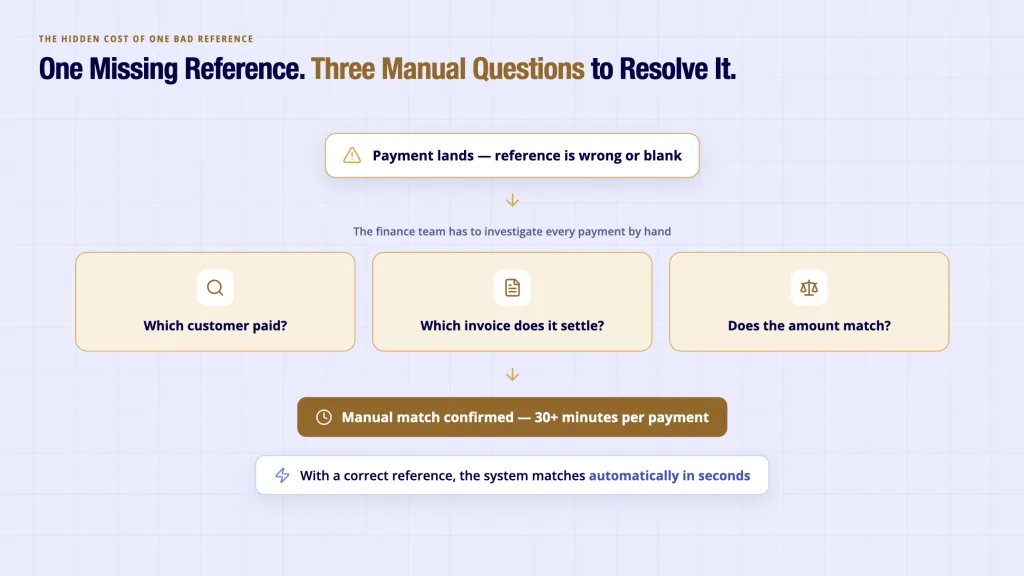
When customers enter an incorrect reference or leave the field blank, finance teams may need to investigate incoming payments manually before matching them to outstanding invoices.
This is why the payment reference plays an important role in the invoice matching process UK. Matching systems compare incoming payment references with invoice records to determine which invoice has been settled.
The two most common problems with manual invoice payments
Although bank transfers remain common across UK businesses, manual payment entry introduces two recurring problems.
Customers request bank details again
Even when invoices contain complete payment information, buyers frequently contact suppliers asking for bank details before making payment.
Every follow-up email delays settlement and increases administrative work.
Incorrect payment references
A payment may arrive in the correct account but carry the wrong reference.
The finance team then needs to determine:
- Which customer made the payment?
- Which invoice has been settled?
- Whether the payment amount matches an outstanding invoice.
As invoice volumes increase, these manual checks become increasingly time-consuming.
How does Open Banking Pay by Bank reduce invoice payment errors?
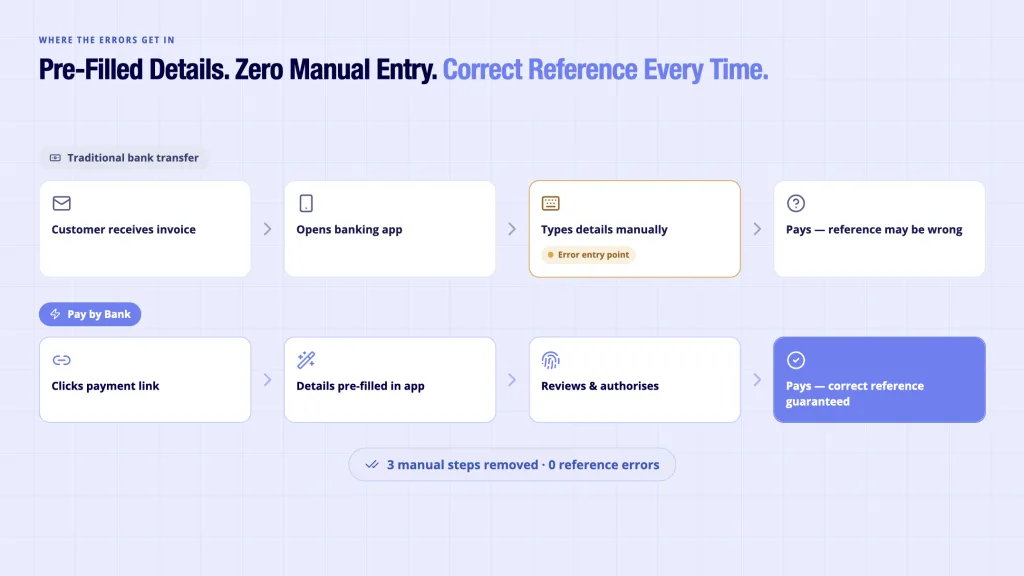
Traditional bank transfers depend on the buyer copying information from the invoice into their banking app. Even careful customers can mistype an account number, omit the payment reference or pay the wrong amount.
Open Banking offers a different payment journey.
Instead of manually entering payment information, the buyer clicks a payment link embedded in the invoice. The link securely redirects them to their own banking application, where the payment amount, payee details and reference are already completed.
The buyer reviews the information, authorises the payment with their bank and the payment is initiated without retyping any banking information.
Learn more about Pay by Bank and how it replaces manual bank transfers with customer-authorised account-to-account payments.
This approach helps reduce:
- Incorrect account numbers
- Missing or incorrect payment references
- Underpayments caused by manually entered amounts
- Buyer emails requesting bank details before making payment
It also gives platforms greater confidence that payments are initiated using exactly the information generated by the invoice.
How do requests to payment links work?
A modern invoice no longer needs to rely solely on printed bank details.
Using request to payment links, platforms can generate a secure payment request that contains:
- The correct receiving account
- The invoice amount
- The unique payment reference
- The payee information
The customer selects their bank, authenticates directly with the bank and authorises the payment. At no point does the platform see the customer’s online banking password or credentials.
For businesses issuing hundreds or thousands of invoices, reducing manual data entry also improves the quality of downstream reconciliation because each payment arrives with the intended reference.
How Does Finexer’s Open Banking Invoice Tracker support accurate invoice payments?
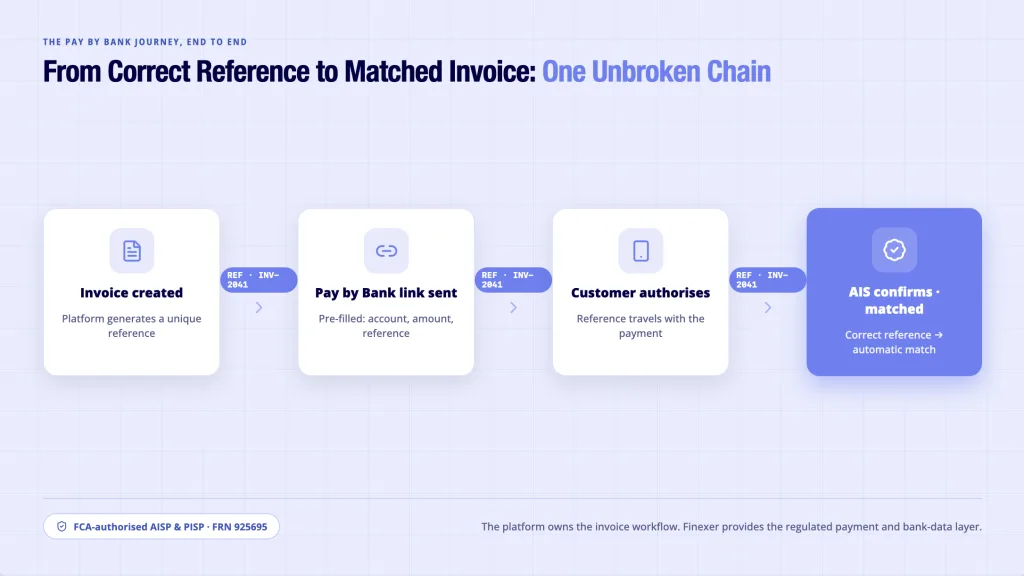
Incorrect payment information creates work long before reconciliation begins. If customers use the wrong payment reference or manually re-enter bank details, finance teams spend additional time identifying payments instead of processing them.
Finexer’s Open Banking Invoice Tracker helps platforms remove much of this manual effort by generating Pay by Bank payment links that include the correct payee details, payment amount and invoice reference from the outset.
For platforms embedding invoice workflows, the infrastructure provides the regulated Open Banking layer while the platform continues to own the customer experience.
Relevant capabilities include:
- Pay by Bank payment links with pre-populated payee details
- Correct invoice reference included within every payment request
- Payment status webhooks throughout the payment journey
- AIS confirmation when matching funds reach the receiving account
- White-label deployment under the platform’s own brand
- FCA-authorised AISP and PISP (FRN925695)
- Usage-based pricing
- 3 to 5 weeks onboarding support
- Almost all UK banks covered
Using accurate invoice payment details at the start of the payment journey also improves invoice tracking UK, since correctly referenced payments are significantly easier to associate with outstanding invoices.
What invoice payment details should be included on a UK invoice?
A UK invoice should normally include the account name, sort code, account number, payment reference, payment due date and payment terms, together with the statutory business information required by HMRC and, where applicable, the Companies Act 2006.
Are bank details legally required on an invoice?
Bank details are not mandatory under every legal requirement, but they should be included whenever payment is expected by bank transfer. Without them, customers may need to request payment information before paying.
Why is the payment reference important?
The payment reference connects the incoming bank transaction with the correct outstanding invoice. Accurate references reduce manual reconciliation and improve automated matching.
Does Pay by Bank replace invoice bank details?
Pay by Bank complements invoice payment details by embedding them into a secure payment link. Instead of manually entering banking information, the buyer authorises a payment with the details already completed.
Can Open Banking improve invoice reconciliation?
Yes. Open Banking helps reduce manual entry errors and, when combined with real-time bank data, allows platforms to identify correctly referenced payments more quickly than traditional manual bank transfer workflows.
Discover how Finexer’s FCA-authorised Open Banking infrastructure helps platforms simplify invoice payments and improve reconciliation with Pay by Bank.
Explore with AI
About the Author

Ravi Ranjan
Ravi Ranjan is Co founder & CEO of Finexer