Better Data, Fewer False Alerts
Enriched banking data your monitoring rules can rely on.
Anti-money laundering transaction monitoring exists to detect patterns that suggest money laundering once a customer relationship is live, after onboarding is complete. It tests activity against what the firm knows about the customer and their risk profile, and it flags activity for review rather than proving anything.
TL;DR: Anti-money laundering transaction monitoring tests live activity against what a firm knows about a customer and their risk profile. Vendor capability is a separate question, covered in our guide to transaction monitoring solutions.
What does anti-money laundering transaction monitoring do?
Monitoring picks up where onboarding stops and watches for activity that no longer fits the customer.
UK guidance treats ongoing monitoring as risk-sensitive. The FCA’s Financial Crime Guide says firms should scrutinise transactions to check they are consistent with what the firm knows about the customer, on a risk-sensitive basis. HMRC similarly expects transaction monitoring throughout an ongoing relationship.
In a compliance stack, anti-money laundering transaction monitoring is a layer. Customer due diligence establishes the expected relationship, monitoring tests what happens, and investigation follows when activity raises concern, a sequence our transaction monitoring process guide maps stage by stage.
What should transaction monitoring detect?
In anti-money laundering transaction monitoring, a useful rule starts with a behavioural question.
| Pattern | Rule question |
|---|---|
| Unusual value | Larger than expected? |
| Unusual frequency | Suddenly accelerated? |
| Rapid movement | Entered and left unusually quickly? |
| Structuring | Do smaller transactions suggest splitting? |
| Business mismatch | Does activity fit the stated business? |
HMRC’s guidance for accountancy service providers points to unusual activity, such as funds paid out to a different account from the one used to pay in.
“Unusual” is customer-specific. A £20,000 payment may be ordinary for a construction business and extraordinary for a small consultancy.
Why static rules create noisy alerts
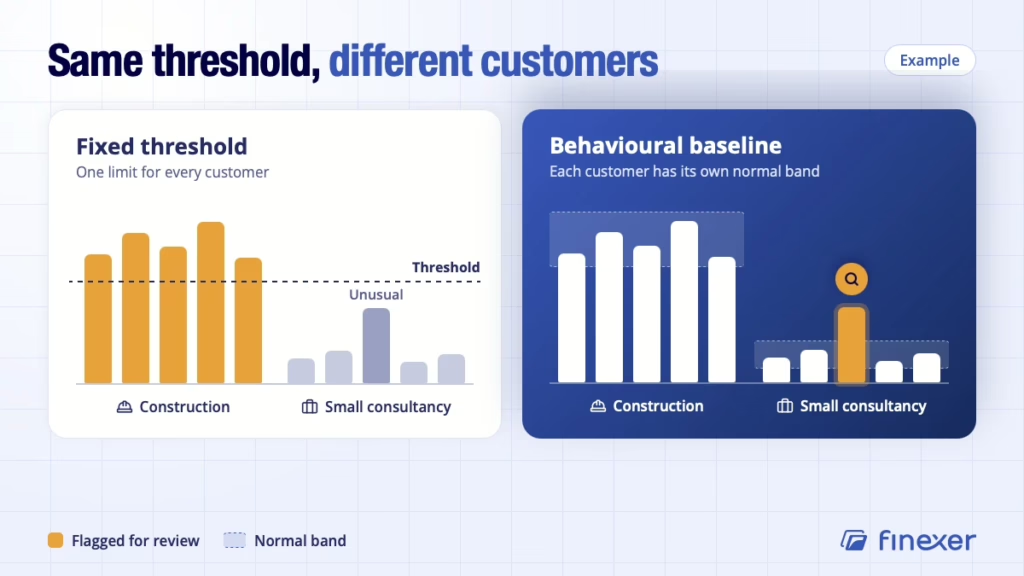
Threshold rules are easy to explain and test, but a £10,000 threshold may catch routine supplier payments as well as anomalies, leaving analysts to prove that normal activity is normal.
Behavioural rules add context. They can compare current activity with the customer’s own history, expected transaction types, frequency and counterparties.
The FCA notes that sophisticated monitoring can take a broader view of customer behaviour and networks.
That is where data quality becomes a control issue for anti-money laundering transaction monitoring.
The false-positive problem starts with identification
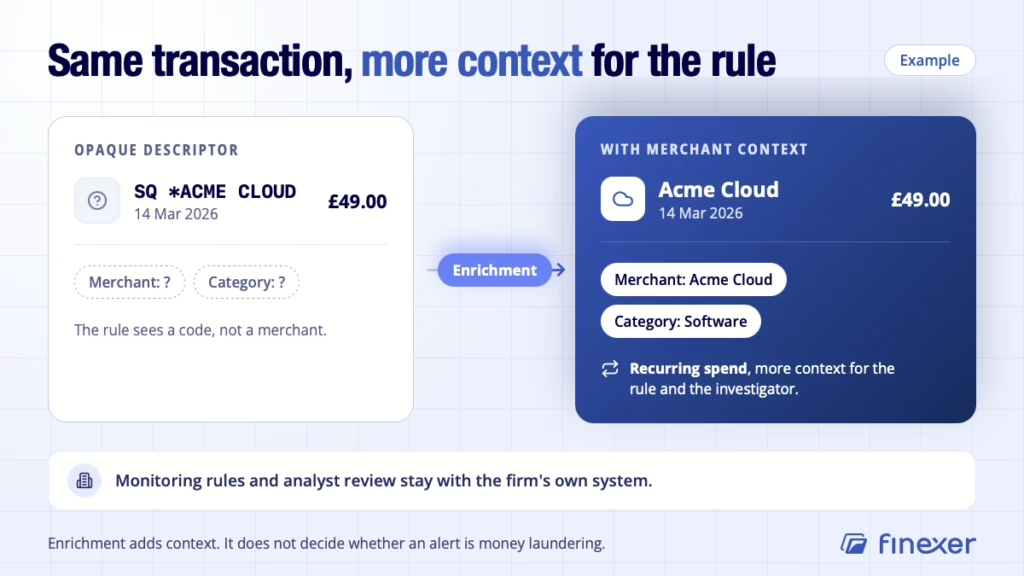
If a transaction arrives with an opaque merchant descriptor, the rule may fire because the system lacks context, not because the customer behaved suspiciously.
A rule that sees “PAYPAL *7H8K” cannot tell the customer bought software through PayPal, but categorising “SQ *ACME CLOUD” as a known software merchant can help a behavioural rule recognise recurring spend.
It gives anti-money laundering transaction monitoring better inputs.
Rule design: three layers
A practical rule framework combines three layers:
- Threshold rules: Flag values, frequencies or patterns above defined limits.
- Behavioural rules: Compare activity with the customer’s established baseline.
- Context rules: Test activity against the customer’s business, risk profile and known counterparties.
A large transaction may be ordinary, while a modest payment can matter in a pattern.
Automation can run checks continuously, as our guide to automated transaction monitoring explains, but it does not decide what a firm should report.
What happens after an alert?
In anti-money laundering transaction monitoring, an alert is a starting point for review.
Transaction → rule match → alert → analyst review → contextual checks → escalation where warranted → firm’s applicable reporting or other actionAn analyst should record why each alert was closed or escalated, and on what evidence. Where activity still raises concern, the analyst escalates it internally to the person the firm has named for that role, who considers the firm’s own reporting obligations.
This guide is general information, not legal advice. Firms should confirm their obligations with their supervisory body.
Anti-money laundering checks UK firms should connect
Onboarding gets most of the attention, but anti-money laundering checks UK firms must carry out can include customer due diligence, risk assessment, record keeping, internal controls and ongoing monitoring. HMRC says controls should suit the firm’s size and complexity.
The design question is how those checks connect. A platform may run identity verification, sanctions screening, PEP screening, risk scoring and monitoring as separate components, and monitoring works better when transaction data can be read alongside them.
What anti-money laundering checks for accountants look like
For accounting practices, transaction monitoring forms part of anti-money laundering checks for accountants and can sit close to the work accountants already perform.
HMRC’s risk guidance for accountancy service providers says firms must assess money laundering, terrorist financing and proliferation financing risks.
The 2025 National Risk Assessment rates accountancy services as high risk and highlights payroll, bookkeeping, insolvency and tax advice as attractive for money laundering.
When running anti-money laundering checks for accountants, practices can ask the following questions:
- Does client activity still resemble the business described at onboarding?
- Have transaction values or frequencies changed materially?
- Are funds moving through client accounts in ways that need explanation?
- Does new activity change the customer’s risk assessment?
HMRC also notes that monitoring client-account transactions can help identify activity inconsistent with expected purposes or permitted customers.
Technology supports these checks but does not transfer responsibility to a data provider.
Software companies building these checks into accounting products can compare options in our guide to AML software for accountants.
Where Finexer fits, and where it does not
Finexer is not an AML monitoring system. It does not perform transaction monitoring, AML screening, PEP screening or sanctions monitoring.
Its role sits underneath the monitoring engine: real-time banking data and enrichment that give monitoring rules better context. Finexer Data supplies account, balance and transaction data, and Enrichment adds merchant identification and categorisation at 95%+ accuracy, with sub-100ms response and 100M+ merchants.
That can reduce alerts caused by unrecognised descriptors and add context when an alert fires. Finexer does not decide whether an alert represents money laundering.
| Architecture layer | Typical job |
|---|---|
| Banking data | Supplies account and transaction activity |
| Enrichment | Identifies merchants and adds transaction context |
| Monitoring engine | Applies AML rules and generates alerts |
| Screening tools | Check relevant people, entities and lists |
| Investigation workflow | Reviews alerts and records decisions |
Finexer covers almost all major UK financial institutions and is FCA-authorised, FRN 925695.
Use cases by ICP
Accounting and bookkeeping: Distinguish recurring spend from unfamiliar activity as part of anti-money laundering checks for accountants.
Law firms and legal software: Add transaction context to client money and source-of-funds workflows.
Platform compliance teams: Feed enriched data into a monitoring engine.
Build the control around the signal
Good anti-money laundering transaction monitoring begins with a defensible view of normal activity, risk indicators and the context an analyst needs.
The data layer matters because every rule is only as intelligible as the transaction it receives.
If alerts arise because merchants are hard to identify, the problem may sit below the rule engine.
How often should AML monitoring rules be reviewed?
Review rules whenever risk assessments, products, customer behaviour or typologies change, not only on a fixed date. An annual review alone can miss material changes, so many firms also track alert outcomes to spot noisy or ineffective rules and adjust them.
Is transaction monitoring a legal requirement in the UK?
Firms covered by the UK Money Laundering Regulations must monitor business relationships on an ongoing basis, including scrutinising transactions against what they know about the customer. The regulations do not prescribe one system, so each firm chooses a risk-sensitive approach that suits it.
What is the difference between transaction monitoring and sanctions screening?
Transaction monitoring looks at behaviour over time, testing payments against a customer’s expected activity and flagging patterns for review. Sanctions screening checks the names of customers, counterparties and payees against sanctions lists. Most firms need both, because each catches risks the other misses.
Does transaction monitoring cover every payment risk?
No. Monitoring addresses behavioural transaction risk. Depending on their model, firms may need separate controls for identity verification, sanctions screening, politically exposed persons (PEPs), fraud, device risk and source of funds, and each control needs its own owner, records and review cycle.
See how Finexer supplies real-time banking data and transaction enrichment with merchant identification, so your monitoring rules can work from a clearer transaction context.
Explore with AI
About the Author

Paul Lucraft
Paul Lucraft is a payments industry strategist and advisor with more than two decades of experience across banking, card networks, and financial services infrastructure. His expertise covers fraud prevention, payment risk management, financial strategy, and the operational development of card payment systems. He previously held senior roles at Mastercard Europe where he served as General Manager for the UK and Ireland, overseeing fraud risk, operational governance, and payment network strategy across the region. Earlier in his career, Paul worked at Lloyds TSB and TSB Bank leading fraud strategy, credit collections, and card business finance operations.