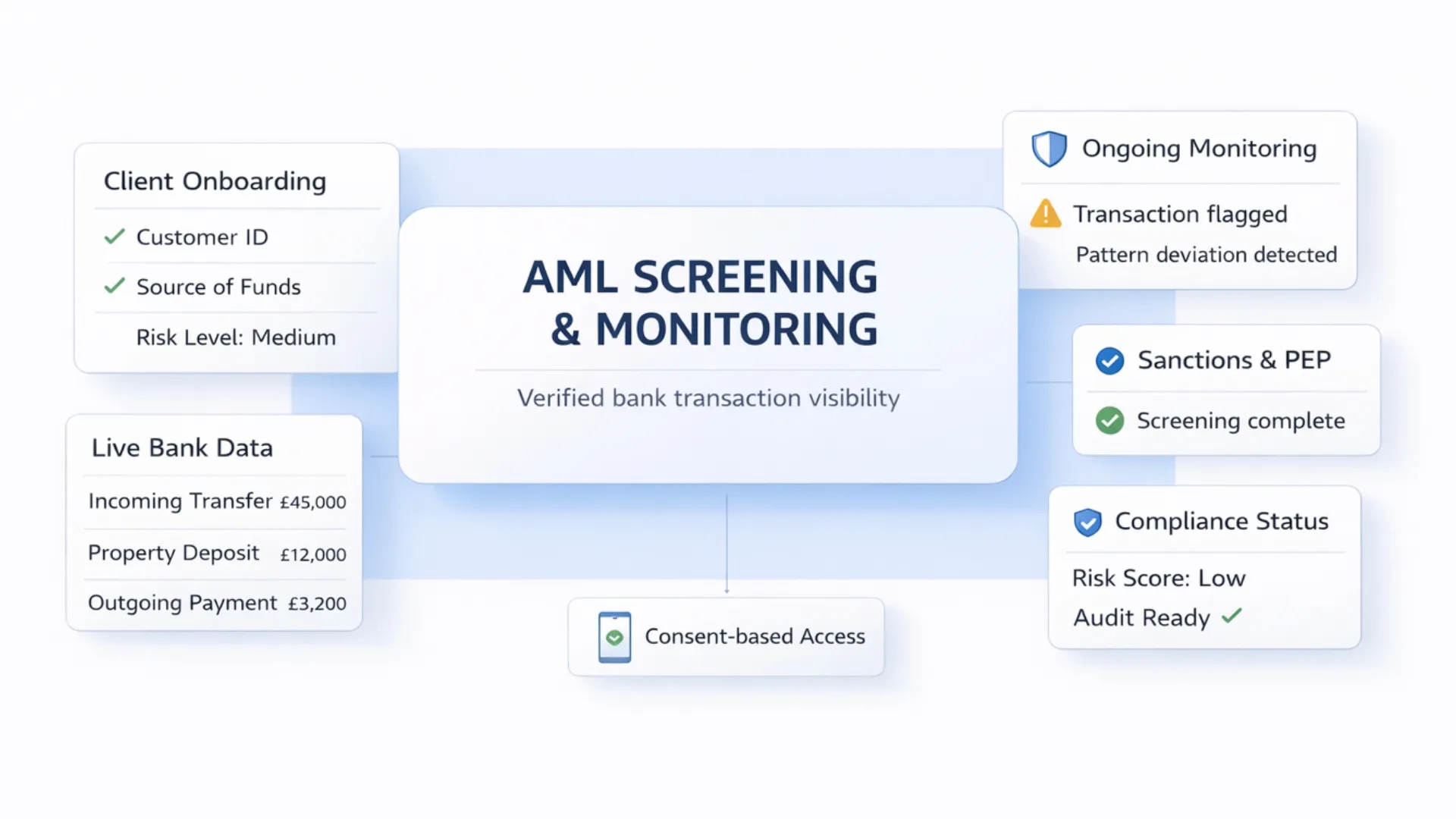
UK regulated platforms handling client funds cannot perform AML screening and monitoring reliably when financial visibility depends on manual bank statement uploads. LawTech platforms, compliance SaaS products, and conveyancing tools need verified transaction data enabling source-of-funds verification and ongoing monitoring without operational overhead.
AML screening and monitoring in the UK are legal obligations under the Money Laundering, Terrorist Financing and Transfer of Funds (Information on the Payer) Regulations 2017. Businesses must verify client identities, check against sanction and PEP lists, and conduct ongoing transaction monitoring. Manual processes create compliance gaps when screenshot-based reviews lack verification.
This blog explains how UK platforms enable AML screening and monitoring using verified bank transaction data, what infrastructure eliminates manual checks, and why consent-based access supports compliance workflows that manual processes cannot deliver.
Key Takeaways
What is AML screening and monitoring in the UK?
AML screening and monitoring verifies customer financial activity meets Money Laundering Regulations 2017 requirements. Platforms need verified bank transaction data enabling source-of-funds checks, ongoing monitoring, and suspicious activity reporting without manual statement collection.
What are AML checks in the UK?
AML checks include customer due diligence (CDD), identity verification, sanction and PEP screening, source-of-funds verification, and ongoing transaction monitoring. Platforms require verified financial data infrastructure supporting these compliance obligations.
Why does transaction data matter for AML compliance?
Manual screenshots lack verification. Platforms need consent-based bank data access providing transaction-level visibility, structured financial activity, and audit-ready records supporting AML screening process requirements under MLR 2017.
What is the AML screening procedure for platforms?
AML screening procedure involves customer identification, risk assessment, source-of-funds verification, ongoing transaction monitoring, and suspicious activity reporting. Platforms access verified bank data through Open Banking enabling automated compliance workflows.
Where does Finexer fit in AML workflows?
Finexer provides verified bank transaction infrastructure. Platforms access financial data through FCA-authorised Open Banking APIs. Platforms build AML screening and monitoring features on top.
Why do platforms need AML screening infrastructure?
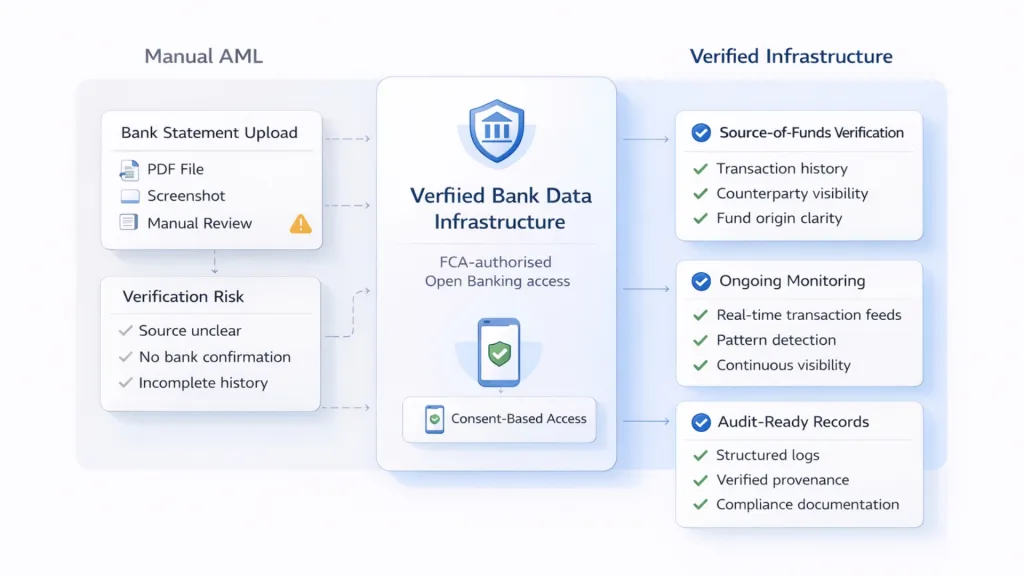
LawTech platforms handling property transactions cannot vLawTech platforms handling property transactions cannot verify source-of-funds manually when clients provide unverified screenshots. Money Laundering Regulations require solicitors to obtain verified financial evidence showing legitimate fund origins. Manual document review creates compliance exposure when verification lacks bank confirmation.
LawTech platforms require:
- Verified source-of-funds evidence
- Transaction-level visibility into fund origins
- Ongoing client account monitoring
- Audit-ready compliance records
Compliance SaaS products depend on:
- Verified bank data layer
- Transaction-level AML visibility
- Real-time monitoring capability
- Audit trail maintenance
Manual bank statement collection prevents verification. Users upload PDFs or screenshots. Platforms cannot confirm authenticity. AML screening and monitoring becomes unreliable when financial data lacks bank verification.
What are AML regulations in the UK?
UK AML regulations under the Money Laundering, Terrorist Financing and Transfer of Funds (Information on the Payer) Regulations 2017 require businesses to implement specific measures.
- Customer due diligence (CDD): Businesses must verify customer identity and understand the nature of business relationships. Platforms need verified financial data supporting CDD requirements.
- Risk assessment: Businesses must assess and manage money laundering risks. Transaction data reveals patterns supporting risk-based approaches to AML screening and monitoring.
- Ongoing monitoring: Businesses must scrutinize transactions throughout relationships and keep documents up to date. Platforms require real-time transaction feeds enabling ongoing monitoring obligations.
- Suspicious activity reporting (SAR): Businesses must submit suspicious activity reports to the National Crime Agency when they know or suspect money laundering. Structured transaction data supports SAR preparation with verified evidence.
Platforms building compliance features must access verified financial data meeting regulatory standards.
What infrastructure gap breaks AML workflows?
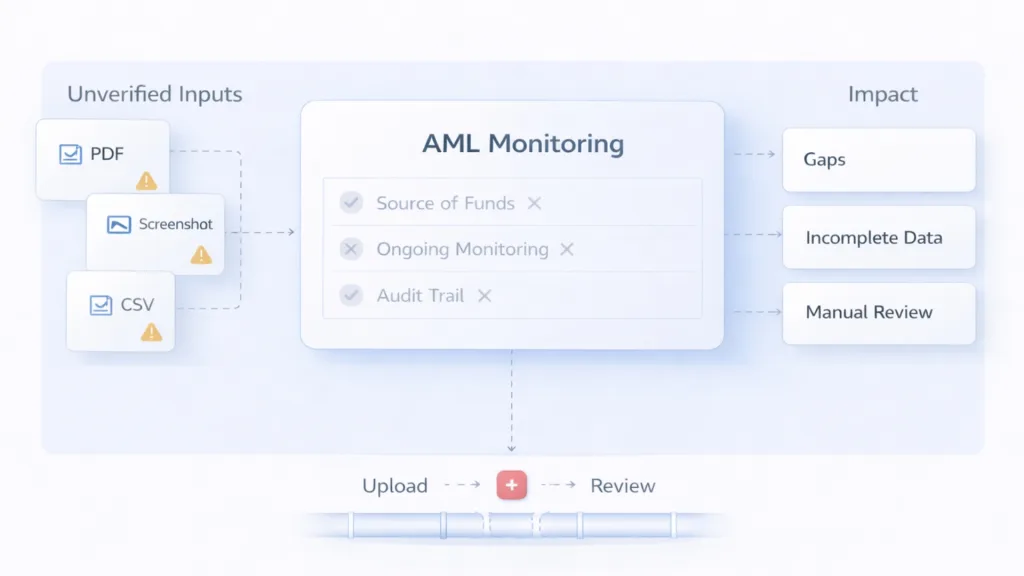
Manual bank statement uploads create verification problems. Platforms receive unverified documents. Screenshot-based reviews lack authentication. PDF analysis cannot confirm transaction legitimacy.
Ongoing monitoring becomes impossible without continuous data access. Money Laundering Regulations require businesses to scrutinise transactions throughout customer relationships. Manual processes cannot provide real-time visibility when transaction feeds depend on periodic uploads.
Transaction pattern analysis fails when data arrives incomplete. Platforms need complete financial history showing fund movement. Manual collection creates gaps when users provide selective information.
Audit preparation requires verified records. Compliance teams must demonstrate proper AML screening process execution. Manual workflows lack structured evidence when regulatory reviews demand transaction-level documentation.
How does verified transaction data enable AML compliance?
Platforms need consent-based bank access providing verified financial information. Each platform user authenticates accounts through banking apps. Platforms retrieve transaction data automatically without managing AML screening and monitoring complexity internally.
AML screening requirements:
- Verified source-of-funds evidence
- Complete transaction history
- Structured financial activity data
- Authentication from banking institutions
Ongoing monitoring capabilities:
- Real-time transaction feeds
- Continuous financial visibility
- Pattern analysis capability
- Exception detection for unusual activity
Compliance infrastructure needs:
- Audit-ready transaction logs
- Verified data provenance
- Consent lifecycle management
- Regulatory-grade connectivity
Open Banking provides regulated access. FCA-authorised infrastructure ensures compliance alignment. Platforms receive bank-verified data rather than unverified uploads supporting AML screening process requirements.
How does Finexer enable AML infrastructure?
Finexer provides FCA-authorised infrastructure enabling platforms to access verified bank transaction data supporting AML screening and monitoring.
Key capabilities:
- 99% UK bank coverage
- FCA-authorised infrastructure
- Real-time webhooks
- Up to 7 years historical data
- Usage-based pricing
- White-label ready
- 2-3x faster integration
- 3-5 weeks onboarding support
- Saves up to 90% on transaction costs
Platforms integrate AML data APIs through REST endpoints. Users authenticate accounts via secure Open Banking flows. Platforms receive verified transaction information in consistent JSON format.
Real-time webhooks notify platforms when transactions occur. Ongoing monitoring updates automatically. AML screening and monitoring continues without manual data collection.
Consent lifecycle management is automated with clear permission tracking. Users receive notifications before access expires. Re-authentication happens smoothly without disrupting compliance workflows.
Historical transaction access extends up to seven years depending on bank support. Platforms retrieve complete financial history enabling comprehensive source-of-funds verification without manual statement requests.
Transaction data includes structured fields enabling AML analysis. Payment amounts, counterparties, timestamps, and merchant details arrive consistently formatted supporting AML screening process automation.
Critical compliance clarity:
Finexer does not perform AML decisions, risk scoring, sanctions checks, PEP screening, or compliance determinations. Platforms control AML logic, case management, and regulatory reporting.
Finexer provides the verified bank transaction data layer enabling AML infrastructure.
For platforms requiring AML screening capabilities, verified data access removes compliance bottlenecks.
AML infrastructure evaluation checklist
| Evaluation Criteria | Why It Matters | What to Look For |
|---|---|---|
| Verified data sources | Unverified uploads create compliance exposure | FCA-authorised Open Banking connectivity |
| Transaction completeness | Incomplete data prevents proper AML analysis | Complete transaction history with counterparty details |
| Real-time monitoring | Ongoing AML requires continuous visibility | Webhook notifications for immediate transaction updates |
| UK bank coverage | Users cannot verify funds from unsupported accounts | 99% coverage including challengers and building societies |
| Historical depth | Source-of-funds checks require complete financial history | Multi-year transaction retrieval supporting verification |
| Consent management | Expired permissions disrupt ongoing monitoring | Automated tracking with proactive renewal notifications |
Platforms building automated AML checksshould confirm infrastructure supports MLR 2017 requirements.
What we see in practice
Most platforms underestimate the compliance risk of manual AML screening and monitoring. Manual document collection appears manageable initially but creates serious gaps when client numbers grow.
Source-of-funds verification quality determines compliance outcomes. Platforms accepting unverified screenshots face regulatory exposure. Automated bank-verified data provides evidence that manual processes cannot deliver.
Ongoing monitoring becomes critical for regulated platforms. Money Laundering Regulations require continuous scrutiny of transactions throughout customer relationships. Manual workflows cannot provide real-time monitoring when transaction access depends on periodic uploads.
Transaction pattern analysis reveals risks that static documents miss. Platforms accessing continuous feeds detect unusual activity proactively. Manual reviews happen retrospectively when problems already exist.
For platforms serving property transactions, verified financial data transforms AML compliance quality.
Common use cases
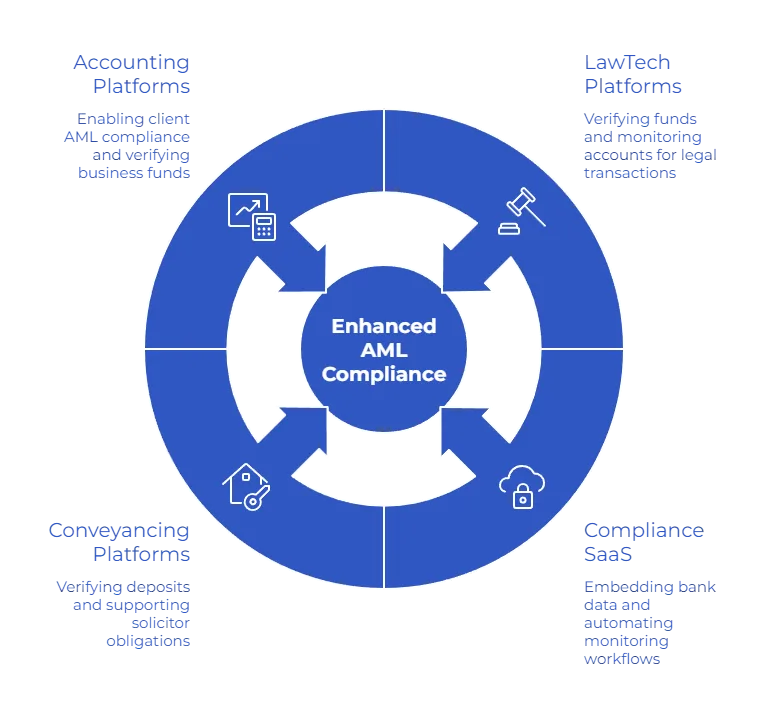
LawTech platforms:
- Verify source-of-funds for property transactions
- Monitor client account activity continuously
- Access verified transaction history for compliance
- Build audit-ready AML screening process records
Compliance SaaS:
- Embed verified bank data layer
- Enable transaction-level AML visibility
- Automate ongoing monitoring workflows
- Provide audit trails for regulatory reviews
Conveyancing platforms:
- Verify deposit source legitimacy
- Monitor client funds throughout transactions
- Access complete financial history
- Support solicitor AML obligations
Accounting platforms:
- Enable client AML compliance for accountants
- Verify business fund origins
- Monitor client account activity
- Support regulated firm requirements
What are AML checks in the UK?
AML checks in the UK include customer due diligence (CDD), identity verification, sanction and PEP list screening, source-of-funds verification, and ongoing transaction monitoring under the Money Laundering Regulations 2017. Platforms use verified bank data accessed through Open Banking to automate these compliance requirements.
What are the AML regulations in the UK?
UK AML regulations under the Money Laundering, Terrorist Financing and Transfer of Funds (Information on the Payer) Regulations 2017 require businesses to verify client identities, assess money laundering risks, conduct ongoing transaction monitoring, and report suspicious activity to the National Crime Agency.
What is the AML screening procedure?
AML screening procedure involves customer identification, risk assessment, source-of-funds verification using verified bank transaction data, ongoing monitoring of financial activity, and suspicious activity reporting when required. Platforms automate this process using Open Banking APIs rather than manual document collection.
Can Open Banking support AML compliance?
Yes, Open Banking provides FCA-authorised access to verified bank transaction data. Platforms retrieve financial information through secure APIs enabling AML screening and monitoring with bank-authenticated evidence supporting source-of-funds verification and ongoing compliance workflows.
Why do platforms need verified transaction data for AML?
Money Laundering Regulations require businesses to verify customer financial activity and conduct ongoing monitoring. Verified transaction data accessed through Open Banking provides bank-authenticated evidence that manual screenshots and PDF uploads cannot deliver for compliance purposes.
See how Finexer’s UK-exclusive focus provides 99% bank coverage without multi-market complexity.
About the Author

Paul Lucraft
Paul Lucraft is a payments industry strategist and advisor with more than two decades of experience across banking, card networks, and financial services infrastructure. His expertise covers fraud prevention, payment risk management, financial strategy, and the operational development of card payment systems. He previously held senior roles at Mastercard Europe where he served as General Manager for the UK and Ireland, overseeing fraud risk, operational governance, and payment network strategy across the region. Earlier in his career, Paul worked at Lloyds TSB and TSB Bank leading fraud strategy, credit collections, and card business finance operations.