Production-grade automated bank feeds.
Open Banking AIS for accounting platforms that need consistent UK financial data at scale.
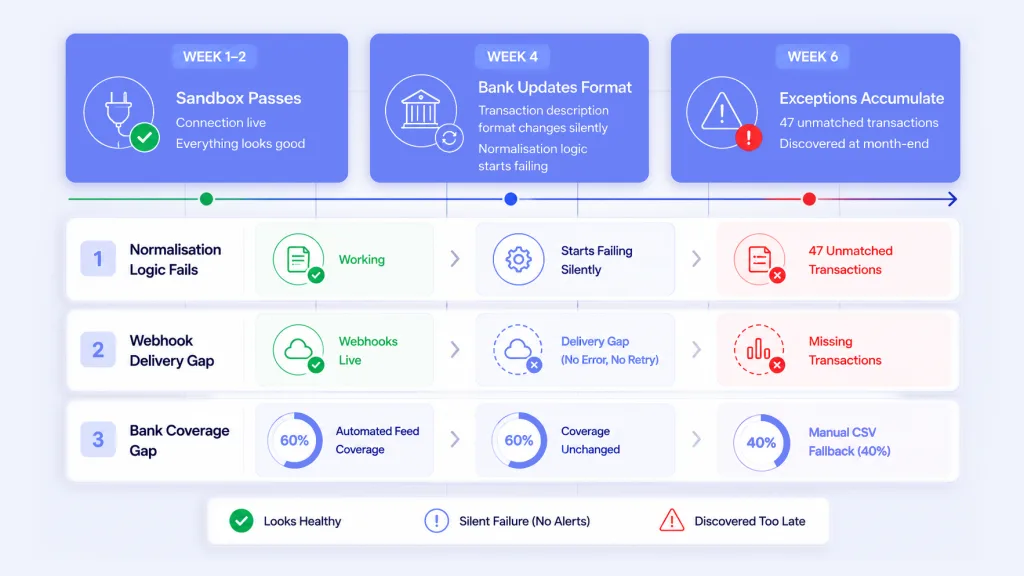
Automated bank feeds pass every sandbox test. The integration went live. Six weeks later, a client’s reconciliation broke.
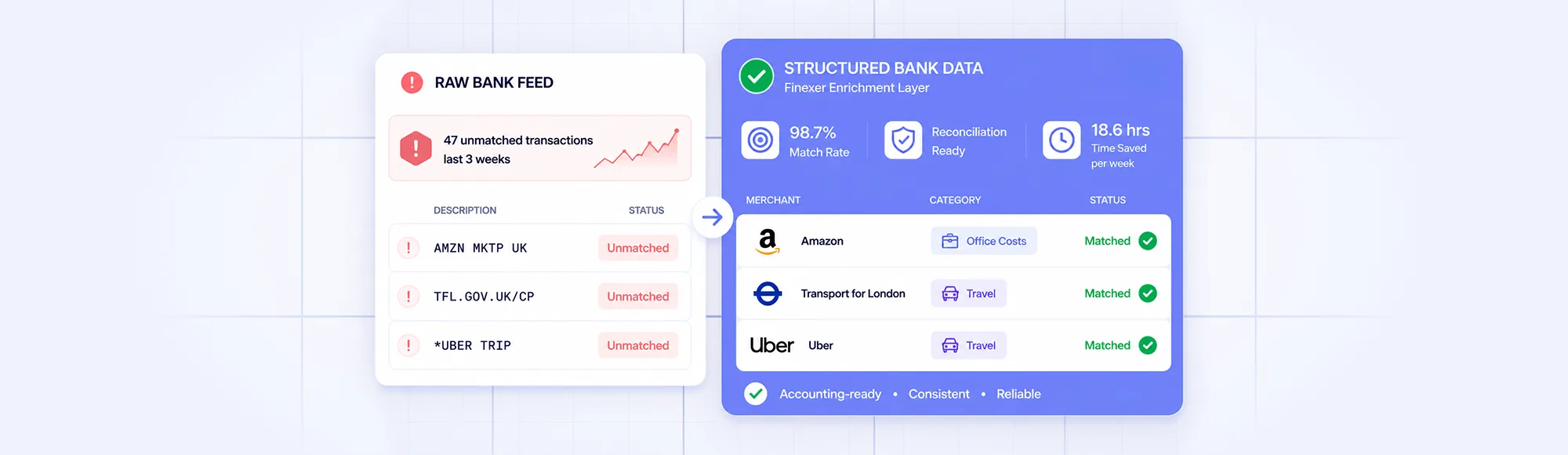
Not because the code was wrong. Because the bank changed how it formatted transaction descriptions and the feed normalisation layer had not anticipated it. The accounting platform discovered the problem at month-end, when three weeks of transactions needed manual review.
This is not an unusual story. It is one of the common production failure modes automated bank feeds can face when the underlying financial data is inconsistent.
The dev environment shows you whether the connection works. It doesn’t show you whether the data arriving through that connection is consistent enough, complete enough, and structured enough to support real accounting workflows at scale.
Automated bank feeds are an infrastructure problem before they are an integration problem.
“The bank feed failures I see in production aren’t connection failures. The connection is fine. The data arriving through it is inconsistent – missing merchant identifiers, shifting category formats, transaction descriptions that change without notice. The feed works. The accounting logic built on top of it breaks.” – Yuri, Finexer
Key Takeaways
What are automated bank feeds?
Automated bank feeds retrieve bank transaction data into accounting or ERP systems via API – replacing manual CSV downloads. Open Banking AIS provides FCA-regulated, consent-based access. Reliability depends on data consistency, not the connection.
What causes automated bank feed failures in production?
Three problems: inconsistent transaction formats that break normalisation logic, webhook delivery gaps that create silent data holes, and incomplete bank coverage forcing manual fallback. Each surface after deployment – sandbox data never replicates production.
What does a production-grade automated bank feed require?
Normalised JSON across supported bank connections so normalisation logic writes once. Webhook retry designed to reduce missed-event gaps. Near-settlement data, not overnight batch. Coverage across almost all major UK banks.
The Production Reality of Automated Bank Feeds
What Goes Wrong Between Sandbox and Production?
Sandbox environments are designed to pass. Production environments are designed to survive.
The gap between them is where automated bank feeds fail.
Three failure modes appear consistently in production accounting workflows, regardless of which bank feed provider is running underneath:
Inconsistent transaction data formats. A bank changes how it returns merchant names in transaction descriptions. The field that previously read “TESCO STORES 2847” now reads “TSC 2847 LONDON.” The normalisation logic the accounting platform wrote does not recognise it. Transactions stop categorising correctly. Reconciliation exceptions accumulate silently until someone notices the accounts do not balance.
This happens. Not rarely – regularly. UK banks update their data formatting without notice. A production-grade automated bank feed handles this at the infrastructure layer, not at the platform layer.
Webhook delivery gaps. The bank feed uses webhooks to push new transaction events to the accounting platform. Under load – high transaction volumes, bank maintenance windows, peak processing periods – webhooks drop. The accounting platform receives no notification. No errors. No retry. The transaction simply does not arrive.
The data hole is invisible until reconciliation runs and finds missing entries.
Incomplete UK bank coverage. If a provider has partial bank coverage, unsupported institutions force manual CSV fallback. The accounting platform ends up maintaining two parallel workflows – one automated, one manual – and the manual one negates the reliability advantage of the automated one.
For accounting and ERP platforms that have already encountered these failure modes and are evaluating how to address them structurally, API integration challenges in production environments differ structurally from development failures – real client data surfaces inconsistencies that sandbox test data never does.
What Reliable UK Financial Data Infrastructure Actually Requires
How Does Data Quality Determine Whether Bank Feeds Work in Practice?
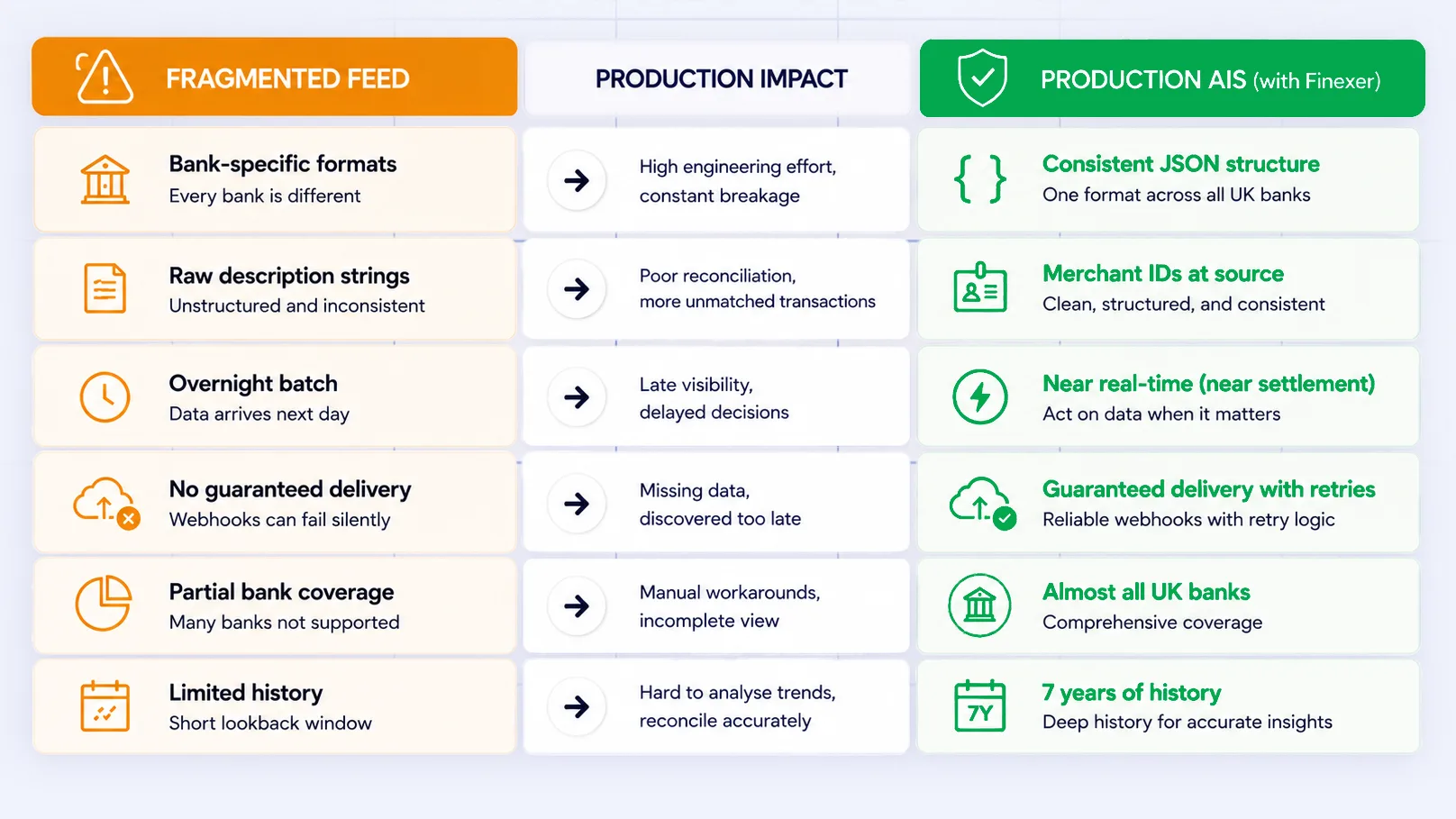
| Bank Feed Requirement | Fragmented / Inconsistent Feed | Production-Grade AIS Feed |
|---|---|---|
| Transaction data format | Bank-specific – separate normalisation logic per institution | Normalised JSON format across supported bank connections – write logic once |
| Merchant identification | Raw bank description strings – unstable, bank-dependent | Merchant identification and categorisation applied through the data layer |
| Transaction timing | Overnight batch imports – reconciliation runs on yesterday’s data | Near-settlement data – feed reflects current confirmed transactions |
| Webhook reliability | No guaranteed delivery – data holes under load or maintenance | Retry logic designed to reduce missed-event gaps |
| UK bank coverage | Partial – manual fallback required for unsupported institutions | Coverage across almost all major UK banks – reduced manual fallback where coverage is available |
| Transaction history depth | Limited – varies by bank and connection type | Up to 7 years – full historical access for reconciliation and audit |
The right column isn’t a feature list. It is the specification for a bank feed that doesn’t require manual intervention when something changes in the underlying bank data.
Some automated bank feeds can begin to show these weaknesses once real client data, bank variation, and operational load increase.
For accounting platforms evaluating how Open Banking infrastructure connects to reconciliation workflows, bank reconciliation exception volume is directly tied to bank feed data quality – inconsistent inputs produce predictably higher manual review rates at month-end.
Finexer: AIS Infrastructure for Production Bank Feed Workflows
Finexer isn’t accounting software. It doesn’t build reconciliation logic, manage ledgers, or replace ERP systems.
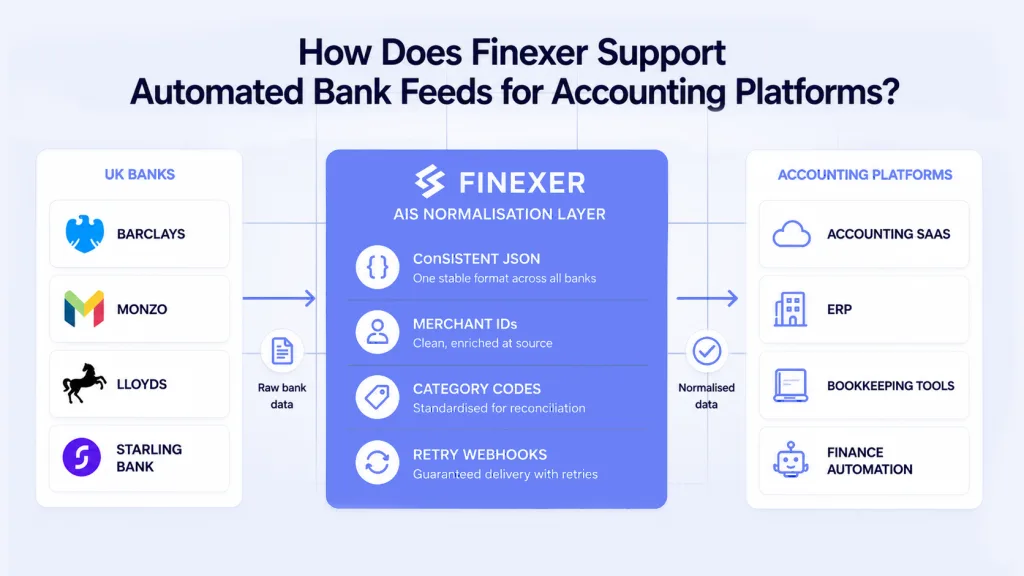
Finexer provides FCA-authorised Open Banking AIS – the UK financial data infrastructure layer that accounting SaaS platforms, ERP systems, and bookkeeping tools use to power automated bank feeds in production.
Inconsistent formats, webhook gaps, and incomplete coverage – these are infrastructure problems. Finexer addresses it at the infrastructure layer, not the application layer.
What Finexer’s AIS delivers for automated bank feeds:
- Consistent JSON transaction format across almost all major UK banks – one normalisation layer, not one per bank
- Merchant identification and category codes applied through Finexer’s data layer
- Transaction data near-settlement – not overnight batch
- Webhook delivery with retry logic designed to reduce missed-event gaps
- Up to 7 years of transaction history – full historical access through a single integration
- Consent lifecycle management – token refresh and expiry handled without platform intervention
- Balance data alongside transaction data – complete account picture per connected institution
One integration. The aim is to provide a more consistent data structure across supported institutions, including major UK banks such as Barclays, Monzo, Lloyds, and Starling.
- Usage-based pricing with commercial terms agreed based on use case. 3 to 5 weeks of hands-on onboarding support.
- FCA-authorised (FRN 925695)
For accounting platforms evaluating how to connect automated bank feeds to reconciliation automation, Manual reconciliation automation becomes significantly more reliable when the bank feeds data feeding it arrives in consistent, structured format rather than requiring pre-processing.
Why Production Bank Feeds Need Data Infrastructure, Not Just Connectivity
The accounting platform teams I work with that have the most reliable automated bank feeds share one thing in common. They stopped thinking about bank feeds as connections and started thinking about them as data infrastructure.
A connection tells you the feed is on. Infrastructure tells you the data is consistent, complete, and arriving when the accounting logic expects it.
Most automated bank feed problems are not connection problems. They are data quality problems that surface after the connection is working perfectly – when the format changes, when the webhook drops, when a client switches banks and the new institution returns data in a structure the normalisation layer was not built for.
These problems aren’t fixable at the application layer. They require infrastructure that handles bank data variability before it reaches the accounting platform.
That is what production-grade UK financial data infrastructure is for.
“The platforms that have solved this stopped treating bank feeds as a connectivity feature and started treating them as a data quality requirement. That reframing changes which infrastructure decisions they make.” – Yuri, Finexer
Common Use Cases
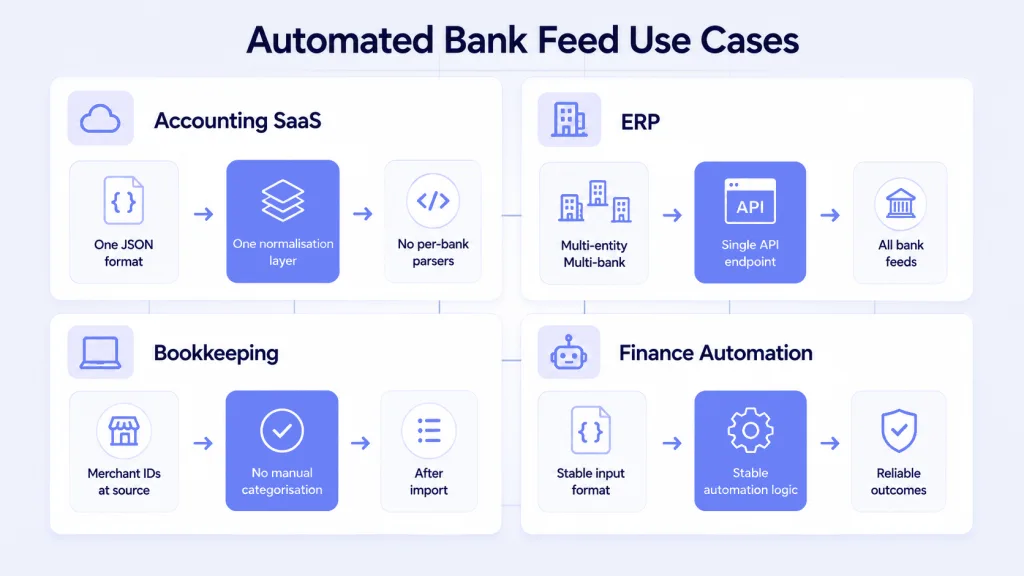
Accounting SaaS Platforms
Accounting platforms replace manual CSV bank imports with automated bank feeds via Finexer’s AIS. Client transaction data arrives in normalised JSON format across supported UK bank connections. The reconciliation module writes one matching logic layer rather than maintaining separate parsers per institution. When a bank updates its transaction description format, the impact is absorbed at the infrastructure layer.
ERP and Finance Operations Systems
ERP systems consolidating multi-entity cash positions need bank feed data that arrives in consistent format across every institution in the group. Finexer’s AIS delivers transaction and balance data from almost all major UK banks through a single API endpoint. Finance teams see a unified financial data view without maintaining separate bank connections per entity.
Bookkeeping Software
Bookkeeping platforms automating client transaction import need feeds that do not require manual intervention when a client changes banks or a bank changes its data format. Merchant identification and categorisation applied through the data layer reduce the manual categorisation that bookkeeping workflows typically require after import. For platforms building the Open Banking infrastructure layer that powers these workflows, Open Banking API integration architecture determines how consistently bank data arrives across multiple institutions – and therefore how reliable the automated bank feed workflows built on top can be.
Finance Automation and Reconciliation Tools
Finance automation platforms building reconciliation, expense management, or reporting workflows on top of bank feed data need UK financial data that arrives in a consistent structure. When the input data format is stable, the automation logic built on top of it stays stable. When it is not, the automation inherits every inconsistency the bank introduces.
Are Open Banking bank feeds secure?
Yes. Open Banking bank feeds operate under FCA regulation via AIS providers. Users authenticate directly with their bank – the platform never handles credentials. Access uses consent tokens with defined expiry. Security requirements are set by the FCA and with standards maintained by Open Banking Limited.
How do automated bank feeds work?
An accounting platform integrates with an Open Banking AIS provider. The user authenticates via a consent flow. The AIS provider retrieves transaction data and balances and delivers them via webhook or API. Data format consistency and webhook delivery determine production performance.
What causes bank feed sync issues?
Three production problems: inconsistent data formats across UK banks that break normalisation logic, webhook delivery gaps creating silent data holes, and incomplete bank coverage forcing manual fallback. All three are infrastructure-layer problems that surface after deployment, not in the sandbox.
Build automated bank feeds on structured UK financial data.
About the Author

Yuri
Yuriy Yakushko is a fintech founder and software engineer with over 20 years of experience building financial technology. He’s passionate about creating scalable, secure infrastructure that helps businesses modernise how they access financial data and manage payments.