Table of Contents
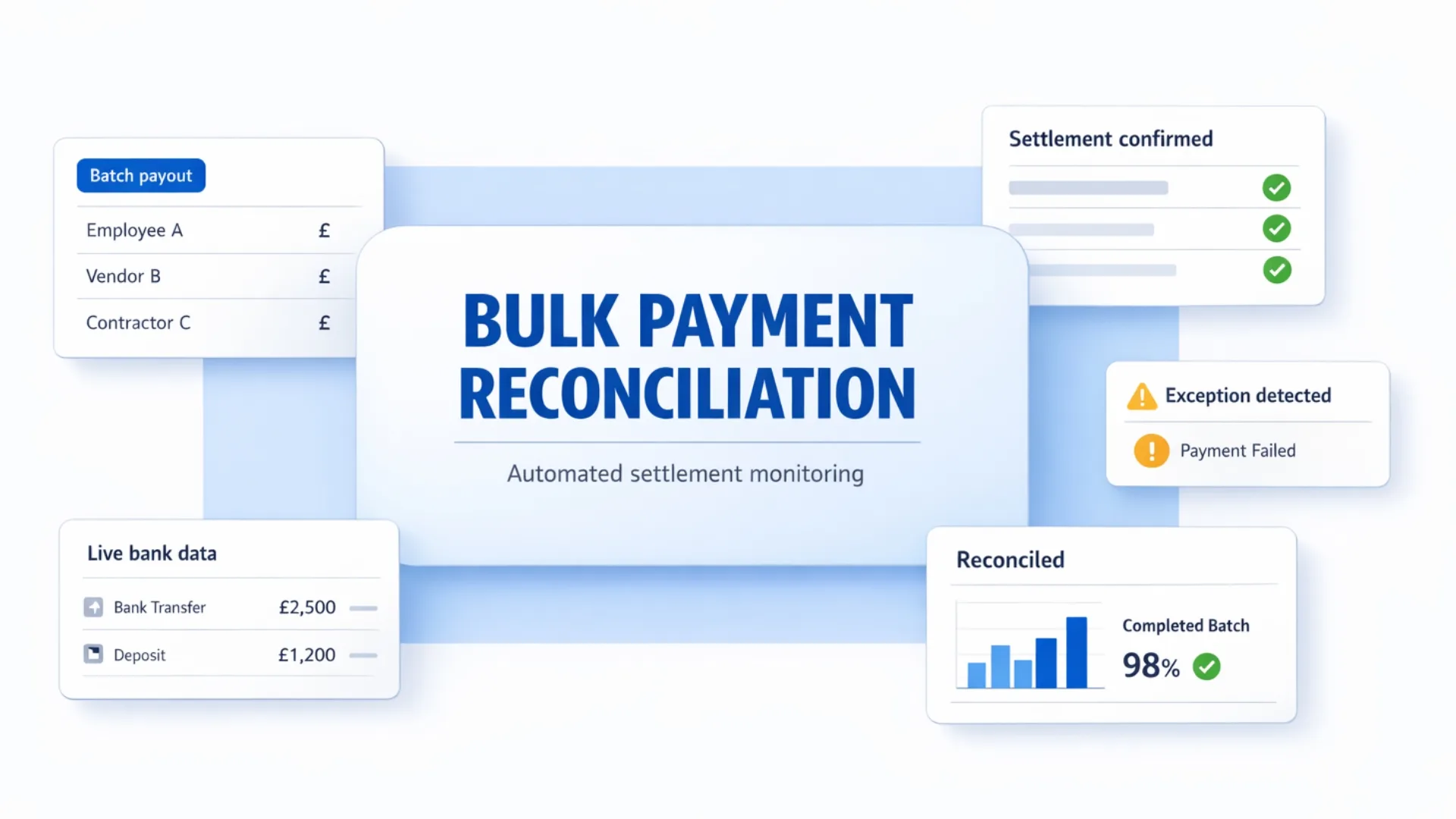
Corporate bulk payment workflows generate hundreds or thousands of transactions in single cycles. Payroll runs, vendor payouts, contractor payments, escrow releases, and marketplace disbursements create reconciliation complexity that manual processes cannot handle at scale.
The challenge is not executing payments. The challenge is monitoring settlement in real-time, validating successful disbursement automatically, reconciling payout batches without manual checking, detecting failures instantly, and maintaining audit-ready records.
This explains how UK financial platforms automate corporate bulk payment reconciliation using structured bank transaction data, what infrastructure eliminates manual monitoring, and why reliable connectivity enables workflows that manual processes cannot support.
Key Takeaways
What is bulk payment in corporate banking?
Corporate bulk payment enables businesses to execute multiple payments simultaneously-payroll, vendor payouts, contractor disbursements. Platforms need automated reconciliation infrastructure to monitor settlement and validate execution at scale.
Why does automated reconciliation matter for platforms?
Manual reconciliation prevents scaling. Automated transaction access enables real-time settlement monitoring, batch validation, exception detection, and audit-ready records without operational overhead.
What breaks with manual bulk payment workflows?
Settlement visibility gaps extend. Reconciliation requires manual effort consuming days. Exception handling becomes reactive. Audit preparation lacks structured records.
What should platforms evaluate in reconciliation infrastructure?
UK bank coverage, transaction data completeness, real-time webhook reliability, historical access depth, batch reconciliation capability, API performance.
Where does Finexer fit in bulk payment operations?
Finexer provides bank transaction infrastructure. Platforms access settlement data through APIs. Platforms build automated reconciliation, monitoring, and compliance features on top.
Why do platforms need automated bulk payment reconciliation?
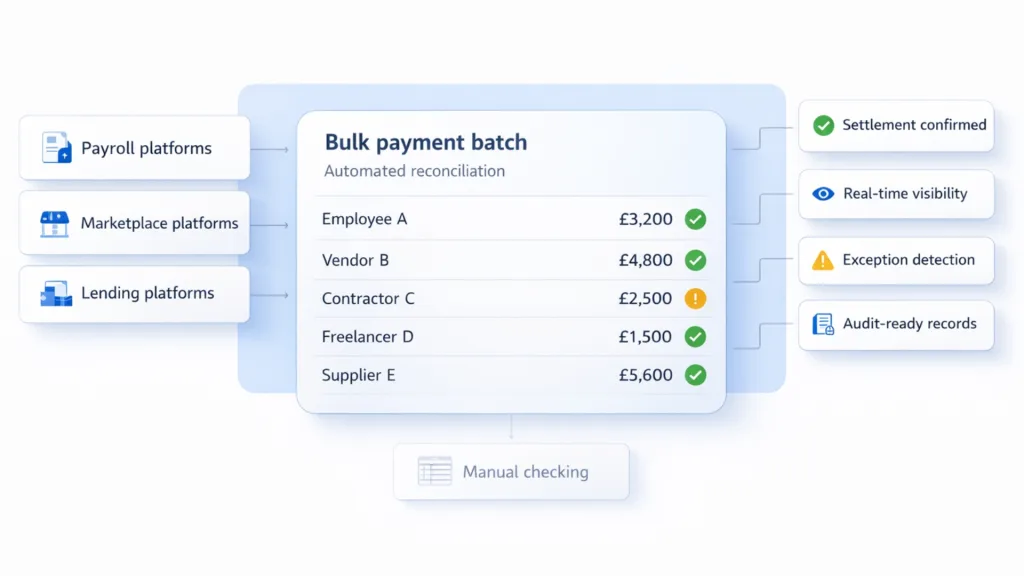
Payroll SaaS platforms cannot confirm salary settlement manually when processing hundreds of employee payments monthly. Finance teams require automated validation showing successful disbursement. Manual checking creates operational delays damaging user experience.
Payroll platforms require:
- Automated settlement confirmation for salary runs
- Real-time visibility into payment execution
- Exception detection for failed transfers
- Audit-ready transaction records
Marketplace platforms need:
- Vendor payout batch reconciliation
- Failed disbursement detection
- Automated matching against payout schedules
- Structured reporting for accounting
Lending platforms depend on:
- Loan disbursement monitoring
- Settlement validation for funding batches
- Exception handling for returned payments
- Complete audit trails for compliance
Manual settlement monitoring prevents automation. Teams check bank portals separately. Transaction matching happens retrospectively. Corporate bulk payment reconciliation becomes impossible to scale when volumes grow.
What happens when bulk payment monitoring fails?
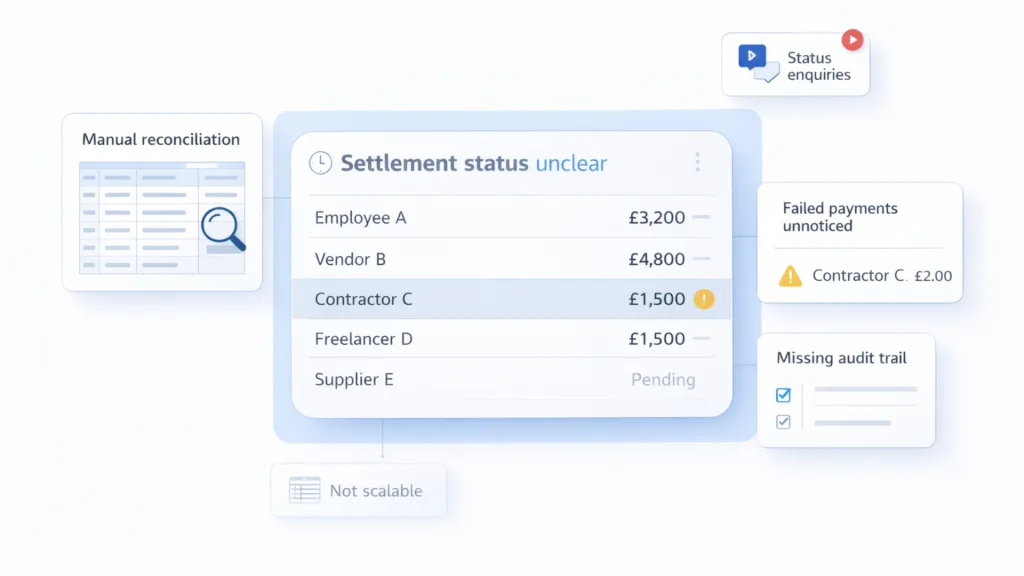
Settlement visibility gaps create support overhead. Finance teams cannot confirm whether payroll executed successfully. Users contact support asking about payment status. Manual investigation consumes hours that automated monitoring eliminates.
Reconciliation delays extend month-end close. Accounting teams match transactions manually against disbursement schedules. Batch payments with hundreds of line items require individual verification. Manual processes slow financial reporting when automation would provide instant confirmation.
Exception handling becomes reactive rather than proactive. Failed payments go undetected until users report issues. Returned transfers lack immediate visibility. Platforms discover problems through complaints instead of automated alerts.
Audit preparation requires manual reconstruction. Compliance teams gather transaction records retrospectively. Structured logs don’t exist when monitoring happens manually. Regulatory reviews reveal gaps that proper infrastructure prevents.
Operational costs increase when staff reconcile corporate bulk payment batches manually. Finance teams spend days matching transactions. Scaling becomes impossible when every payout cycle requires manual attention.
What infrastructure enables automated reconciliation?
Platforms need secure bank transaction access providing settlement visibility. Each platform user authenticates accounts once through banking apps. Platforms retrieve transaction information automatically tracking bulk payment services execution without manual checking.
Reconciliation requirements:
- Real-time transaction feeds showing settlement
- Batch-level visibility for payout cycles
- Complete transaction details for matching
- Historical access supporting audit trails
Automation capabilities needed:
- Instant settlement notifications
- Structured data enabling automated matching
- Exception detection for failed transfers
- Audit-ready records demonstrating oversight
Integration supporting reconciliation features:
- REST APIs providing transaction data
- Webhook notifications for real-time updates
- Batch retrieval supporting historical reconciliation
- Consistent response format simplifying automation
Consent management must be automated. Platforms cannot ask users to re-authenticate repeatedly without destroying experience. Permission tracking needs visibility into expiry dates with proactive renewal.
How does Finexer enable automated bulk payment reconciliation?
Finexer provides FCA-authorised infrastructure enabling platforms to access bank transaction data supporting corporate bulk payment monitoring.
Key capabilities:
- 99% UK bank coverage
- FCA-authorised infrastructure
- Real-time webhooks
- Up to 7 years historical data
- Usage-based pricing
- White-label ready
- 2-3x faster integration
- 3-5 weeks onboarding support
- Saves up to 90% on transaction costs
Platforms integrate reconciliation APIs through REST endpoints. Users authenticate accounts via secure open banking flows. Platforms receive transaction information in consistent JSON format.
Real-time webhooks notify platforms when transactions occur. Settlement data arrives immediately. Reconciliation happens automatically without manual statement processing.
Consent lifecycle management is automated with clear permission tracking. Users receive notifications before access expires. Re-authentication happens smoothly without disrupting monitoring workflows.
Historical transaction access extends up to seven years depending on bank support. Platforms retrieve complete payment history enabling comprehensive audit trails without manual data collection.
Transaction data includes structured fields enabling automated matching. Payment amounts, references, timestamps, and counterparty details arrive consistently formatted supporting accurate corporate bulk payment reconciliation.
For platforms requiring bulk payment processing capabilities, reliable infrastructure removes reconciliation bottlenecks.
Reconciliation infrastructure evaluation
| Evaluation Criteria | Why It Matters | What to Look For |
|---|---|---|
| Real-time settlement visibility | Delayed data creates monitoring gaps | Webhook notifications for immediate transaction updates |
| Batch reconciliation capability | Manual matching prevents scaling | APIs supporting bulk transaction retrieval and matching |
| Exception detection | Failed payments go unnoticed manually | Automated alerts for returned or failed transfers |
| UK bank coverage | Users cannot reconcile from unsupported accounts | 99% coverage including challengers and building societies |
| Historical depth | Audit trails require complete transaction history | Multi-year retrieval supporting regulatory compliance |
| API reliability | Connection failures disrupt monitoring | Proven uptime metrics with real-time monitoring |
Platforms offering bulk payment services should confirm infrastructure supports reconciliation automation.
What we see in practice
Most platforms underestimate the operational cost of manual corporate bulk payment reconciliation. Initial manual processes appear manageable but scaling becomes impossible when transaction volumes grow.
Payroll cycles create reconciliation spikes. Finance teams spend days confirming settlement after monthly runs. Platforms discover manual workflows cannot handle volume when employee numbers reach hundreds.
Automated transaction access transforms reconciliation experience. Settlement visibility arrives immediately after execution. Platforms handle thousands of bulk payment services transactions without proportional cost increases.
Exception detection quality determines operational efficiency. Platforms receiving real-time alerts resolve issues proactively. Manual discovery means problems compound before detection.
For platforms requiring bulk payment solutions, reliable connectivity determines reconciliation accuracy.
Common use cases
Payroll SaaS platforms:
- Monitor corporate bulk salary runs automatically
- Confirm settlement of employee payments in real-time
- Reconcile payroll cycles without manual checking
- Build audit-ready transaction logs
Marketplace platforms:
- Track mass vendor payouts across payment cycles
- Detect failed disbursements immediately
- Automate reconciliation reporting for accounting
- Maintain structured payout records
Lending platforms:
- Monitor disbursement batches for loan funding
- Validate outbound payment settlement
- Track returned or failed transfers
- Build compliance-ready audit trails
Accounting platforms:
- Reconcile client corporate bulk payments automatically
- Automate GL updates from settlement data
- Reduce manual bookkeeping effort
- Support client financial reporting
Contractor payout platforms:
- Track freelancer payment batches
- Confirm successful disbursement
- Handle exception reporting automatically
- Maintain payment history for tax compliance
What is bulk payment?
Bulk payment enables businesses to execute multiple payments simultaneously in one transaction batch. Platforms use automated reconciliation infrastructure to monitor settlement and validate execution across hundreds or thousands of individual transfers.
Why did I receive money from bulk posting?
Bulk posting indicates payment received from a batch transaction-typically payroll, vendor payout, or marketplace disbursement. Employers and platforms use corporate bulk payment systems to process multiple transfers efficiently.
What is bulk mode in corporate banking?
Bulk mode in corporate banking allows businesses to process multiple payments together rather than individually. Platforms automate reconciliation of these batch transactions using bank data APIs to confirm settlement and detect exceptions.
What is a CHAPS payment in the UK?
CHAPS (Clearing House Automated Payment System) processes same-day high-value sterling payments in the UK. Corporate bulk payment platforms may use CHAPS for urgent payroll or vendor disbursements requiring immediate settlement.
How do platforms automate bulk payment reconciliation?
Platforms integrate bank transaction APIs retrieving settlement data through open banking. Automated reconciliation matches payout batches against bank records, detects exceptions, and maintains audit trails without manual checking.
Automate corporate bulk payment reconciliation with real-time settlement monitoring and structured transaction data.
About the Author

Ravi Ranjan
Finexer