Table of Contents
UK platforms building financial features cannot automate workflows when transaction data arrives without clear categories.
Accounting software, lending platforms, and fintech products need financial data categorisation enabling automated reconciliation and spending analysis without manual processing overhead.
Raw transaction descriptions prevent automation. Teams classify transactions manually into expense categories. Financial dashboards show uncategorised data requiring operational intervention.
Data categorisation workflows become impossible to scale when volumes grow.
This blog explains how platforms enable automated financial data categorisation using structured bank transaction APIs, what infrastructure provides pre-categorised information, and how reliable connectivity eliminates manual classification preventing workflow automation.
Key Takeaways
What problem does this solve?
Platforms cannot automate workflows when transaction data lacks categories and requires manual classification.
Why does infrastructure matter?
Manual categorisation prevents scaling. Automated financial data categorisation provides structured information enabling workflows without operational overhead.
What breaks without proper categorisation?
Reconciliation requires manual work. Financial dashboards show unclear data. Spending analysis becomes unreliable. Automation fails when data lacks structure.
What should platforms evaluate before integration?
Category accuracy, merchant identification quality, UK bank coverage, data categorisation consistency, API reliability, update frequency.
Where does Finexer fit operationally?
Finexer provides bank transaction infrastructure. Platforms access categorised data through APIs. Platforms build reconciliation, analysis, and dashboard features on top.
Why do platforms need data categorisation infrastructure?
Accounting platforms cannot automate expense classification when transaction descriptions are unclear.
Users expect automatic categorisation matching expenses to correct accounts. Manual processing creates operational delays that damage user experience.
Accounting platforms require:
- Automated transaction categorisation for expense tracking
- Structured spending categories for accurate reporting
- Merchant identification enabling proper classification
- Consistent categories supporting reconciliation workflows
Lending platforms need:
- Spending categorisation for cash flow analysis
- Financial behaviour patterns from categorised data
- Income and expense classification for underwriting
- Structured categories supporting risk assessment
Fintech platforms building dashboards depend on:
- Spending categorisation for financial insights
- Structured categories enabling budgeting features
- Transaction classification supporting analytics
- Automated categorisation reducing development time
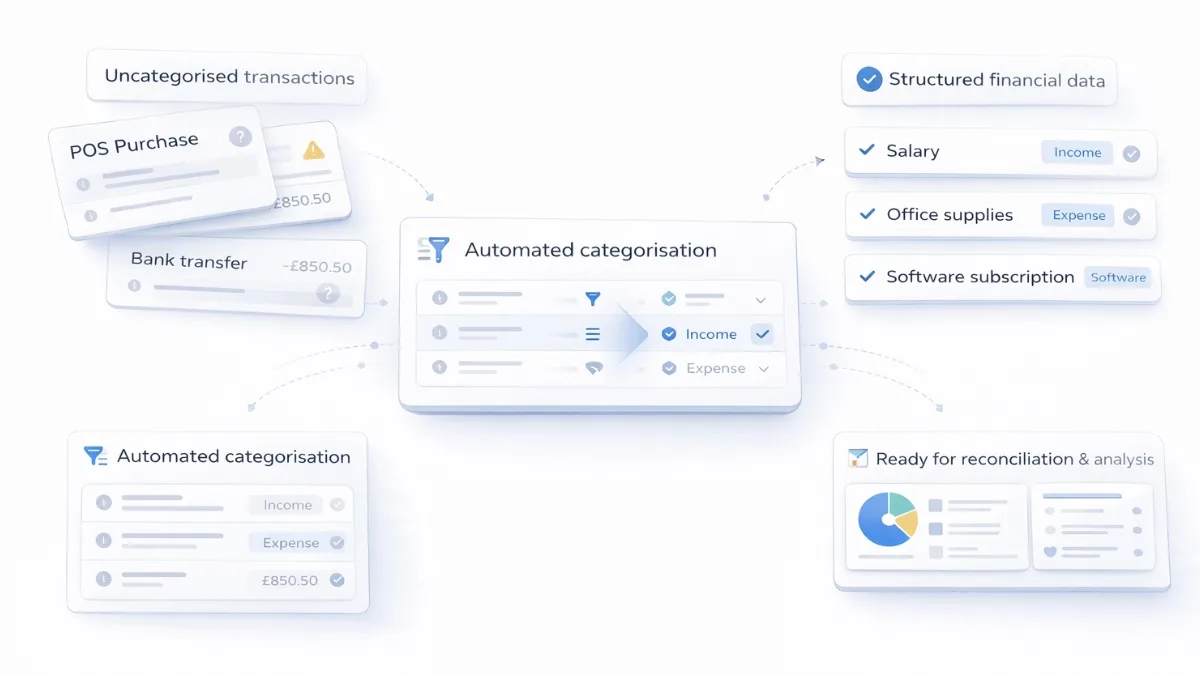
Raw transaction descriptions vary significantly by bank. Generic labels like “POS purchase” lack detail needed for accurate financial data categorisation. Manual classification becomes necessary when transaction information needs operational intervention to become useful.
Who needs categorisation automation?
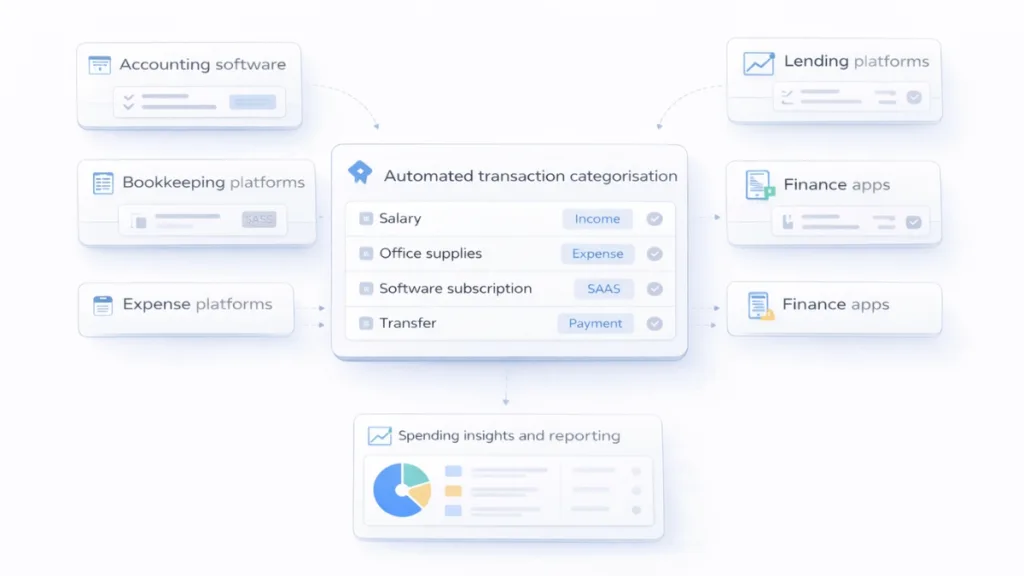
Cloud accounting software managing client expenses requires automated transaction classification. Finance teams cannot review descriptions manually when processing thousands of transactions monthly. Structured data categorisation enables reliable expense tracking.
Bookkeeping platforms handling small business finances need merchant identification supporting accurate classification.
Manual categorisation prevents scaling when client numbers grow. Automated financial data categorisation provides consistent information across accounts.
Consumer lending platforms analysing spending behaviour depend on categorised transaction data. Underwriting decisions require understanding expense patterns. Spending categories reveal financial habits that raw descriptions cannot show clearly.
Personal finance apps displaying spending insights need transaction categorisation for dashboard features.
Users expect automatic classification showing where money goes. Data categorisation infrastructure provides information supporting budgeting tools.
Expense management software tracking business spending requires accurate categories for policy compliance.
Automated classification identifies expense types instantly. Manual categorisation creates delays when employees submit receipts requiring approval.
What happens when categorisation fails?
Reconciliation workflows break when unclear transactions prevent automatic classification. Finance teams spend hours categorising manually against chart of accounts. Month-end close extends while staff process data that automated systems cannot interpret.
Financial dashboards show incomplete information when spending lacks categories. Users see generic descriptions instead of meaningful expense classifications. Product value decreases when insights depend on clarity that raw feeds cannot provide.
Engineering costs increase when teams build internal categorisation systems. Maintaining classification logic across different banks requires ongoing development effort. Product roadmaps slow when resources focus on infrastructure rather than features.
Operational scaling becomes impossible when manual classification prevents volume growth. Hiring additional staff increases costs faster than revenue. Platforms cannot compete against alternatives offering automated financial data categorisation.
Spending analysis becomes unreliable when categories are inconsistent. Budget tracking fails when expense classifications vary. Financial planning suffers when transaction categories lack accuracy that automated data categorisation provides.
What infrastructure enables categorisation automation?
Platforms need secure bank transaction access providing categorised financial information. Each platform user authenticates accounts once through banking apps.
Platforms retrieve structured data automatically without managing categorisation complexity internally.
Categorisation requirements:
- Merchant names and business identification
- Transaction categories and spending classifications
- Payment types and transaction characteristics
- Consistent structure across different banks
Data structure needs for automation:
- Standardised categories enabling unified processing
- Reliable classification supporting reconciliation
- Complete merchant details improving accuracy
- Historical consistency maintaining quality over time
Integration supporting categorisation features:
- REST APIs providing categorised transaction data
- Webhook notifications for real-time updates
- Batch retrieval supporting historical analysis
- Consistent response format simplifying automation
Consent management must be automated. Platforms cannot ask users to re-authenticate repeatedly without destroying experience. Permission tracking needs visibility into expiry dates with proactive renewal.
How does Finexer enable financial data categorisation?
Finexer provides FCA-authorised infrastructure enabling platforms to access structured bank transaction data supporting automated categorisation.
Key capabilities:
- 99% UK bank coverage
- FCA-authorised infrastructure
- Real-time webhooks
- Up to 7 years historical data
- Usage-based pricing
- White-label ready
- 2-3x faster integration
- 3-5 weeks onboarding support
- Saves up to 90% on transaction costs
Platforms integrate APIs through REST endpoints. Users authenticate accounts via secure open banking flows. Platforms receive categorised transaction information in consistent JSON format.
Transaction data includes structured fields providing merchant identification, spending categories, and payment types. Platforms write processing logic once and apply across all UK banking institutions.
Real-time webhooks notify platforms when new transactions occur. Categorised data arrives immediately. Transaction feeds continue automatically supporting continuous workflows without manual classification.
Consent lifecycle management is automated with clear permission tracking. Users receive notifications before access expires. Re-authentication happens smoothly without disrupting data categorisation workflows.
Historical transaction access extends up to seven years depending on bank support. Platforms retrieve complete categorised history enabling comprehensive analysis without manual processing.
For platforms requiring categorised bank data, reliable infrastructure removes classification bottlenecks.
Categorisation infrastructure evaluation
| Evaluation Criteria | Why It Matters | What to Look For |
|---|---|---|
| Category accuracy | Incorrect classifications create reconciliation errors | Reliable categorisation logic with high accuracy rates |
| Merchant identification | Generic descriptions prevent proper classification | Consistent merchant names and business details |
| Category consistency | Format variations require custom processing per bank | Standardised categories across all institutions |
| UK bank coverage | Users cannot access categorised data from unsupported accounts | 99% coverage including challengers and building societies |
| Historical categorisation | Past transactions need same quality as current data | Consistent categorisation depth across time periods |
| API reliability | Categorisation failures disrupt financial workflows | Proven uptime metrics with real-time monitoring |
Platforms building transaction categorisation features should confirm infrastructure supports automation requirements.
What we see in practice
Most platforms underestimate the engineering cost of building categorisation systems internally. Initial manual classification appears manageable but scaling becomes impossible when transaction volumes grow.
Merchant identification quality determines categorisation accuracy. Platforms receiving generic descriptions cannot classify reliably. Manual intervention becomes necessary when transaction details lack sufficient information.
Category consistency affects reconciliation across different banks. Platforms must maintain separate logic when categorisation quality varies by institution. Unified processing becomes possible only with standardised financial data categorisation.
Engineering teams discover maintenance burden after initial integration. Banks change transaction formats without notice. Categorisation systems require constant updates when built internally rather than consumed as infrastructure.
For platforms requiring enriched transaction data, reliable connectivity determines classification quality.
Common use cases
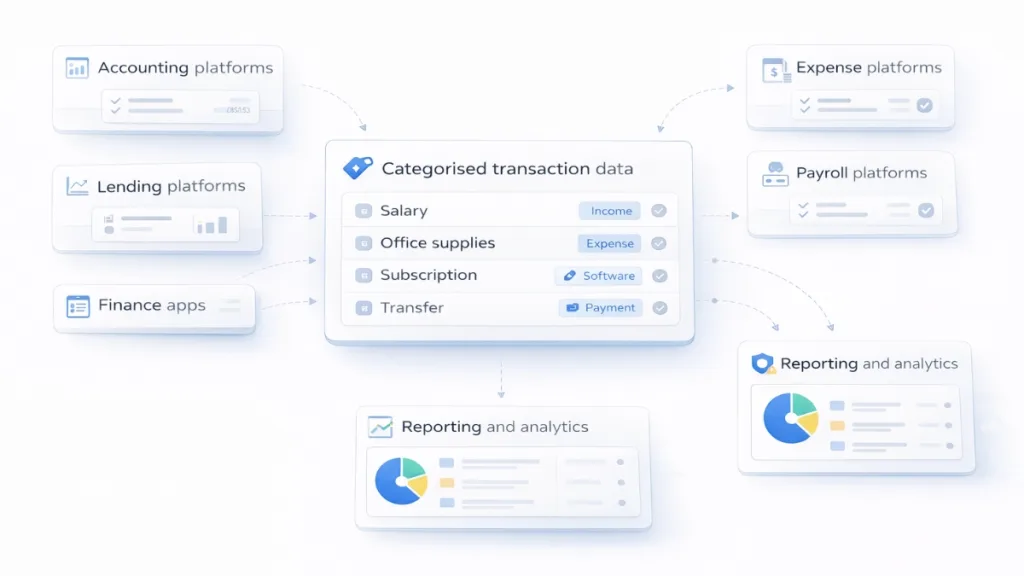
Accounting platforms:
- Retrieve categorised transaction data for automated expense tracking
- Access spending categories enabling accurate classification
- Use structured data supporting reconciliation workflows
- Build financial reporting using consistent categories
Lending platforms:
- Analyse spending patterns using categorised transaction details
- Assess financial behaviour from structured data
- Retrieve complete categorised history for underwriting
- Enable risk profiling using merchant and category information
Personal finance apps:
- Build spending dashboards using categorised data
- Display insights with automatic transaction classification
- Create budget tools using structured categories
- Enable financial planning features using reliable categorisation
Expense management platforms:
- Categorise business spending automatically
- Track expenses using structured classifications
- Automate policy compliance using category information
- Build reporting features using consistent data
Payroll platforms:
- Identify salary transactions using categorised data
- Track payroll-related expenses automatically
- Categorise financial activity for reporting
- Build analytics using structured information
What are the 5 levels of data classification?
Data classification typically includes public, internal, confidential, restricted, and highly confidential levels. Financial data categorisation for platforms involves transaction type, merchant category, spending classification, income identification, and payment categorisation.
What is data classification for financial information?
Data categorisation for financial platforms structures transaction information into spending categories, merchant types, and payment classifications. Platforms access categorised bank data through APIs enabling automated workflows.
Why do platforms need financial data categorisation?
Raw transaction descriptions prevent automation. Platforms need categorised data enabling reconciliation, analysis, and dashboard features without operational overhead processing unclear information.
How does automated categorisation work?
Platforms integrate APIs retrieving bank transaction data through open banking. Infrastructure provides categorised information with merchant identification and spending classifications rather than generic descriptions.
What are the 8 financial sectors?
Financial sector classifications include banking, insurance, investments, real estate, fintech, accounting, payments, and wealth management. Transaction categorisation organises spending into relevant sectors supporting financial analysis.
Access structured financial data categorisation with automated transaction classification and merchant identification.
About the Author

Ravi Ranjan
Ravi Ranjan is Co founder & CEO of Finexer