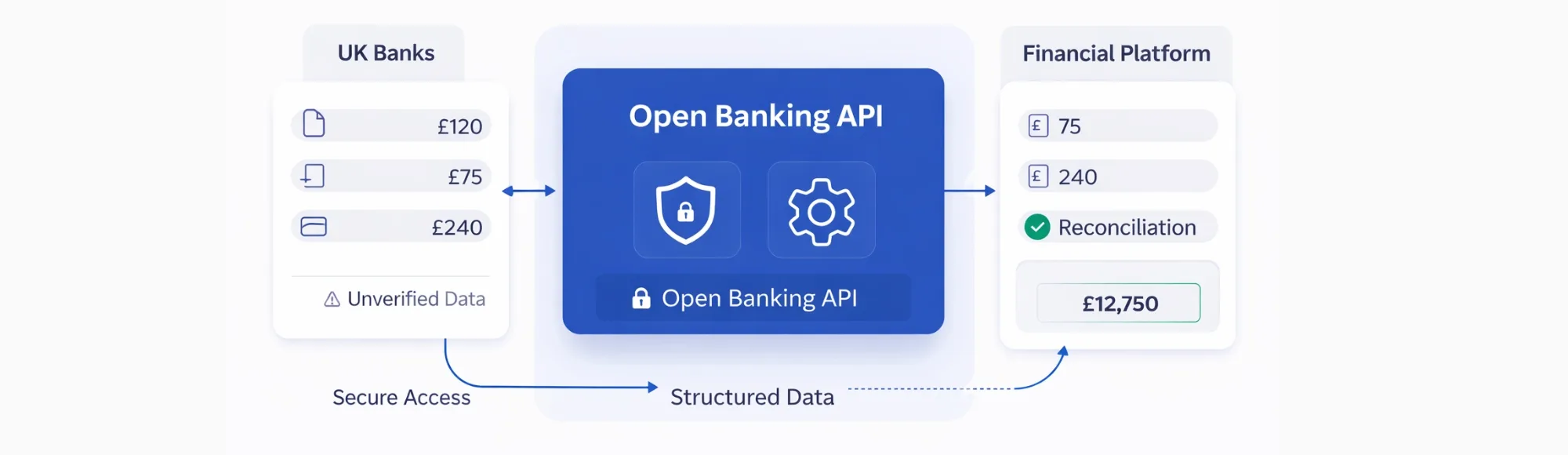
Need reliable bank data connectivity for your platform?
Finexer gives UK financial platforms FCA-authorised API access to bank transaction data.
Every financial platform eventually hits the same ceiling. The automation logic is built. The workflows are designed. But the data feeding them arrives late, in inconsistent formats, or requires a manual step to collect.
That ceiling is a data connectivity problem. Not a product problem.
At Finexer, we work with UK accounting platforms, LawTech tools, EPOS systems, and payroll infrastructure that have replaced fragmented bank data collection with direct API connectivity.
The operational difference is significant – workflows that required daily manual input run automatically once bank data flows directly into the system.
This blog explains what data connectivity means for financial platforms, why legacy approaches fall short, and how Open Banking infrastructure solves the problem.
TL;DR
Data connectivity for financial platforms means secure, API-based access to bank transaction data across multiple banks – without manual uploads or screen scraping. Finexer provides FCA-authorised Open Banking infrastructure combining AIS for bank data access and PIS for payment initiation, giving UK financial data platforms a single connectivity layer for transaction data and payments.
Key Takeaways
What is data connectivity in financial platforms?
Data connectivity refers to the infrastructure that allows financial platforms to retrieve bank transaction data securely through APIs. In Open Banking ecosystems, this enables platforms to access transaction history, account balances, and payment confirmations directly from banks with user consent.
Why do financial platforms struggle with bank data connectivity?
Each UK bank has different interfaces and data formats. Building and maintaining individual bank connections requires significant engineering resources. Legacy approaches like screen scraping introduce security risks and data inaccuracies that break automation workflows.
What does a financial data platform provide as a connectivity layer?
A financial data platform standardises API access across multiple banks – returning structured transaction data in consistent formats that platform workflows can process automatically without bank-specific customisation.
Which financial workflows depend on reliable data connectivity?
Reconciliation, payment verification, affordability assessment, source-of-funds checks, invoice settlement confirmation, and financial reporting all require structured, timely bank transaction data to function without manual steps.
What does Finexer provide for financial platform data connectivity?
Finexer provides FCA-authorised AIS for bank transaction data access and PIS for payment initiation – covering 99% of UK banks through a single API integration with structured outputs and real-time webhooks.
What Is Data Connectivity in Financial Systems?
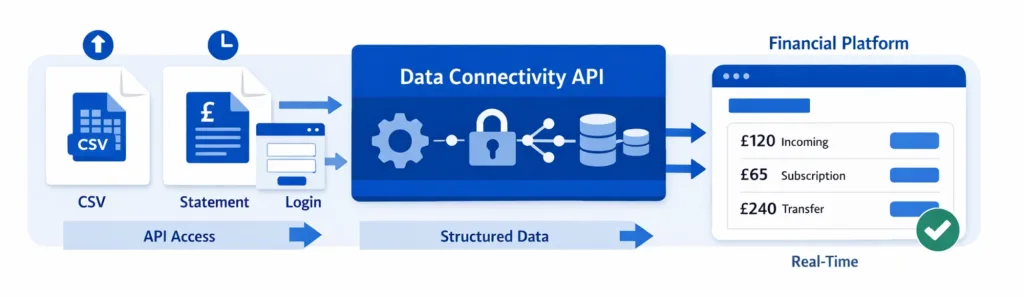
Data connectivity is the infrastructure layer that sits between a financial platform and the banks its users hold accounts with.
Without it, platforms retrieve bank data through:
- Manual CSV exports from banking portals
- Scheduled batch imports from aggregators
- Screen scraping – which shares credentials and produces unreliable data
Each approach introduces the same problems. Data arrives late. Formats are inconsistent. Manual steps create bottlenecks that scale with volume rather than staying flat.
API-based data connectivity removes these steps entirely. The platform connects once to a regulated Open Banking provider. Bank transaction data flows directly into the system – structured, real-time, and consistent across all connected banks.
“A financial data platform is only as reliable as its bank connectivity layer. If data arrives in batches or requires manual collection, the automation built on top of it is fragile.” – Yuri, Finexer
Why Legacy Bank Data Collection Falls Short
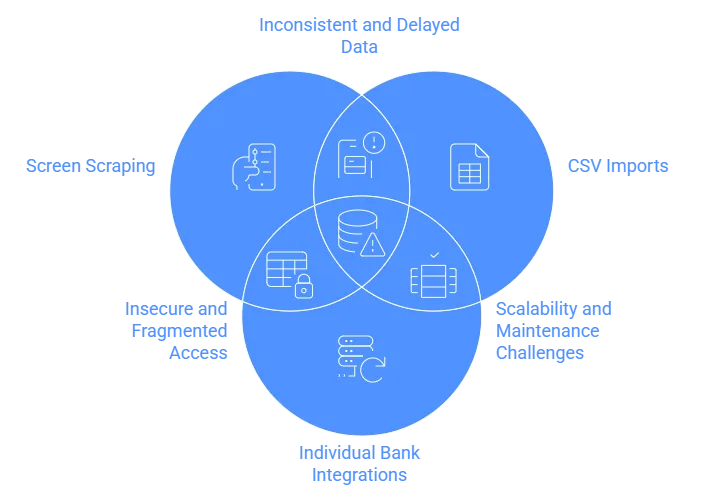
Screen Scraping Creates Security and Accuracy Problems
Screen scraping retrieves bank data by simulating user login sessions. It requires credential sharing, produces inconsistent data quality, and breaks when banks update their interfaces. It is also non-compliant with UK Open Banking regulation – FCA-authorised data access requires consent-based API connectivity, not credential harvesting.
CSV Imports Introduce Latency at Every Step
Batch imports work at low volume. At scale, they create reconciliation delays, reporting inaccuracies, and finance team workload that grows linearly with transaction volume. A platform processing thousands of daily transactions cannot reconcile accurately on yesterday’s data.
Individual Bank Integrations Are Unsustainable
Building direct connections to individual banks requires separate API integrations per institution, ongoing maintenance as bank interfaces change, and security certifications per connection. For platforms serving clients across multiple UK banks, this is not a viable engineering approach.
The FCA’s Open Banking and Open Finance research outlines how regulated API connectivity addresses these structural problems in UK financial data access.
How Open Banking Provides Secure Data Connectivity
Open Banking solves the multi-bank connectivity problem through a standardised, regulated API layer.
FCA-authorised providers connect to UK banks on behalf of platforms – handling authentication, consent management, and data retrieval. Platforms receive structured transaction data without building or maintaining individual bank connections.
Two services enable this:
AIS – Account Information Services Retrieves bank transaction data, account balances, and financial history with user consent. Read-only. Cannot initiate payments.
PIS – Payment Initiation Services Initiates account-to-account payments directly from a user’s bank account. Enables Pay by Bank and direct payment flows within platform workflows.
How Finexer’s data aggregation infrastructure works covers the technical data access layer in detail.
How Should Platforms Evaluate Financial Data Connectivity Infrastructure?
| Criteria | Why It Matters | What to Look For |
|---|---|---|
| UK Bank Coverage | Gaps in coverage create incomplete financial pictures for users on smaller banks | 99% UK bank coverage; CMA9 and challenger banks included |
| Data Structure | Consistent formats are required for automated field mapping in platform workflows | Structured JSON outputs; merchant IDs; category codes; standardised schema |
| Real-Time Events | Reconciliation and verification workflows need transactions as they settle | Webhook-driven events; live balance data; real-time transaction feeds |
| FCA Authorisation | UK platforms must use regulated providers for compliant bank data access | FCA-authorised AIS and PIS; GDPR-compliant; consent-based access |
| Payment Capability | Platforms combining data access and payments need both in one connectivity layer | PIS for Pay by Bank; A2A payment initiation; webhook payment confirmation |
| Integration Speed | Product teams need deployment timelines that fit roadmap cycles | Rapid deployment; 3-5 weeks onboarding support; well-documented APIs |
How Does Finexer Provide Financial Data Connectivity?
Finexer is an FCA-authorised Open Banking infrastructure provider offering a unified data connectivity layer for UK financial platforms.
What Finexer provides:
- AIS connectivity covering 99% of UK bank accounts
- PIS for Pay by Bank and account-to-account payment initiation
- Real-time webhooks for live transaction and payment events
- Structured JSON outputs with merchant identification and category data
- FCA-compliant consent flows with granular permissions and instant revocation
- White-label capability for branded bank connection journeys
- Usage-based pricing with no fixed volume commitments
Finexer Connect enables platforms to manage financial accounts on behalf of users – extending data connectivity beyond read-only access.
How financial data platform integration works with Open Banking covers the integration architecture in detail.
Finexer does not provide financial analysis software or reporting tools. Platforms build those layers on top of Finexer’s data connectivity infrastructure.
What I Feel
Platforms often treat bank data connectivity as a late-stage infrastructure decision – something to solve after the product logic is built. That is the wrong order.
The quality of financial workflows depends entirely on the data feeding them. A reconciliation engine built on CSV imports will always be one manual step away from breaking. The connectivity layer is not plumbing. It is the foundation.
UK platforms have a genuine advantage here – FCA-regulated Open Banking means standardised, consent-based API access across all major banks. That infrastructure exists. The question is whether platforms use it or work around it.
Common Use Cases

Accounting & ERP Platforms
Accounting platforms use Finexer’s AIS to replace CSV bank imports with direct transaction feeds – powering reconciliation, financial reporting, and balance tracking from live bank data.
LawTech Platforms
LawTech platforms – including insolvency practices – use AIS data connectivity to access verified client financial history for source-of-funds checks and KYC workflows.
EPOS & Payment Platforms
EPOS platforms connect payment confirmation workflows to bank transaction data via AIS – verifying Pay by Bank settlement without end-of-day batch reports.
Payroll & Invoicing Platforms
Payroll platforms use AIS for settlement verification and PIS for automated contractor disbursements – combining data connectivity and payment initiation in one integration.
Proptech & Real Estate Platforms
PropTech platforms use AIS data connectivity to retrieve tenant bank transaction history for affordability assessment and income verification during onboarding.
Utility Billing Platforms
Utility platforms use AIS to verify customer payment activity and PIS for Request-to-Pay billing – replacing manual payment tracking with direct bank data connectivity.
What is data connectivity in financial platforms?
Data connectivity refers to the infrastructure that allows financial platforms to access bank transaction data securely through APIs. In UK Open Banking, this means FCA-authorised AIS connectivity that retrieves transaction history, account balances, and payment confirmations directly from banks with user consent – replacing manual imports and screen scraping.
Why do financial platforms need a financial data platform for bank connectivity?
Building individual bank connections requires separate integrations, ongoing maintenance, and security certifications per institution. A financial data platform standardises access across all UK banks through a single API – returning structured data in consistent formats without platform teams maintaining individual bank relationships.
Is Finexer suitable for financial platforms needing multi-bank data connectivity?
Yes. Finexer is FCA-authorised and provides AIS infrastructure covering 99% of UK banks through a single integration. Financial platforms connect once and retrieve structured bank transaction data across all supported institutions – with real-time webhooks and consent-based access.
Build on reliable bank data connectivity with FCA-authorised infrastructure.
About the Author

Yuri
Yuriy Yakushko is the Founder of Finexer, an FCA-authorised Open Banking platform that enables businesses to access real-time bank data and Pay-by-Bank payments through secure API infrastructure. With more than 20 years of experience in fintech and software engineering, he focuses on building scalable financial technology that helps businesses modernise payments and financial data workflows.