Building financial automation into your ERP platform?
Finexer gives accounting and ERP platforms direct bank data access and payment initiation – API-ready, FCA-authorised.
Most ERP platforms have automation built into their operational logic. Workflows trigger. Records update. Reports generate. But when those workflows hit a financial data step – bank reconciliation, payment confirmation, invoice settlement – the automation stops.
The reason is consistent. Financial data does not flow into ERP systems automatically. It arrives via CSV export, manual upload, or scheduled batch import. The automation layer is only as good as the data feeding it – and manual data collection is a ceiling, not a foundation.
At Finexer, we work with UK accounting platforms and ERP software providers that have replaced manual bank data collection with direct Open Banking API connectivity. The difference is not incremental. Reconciliation workflows that previously required daily manual input run automatically. Invoice payment confirmation that depended on batch reports now arrives via real-time webhook.
This blog is written for Product Managers, Engineering Managers, and Finance Operations leads at accounting and ERP platforms evaluating bank data integration for financial workflow automation. It explains how ERP automation works in financial systems and where Open Banking infrastructure fits.
TL;DR
ERP automation in financial systems depends on reliable, structured bank transaction data. Without a direct bank data connection, reconciliation, payment confirmation, and reporting workflows require manual input that limits automation at scale. Finexer provides FCA-authorised AIS for bank transaction data access and PIS for payment initiation – enabling accounting and ERP platforms to automate financial workflows directly within their systems.
Key Takeaways
What is ERP automation in financial systems?
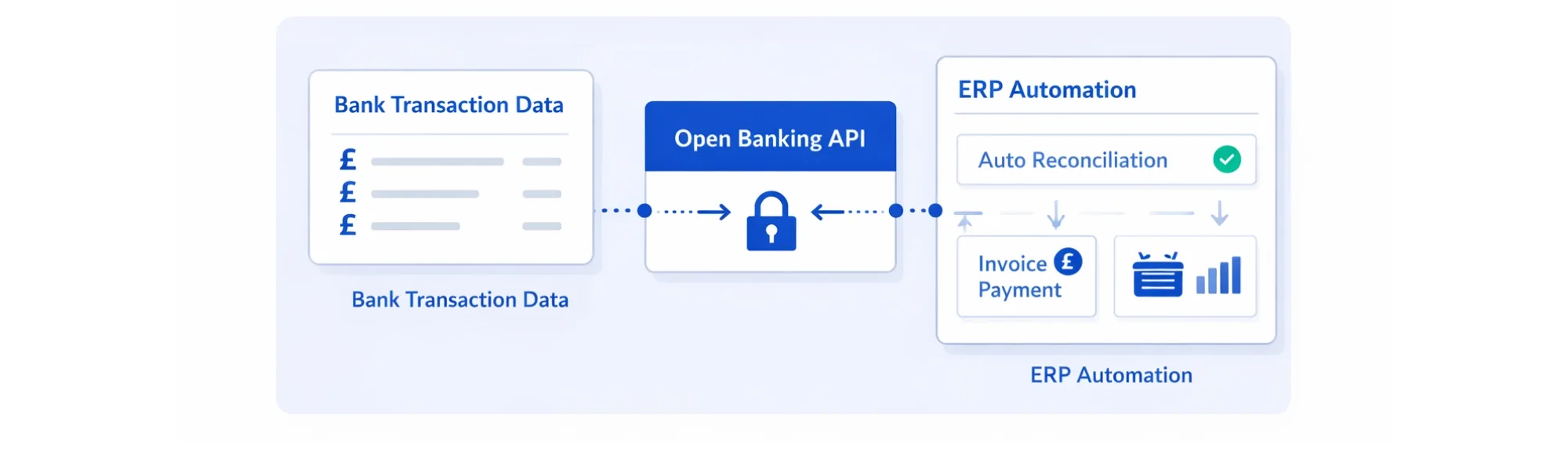
ERP automation refers to software-driven execution of financial workflows – reconciliation, payment processing, invoice settlement, and reporting – without manual intervention. In financial ERP systems, automation depends on structured, real-time bank transaction data flowing directly into the platform.
Why does manual bank data collection limit ERP automation?
Manual bank statement uploads and CSV imports introduce data latency, formatting inconsistencies, and human error. Automation workflows built on manually collected data break at the data collection step – creating a ceiling on how far financial processes can be automated.
How does Open Banking enable ERP automation?
Open Banking AIS APIs retrieve bank transaction data directly from source with user consent – replacing manual uploads with structured, real-time feeds. PIS APIs initiate payments from within the ERP system – removing external payment tools from invoice and supplier payment workflows.
Which ERP financial workflows can be automated with bank data?
Bank reconciliation, transaction categorisation, invoice payment processing, supplier payment automation, payment confirmation, and financial reporting can all be automated when ERP platforms have direct bank data connectivity.
What does Finexer provide for ERP automation?
Finexer provides FCA-authorised AIS for bank transaction data retrieval and PIS for account-to-account payment initiation – covering 99% of UK banks with structured API outputs and real-time webhooks for ERP workflow automation.
What Is ERP Automation in Financial Systems?
What is ERP automation, specifically in a financial context? It is the elimination of manual steps from financial workflows by connecting ERP systems directly to the data sources and payment infrastructure those workflows depend on.
Generic ERP automation covers HR, supply chain, and procurement. Financial ERP automation is different. It focuses on:
- Bank reconciliation – matching transactions to records automatically
- Payment processing – initiating and confirming payments without manual steps
- Invoice settlement – confirming payment receipt and updating records
- Financial reporting – generating accurate reports from live financial data
Each of these workflows shares the same dependency. They need structured, timely, accurate bank transaction data. Without it, automation either does not start or breaks partway through.
“What is ERP automation without reliable bank data? It is workflow logic waiting on a manual step that never fully disappears.” – Yuri, Finexer Infrastructure Team
Why Do Financial Workflows Resist Automation in ERP Systems?
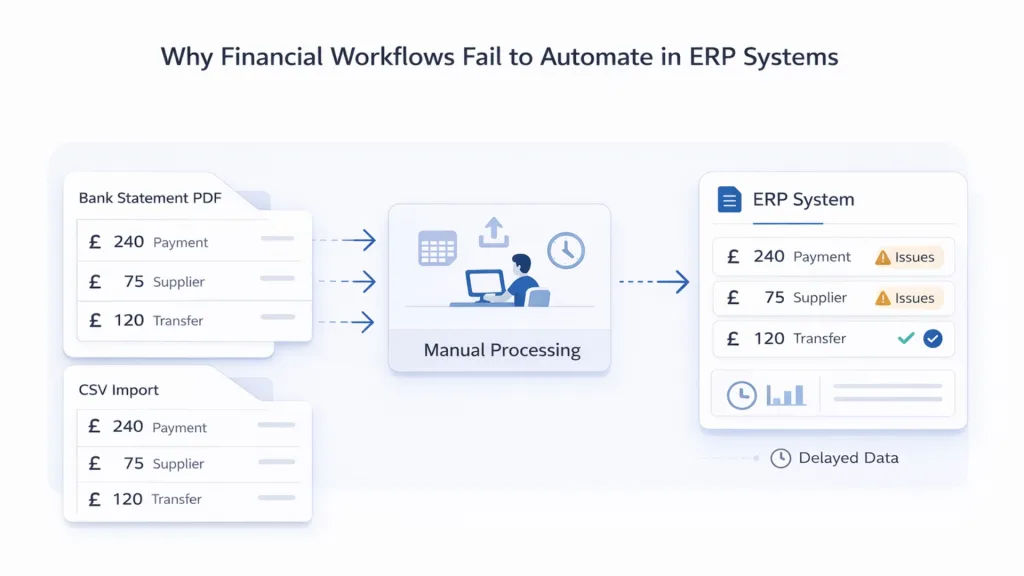
ERP platforms are built for automation. The logic exists. The workflow architecture is in place. The bottleneck is almost always the same – financial data arrives too late, in the wrong format, or requires a human to collect it.
The Manual Bank Data Problem
Most ERP platforms access bank data through one of three methods:
- Manual bank statement downloads and uploads
- Scheduled CSV imports from banking portals
- End-of-day batch feeds from banking aggregators
Each introduces latency. A transaction that settles at 10am may not appear in the ERP system until the next morning. Reconciliation runs on yesterday’s data. Payment confirmations arrive in batch, not in real time.
For a platform processing dozens of transactions daily, this is manageable. For a platform processing hundreds or thousands, it creates reconciliation backlogs, reporting inaccuracies, and finance team workload that scales with transaction volume rather than staying flat.
The Disconnected Payment Problem
Invoice and supplier payments in most ERP systems require external action. A finance team member logs into a banking portal. Approves the payment manually. Returns to the ERP to update the record. This multi-system workflow is a manual step embedded inside what should be an automated process.
How accounting workflow automation works for finance teams covers the operational impact of these manual steps in detail.
How Does Open Banking Enable ERP Automation?
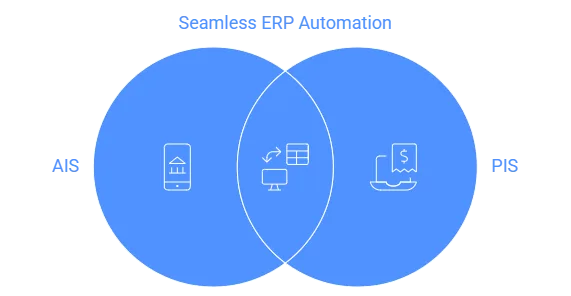
Open Banking solves both problems – data latency and payment disconnection – through two API services that ERP platforms can integrate directly.
AIS – Bank Transaction Data for Reconciliation Automation
Account Information Services (AIS) allow ERP platforms to retrieve bank transaction data directly from a user’s bank account with consent. Instead of waiting for a CSV export, the platform pulls structured transaction data via API.
What ERP systems receive through AIS:
- Transaction history with merchant identifiers and category codes
- Account balances updated in real time
- Payment confirmations at transaction level
- Structured JSON outputs compatible with ERP data models
Reconciliation workflows that previously required manual bank statement review run automatically against live bank data. Transactions are matched to records as they settle – not at the end of day.
PIS – Payment Initiation for Invoice and Supplier Automation
Payment Initiation Services (PIS) allow ERP platforms to initiate account-to-account payments directly from within the system. Invoice payment, supplier payment, and contractor disbursement workflows execute from the ERP – without requiring a separate banking portal login.
What PIS enables inside ERP systems:
- Pay by Bank invoice payment initiated at approval stage
- Supplier payments triggered by workflow conditions
- Real-time payment confirmation via webhook
- Automatic record update on payment settlement
The manual step of leaving the ERP to initiate a payment externally is removed entirely.
How automation of accounting processes works with bank data explains how these two capabilities combine in practice.
How Should ERP Platforms Evaluate Bank Data Integration for Automation?
| Automation Requirement | Why It Matters | What to Look For |
|---|---|---|
| Real-Time Transaction Data | Reconciliation automation requires transactions as they settle – not end-of-day batches | AIS with real-time webhooks; live balance data; event-driven transaction feeds |
| Structured Data Output | ERP data models require consistently formatted inputs for automated field mapping | Structured JSON outputs; merchant IDs; category codes; standardised transaction schema |
| Payment Initiation Inside ERP | Invoice and supplier automation requires payment initiation from within the ERP workflow | PIS API; Pay by Bank support; webhook payment confirmation; account-to-account transfers |
| UK Bank Coverage | ERP platforms serving UK clients need data from all major UK banks – not just CMA9 | 99% UK bank coverage; CMA9 and challenger banks; consistent data formats across institutions |
| Transaction History Depth | Financial reporting and audit workflows require historical data beyond 90 days | Up to 7 years of transaction history; configurable lookback periods |
| Integration Speed | Engineering teams need deployment timelines that match product roadmap cycles | 2-3x faster integration vs alternatives; 3-5 weeks onboarding support; well-documented APIs |
How Does Finexer Enable ERP Automation for UK Platforms?
Finexer provides FCA-authorised Open Banking infrastructure for UK accounting and ERP platforms – combining AIS for bank transaction data access and PIS for payment initiation in one integration layer.
What Finexer’s Infrastructure Provides for ERP Automation
- AIS connectivity covering 99% of UK bank accounts for automated transaction data retrieval
- PIS infrastructure for Pay by Bank invoice and supplier payment initiation within ERP workflows
- Real-time webhooks delivering transaction events as they occur – not in batches
- Structured JSON transaction outputs with merchant identification and category codes
- Up to 7 years of transaction history for reporting and audit automation
- FCA-compliant consent flows with granular permissions and instant revocation
- White-label capability for branded bank connection journeys within ERP products
- 2-3x faster integration versus alternative providers with 3-5 weeks onboarding support
- Usage-based pricing – costs scale with transaction volume, not fixed overhead
ERP platforms integrate Finexer’s APIs once. Bank data flows automatically into reconciliation workflows. Payments initiate from within the ERP system. Manual steps between financial data and workflow execution are removed.
Finexer’s Accounting and ERP use case page covers the full product capabilities available for accounting platform integration.
Finexer does not provide ERP software, reconciliation engines, or financial reporting tools. ERP platforms build those product layers on top of Finexer’s bank data and payment infrastructure.
What I Feel
Accounting and ERP platforms integrating bank data infrastructure follow a predictable adoption pattern. The first integration almost always targets one specific bottleneck – usually bank reconciliation or invoice payment confirmation.
The scope expands quickly. Once structured bank transaction data is flowing into the ERP system in real time, engineering teams find additional workflow steps that were previously blocked by data latency. Reporting workflows that ran on weekly batch imports run daily. Categorisation that required manual review runs automatically against enriched transaction data.
A pattern we observe consistently: a UK accounting SaaS platform integrates Finexer’s AIS to replace daily CSV bank statement imports. Within two months, the same data feed powers automated reconciliation, client financial reporting, and transaction categorisation – three separate manual workflows replaced by one bank data connection.
“ERP automation stalls at the data boundary. Once bank transaction data flows directly into the system, the automation logic that was already built starts working as intended.” – Yuri, Finexer Infrastructure Team
ERP platforms using Finexer’s bank data integration for automation report:
- Reconciliation workflows running automatically against real-time bank data
- Invoice payment confirmation arriving via webhook rather than batch settlement reports
- Financial reporting accuracy improving from live data versus delayed imports
- Engineering time saved on manual data pipeline maintenance
Common Use Cases
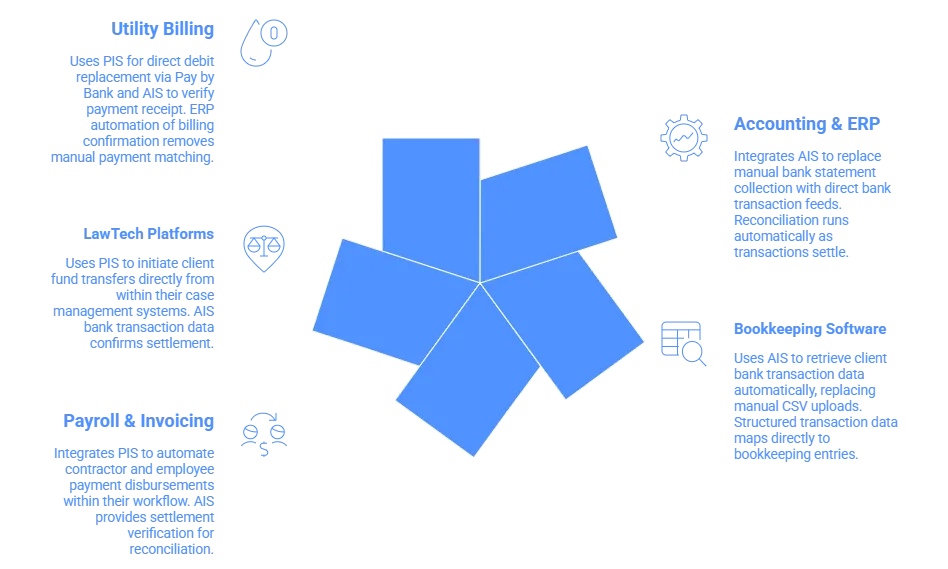
Accounting & ERP Platforms
Accounting platforms integrate Finexer’s AIS to replace manual bank statement collection with direct bank transaction feeds. Reconciliation runs automatically as transactions settle. Financial reporting generates from live data. Invoice payment workflows use PIS to initiate Pay by Bank payments directly within the accounting system – removing the external banking portal step entirely.
Bookkeeping Software Providers
Bookkeeping platforms use Finexer’s AIS to retrieve client bank transaction data automatically – replacing manual CSV uploads and end-of-day imports. Structured transaction data with merchant identifiers and category codes maps directly to bookkeeping entries, reducing manual categorisation workload for bookkeepers managing multiple client accounts.
Payroll & Invoicing Platforms
Payroll platforms integrate PIS to automate contractor and employee payment disbursements within their workflow – payments initiate from the platform at approval stage, with real-time confirmation via webhook. AIS provides settlement verification for reconciliation and payment record accuracy.
LawTech Platforms
LawTech platforms managing client billing and disbursement workflows use PIS to initiate client fund transfers directly from within their case management systems. AIS bank transaction data confirms settlement and supports the compliant financial audit trails that regulated legal workflows require.
Utility Billing Platforms
Utility billing platforms use Finexer’s PIS for direct debit replacement via Pay by Bank and AIS to verify payment receipt and update billing records automatically. ERP automation of billing confirmation and account status update removes manual payment matching from high-volume utility billing workflows.
What is ERP automation in financial operations?
ERP automation in financial operations refers to the use of software to execute financial workflows – reconciliation, payment processing, invoice settlement, and reporting – without manual steps. In modern financial ERP systems, this depends on structured bank transaction data flowing directly into the platform via Open Banking AIS APIs and payment initiation via PIS APIs.
How does Open Banking improve ERP automation for accounting platforms?
Open Banking AIS APIs retrieve bank transaction data directly from source with user consent – replacing manual CSV imports with real-time structured feeds. PIS APIs initiate payments from within the ERP system – removing the external banking portal step from invoice and supplier payment workflows. Together they remove the two most common manual bottlenecks in financial ERP automation.
Is Finexer suitable for accounting and ERP platforms building financial automation?
Yes. Finexer is FCA-authorised and provides AIS for bank transaction data retrieval and PIS for payment initiation – covering 99% of UK banks. Accounting and ERP platforms integrate Finexer’s APIs to automate reconciliation, invoice payment, and financial reporting workflows directly within their systems.
Stop waiting on manual bank data. Automate financial workflows with direct bank connectivity.
About the Author

Yuri
Yuriy Yakushko is the Founder of Finexer, an FCA-authorised Open Banking platform that enables businesses to access real-time bank data and Pay-by-Bank payments through secure API infrastructure. With more than 20 years of experience in fintech and software engineering, he focuses on building scalable financial technology that helps businesses modernise payments and financial data workflows.