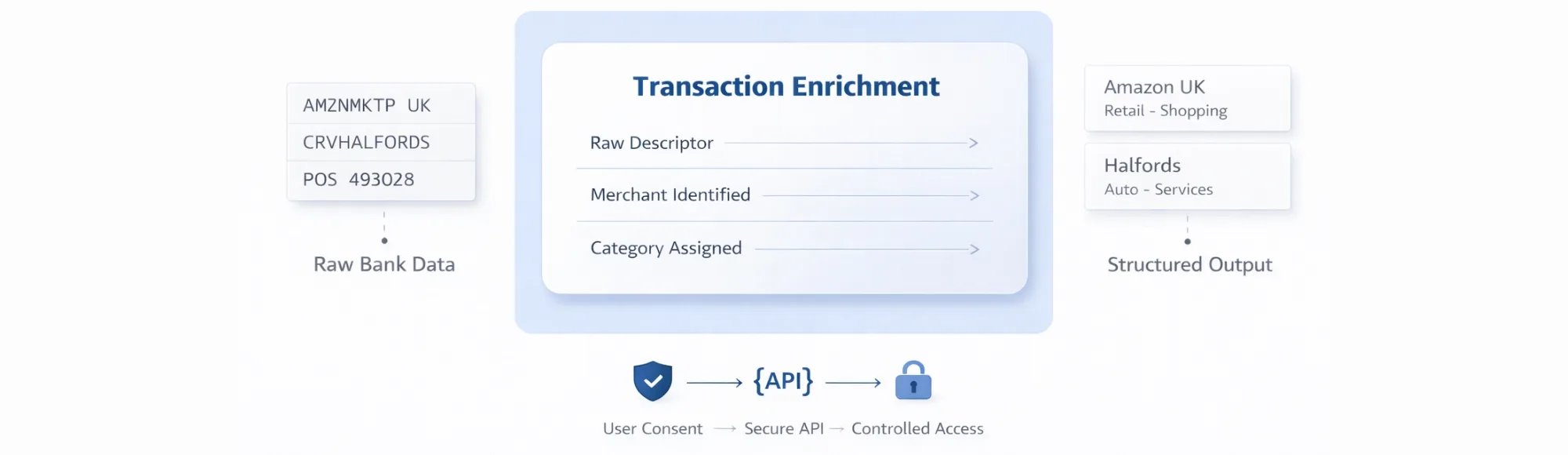
Evaluating data enrichment tools for financial workflows?
Access structured transaction data with merchant identification.
UK financial platforms cannot build reliable features when transaction data lacks structure and merchant clarity. Accounting SaaS, lending platforms, and LawTech products need data enrichment tools providing transaction categorisation, merchant identification, and structured outputs enabling financial automation.
Generic data enrichment tools serving B2B sales and marketing cannot handle financial transaction processing. UK financial platforms require transaction-specific enrichment providing merchant identification, spending categorisation, and Open Banking integration.
This explains how UK platforms evaluate data enrichment tools for financial use cases, what capabilities matter for transaction processing, and why infrastructure integration determines automation success.
Key Takeaways
Why do financial platforms need specialized enrichment?
Generic data enrichment tools serve B2B sales and marketing. Financial platforms need transaction-specific enrichment providing merchant identification, spending categorisation, and structured financial data integrated with Open Banking infrastructure.
What breaks without proper transaction enrichment?
Raw transaction descriptors prevent automated categorisation. Unclear merchant names break reconciliation. Missing counterparty intelligence blocks AML workflows. Manual data cleanup consumes operational capacity.
What capabilities should platforms prioritise?
Merchant identification accuracy, transaction categorisation reliability, Open Banking integration, real-time processing capability, UK bank coverage, compliance-grade outputs, API-first architecture.
How do enrichment tools integrate with workflows?
Best data enrichment tools provide API connectivity receiving raw transaction data, returning structured enrichment including merchant details, category assignments, and metadata enabling automated processing.
Where does Finexer provide enrichment?
Finexer operates Open Banking connectivity using FCA-authorised infrastructure. Platforms access verified bank transaction data with merchant identification and categorisation through APIs.
Why financial platforms need transaction enrichment
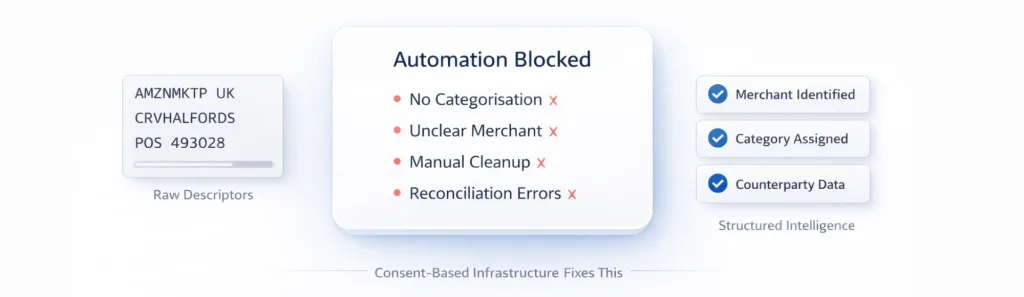
Accounting SaaS platforms cannot automate reconciliation when transaction descriptions arrive as cryptic bank codes. “AMZNMKTP UK” requires merchant identification. “CRVHALFORDS” needs category assignment. Manual interpretation prevents automation.
Operational problems without enrichment:
- Raw transaction descriptors block automated workflows
- Unclear merchant names prevent accurate categorisation
- Missing counterparty intelligence breaks compliance checks
- Manual data cleanup consumes staff time
- Reconciliation errors require investigation
- User experience suffers from confusing descriptions
Lending platforms performing cash flow underwriting cannot analyse spending patterns when transaction data lacks categorisation. LawTech platforms monitoring client accounts need merchant intelligence for proper oversight.
Financial platforms require transaction-specific data enrichment tools integrated with bank data infrastructure enabling automated workflows.
What capabilities matter for financial enrichment

- Merchant identification: Convert raw transaction descriptors into clean merchant names. Match against a comprehensive merchant database. Provide business details including location and category. Handle international transactions accurately.
- Transaction categorisation: Assign spending categories automatically. Support personal and business classification. Enable custom category mapping. Maintain consistency across transactions. Provide confidence scores.
- Open Banking integration: Process bank transaction data directly. Handle multiple UK bank formats. Support real-time and batch enrichment. Integrate with AIS infrastructure. Maintain consent-based access.
- Compliance-grade outputs: Provide audit-ready categorisation logs. Support regulatory reporting requirements. Enable AML workflow integration. Maintain data provenance. Support retention policies.
- API-first architecture: REST APIs enabling platform integration. Webhook notifications for real-time processing. Batch endpoints for historical enrichment. Consistent response formats. Comprehensive error handling.
For platforms requiring transaction data enrichment, infrastructure integration determines success.
Data enrichment tools evaluation framework
| Criteria | Why It Matters | What to Look For |
|---|---|---|
| Merchant database depth | Long-tail merchants break generic tools | 100M+ merchant coverage with UK specialisation |
| Categorisation accuracy | Incorrect categories break automation | 95%+ accuracy with confidence scoring |
| Processing latency | Real-time workflows require speed | Sub-100ms response for authorisation flows |
| Open Banking integration | Manual data flows prevent automation | Native AIS connectivity with UK banks |
| API reliability | Downtime breaks financial workflows | Proven uptime metrics with monitoring |
| Compliance support | Audit trails require structured logs | Audit-ready outputs with provenance tracking |
Common evaluation mistakes
- Choosing generic enrichment tools: Sales intelligence and CRM enrichment cannot handle transaction-specific requirements. Financial platforms need specialized transaction enrichment integrated with bank data infrastructure.
- Ignoring latency requirements: Batch-only processing delays real-time features. Payment authorisation requires sub-100ms responses. Data enrichment tools must support immediate processing.
- Overlooking UK bank compatibility: Tools optimised for other markets lack UK merchant coverage. Transaction formats vary by region. Platforms need UK-specialised enrichment.
- Underestimating long-tail complexity: Initial accuracy covers common merchants. Edge cases consume engineering effort. Best data enrichment tools handle uncommon transactions accurately.
- Missing compliance requirements: Generic tools lack audit-ready outputs. Financial platforms need categorisation logs supporting regulatory reporting. Compliance-grade enrichment prevents gaps.
For platforms comparing data enrichment approaches, infrastructure matters critically.
How Finexer enables transaction enrichment
Finexer operates Open Banking connectivity using FCA-authorised infrastructure enabling platforms to access verified bank transaction data with enrichment capabilities.
Key capabilities:
- 99% UK bank coverage
- FCA-authorised infrastructure
- Merchant identification (100M+ database)
- Transaction categorisation (95%+ accuracy)
- Real-time enrichment (<100ms latency)
- Up to 7 years historical data
- Usage-based pricing
- White-label ready
- 2-3x faster integration
- 3-5 weeks onboarding support
- Saves up to 90% on transaction costs
Platforms integrate enrichment APIs through REST endpoints. Bank transaction data flows through Open Banking infrastructure. Enrichment happens automatically providing merchant details and category assignments.
Real-time webhooks deliver enriched transactions immediately. Batch processing handles historical enrichment. Structured outputs enable automated workflows without manual intervention.
Critical positioning:
Finexer does not provide generic B2B enrichment or CRM data. Platforms control workflow logic and categorisation rules.
Finexer provides transaction-specific enrichment integrated with Open Banking infrastructure enabling financial automation.
Common use cases
Accounting SaaS platforms:
- Automate expense categorisation using enriched transaction data
- Provide clients with clean merchant names eliminating confusion
- Enable automated reconciliation with accurate categorisation
- Support MTD ITSA compliance with structured records
Lending platforms:
- Analyse spending patterns using categorised transactions
- Identify income sources through merchant intelligence
- Perform cash flow underwriting with enriched data
- Support credit decisions with complete financial context
LawTech platforms:
- Monitor client accounts with clear merchant visibility
- Verify source-of-funds using transaction intelligence
- Maintain audit-ready records with enriched descriptions
- Support AML compliance with counterparty details
Fintech platforms:
- Build PFM features using categorised spending data
- Provide users with clear transaction descriptions
- Enable financial insights through enriched intelligence
- Support automated workflows with structured data
Embedded finance products:
- Integrate transaction enrichment into applications
- Provide SME clients with categorised financial data
- Enable automated bookkeeping features
- Support financial visibility workflows
What I Feel About Data Enrichment Tools
Most platforms evaluate data enrichment tools like they’re buying CRM software. They look at generic B2B enrichment providers built for sales teams. Then wonder why transaction processing doesn’t work.
Here’s the disconnect: sales enrichment finds company info and contact details. Transaction enrichment identifies “AMZNMKTP UK 3:47AM” as an Amazon purchase in the office supplies category. Completely different problems.
I’ve watched platforms try to build merchant identification in-house. They scrape merchant databases. Build pattern matching engines. Handle edge cases manually. Six months later they’ve covered 60% of transactions and burned engineering capacity.
The real complexity isn’t the common cases:
- Everyone can identify Tesco or Amazon transactions
- The hard part is the 40% long-tail merchants
- Regional businesses with inconsistent descriptors
- International transactions with currency codes
- Subscription services with cryptic billing names
Generic enrichment tools fail here because they don’t specialise in financial transaction processing. They handle volume well but accuracy suffers on edge cases.
What actually matters for financial enrichment:
- Merchant database depth (100M+ coverage minimum)
- UK-specific transaction format handling
- Sub-100ms latency for real-time workflows
- Native Open Banking integration
- Compliance-grade audit logging
Platforms choosing enrichment tools should ask one question: does this provider specialise in financial transactions or generic B2B data? The wrong choice wastes months of integration effort.
What are data enrichment tools for financial platforms?
Data enrichment tools for financial platforms process bank transaction data providing merchant identification and spending categorisation. Unlike generic B2B enrichment serving sales teams, transaction enrichment enables accounting automation, lending workflows, and compliance features integrated with Open Banking infrastructure.
How do transaction enrichment tools work?
Transaction enrichment tools receive raw bank transaction data via APIs, match merchant descriptors against comprehensive databases, apply categorisation models, and return structured enrichment. Platforms integrate enrichment into automated workflows eliminating manual data processing.
What capabilities matter for financial enrichment?
Financial enrichment requires merchant identification accuracy, transaction categorisation reliability, Open Banking integration, real-time processing capability, UK bank coverage, compliance-grade outputs, and API-first architecture. Generic enrichment tools lack these transaction-specific capabilities.
Enable transaction enrichment with merchant identification and automated categorisation integrated with Open Banking infrastructure.
About the Author

Ravi Ranjan
Finexer