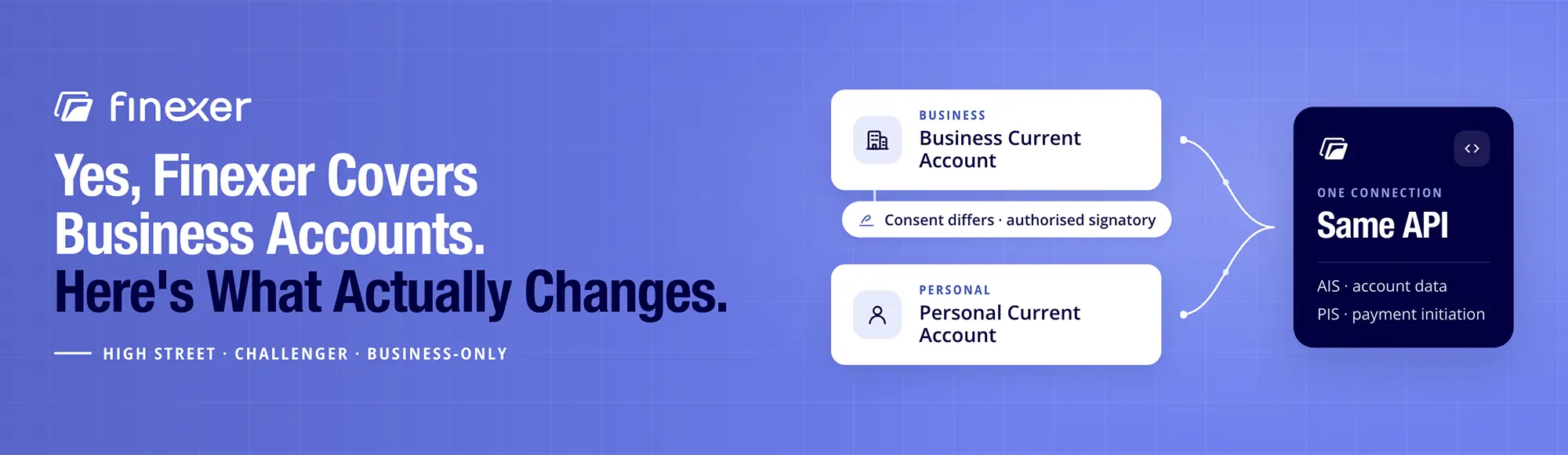
Yes. Finexer connects to business current accounts as well as personal accounts, across high street, challenger and business-only providers. Business bank account open banking through Finexer works the same way as personal account access at the API level, but the consent and authorisation process differs in ways worth understanding before you build against it.
Does business bank account open banking work the same as personal accounts?
At the API level, yes: the same underlying AIS and PIS mechanics apply whether you’re connecting to a personal current account or a business one. What changes is who’s allowed to grant consent and how a payment can be authorised, both of which are shaped by how the business account itself is structured rather than by the API.
What differs for business accounts
Business bank account open banking involves a few structural differences from personal account access:
| Element | Personal Accounts | Business Accounts |
|---|---|---|
| Who grants consent | The account holder | An authorised signatory acting for the business |
| Account structure | Typically single user | Often multiple authorised users |
| Payment authorisation | Single approval | May require dual authorisation under mandate rules |
| Reconnection | Straightforward, one user to re-consent | Needs to account for which signatory last held consent |
Consent granted by an authorised signatory: On a business account, consent has to come from someone with the authority to act for the business, not just any user with account access.
- Multi-user account structures: Business accounts often have several authorised users, which affects how consent and reconnection flows need to be designed.
- Mandate rules affecting payment initiation: Some business accounts require dual authorisation or specific mandate rules before a payment can be initiated, which a product needs to account for in its payment flow.
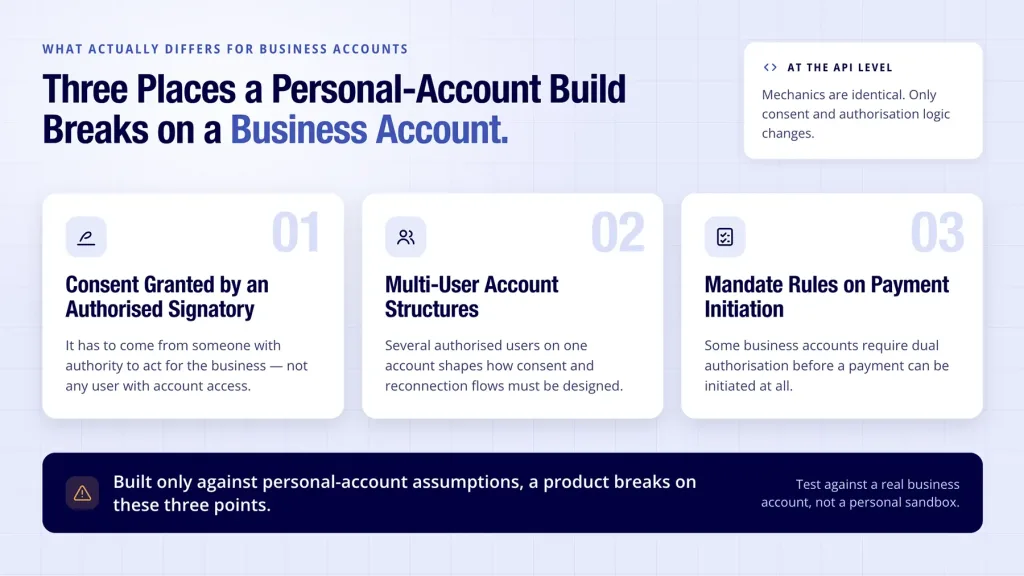
A product built only against personal account assumptions will typically break on these points the first time it meets a business account with a multi-signatory mandate. Testing against a real business account, not just a personal sandbox account, catches this early.
What account types are covered
Finexer’s AIS scope covers current accounts, business accounts, savings accounts, debit card accounts, credit card accounts, and other payment accounts. Pension and investment accounts are not included in this scope. This boundary applies consistently, so it’s worth checking against your product’s actual data requirements before assuming full coverage.
- Finexer covers almost all the UK banks, including business accounts and challenger banks.
For a broader look at how business banking connectivity works across the market, our guide to open banking for businesses covers the wider landscape beyond Finexer specifically.
Why business account coverage separates providers
Personal current account coverage is broadly similar across UK Open Banking providers, since these were the first accounts supported when Open Banking launched.
Business and challenger account coverage is where providers diverge more noticeably, because it involves more account structures, more mandate variations, and generally later bank-side implementation.
This is why business bank account open banking coverage is a better test of a provider’s depth than a headline bank count.
How active is business-relevant Open Banking activity in the UK right now?
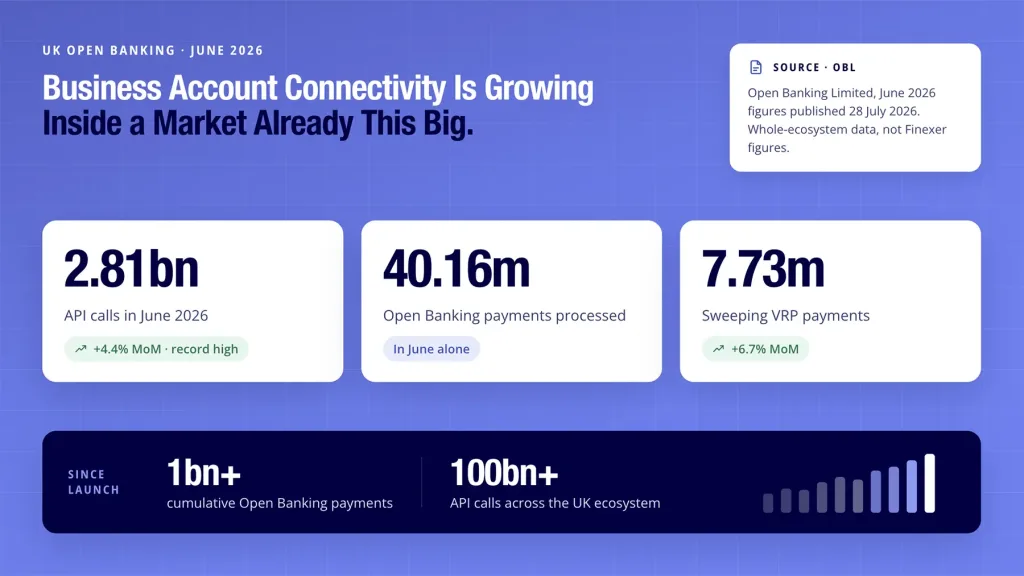
UK Open Banking activity continues to scale. Open Banking Limited’s June 2026 figures, published 28 July 2026, recorded 2.81 billion API calls for the month, the highest monthly volume to date and up 4.4% on the prior month.
The ecosystem processed 40.16 million Open Banking payments in June, with Sweeping Variable Recurring Payments growing 6.7% month on month to 7.73 million, even as Single Domestic Payments dipped slightly.
Weighted API availability across the CMA9 banks stood at 99.80%, with average response times improving to 349 milliseconds. The UK ecosystem has now surpassed one billion cumulative Open Banking payments and 100 billion API calls since launch.
Where does business account connectivity fit into this growth, and where does Finexer sit within it?
Business account connectivity is a growing part of this volume as more B2B platforms adopt Open Banking for onboarding, lending assessments, and payment initiation. A provider that has only optimised for personal accounts is working against this trend, not with it.
This coverage sits behind Finexer’s bank data API, and connects through the same integration used across Finexer’s products. For a broader comparison of providers, our pillar guide to open banking solution providers sets out wider selection criteria, and if QuickBooks integration is part of your evaluation, our breakdown of QuickBooks pricing may be useful.
See how Finexer’s business bank account open banking coverage fits your platform, and where mandate rules apply to your payment flow.
Explore with AI
About the Author

Ravi Ranjan
Ravi Ranjan is Co founder & CEO of Finexer